
Size & measurements
No sourced size & measurements summary has yet been added to this account.
Colubridae · Species account
Clelia clelia(DAUDIN, 1803)
Venom unknownNot yet assessedThe synthesis includes savanna, cloud forest and other woodland as well as swamps and creek settings. Disturbed pasture and rural sites are also reported; no additional locality is inferred. This is an authored habitat synthesis; it creates no additional occurrence or province assignment.
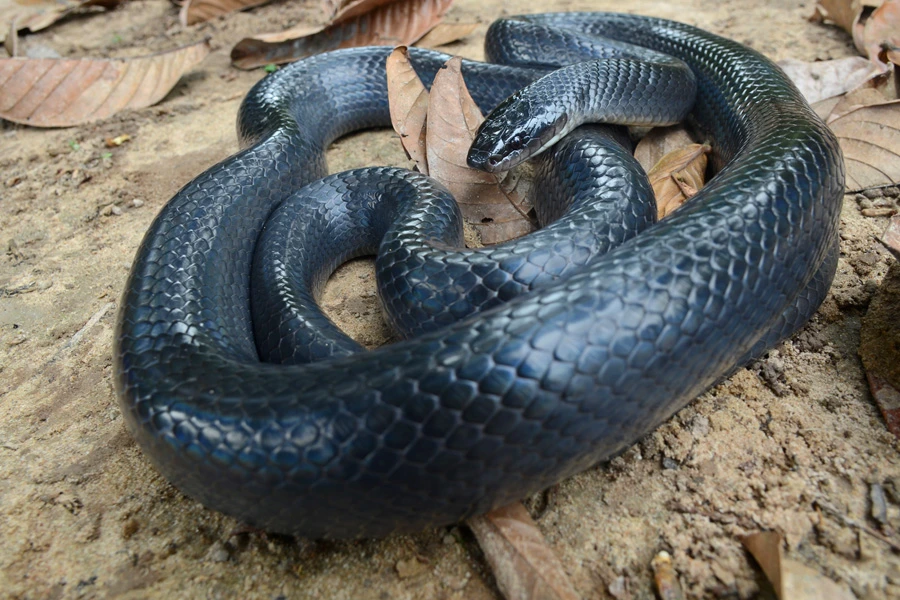
Venom & human effects
Venom status has not yet been established from the reviewed evidence for this account.
Missing evidence is not a non-venomous classification or a statement of low risk.
These are editorial summaries of the linked evidence, not toxicity rankings or WHO antivenom-priority categories. Effects vary with the bite and patient. Non-venomous does not mean safe to handle.
The scientific identity
Reliable identification uses the published combination of scale characters, proportions and other diagnostic evidence. Colour or a photograph alone may not separate closely related species.
From observations & literature
No sourced size & measurements summary has yet been added to this account.
No sourced diet & feeding summary has yet been added to this account.
The local snake responded defensively with constriction and a cloacal discharge.
Original observations from Caxiuanã and adjacent areas, Pará, Brazil, reported in Maschio’s 2008 doctoral thesis. Local records do not establish species-wide preferences, breeding seasons or typical clutch sizes.
Maschio (2008), printed pp. 104, species account Clelia clelia; original observations, excluding separately attributed literature.
Egg-laying.
The synthesis includes savanna, cloud forest and other woodland as well as swamps and creek settings. Disturbed pasture and rural sites are also reported; no additional locality is inferred. This is an authored habitat synthesis; it creates no additional occurrence or province assignment.
[2]The Grenada review discusses historical specimens from Beausejour and the Duquesne Valley and an earlier wet-lowland assessment. It does not establish a specific broad vegetation class or a current confirmed population at those sites. Country-scoped literature evidence only; no regional occurrence is added.
[3]Table 1 records this species at forest sites (Kartabo). These are broad survey-landscape categories, not exclusive habitat preferences or precise microhabitat records. Mixed Dubulay Ranch records alone are not assigned to a category. No new country or regional occurrence is added.
[4][5][6]Aparicio et al. (2025), Table 2, report Clelia clelia in the Pre-Andean Amazon Forests, Yungas mountain forests, Inter-Andean Dry Forests ecoregions of Madidi, Bolivia. These are broad ecological settings, not demonstrated microhabitat preferences. Only non-bold in/bo entries are used: modelled presence and outside-only records are excluded. The study counts a 1-km boundary buffer as inside; no new locality or countrywide distribution is inferred.
[7]The Manu National Park and buffer-zone checklist records floodplain forest, terra firme forest, submontane rainforest. This broad habitat record is scoped to Peru; it does not establish a new regional occurrence or continuous occupancy.
[8][9]Premontane forest and humid or dry lowland forest. The Panama field-guide account supplies this broad country-scoped habitat evidence; no new regional occurrence is inferred.
[10][11]The Trinidad account describes heavily forested evergreen habitat and documents named Trinidad sightings. Country-level literature evidence only; no new regional occurrence is created. John C. Murphy’s Trinidad and Tobago species account describes forest and savanna. Country-scoped literature evidence only; no new regional occurrence is created.
[12][13]The Argentine national species assessment describes humid woodland associated with the Parana and Paraguay river corridors; the account distinguishes historical misidentifications. Country-level habitat evidence only; no provincial occurrence is created. Grassland, where documented, is included under the shared savanna/grassland category.
[14]The Tirimbina survey records secondary forest. Country-scoped habitat evidence; no regional occurrence is inferred.
[15]The Honduran rainforest inventory explicitly records forest habitats. Historical country-scoped habitat evidence; no present-day population assessment or new regional occurrence is inferred.
[16]Collection habitat record: Bosque denso; Quebrada. Country-scoped locality context; this is not a complete habitat range, and no regional occurrence or aquatic behaviour is inferred.
[17][18]Collection habitat record: bosque tropical muy humedo. Country-scoped locality context; this is not a complete habitat range, and no regional occurrence or aquatic behaviour is inferred.
[19]The natural-history synthesis documents forest habitat using Brazilian field studies, including a terra-firme forest record from Manaus. Country-scoped evidence; no additional regional occurrence or continuous occupancy is inferred.
[20]The treatment names these subdivisions in its Trinidad and Tobago distribution clause: Trinidad. They are assigned to the declared atlas navigation groups; this is not a field observation, a whole-region range polygon or a complete local inventory.
[21]A reported observation is not necessarily the full ecological range of a species. Where reproduction is inferred in a source dataset, the account identifies that limitation.
One species · Across borders
Explore the recorded countries and islands. Select a highlighted area to see its distribution evidence.
Loading geographic boundaries…
Click a highlighted country to zoom in and explore its records.
Shading identifies recorded countries or named islands, not continuous habitat coverage. Uncoloured areas do not establish absence.
Natural Earth · 1:50m · public domain; Gibraltar: geoBoundaries. Small islands may lack an outline.
Explore the distribution
Select a highlighted area to see its status, island records and sources. Each country and island links to the same shared species collection.
Use “Worldwide records” to include distant introduced and uncertain records in the map view.
The checked taxonomic distribution account explicitly lists Belize. Country-level evidence does not establish continuous occupancy or a complete national inventory.
Locality source 1 ↗The checked taxonomic distribution account explicitly lists Guatemala. Country-level evidence does not establish continuous occupancy or a complete national inventory.
Locality source 1 ↗The checked taxonomic distribution account explicitly lists El Salvador. Country-level evidence does not establish continuous occupancy or a complete national inventory.
Locality source 1 ↗The checked taxonomic distribution account explicitly lists Honduras. Country-level evidence does not establish continuous occupancy or a complete national inventory.
Locality source 1 ↗The checked taxonomic distribution account explicitly lists Nicaragua. Country-level evidence does not establish continuous occupancy or a complete national inventory.
Locality source 1 ↗The checked taxonomic distribution account explicitly lists Costa Rica. Country-level evidence does not establish continuous occupancy or a complete national inventory.
Locality source 1 ↗The checked taxonomic distribution account explicitly lists Panama. Country-level evidence does not establish continuous occupancy or a complete national inventory.
Locality source 1 ↗The checked taxonomic distribution account explicitly lists Trinidad and Tobago. Country-level evidence does not establish continuous occupancy or a complete national inventory. The treatment names these subdivisions in its Trinidad and Tobago distribution clause: Trinidad. They are assigned to the declared atlas navigation groups; this is not a field observation, a whole-region range polygon or a complete local inventory.
Trinidad → · Trinidad
Locality source 1 ↗The checked taxonomic distribution account explicitly lists Argentina. Country-level evidence does not establish continuous occupancy or a complete national inventory.
Locality source 1 ↗The checked taxonomic distribution account explicitly lists Bolivia. Country-level evidence does not establish continuous occupancy or a complete national inventory.
Locality source 1 ↗The checked taxonomic distribution account explicitly lists Brazil. Country-level evidence does not establish continuous occupancy or a complete national inventory.
Locality source 1 ↗The checked taxonomic distribution account explicitly lists Colombia. Country-level evidence does not establish continuous occupancy or a complete national inventory.
Locality source 1 ↗The checked taxonomic distribution account explicitly lists Ecuador. Country-level evidence does not establish continuous occupancy or a complete national inventory.
Locality source 1 ↗The checked taxonomic distribution account explicitly lists Guyana. Country-level evidence does not establish continuous occupancy or a complete national inventory.
Locality source 1 ↗The checked taxonomic distribution account explicitly lists Paraguay. Country-level evidence does not establish continuous occupancy or a complete national inventory.
Locality source 1 ↗The checked taxonomic distribution account explicitly lists Peru. Country-level evidence does not establish continuous occupancy or a complete national inventory.
Locality source 1 ↗The checked taxonomic distribution account explicitly lists Uruguay. Country-level evidence does not establish continuous occupancy or a complete national inventory.
Locality source 1 ↗The checked taxonomic distribution account explicitly lists Venezuela. Country-level evidence does not establish continuous occupancy or a complete national inventory.
Locality source 1 ↗The checked taxonomic distribution account explicitly lists Antigua and Barbuda. Country-level evidence does not establish continuous occupancy or a complete national inventory.
Locality source 1 ↗The checked taxonomic distribution account explicitly lists Dominica. Country-level evidence does not establish continuous occupancy or a complete national inventory.
Locality source 1 ↗The checked taxonomic distribution account explicitly lists Grenada. Country-level evidence does not establish continuous occupancy or a complete national inventory.
Locality source 1 ↗Country entries supported by this Americas review: Belize, Guatemala, El Salvador, Honduras, Nicaragua, Costa Rica, Panama, Trinidad and Tobago. These are reviewed atlas entries, not a complete global distribution. [1]
The text retains the source’s geographic qualifications. The map shows countries with atlas occurrence records; it is not a complete global range model. A type locality is a nomenclatural reference, not the only place the species occurs.
Status & its meaning
No matching global assessment was verified for this account. This is an unresolved assessment link, not an IUCN “Not Evaluated” classification and not evidence that the species is secure.
Locality coverage in the atlas does not measure abundance, population trends or national legal protection.
Follow the evidence
Latest evidence added 2026-10-19. Taxonomic and distribution treatments may change.
The linked taxonomic treatment provides its original descriptions, revisions and bibliography. Observations from other countries are not relabelled as local field studies.