Colubridae · Species account

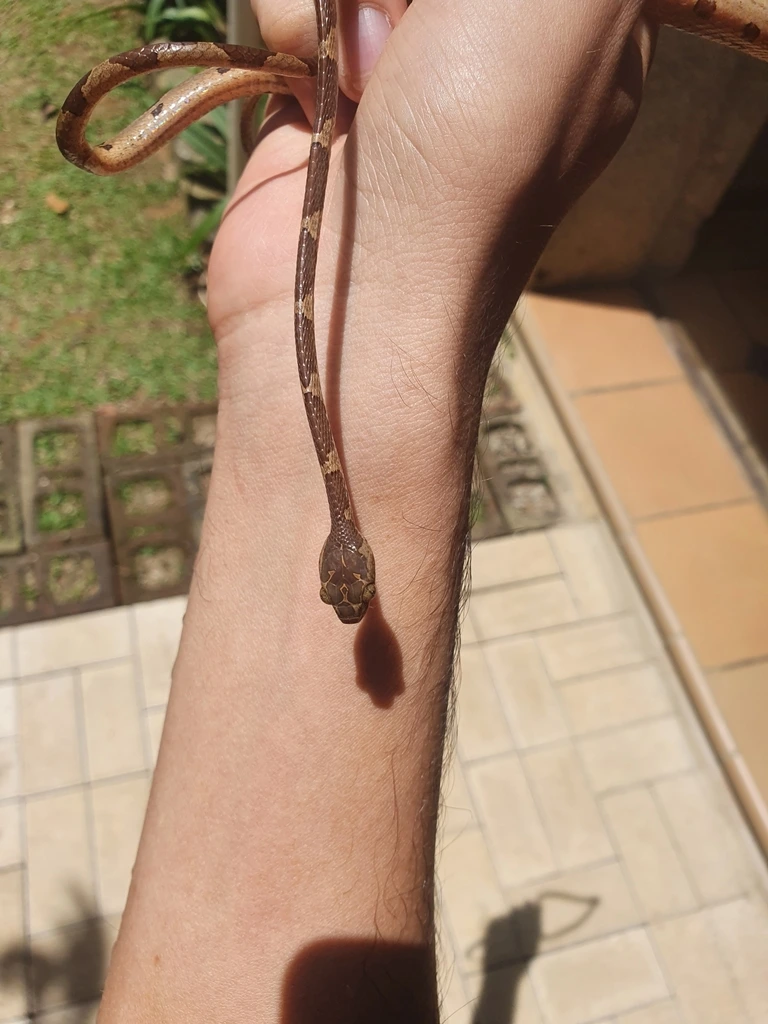
Neotropical Blunt-headed Treesnake, Blunthead Tree Snake

Imantodes cenchoa(LINNAEUS, 1758)

Venom unknownNot yet assessed

Humid lowland and upland forests, secondary growth and plantations support this arboreal snake. Low vegetation, including bromeliads and coffee shrubs, provides perches. Source scope: Animal Diversity Web species account; habitat use is not a state or province occurrence record.

FamilyColubridae
ReproductionEgg-laying
Country chaptersMexico · Belize · Guatemala · El Salvador · Honduras · Nicaragua · Costa Rica · Panama · Trinidad and Tobago · Argentina · Bolivia · Brazil · Colombia · Ecuador · Guyana · Paraguay · Peru · Venezuela
Evidence updated2026-10-19
Explore its biology ↓

Venom & human effects

What is documented?

Venom unknownNot yet assessed

Venom status has not yet been established from the reviewed evidence for this account.

Missing evidence is not a non-venomous classification or a statement of low risk.

How to read these badges
Limited documented effects
The cited human cases reported limited effects. Sparse observations cannot exclude a severe reaction.
Medically significant effects
The cited human cases document clinically important injury or illness. This is not an upper limit on severity.
Potentially life-threatening
Species-specific clinical evidence documents life-threatening illness or deaths after bites. The account explains the affected patients and any uncertainty about the cause.
Clinical severity not established
Venom presence is documented, but the reviewed evidence does not establish a clinical tier. When human effects are reported under an unresolved historical species name, the badge and account say so explicitly.
Venom status uncertain
The reviewed sources are inconclusive or conflicting about venom presence. The account explains the uncertainty.
Venom status not assessed
The atlas lacks a reviewed venom-presence classification for this species.

These are editorial summaries of the linked evidence, not toxicity rankings or WHO antivenom-priority categories. Effects vary with the bite and patient. Non-venomous does not mean safe to handle.

The scientific identity

Taxonomy & recognition

From observations & literature

Natural history

Size & measurements

Specimens identified as Imantodes cenchoa cenchoa in the northern Bahia study had snout–vent lengths of 45.5–67 cm, excluding the tail. This is the local sample range, not the species maximum or typical adult size.

Observations and specimen measurements from northern coastal Bahia, Brazil. Local sample ranges, observation times and individual reproductive records do not establish species-wide limits. The source identifies the nominate form, Imantodes cenchoa cenchoa.

Study & evidence

Marques et al. (2016), Composition and natural history notes of the coastal snake assemblage from Northern Bahia, Brazil, ZooKeys 611:93–142; Results > Natural history notes of species > Imantodes cenchoa cenchoa. Voucher lists: Appendix 1.

Study source 1 ↗

Study source 2 ↗

Diet & feeding

The study’s literature synthesis lists frogs and lizards as prey, citing Marques et al. (2001).

Literature synthesis in the 2016 survey account; these are attributed reports, rather than new feeding or reproductive observations from the Bahia sample. The source identifies the nominate form, Imantodes cenchoa cenchoa.

Study & evidence

Marques et al. (2016), Composition and natural history notes of the coastal snake assemblage from Northern Bahia, Brazil, ZooKeys 611:93–142; Results > Natural history notes of species > Imantodes cenchoa cenchoa. Voucher lists: Appendix 1.

Study source 1 ↗

Study source 2 ↗

Identified stomach contents in the local sample included lizards; Table 06 reports 18 individuals with identifiable prey.

Original observations from Caxiuanã and adjacent areas, Pará, Brazil, reported in Maschio’s 2008 doctoral thesis. Local records do not establish species-wide preferences, breeding seasons or typical clutch sizes.

Study & evidence

Maschio (2008), printed p. 70 / PDF page 70, Table 06, row Imantodes cenchoa; sample count in parentheses.

Study source 1 ↗

Study source 2 ↗

Activity & behaviour

Climbing activity

Arboreal activity is explicitly described in the treatment. This does not establish forest occupancy at every locality or imply that the species spends all its time above ground.

[1]

A northern Bahia individual was observed foraging on a bromeliad at 20:23 in November.

Observations and specimen measurements from northern coastal Bahia, Brazil. Local sample ranges, observation times and individual reproductive records do not establish species-wide limits. The source identifies the nominate form, Imantodes cenchoa cenchoa.

Study & evidence

Marques et al. (2016), Composition and natural history notes of the coastal snake assemblage from Northern Bahia, Brazil, ZooKeys 611:93–142; Results > Natural history notes of species > Imantodes cenchoa cenchoa. Voucher lists: Appendix 1.

Study source 1 ↗

Study source 2 ↗

Reproduction

Two females examined in November each contained two oviductal eggs. Three additional females had secondary ovarian follicles in March, April and May.

Original observations from Caxiuanã and adjacent areas, Pará, Brazil, reported in Maschio’s 2008 doctoral thesis. Local records do not establish species-wide preferences, breeding seasons or typical clutch sizes.

Study & evidence

Maschio (2008), printed pp. 117, species account Imantodes cenchoa; original observations, excluding separately attributed literature.

Study source 1 ↗

Study source 2 ↗

Habitat & ecology

Habitat & microhabitat · Mexico

Humid lowland and upland forests, secondary growth and plantations support this arboreal snake. Low vegetation, including bromeliads and coffee shrubs, provides perches. Source scope: Animal Diversity Web species account; habitat use is not a state or province occurrence record.

[2]

Habitat & microhabitat · Ecuador

Lowland and foothill rainforest and the seasonal dry woodland of southwestern Ecuador are documented, including altered wooded settings and cultivation. This is an authored habitat synthesis; it creates no additional occurrence or province assignment.

[3]

Habitat & microhabitat · Brazil

Caatinga records are associated with moist forest remnants; the authors qualify the apparent habitat restriction. Country-scoped literature evidence only; no regional occurrence is added.

[4][5]

Habitat & microhabitat · Guyana

Table 1 records this species at forest sites (Kartabo, Konawaruk Camp, Berbice River Camp). These are broad survey-landscape categories, not exclusive habitat preferences or precise microhabitat records. Mixed Dubulay Ranch records alone are not assigned to a category. No new country or regional occurrence is added.

[6][7][8]

Habitat & microhabitat · Bolivia

Aparicio et al. (2025), Table 2, report Imantodes cenchoa in the Sub-Andean Amazon Forests, Pre-Andean Amazon Forests, Yungas mountain forests ecoregions of Madidi, Bolivia. These are broad ecological settings, not demonstrated microhabitat preferences. Only non-bold in/bo entries are used: modelled presence and outside-only records are excluded. The study counts a 1-km boundary buffer as inside; no new locality or countrywide distribution is inferred.

[9]

Habitat & microhabitat · Peru

The Manu National Park and buffer-zone checklist records floodplain forest, terra firme forest, bamboo forest, Mauritia palm swamp, submontane rainforest. This broad habitat record is scoped to Peru; it does not establish a new regional occurrence or continuous occupancy. Wetland or waterside habitat does not by itself establish aquatic behaviour.

[10][11]

Habitat & microhabitat · Panama

Dry lowland through humid premontane forest. The Panama field-guide account supplies this broad country-scoped habitat evidence; no new regional occurrence is inferred.

[12][13]

Habitat & microhabitat · Trinidad and Tobago

John C. Murphy’s Trinidad and Tobago species account describes forest canopy and understory. Country-scoped literature evidence only; no new regional occurrence is created.

[14]

Habitat & microhabitat · Argentina

The Argentine national species assessment describes Paranaense forest, Yungas forest and Paraguay River gallery forest in northern Argentina. Country-level habitat evidence only; no provincial occurrence is created. Grassland, where documented, is included under the shared savanna/grassland category.

[15]

Habitat & microhabitat · Costa Rica

The Tirimbina survey records secondary forest, riparian forest, swamps. Country-scoped habitat evidence; no regional occurrence is inferred. Waterside records do not imply an aquatic lifestyle.

[16]

Habitat & microhabitat · Honduras

The Honduran cloud-forest inventory records lower montane wet or moist forest. Country-scoped habitat evidence; no regional occurrence is inferred. This is a historical habitat record, not a current population-status assessment.

[17]

Habitat & microhabitat · Colombia

Collection habitat record: Bosque secundario; Bosque ripario. Country-scoped locality context; this is not a complete habitat range, and no regional occurrence or aquatic behaviour is inferred.

[18][19]

Habitat & microhabitat · Guatemala

Collection habitat record: bosque tropical muy humedo. Country-scoped locality context; this is not a complete habitat range, and no regional occurrence or aquatic behaviour is inferred.

[20]

Habitat & microhabitat · Nicaragua

The 2018 expedition report documents the following specimen-based habitat observation: Three specimens were encountered on branches in upland forest or the riparian zone at Bartola. Country-scoped evidence; no new regional occurrence or continuous occupancy is inferred.

[21]

Habitat & microhabitat · Paraguay

The Paraguay-specific account explicitly characterizes the species as a Neotropical forest inhabitant, documenting its occurrence in the Pantanal and Cerrado landscapes of Paraguay. Country-scoped evidence; no new regional occurrence or continuous occupancy is inferred.

[22]

The northern Bahia study recorded the nominate form in humid forest.

Observations and specimen measurements from northern coastal Bahia, Brazil. Local sample ranges, observation times and individual reproductive records do not establish species-wide limits. The source identifies the nominate form, Imantodes cenchoa cenchoa.

Study & evidence

Marques et al. (2016), Composition and natural history notes of the coastal snake assemblage from Northern Bahia, Brazil, ZooKeys 611:93–142; Results > Natural history notes of species > Imantodes cenchoa cenchoa. Voucher lists: Appendix 1.

Study source 1 ↗

Study source 2 ↗

Further observations & source notes (2)

Documented localities · Mexico

The treatment names these subdivisions in its Mexico distribution clause: Campeche, Chiapas, Guerrero, Hidalgo, Oaxaca, Puebla, Quintana Roo, San Luis Potosi, Tamaulipas, Veracruz. They are assigned to the declared atlas navigation groups; this is not a field observation, a whole-region range polygon or a complete local inventory.

[23]

Documented localities · Trinidad and Tobago

The treatment names these subdivisions in its Trinidad and Tobago distribution clause: Trinidad, Tobago. They are assigned to the declared atlas navigation groups; this is not a field observation, a whole-region range polygon or a complete local inventory.

[24]

A reported observation is not necessarily the full ecological range of a species. Where reproduction is inferred in a source dataset, the account identifies that limitation.

One species · Across borders

Global distribution

Explore the recorded countries and islands. Select a highlighted area to see its distribution evidence.

Recorded distribution
Imantodes cenchoa — select a recorded country or island

Loading geographic boundaries…

ListedIntroducedUncertain

Click a highlighted country to zoom in and explore its records.

Shading identifies recorded countries or named islands, not continuous habitat coverage. Uncoloured areas do not establish absence.

Natural Earth · 1:50m · public domain; Gibraltar: geoBoundaries. Small islands may lack an outline.

Explore the distribution

Across borders

18 recorded countries & territories

Select a highlighted area to see its status, island records and sources. Each country and island links to the same shared species collection.

Use “Worldwide records” to include distant introduced and uncertain records in the map view.

Mexico · regional locality evidence

The checked taxonomic distribution account explicitly lists Mexico. Country-level evidence does not establish continuous occupancy or a complete national inventory. The treatment names these subdivisions in its Mexico distribution clause: Campeche, Chiapas, Guerrero, Hidalgo, Oaxaca, Puebla, Quintana Roo, San Luis Potosi, Tamaulipas, Veracruz. They are assigned to the declared atlas navigation groups; this is not a field observation, a whole-region range polygon or a complete local inventory.

Campeche → · Campeche

Chiapas → · Chiapas

Guerrero → · Guerrero

Hidalgo → · Hidalgo

Oaxaca → · Oaxaca

Puebla → · Puebla

Quintana Roo → · Quintana Roo

San Luis Potosi → · San Luis Potosi

Tamaulipas → · Tamaulipas

Veracruz → · Veracruz

Locality source 1 ↗
Belize · regional locality evidence

The checked taxonomic distribution account explicitly lists Belize. Country-level evidence does not establish continuous occupancy or a complete national inventory.

Locality source 1 ↗
Guatemala · regional locality evidence

The checked taxonomic distribution account explicitly lists Guatemala. Country-level evidence does not establish continuous occupancy or a complete national inventory.

Locality source 1 ↗
El Salvador · regional locality evidence

The checked taxonomic distribution account explicitly lists El Salvador. Country-level evidence does not establish continuous occupancy or a complete national inventory.

Locality source 1 ↗
Honduras · regional locality evidence

The checked taxonomic distribution account explicitly lists Honduras. Country-level evidence does not establish continuous occupancy or a complete national inventory.

Locality source 1 ↗
Nicaragua · regional locality evidence

The checked taxonomic distribution account explicitly lists Nicaragua. Country-level evidence does not establish continuous occupancy or a complete national inventory.

Locality source 1 ↗
Costa Rica · regional locality evidence

The checked taxonomic distribution account explicitly lists Costa Rica. Country-level evidence does not establish continuous occupancy or a complete national inventory.

Locality source 1 ↗
Panama · regional locality evidence

The checked taxonomic distribution account explicitly lists Panama. Country-level evidence does not establish continuous occupancy or a complete national inventory.

Locality source 1 ↗
Trinidad and Tobago · regional locality evidence

The checked taxonomic distribution account explicitly lists Trinidad and Tobago. Country-level evidence does not establish continuous occupancy or a complete national inventory. The treatment names these subdivisions in its Trinidad and Tobago distribution clause: Trinidad, Tobago. They are assigned to the declared atlas navigation groups; this is not a field observation, a whole-region range polygon or a complete local inventory.

Trinidad → · Trinidad

Tobago → · Tobago

Locality source 1 ↗
Argentina · regional locality evidence

The checked taxonomic distribution account explicitly lists Argentina. Country-level evidence does not establish continuous occupancy or a complete national inventory.

Locality source 1 ↗
Bolivia · regional locality evidence

The checked taxonomic distribution account explicitly lists Bolivia. Country-level evidence does not establish continuous occupancy or a complete national inventory.

Locality source 1 ↗
Brazil · regional locality evidence

The checked taxonomic distribution account explicitly lists Brazil. Country-level evidence does not establish continuous occupancy or a complete national inventory.

Locality source 1 ↗
Colombia · regional locality evidence

The checked taxonomic distribution account explicitly lists Colombia. Country-level evidence does not establish continuous occupancy or a complete national inventory.

Locality source 1 ↗
Ecuador · regional locality evidence

The checked taxonomic distribution account explicitly lists Ecuador. Country-level evidence does not establish continuous occupancy or a complete national inventory.

Locality source 1 ↗
Guyana · regional locality evidence

The checked taxonomic distribution account explicitly lists Guyana. Country-level evidence does not establish continuous occupancy or a complete national inventory.

Locality source 1 ↗
Paraguay · regional locality evidence

The checked taxonomic distribution account explicitly lists Paraguay. Country-level evidence does not establish continuous occupancy or a complete national inventory.

Locality source 1 ↗
Peru · regional locality evidence

The checked taxonomic distribution account explicitly lists Peru. Country-level evidence does not establish continuous occupancy or a complete national inventory.

Locality source 1 ↗
Venezuela · regional locality evidence

The checked taxonomic distribution account explicitly lists Venezuela. Country-level evidence does not establish continuous occupancy or a complete national inventory.

Locality source 1 ↗

Geographic scope of the source

Country entries supported by this Americas review: Mexico, Belize, Guatemala, El Salvador, Honduras, Nicaragua, Costa Rica, Panama, Trinidad and Tobago. These are reviewed atlas entries, not a complete global distribution. [1]

The text retains the source’s geographic qualifications. The map shows countries with atlas occurrence records; it is not a complete global range model. A type locality is a nomenclatural reference, not the only place the species occurs.

Status & its meaning

Conservation

No matching global assessment was verified for this account. This is an unresolved assessment link, not an IUCN “Not Evaluated” classification and not evidence that the species is secure.

Locality coverage in the atlas does not measure abundance, population trends or national legal protection.

Follow the evidence

Sources & further reading

Latest evidence added 2026-10-19. Taxonomic and distribution treatments may change.

  1. The Reptile Database · Imantodes cenchoa
  2. University of Michigan · Animal Diversity Web · Imantodes cenchoa
  3. Reptiles of Ecuador · Imantodes cenchoa — authored natural-history account
  4. Guedes, Nogueira & Marques (2014), Diversity, natural history, and geographic distribution of snakes in the Caatinga, Northeastern Brazil
  5. Species account, printed page 42
  6. Cole et al. (2013), Amphibians and reptiles of Guyana, article DOI
  7. Cole et al. (2013), Amphibians and reptiles of Guyana, Table 1, printed page 538
  8. Table 1 habitat-code definitions, printed page 536
  9. Aparicio et al. (2025), reptile diversity of Madidi, Table 2, p. 149
  10. Catenazzi, Lehr & von May (2013), The amphibians and reptiles of Manu National Park and its buffer zone, Peru
  11. Table 2, printed page 9; habitat definitions and exclusion of predicted records in Methods
  12. Batista & Miranda (2020), Las serpientes de Panama: venenosas y mas comunes no venenosas
  13. Species account and Habitat section, printed page 140
  14. John C. Murphy, The Herpetology of Trinidad and Tobago: Imantodes cenchoa (Friday, October 21, 2016)
  15. Giraudo and colleagues (2012), Fichas de los taxones - Serpientes, Cuadernos de Herpetologia 26 Supplement 1: species account, printed page 354
  16. Hilje and colleagues (2020), Table 1, Check List 16(6), printed page 1638
  17. Wilson and McCranie (2004), Table 1, Amphibian and Reptile Conservation 3(1), printed page 38
  18. Instituto Amazónico de Investigaciones Científicas - SINCHI · 4671 · original habitat field
  19. Instituto de Investigación de Recursos Biológicos Alexander von Humboldt (IAvH) · IAvH-CT-37401 · original habitat field
  20. UVG · UVGR003794 · original habitat field
  21. Martinez-Fonseca, Holmes et al., An expeditionary collection and analysis of amphibians and reptiles from Nicaragua, species account, PDF p. 55
  22. Cacciali et al. (2016), The Reptiles of Paraguay, species account p. 182
  23. The Reptile Database · Imantodes cenchoa
  24. The Reptile Database · Imantodes cenchoa
  25. Photograph provenance — Imantodes cenchoa (source 1)
  26. Photograph provenance — Imantodes cenchoa (source 2)

The linked taxonomic treatment provides its original descriptions, revisions and bibliography. Observations from other countries are not relabelled as local field studies.