Historical estimate · cited in 1999
≈6.7%Historical old-growth remainder
0.804 million hectares divided by an estimated 12 million hectares 55 years earlier. Old-growth dipterocarp forest in a historical report—not the amount remaining today.
Habitat 01 / 05 · Forest layers · Above the ground
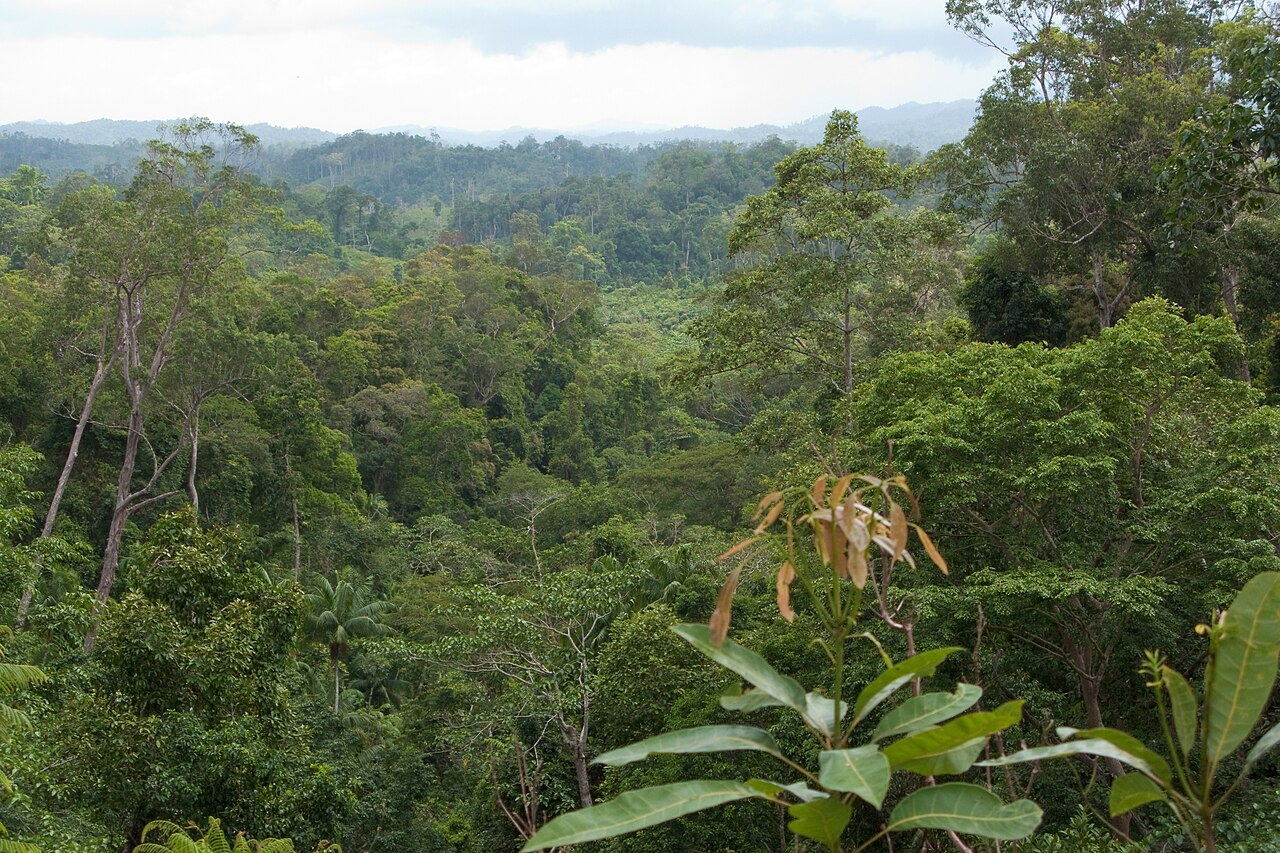
A forest has depth as well as distance. Between the brightest crown and the darkest understorey, a few metres can change the conditions an animal experiences.
Understanding the environment
The canopy is the layer formed by tree crowns, not a separate kind of forest. It occurs above a connected understorey and forest floor. Tall trunks, branching limbs, palms, climbing plants and tree cavities create very different surfaces within the same patch of woodland.
Explore the structure · Crown to ground
Select a zone to see what changes.
Sun & exposure
Leaves at the outer surface receive direct light and moving air. A crown is a patchwork of exposure rather than one uniform temperature.
Look for: gaps between crowns and sunlit outer branches.
Conceptual layers, not a height scale. Their depth and continuity vary between forests.
Sources: Alcala · Philippine rainforest field recollections (1998) · Scheffers et al. · Microhabitats and climate extremes (2014)
Field notes · 01
Philippine rainforest measurements show that soil, tree holes, epiphytes and vegetation can buffer heat relative to more exposed surroundings. The study tested the thermal limits of frogs and lizards; it does not provide temperature tolerances for snakes. For a reader, the useful lesson is that a weather forecast cannot describe every refuge inside a forest.
Sources: Scheffers et al. · Microhabitats and climate extremes (2014)
Field notes · 02
Climbing gives a snake access to resting sites and feeding areas that are unavailable on the ground. It also requires support: branch diameter, gaps and connections matter. “Arboreal” describes use of vegetation, but need not mean a life spent only in the tallest trees.
Northern Luzon surveys recorded Dendrelaphis luzonensis sleeping in streamside vegetation and, at Mount Cagua, in vines on a tree away from water. These are direct observations of resting sites, not proof of a strict canopy preference.
Sources: Brown et al. · Herpetofauna of northern Luzon (2013)
Field notes · 03
Treefalls and storms open gaps; growing vegetation closes them again. Logging and clearing can create larger breaks and remove old trees with hollows. When comparing forests, notice whether the overhead cover is continuous, how much light reaches the ground, and whether mature trees and climbing plants remain. A recovering forest and an old forest can both look green from above while offering different structures.
Sources: Alcala · Philippine rainforest field recollections (1998)
Pressures on Philippine habitats
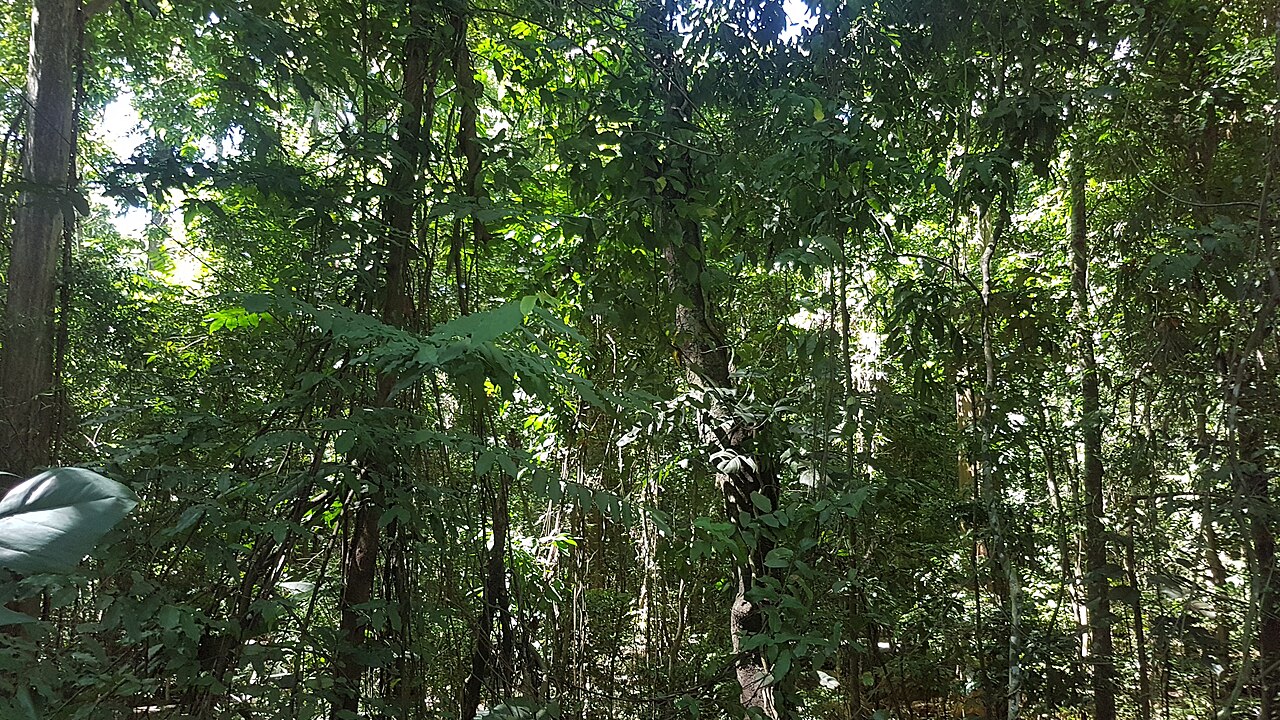
The main danger is loss of natural forest and the breaking up or simplification of what remains. A tree-covered plantation, regenerating woodland and primary rainforest do not offer the same structures or history.
There is no single verified current percentage of the original primary rainforest in the sources used here. These figures answer different questions. A recent satellite baseline begins after much historical forest loss had already occurred.
Historical estimate · cited in 1999
≈6.7%0.804 million hectares divided by an estimated 12 million hectares 55 years earlier. Old-growth dipterocarp forest in a historical report—not the amount remaining today.
Satellite monitoring · 2002–2025
4.0%About 200,000 hectares lost relative to the dataset’s 2001 primary-forest extent. Recent loss from an already depleted baseline, not the share of original rainforest remaining.
Sources: Global Forest Watch / Global Nature Watch · Philippines, 2002–2025
Official land-cover account · 2020
23.4%6.91 million hectares in the PSA account. These categories describe mapped cover; this figure must not be relabelled as primary rainforest.
Sources: Philippine Statistics Authority · Land cover, 2015–2020 · FAO · Philippines FRA 2010 report, Table 4 and comments
Philippine research identifies timber extraction, agricultural expansion and infrastructure—including roads and mining—as forest pressures. Clearing removes habitat; selective extraction can leave trees standing while changing forest structure. The mix of causes differs by locality.
Sources: Carandang et al. · Philippine deforestation and degradation drivers (2013)
Separated crowns and the loss of mature trees reduce connected vegetation and sheltered spaces. Planting trees can help recovery, but does not immediately recreate old trees, cavities and the conditions of a mature forest.
Sources: Alcala · Philippine rainforest field recollections (1998) · Scheffers et al. · Microhabitats and climate extremes (2014)
Fire is a documented Philippine degradation pressure. Heat and dry conditions also make cool, moist refuges important. Microclimate research supports preserving shelter; it does not provide a national estimate of snake deaths or temperature limits for all snakes.
Sources: Carandang et al. · Philippine deforestation and degradation drivers (2013) · Scheffers et al. · Microhabitats and climate extremes (2014)
Retain natural forest, protect mature trees and connections between patches, and restore native vegetation. Track condition as well as hectares: a gain in tree cover alone does not demonstrate recovery of primary rainforest.
Read further
Guide checked 7 October 2026. Study dates and scope are retained below. Photographs illustrate habitats and do not establish snake occurrence at the photographed sites.
Firsthand descriptions of forest structure. Historical forest statistics and species assessments are not used.
Philippine rainforest microclimates; physiological experiments concern frogs and lizards, not snake thermal limits.
Field observations of Dendrelaphis, Cyclocorus and Oxyrhabdium; not habitat-preference experiments.
Philippine REDD+ research on direct and underlying drivers; local importance varies, and this is not a 2026 ranking.
Cites Igsoc (1999): 0.804 million ha of old-growth dipterocarp forest versus 12 million ha 55 years earlier. The 6.7% is calculated from these estimates; it is not a current inventory or a pre-human baseline.
Approximately 200,000 ha of humid primary-forest loss and a 4.0% decrease relative to the dataset’s 2001 primary-forest extent. Retrieved 7 October 2026. Methods have changed over time.
2020 open plus closed forest: 6.91 million ha, 23.4% of total land cover. This does not measure primary rainforest remaining.
Old-growth dipterocarp forest and closed forest are not synonymous. This report’s primary-forest series used an unchanged-area assumption, not annual measurements.
Continue through the archipelago
Leaf litter, roots, fallen wood and soil hold a mosaic of sheltered spaces. Discover the living ground layer and the secretive snakes that use it.
03Mountain slopes reshape temperature, exposure and vegetation. Explore mossy trunks, cloud-influenced forest and the differences between isolated mountain habitats.
04Forest streams, riverbanks, floodplains and lakes offer different kinds of freshwater habitat. Follow the water and discover how its margins change through the year.
05Tidal forests, shore refuges, reefs and open water are connected but distinct. Explore changing salinity and the different lives of sea kraits and fully aquatic sea snakes.