All habitat guides

Habitat 02 / 05 · Forest layers · At and below the surface

Forest floor

The ground beneath a forest is a living structure: fresh leaves above decomposing layers, roots around cavities, and fallen timber that changes as it decays.

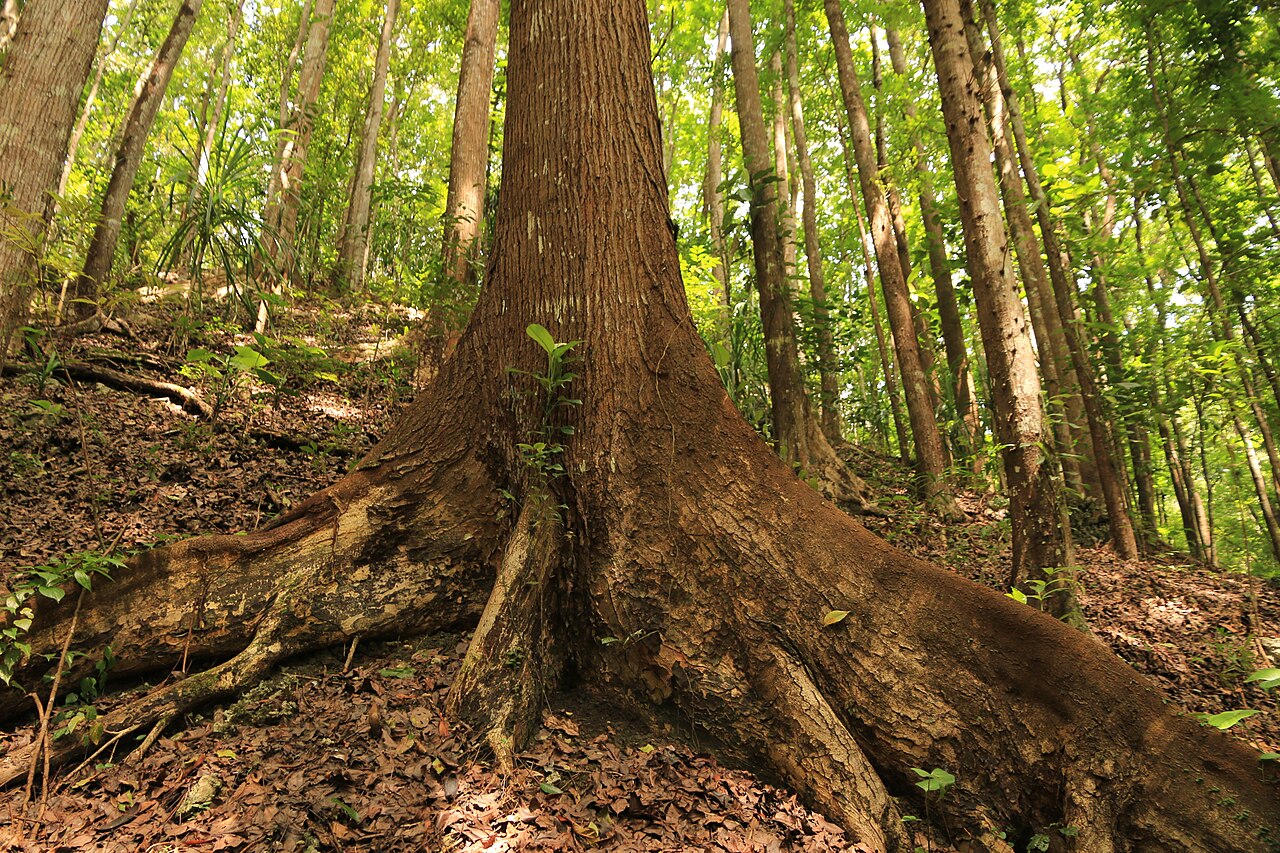
Spreading mahogany roots surrounded by brown fallen leaves on Bohol
Leaf litter and mahogany roots on Bohol. This photograph illustrates ground structure beneath a planted tree; it is not presented as undisturbed native rainforest.Photo: Øyvind Holmstad · Original photograph · CC BY-SA 4.0. Resized; full image retained.

Understanding the environment

A sense of the habitat.

The forest floor is a layer shared by lowland and mountain forests. Its character depends on the trees above it, slope, soil, rainfall and disturbance. Bare compacted ground, a deep litter bed and a waterlogged hollow are different habitats, even when they lie a few steps apart.

Defining feature
Litter, woody debris, roots and upper soil
Main contrast
Exposed surface versus covered refuges
Scale to notice
Centimetres beneath a leaf or beside a root

Explore the structure · Surface to soil

Look beneath the surface

Select a zone to see what changes.

The changing surface

Fresh litter

Recently fallen leaves lie above older material. The upper surface can dry between rain events while covered spaces retain different conditions.

Notice leaf cover, small gaps and the pattern of light from above.

A conceptual ground profile. Layers overlap and vary in depth; this is not a soil classification.

Sources: Alcala · Philippine rainforest field recollections (1998) · Scheffers et al. · Microhabitats and climate extremes (2014) · DOST · Springtails in the canopy and forest floor of Mount Makiling (2021)

Field notes · 01

More than a carpet of leaves

The ground layer links plant growth to decomposition. Leaves and wood break down; fungi and invertebrates participate in that process. A Mount Makiling study found different springtail assemblages in ground and canopy samples, illustrating that even very small animals use the forest unevenly. This is evidence about the invertebrate community, not a feeding study of snakes.

Sources: DOST · Springtails in the canopy and forest floor of Mount Makiling (2021)

Field notes · 02

Shelter, concealment and movement

Some snakes travel over the surface; others spend much of their time beneath cover or in soil. Small size and a narrow body can help an animal enter tight spaces, but appearance alone cannot tell us its diet or exact habitat requirements.

Brown and colleagues recorded Cyclocorus lineatus beneath rocks, logs and other cover in northern Luzon, including decaying wood. On Mindoro, the original description of Calamaria alcalai documents forest habitat, including a primary dipterocarp-forest locality. Different species need their own evidence; “ground snake” is not one ecological category.

Sources: Brown et al. · Herpetofauna of northern Luzon (2013) · Weinell, Leviton & Brown · A reed snake from Mindoro (2020)

Field notes · 03

What changes the ground layer?

Rain, drying, floods and fresh leaf fall continually alter the surface. Removing trees changes shade; removing litter or dead wood removes physical cover. Trampling and conversion can leave a superficially wooded place with little ground structure. To compare sites, record canopy cover, litter, fallen wood and moisture separately rather than reducing everything to “forest”.

Sources: Alcala · Philippine rainforest field recollections (1998) · Scheffers et al. · Microhabitats and climate extremes (2014)

Pressures on Philippine habitats

What is at risk?

A forest can retain trees while losing ground-level shelter. This habitat needs attention even where satellite images still show green cover.

A hidden loss that area totals miss

There is no national “percentage of forest floor remaining” in these sources. Ground and canopy overlap, rather than forming separate land-cover classes. Mount Makiling’s distinct invertebrate communities illustrate why each layer deserves its own observations.

Sources: DOST · Springtails in the canopy and forest floor of Mount Makiling (2021)

What helps this habitat

Preserve litter, fallen wood and native ground vegetation, and concentrate visitor use on established paths. Assess disturbance without dismantling refuges. Restoration should rebuild ground structure as well as overhead cover.

Read further

Evidence & sources.

Guide checked 7 October 2026. Study dates and scope are retained below. Photographs illustrate habitats and do not establish snake occurrence at the photographed sites.

  1. Alcala · Philippine rainforest field recollections (1998)

    Firsthand descriptions of forest structure. Historical forest statistics and species assessments are not used.

  2. Scheffers et al. · Microhabitats and climate extremes (2014)

    Philippine rainforest microclimates; physiological experiments concern frogs and lizards, not snake thermal limits.

  3. DOST · Springtails in the canopy and forest floor of Mount Makiling (2021)

    A study of invertebrate communities in different forest strata, not a study of snake diets.

  4. Brown et al. · Herpetofauna of northern Luzon (2013)

    Field observations of Dendrelaphis, Cyclocorus and Oxyrhabdium; not habitat-preference experiments.

  5. Weinell, Leviton & Brown · A reed snake from Mindoro (2020)

    Original description and natural history of Calamaria alcalai; species and genus-level information are distinguished.

  6. Carandang et al. · Philippine deforestation and degradation drivers (2013)

    Philippine REDD+ research on direct and underlying drivers; local importance varies, and this is not a 2026 ranking.

Continue through the archipelago

Explore another habitat.

01

Rainforest canopy

Sunlit crowns, shaded branches and climbing vines form a vertical landscape. Explore how light, shelter and routes through the trees shape life above ground.

03

Montane forest

Mountain slopes reshape temperature, exposure and vegetation. Explore mossy trunks, cloud-influenced forest and the differences between isolated mountain habitats.

04

Rivers & wetlands

Forest streams, riverbanks, floodplains and lakes offer different kinds of freshwater habitat. Follow the water and discover how its margins change through the year.

05

Mangrove to ocean

Tidal forests, shore refuges, reefs and open water are connected but distinct. Explore changing salinity and the different lives of sea kraits and fully aquatic sea snakes.