All habitat guides

Habitat 03 / 05 · Mountain ecosystems · Cooler, wetter worlds

Montane forest

As a mountain rises, the forest changes. Trunks may shorten, moss thickens in persistently wet places, and a ridge can feel very different from a sheltered ravine.

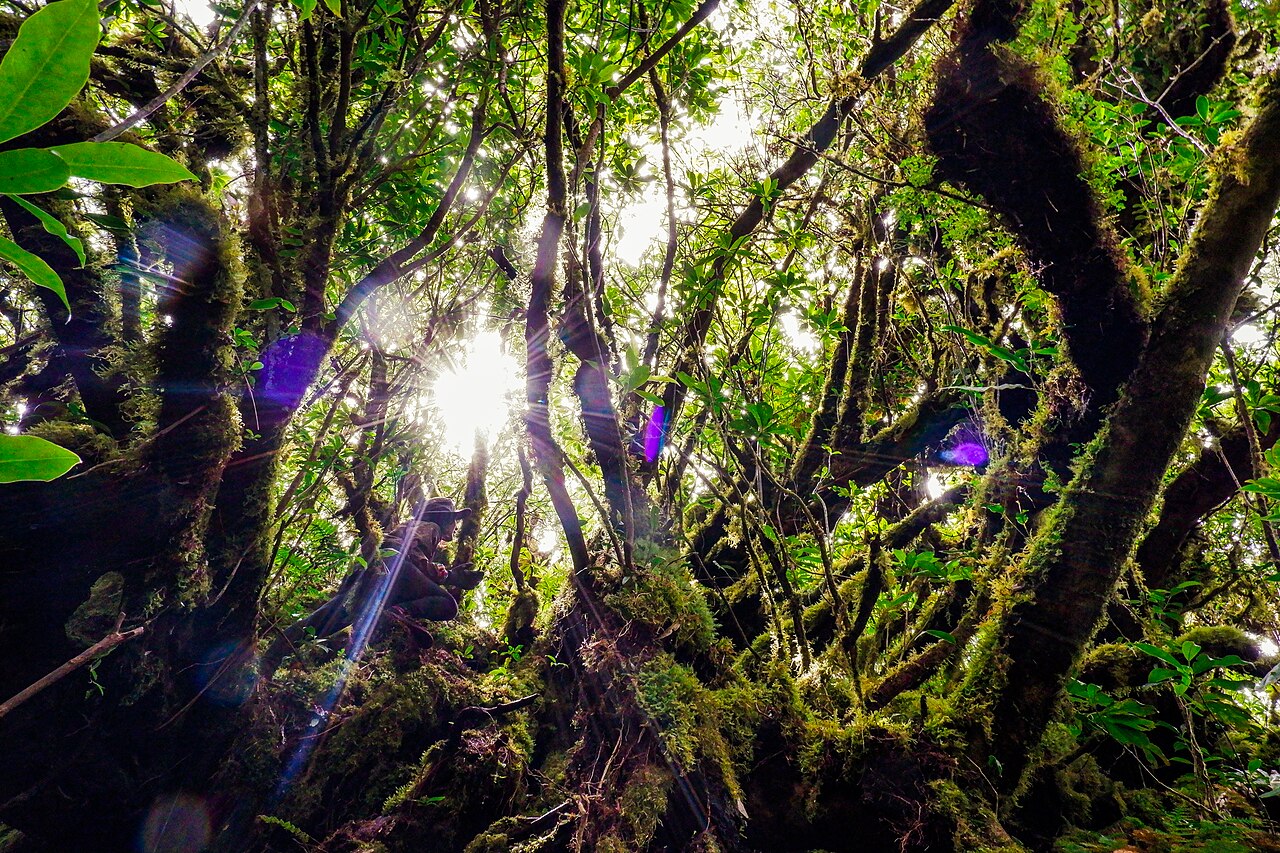
Moss-covered trunks and branches in wet forest on Mount Isarog
Moss-covered forest on Mount Isarog, Camarines Sur, Luzon. Mossy forest is one expression of mountain habitat, not a synonym for every upland forest.Photo: John Samuel Nuñez · Original photograph · CC BY-SA 4.0. Resized; full image retained.

Understanding the environment

A sense of the habitat.

Montane means associated with mountains. Elevation helps explain the environment, but does not define it by itself: cloud exposure, wind, slope and substrate also matter. Philippine mountains do not all change vegetation at the same altitude, and a low, exposed ridge may support a very different forest from a sheltered slope.

Defining feature
Forest shaped by mountain climate and terrain
Main contrast
Sheltered slopes, cloud-exposed forest and ridges
Elevation
Local boundaries; no single national cutoff

Explore the structure · Lower slope to exposed ridge

Read a mountain slope

Select a zone to see what changes.

Transition

Lower slopes

Forest composition changes on the approach to the uplands. There may be no obvious line where lowland conditions stop and montane conditions begin.

Record the actual vegetation, not just the altitude shown by a phone.

A conceptual sequence, not a measured transect. Real mountains can interrupt or reverse this pattern.

Sources: The Field Museum · Field observations on Mount Isarog · Buot & Okitsu · Vegetation zones on Mount Pulog (1998)

Field notes · 01

Why mountains are not interchangeable

Buot and Okitsu’s Mount Pulog study documented distinct vegetation zones and a decline in tree height with elevation. Its flora differed from mountains farther south. This is why a single altitude band cannot stand in for “montane forest” across the archipelago.

At Mount Isarog, Field Museum researchers described frequent fog, densely mossed trunks and a substantial organic ground layer. These observations help explain the photograph, but they should not be treated as weather measurements for every mountain.

Sources: Buot & Okitsu · Vegetation zones on Mount Pulog (1998) · The Field Museum · Field observations on Mount Isarog

Field notes · 02

Snakes in a mountain mosaic

A mountain forest still contains branches, leaf litter, streams and sheltered cavities. Snakes use those smaller environments; the label “montane” does not tell us whether an individual climbs, burrows or forages beside water. Surveys along an elevational gradient, such as the Sibuyan ridge-to-reef study, are needed to establish which animals were actually recorded at each site.

A record from an island is not evidence that the species lives on its highest summit. Likewise, a failure to find a secretive snake during a short survey does not establish its absence.

Sources: Meneses et al. · A ridge-to-reef survey on Sibuyan (2022)

Field notes · 03

Continuity matters from slope to summit

Island separation and mountain topography can isolate populations. Clearing between forest patches adds another break in that landscape. Protecting mountain habitat therefore involves both distinctive upland sites and their connections to lower forests. Describe intact cover, roads, cultivation and exposed edges alongside the attractive mossy interior.

Sources: Alcala · Philippine rainforest field recollections (1998)

Pressures on Philippine habitats

What is at risk?

Mountain habitats face direct disturbance and changes in the conditions that make them distinctive. Steep or remote terrain does not make them immune.

Mining, development and visitor pressure

UNESCO identifies mining, development, wildlife collection and tourism impacts among Mount Hamiguitan’s conservation concerns. This is a concrete Philippine example, not a claim that all mountain forests face equal pressure.

Sources: UNESCO · Mount Hamiguitan conservation requirements

What helps this habitat

Protect elevational sequences and connections between forest patches. Monitor moisture, vegetation and animals over time, and manage development and visitor impacts according to local conditions. Work with communities already caring for these landscapes.

Read further

Evidence & sources.

Guide checked 7 October 2026. Study dates and scope are retained below. Photographs illustrate habitats and do not establish snake occurrence at the photographed sites.

  1. The Field Museum · Field observations on Mount Isarog

    A firsthand account of the cool, wet mossy forest and its organic ground layer.

  2. Buot & Okitsu · Vegetation zones on Mount Pulog (1998)

    Measured vegetation structure on one mountain; its elevation bands are not national thresholds.

  3. Meneses et al. · A ridge-to-reef survey on Sibuyan (2022)

    Local elevational sampling and natural-history observations; not a complete national habitat map.

  4. Alcala · Philippine rainforest field recollections (1998)

    Firsthand descriptions of forest structure. Historical forest statistics and species assessments are not used.

  5. Carandang et al. · Philippine deforestation and degradation drivers (2013)

    Philippine REDD+ research on direct and underlying drivers; local importance varies, and this is not a 2026 ranking.

  6. UNESCO · Mount Hamiguitan conservation requirements

    Site-specific risks and management needs: mining, development, wildlife collection, tourism and climate change. Not a nationwide montane loss estimate.

Continue through the archipelago

Explore another habitat.

01

Rainforest canopy

Sunlit crowns, shaded branches and climbing vines form a vertical landscape. Explore how light, shelter and routes through the trees shape life above ground.

02

Forest floor

Leaf litter, roots, fallen wood and soil hold a mosaic of sheltered spaces. Discover the living ground layer and the secretive snakes that use it.

04

Rivers & wetlands

Forest streams, riverbanks, floodplains and lakes offer different kinds of freshwater habitat. Follow the water and discover how its margins change through the year.

05

Mangrove to ocean

Tidal forests, shore refuges, reefs and open water are connected but distinct. Explore changing salinity and the different lives of sea kraits and fully aquatic sea snakes.