Island atlas · Landscapes & species
Palawan
38 species records name Palawan. Explore their natural history, taxonomic history and distribution sources.
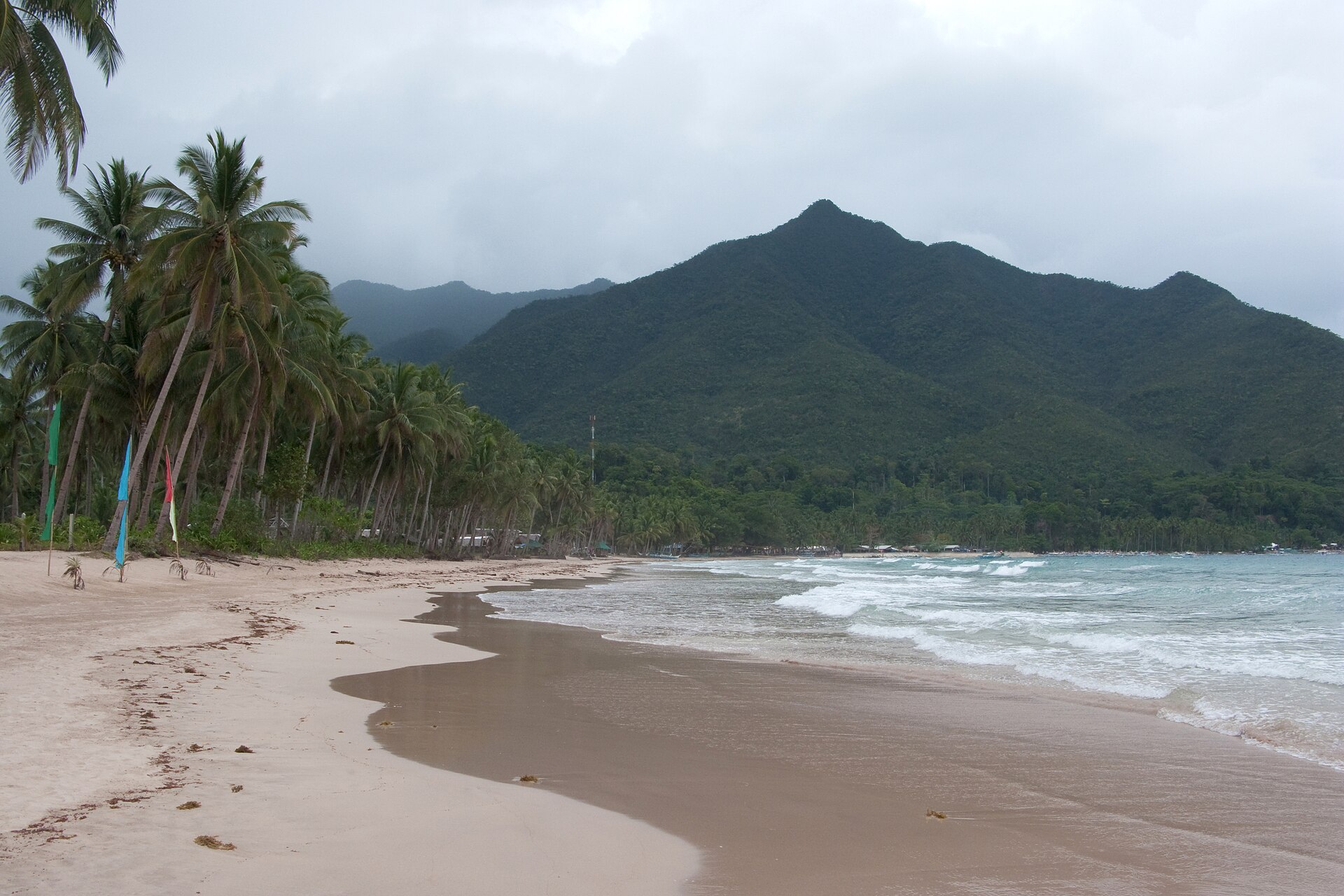
Sabang Beach and the forested mountain backdrop on Palawan Island.
Photo: Vyacheslav Argenberg · Original photograph · CC BY 4.0. Displayed to fit the frame.
Beyond the species list
A sense of place.
The long main island of Palawan separates the South China Sea to the northwest from the Sulu Sea to the southeast. A mountain spine runs through the island. Palawan province also includes many separate islands beyond this main landmass.
Landscape & habitats
Puerto Princesa Subterranean River National Park brings limestone mountains, forest, caves and coast together in one landscape. Its underground river reaches the sea, linking freshwater and tidal environments. Other parts of Palawan have different terrain, so this is one representative setting rather than a description of every locality.
Geographic sources
Geographic overview checked 7 October 2026. The photograph illustrates a landscape, not a snake observation.
Islands, barriers & evolution
Zoogeography
A transition between Sundaland and the oceanic Philippines
Palawan has long been associated with Borneo and the Sunda Shelf, but molecular comparisons reveal a more complex mixture. Some terrestrial vertebrate lineages are close to Sunda relatives; others show strong relationships with the oceanic Philippines.
A major synthesis therefore interprets the boundary around Palawan as a filter zone. Different groups crossed or diversified in different ways. Shared species, evolutionary relationships and proposed land connections offer different kinds of evidence and should not be treated as interchangeable.
How to read the historical island groups
During Pleistocene glacial periods, lower sea levels exposed shallow seabeds and joined some present-day islands. Biogeographers call these reconstructed landmasses Pleistocene Aggregate Island Complexes (PAICs). Deep channels continued to separate others. This model helps explain regional similarities, but dispersal, older geology and habitat differences also shaped each fauna.
“Endemic” means restricted to a stated area; a Philippine endemic need not be confined to one island. The account above summarises published regional and local research. It does not add occurrences to the snake index below.
Regional framework: Meneses et al. (2024) ↗Zoogeographic sources · 1
- Esselstyn et al. (2010) · Biogeographic patterns along Huxley’s modification of Wallace’s Line ↗Comparative evidence from terrestrial vertebrates; Palawan as a transition rather than a simple extension of Borneo.
Literature checked 7 October 2026. Survey results refer to the dates and areas studied.
Source-backed index
38 species
These are explicit source mentions, not a complete island richness estimate. Fine localities and habitat associations remain separate evidence claims.
Acrochordus granulatus
(SCHNEIDER 1799)
Ahaetulla prasina
(BOIE 1827)
Aplopeltura boa
(BOIE 1828)
Boiga cynodon
(BOIE 1827)
Boiga dendrophila
(BOIE 1827)
Boiga schultzei
TAYLOR 1923
Calamaria everetti
BOULENGER 1893
Calamaria palavanensis
INGER & MARX 1965
Calamaria virgulata
BOIE 1827
Calliophis bilineatus
(PETERS 1881)
Cerberus schneiderii
(SCHLEGEL 1837)
Coelognathus erythrurus
(DUMÉRIL, BIBRON & DUMÉRIL 1854)
Coelognathus philippinus
(GRIFFIN 1909)
Dendrelaphis levitoni
VAN ROOIJEN & VOGEL 2012
Dendrelaphis marenae
VOGEL & VAN ROOIJEN 2008
Dryophiops rubescens
(GRAY 1834)
Gonyosoma oxycephalum
(BOIE 1827)
Indotyphlops braminus
(DAUDIN 1803)
Laticauda semifasciata
(REINWARDT 1837)
Liopeltis philippina
(BOETTGER 1897)
Liopeltis tricolor
(SCHLEGEL 1837)
Lycodon capucinus
BOIE 1827
Lycodon philippinus
(GRIFFIN 1909)
Lycodon sealei
LEVITON 1955
Lycodon subannulatus
(DUMÉRIL, BIBRON & DUMÉRIL 1854)
Malayopython reticulatus
(SCHNEIDER 1801)
Naja sumatrana
MÜLLER 1887
Oligodon notospilus
GÜNTHER 1873
Ophiophagus bungarus
SCHLEGEL 1837
Opisthotropis typica
(MOCQUARD 1890)
Psammodynastes pulverulentus
(BOIE 1827)
Ptyas carinata
(GÜNTHER 1864)
Rhabdophis chrysargos
(SCHLEGEL 1837)
Sibynophis bivittatus
(BOULENGER 1894)
Trimeresurus schultzei
GRIFFIN 1909
Tropidolaemus subannulatus
(GRAY 1842)
Tropidonophis spilogaster
(BOIE 1827)
Xenopeltis unicolor
REINWARDT 1827
A source naming Palawan does not establish occurrence in every municipality, protected area, or habitat on the island.