Island atlas · Landscapes & species
Samar
22 species records name Samar. Explore their natural history, taxonomic history and distribution sources.
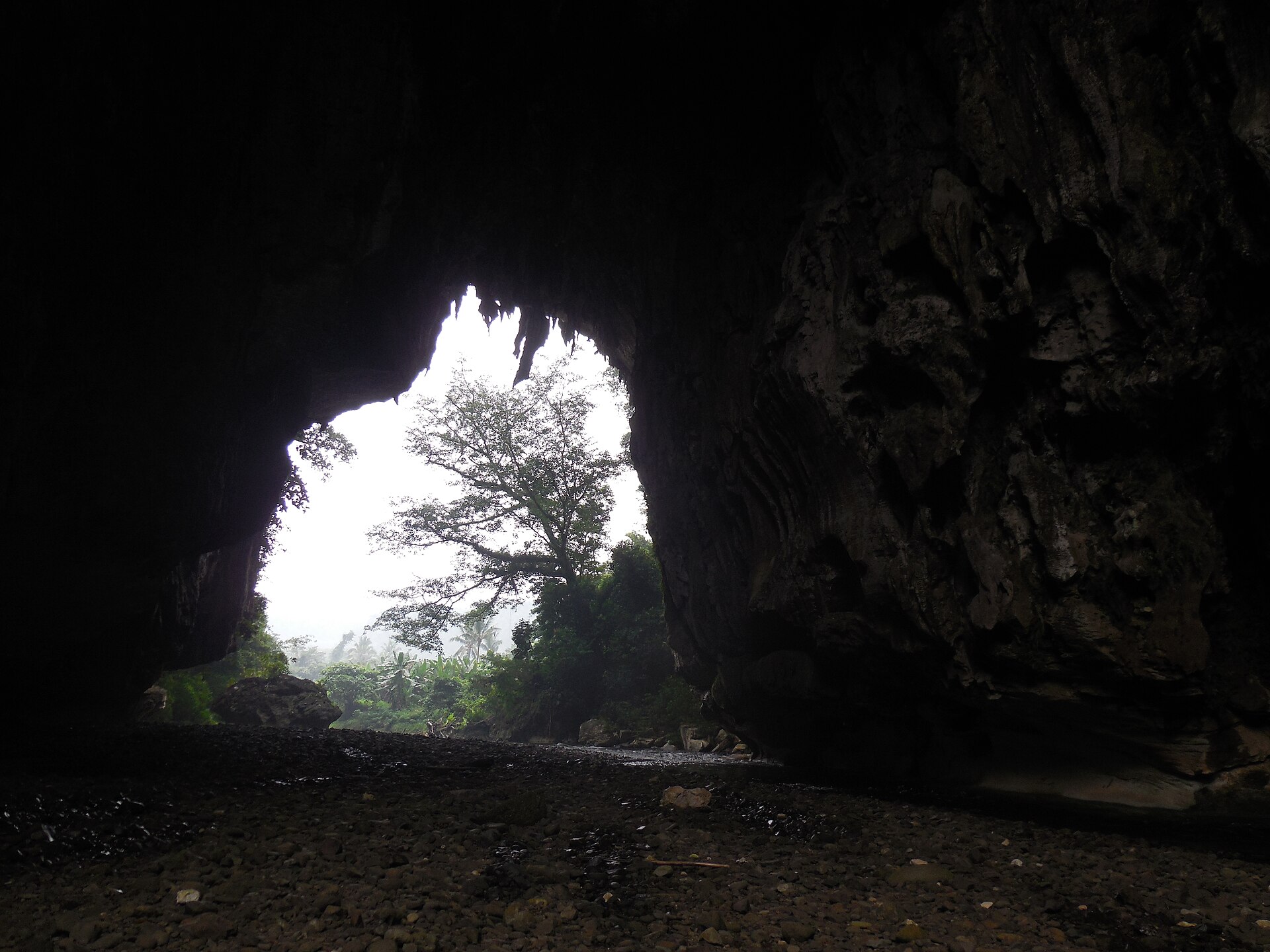
The limestone arch of Sohoton Natural Bridge beside the Cadacan River, Basey, Samar.
Photo: Lawrence Ruiz · Original photograph · CC BY-SA 4.0. Displayed to fit the frame.
Beyond the species list
A sense of place.
Samar is one of the largest Philippine islands, in the Eastern Visayas. Its landmass is shared by Northern Samar, Eastern Samar and Samar provinces; the island extends beyond any one of those provincial names.
Landscape & habitats
At Sohoton in Basey, limestone caves and a natural rock bridge stand beside the Cadacan River. Forest, river and karst meet in this local landscape, illustrating a habitat setting quite different from a simple coastal view of the island.
Geographic sources
- Samar — island overview ↗
- Sohoton Natural Bridge — photographic record ↗
- Samar Island Natural Park — landscape context ↗
Geographic overview checked 7 October 2026. The photograph illustrates a landscape, not a snake observation.
Islands, barriers & evolution
Zoogeography
The northern edge of Greater Mindanao
Samar belongs to the Greater Mindanao faunal region, across the San Bernardino Strait from the Greater Luzon region. Its history therefore links it strongly with Leyte and the southern Philippines despite its closeness to Luzon.
A 2026 study identifies both Samar–Leyte restricted species and Samar endemics within that broader assemblage. Historical connections help explain shared animals, but subsequent isolation and habitat differences also matter. Samar is an evolutionary centre in its own right, not simply a smaller copy of Mindanao.
How to read the historical island groups
During Pleistocene glacial periods, lower sea levels exposed shallow seabeds and joined some present-day islands. Biogeographers call these reconstructed landmasses Pleistocene Aggregate Island Complexes (PAICs). Deep channels continued to separate others. This model helps explain regional similarities, but dispersal, older geology and habitat differences also shaped each fauna.
“Endemic” means restricted to a stated area; a Philippine endemic need not be confined to one island. The account above summarises published regional and local research. It does not add occurrences to the snake index below.
Regional framework: Meneses et al. (2024) ↗Zoogeographic sources · 2
- Amphibians and reptiles of Samar Island Natural Park (2026) · Updated checklist and biogeographic affinities ↗Samar–Leyte endemism within the Greater Mindanao region; regional similarity does not imply identical faunas.
- Meneses et al. (2024) · Philippine herpetology, 20 years on ↗Regional framework, Fig. 1; isolation and research gaps. Open-access review, CC0.
Literature checked 7 October 2026. Survey results refer to the dates and areas studied.
Source-backed index
22 species
These are explicit source mentions, not a complete island richness estimate. Fine localities and habitat associations remain separate evidence claims.
Boiga angulata
(PETERS 1861)
Calamaria lumbricoidea
BOIE 1827
Calliophis philippinus
(GÜNTHER 1864)
Coelognathus erythrurus
(DUMÉRIL, BIBRON & DUMÉRIL 1854)
Dendrelaphis marenae
VOGEL & VAN ROOIJEN 2008
Hydrophis atriceps
GÜNTHER 1864
Levitonius mirus
WEINELL, PALUH, SILER & BROWN 2020
Liopeltis philippina
(BOETTGER 1897)
Lycodon capucinus
BOIE 1827
Lycodon dumerilii
(BOULENGER 1893)
Lycodon ferroni
LANZA 1999
Malayopython reticulatus
(SCHNEIDER 1801)
Malayotyphlops ruber
(BOETTGER 1897)
Naja samarensis
PETERS 1861
Oxyrhabdium modestum
(DUMÉRIL 1853)
Psammodynastes pulverulentus
(BOIE 1827)
Ramphotyphlops marxi
(WALLACH 1993)
Ramphotyphlops olivaceus
(GRAY 1845)
Rhabdophis auriculatus
(GÜNTHER 1858)
Rhabdophis lineatus
(PETERS 1861)
Stegonotus muelleri
DUMÉRIL, BIBRON & DUMÉRIL 1854
Tropidolaemus subannulatus
(GRAY 1842)
A source naming Samar does not establish occurrence in every municipality, protected area, or habitat on the island.