Island atlas · Landscapes & species
Camiguin Sur
10 species records name Camiguin Sur. Explore their natural history, taxonomic history and distribution sources.
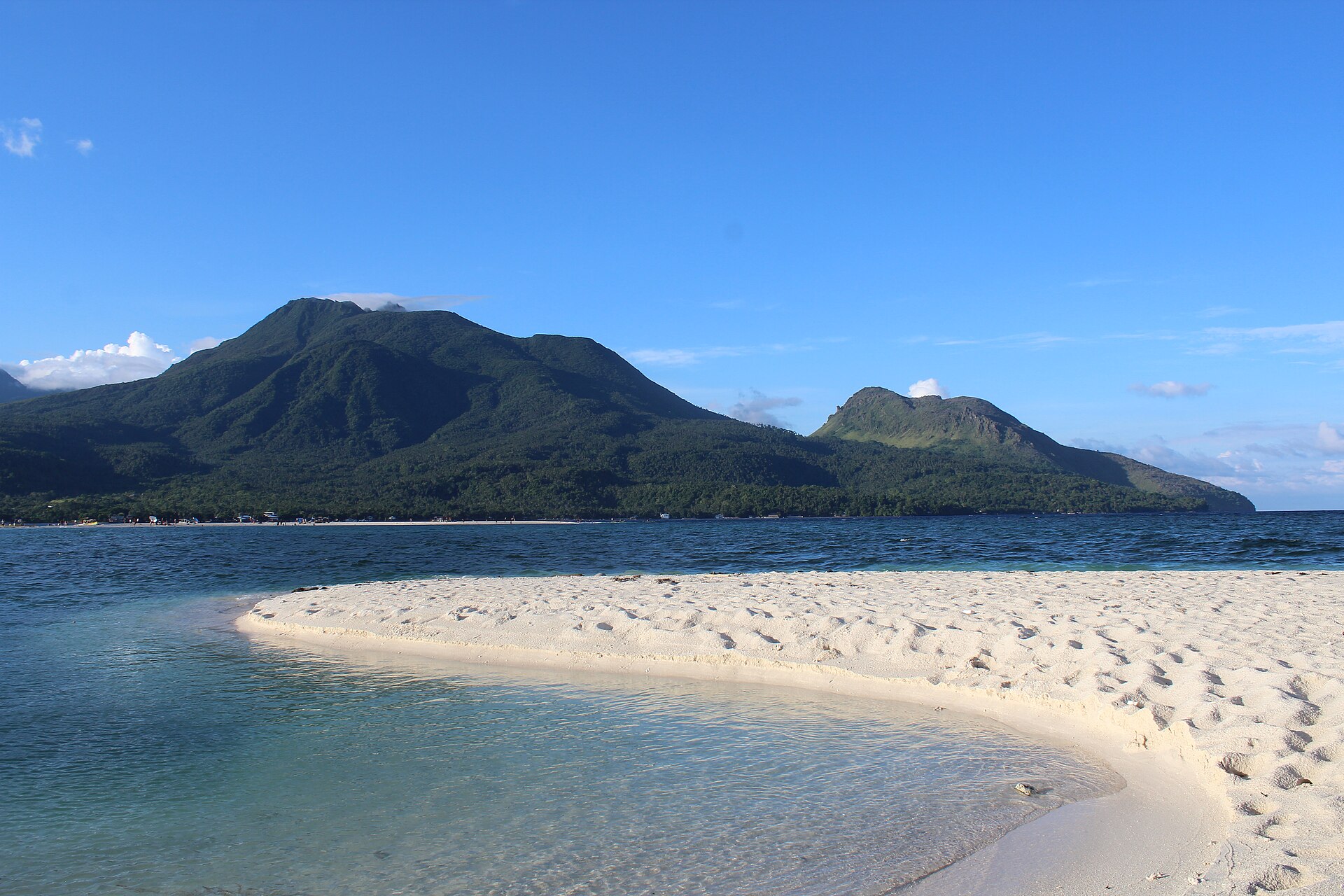
The volcanic landscape of southern Camiguin, viewed from White Island in the Bohol Sea.
Photo: Wolfgang Hägele · Original photograph · CC BY-SA 4.0. Displayed to fit the frame.
Beyond the species list
A sense of place.
Camiguin Sur is the southern Camiguin, an island just off northern Mindanao in the Bohol Sea. This is the island province usually meant by Camiguin in present-day travel and administrative references.
Landscape & habitats
Volcanic mountains rise prominently above the coast. The interior includes forest reserves around the Mount Hibok-Hibok protected landscape. Seen from offshore, the island’s relief makes the short transition from coastal water to mountain slopes especially clear.
Camiguin Norte in the Babuyan Islands has its own page and is not merged into this index.
Geographic sources
Geographic overview checked 7 October 2026. The photograph illustrates a landscape, not a snake observation.
Islands, barriers & evolution
Zoogeography
An isolated island beside Greater Mindanao
Camiguin Sur is geographically close to Mindanao but is not a former piece of its Pleistocene land bridge network. The 2024 herpetological review specifically identifies it among islands associated with a major faunal region that were never fully connected to the neighbouring landmass.
Its fauna must therefore be understood through colonisation across water and subsequent island history, rather than a presumed recent dry-land connection. Its volcanic relief also makes comparisons between lowland and upland habitats particularly relevant.
How to read the historical island groups
During Pleistocene glacial periods, lower sea levels exposed shallow seabeds and joined some present-day islands. Biogeographers call these reconstructed landmasses Pleistocene Aggregate Island Complexes (PAICs). Deep channels continued to separate others. This model helps explain regional similarities, but dispersal, older geology and habitat differences also shaped each fauna.
“Endemic” means restricted to a stated area; a Philippine endemic need not be confined to one island. The account above summarises published regional and local research. It does not add occurrences to the snake index below.
Regional framework: Meneses et al. (2024) ↗Zoogeographic sources · 1
- Meneses et al. (2024) · Philippine herpetology, 20 years on ↗Regional framework, Fig. 1; isolation and research gaps. Open-access review, CC0.
Literature checked 7 October 2026. Survey results refer to the dates and areas studied.
Source-backed index
10 species
These are explicit source mentions, not a complete island richness estimate. Fine localities and habitat associations remain separate evidence claims.
Calamaria lumbricoidea
BOIE 1827
Calliophis philippinus
(GÜNTHER 1864)
Coelognathus erythrurus
(DUMÉRIL, BIBRON & DUMÉRIL 1854)
Cyclocorus nuchalis
TAYLOR 1923
Gonyosoma oxycephalum
(BOIE 1827)
Indotyphlops braminus
(DAUDIN 1803)
Lycodon capucinus
BOIE 1827
Naja samarensis
PETERS 1861
Oxyrhabdium modestum
(DUMÉRIL 1853)
Tropidonophis dendrophiops
(GÜNTHER 1883)
A source naming Camiguin Sur does not establish occurrence in every municipality, protected area, or habitat on the island.