
Size & measurements
No sourced size & measurements summary has yet been added to this account.
Colubridae · Species account
Ptyas mucosa(LINNAEUS, 1758)
Non-venomousTaiwan: the 2013 account describes hills, cleared land and places near homes, with daytime activity often near water. Proximity to water alone does not establish an aquatic habitat.
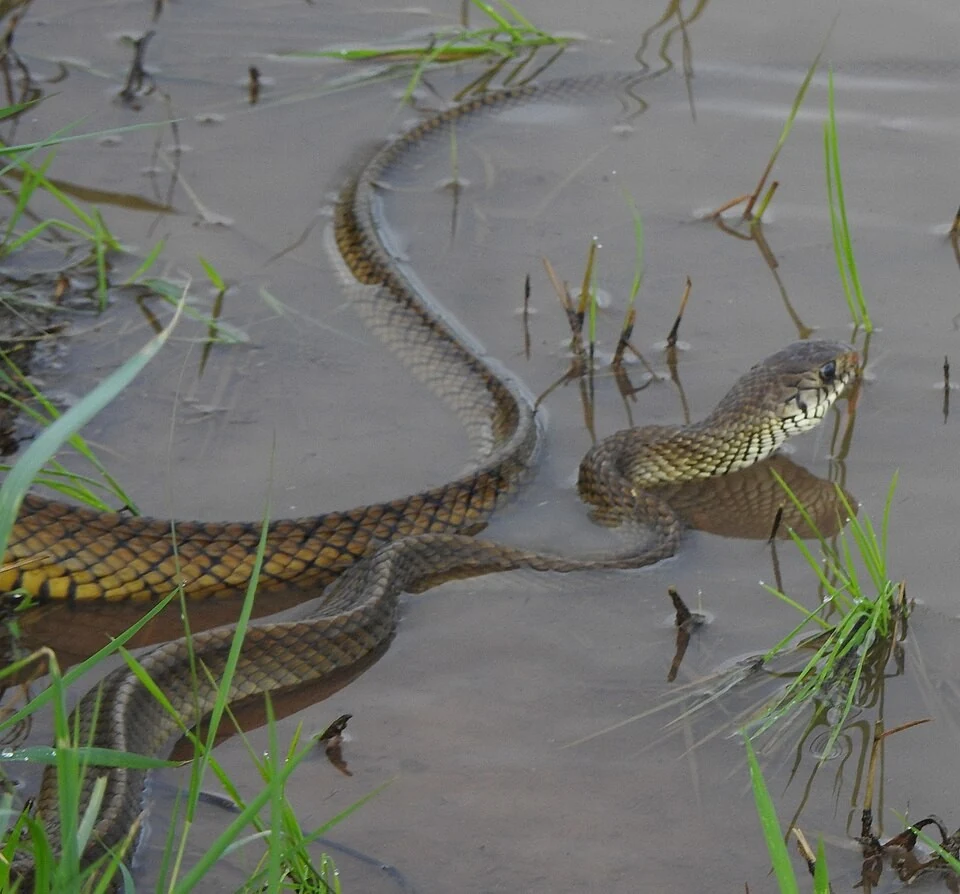
Venom & human effects
The original genome study explicitly characterises Ptyas mucosa as a non-venomous snake.
Species-specific background classification in a genomic study; it does not provide a clinical severity assessment. This claim is not transferred to other Ptyas species.
Wang, J. et al. (2023). The genome assembly and annotation of the Oriental rat snake Ptyas mucosa. Abstract, first sentence, and Background, opening paragraph.
These are editorial summaries of the linked evidence, not toxicity rankings or WHO antivenom-priority categories. Effects vary with the bite and patient. Non-venomous does not mean safe to handle.
The scientific identity
Reliable identification uses the published combination of scale characters, proportions and other diagnostic evidence. Colour or a photograph alone may not separate closely related species.
Taxonomic treatment & original-description references ↗
Coluber mucosus · Natrix mucosa · Coluber blumenbachii · Coluber dhumna · Ptyas blumenbachii · Coryphodon blumenbachii · Leptophis trifrenatus · Ptyas mucosus · Zamenis mucosus · Zaocys mucosus · Ptyas macosa
Names trace the literature, including older combinations and historical usages. Their appearance here does not mean they are all currently accepted synonyms.
From observations & literature
Size and ecological traits credited to SquamBase summarize published studies across the species’ range in its 2024 edition. They are complemented by the locality-specific observations below.
No sourced size & measurements summary has yet been added to this account.
Recorded prey include anurans, lizards, birds, rats, bats, amphibians, reptiles and mammals. This is a compiled list of food records, not an exclusive diet.
Exact-name row in the 2024 literature compilation. These are records from studied populations, not typical values, an exhaustive biological account, or evidence of occurrence in every region.
SquamBase 1.0, Supplementary Table S1, row 10491: Ptyas mucosa; columns Diet, Diet metadata.
The cited ecological classification includes climbing as part of this species’ use of its environment. It does not imply that individuals remain exclusively in trees.
[1]Activity is reported both during daylight and after dark. This is the range-wide classification in the 2024 compilation; it does not exclude occasional activity at other times.
[2]The source classification reports partial use of trees. This does not establish occurrence in every forest.
[1]Ground-dwelling activity is reported in the studies compiled by SquamBase. This describes the species across its studied range, not a record from every island.
[2]The compilation records 7–40 eggs per clutch. These published records need not represent the full variation between populations, and are not a separate estimate for Laos or Vietnam.
[2]Taiwan: the 2013 account describes hills, cleared land and places near homes, with daytime activity often near water. Proximity to water alone does not establish an aquatic habitat.
[11]A Kabul adult was observed in bushes outside the camp barrier.
[12]The Vientiane record distinguishes active daytime sightings from a snake resting on vegetation at night. A nocturnal encounter therefore does not necessarily indicate nocturnal hunting.
[3]Myanmar is explicitly listed in the checked individual taxonomic treatment.
[4]India is explicitly listed in the checked individual taxonomic treatment. The national ZSI checklist independently lists Ptyas mucosa. Regional evidence: Jammu and Kashmir, Himachal Pradesh, Himachal; Assam, Mizoram, Tripura, Sikkim; Odisha; Madhya Pradesh; Gujarat, Maharashtra; Karnataka, Kerala, Tamil Nadu, Telangana; Andamans. Named records do not imply continuous occurrence throughout a region.
[4][5]Confirmed occurrence in the 2025 Bangladesh review, Table 1. The paper explicitly relates its regional labels to the named administrative divisions. Regional evidence: Chattogram; Sylhet; Dhaka; Mymensingh; Barishal; Rangpur; Rajshahi; Khulna. Named records do not imply continuous occurrence throughout a region.
[4][6]Nepal is explicitly listed in the checked individual taxonomic treatment.
[4]Taiwan is explicitly listed in the checked individual taxonomic treatment.
[4]China is explicitly recorded in the checked individual species treatment. The accepted identity is also represented in the 2025 checklist; regional inclusion here is based on explicit locality evidence, not the checklist’s broader geographical scope. Named regional records: Chekiang, Fujian, Jiangxi; Hupeh, Hunan; Guangdong, Guangxi; Yunnan; Xizang; Hong Kong. These localities do not imply continuous occupation of the entire region.
[7][8]Afghanistan is explicitly recorded in the checked individual species treatment. The 2025 revised Afghan colubrid checklist independently corroborates the identity.
[7][9]Pakistan is explicitly recorded in the checked individual species treatment.
[7]The 2024 provincial checklist explicitly lists this species in Thanh Hoa. The 2026 provincial checklist explicitly lists this species in Ha Tinh. The 2020 provincial checklist explicitly lists this species in Son La. This establishes a provincial record; it does not imply occurrence in every protected area or across the whole editorial region.
[15][16][17]Taiwan: Kinmen and Matsu are expressly listed in the 2013 expert account, under the older spelling Ptyas mucosus.
[18]Photographed on 13 October 2010 at 1,865 m.
[19]Published survey identification; individual observation coordinates are not provided. Listed in the March 2011–July 2013 field survey; no specimen-level locality or habitat assignment is supplied.
[20][21][22]Egg-laying (oviparous). [1]
The database classifies its habitat use as partly arboreal. [1]
A reported observation is not necessarily the full ecological range of a species. Where reproduction is inferred in a source dataset, the account identifies that limitation.
One species · Across borders
Explore the recorded countries and islands. Select a highlighted area to see its distribution evidence.
Loading geographic boundaries…
Click a highlighted country to zoom in and explore its records.
Shading identifies recorded countries or named islands, not continuous habitat coverage. Uncoloured areas do not establish absence.
Natural Earth · 1:50m · public domain; Gibraltar: geoBoundaries. Small islands may lack an outline.
Explore the distribution
Select a highlighted area to see its status, island records and sources. Each country and island links to the same shared species collection.
Use “Worldwide records” to include distant introduced and uncertain records in the map view.
Afghanistan is explicitly recorded in the checked individual species treatment. The 2025 revised Afghan colubrid checklist independently corroborates the identity. Photographed on 13 October 2010 at 1,865 m.
Central highlands & Kabul valleys → · Camp Dubs, Kabul
Locality source 1 ↗ Locality source 2 ↗ Locality source 3 ↗Confirmed occurrence in the 2025 Bangladesh review, Table 1. The paper explicitly relates its regional labels to the named administrative divisions. Regional evidence: Chattogram; Sylhet; Dhaka; Mymensingh; Barishal; Rangpur; Rajshahi; Khulna. Named records do not imply continuous occurrence throughout a region.
Chattogram → · Chattogram
Sylhet → · Sylhet
Dhaka → · Dhaka
Mymensingh → · Mymensingh
Barishal → · Barishal
Rangpur → · Rangpur
Rajshahi → · Rajshahi
Khulna → · Khulna
Locality source 1 ↗ Locality source 2 ↗Historical U.S.S.R. wording is not mapped to Russia; explicit Turkmenistan is retained.
Locality source 1 ↗China is explicitly recorded in the checked individual species treatment. The accepted identity is also represented in the 2025 checklist; regional inclusion here is based on explicit locality evidence, not the checklist’s broader geographical scope. Named regional records: Chekiang, Fujian, Jiangxi; Hupeh, Hunan; Guangdong, Guangxi; Yunnan; Xizang; Hong Kong. These localities do not imply continuous occupation of the entire region.
Eastern hills, rivers & coast → · Chekiang, Fujian, Jiangxi
Central river basins & mountains → · Hupeh, Hunan
Guangdong & Guangxi → · Guangdong, Guangxi
Southwestern mountains & basins → · Yunnan
Tibetan Plateau & Qinghai → · Xizang
Hong Kong → · Hong Kong
Locality source 1 ↗ Locality source 2 ↗India is explicitly listed in the checked individual taxonomic treatment. The national ZSI checklist independently lists Ptyas mucosa. Regional evidence: Jammu and Kashmir, Himachal Pradesh, Himachal; Assam, Mizoram, Tripura, Sikkim; Odisha; Madhya Pradesh; Gujarat, Maharashtra; Karnataka, Kerala, Tamil Nadu, Telangana; Andamans. Named records do not imply continuous occurrence throughout a region.
Northern plains & Himalaya → · Jammu and Kashmir, Himachal Pradesh, Himachal
Northeastern hills & Brahmaputra → · Assam, Mizoram, Tripura, Sikkim
Eastern plains & plateau → · Odisha
Central highlands → · Madhya Pradesh
Western drylands & coast → · Gujarat, Maharashtra
Southern peninsula → · Karnataka, Kerala, Tamil Nadu, Telangana
Andaman, Nicobar & Lakshadweep → · Andamans
Locality source 1 ↗ Locality source 2 ↗Explicit country record in the checked taxonomic treatment.
Locality source 1 ↗Laos: Louangphrabang, Xiangkhoang; Vientiane, Bolikhamxai, Khammouan; Champasak.
Northern mountains → · Louangphrabang, Xiangkhoang
Central Laos & the Annamites → · Vientiane, Bolikhamxai, Khammouan
Southern Laos & the Bolaven Plateau → · Champasak
Locality source 1 ↗Nepal is explicitly listed in the checked individual taxonomic treatment.
Locality source 1 ↗Pakistan is explicitly recorded in the checked individual species treatment. Published survey identification; individual observation coordinates are not provided. Listed in the March 2011–July 2013 field survey; no specimen-level locality or habitat assignment is supplied.
Islamabad Capital Territory → · Margalla Hills National Park, Islamabad
Punjab → · Chakwal Tehsil, Chakwal District
Locality source 1 ↗ Locality source 2 ↗ Locality source 3 ↗ Locality source 4 ↗Explicit country record in the checked taxonomic treatment.
Locality source 1 ↗Taiwan is explicitly listed in the checked individual taxonomic treatment. Taiwan: Kinmen and Matsu are expressly listed in the 2013 expert account, under the older spelling Ptyas mucosus.
Penghu, Kinmen & Matsu → · Kinmen, Matsu
Locality source 1 ↗ Locality source 2 ↗Explicit country record in the checked taxonomic treatment.
Locality source 1 ↗Vietnam: Hoa Binh. The 2024 provincial checklist explicitly lists this species in Thanh Hoa. The 2026 provincial checklist explicitly lists this species in Ha Tinh. The 2020 provincial checklist explicitly lists this species in Son La. This establishes a provincial record; it does not imply occurrence in every protected area or across the whole editorial region.
Northwest mountains → · Hoa Binh, Son La
North Central Coast & Annamites → · Thanh Hoa, Ha Tinh
Locality source 1 ↗ Locality source 2 ↗ Locality source 3 ↗ Locality source 4 ↗Malaysia: West Malaysia.
Peninsular Malaysia → · West Malaysia
Locality source 1 ↗Thailand: country-level record; no named guide locality extracted.
Locality source 1 ↗Myanmar is explicitly listed in the checked individual taxonomic treatment.
Locality source 1 ↗Explicit Indonesian country or island locality supports inclusion.
Afghanistan, Bangladesh, Burma (Myanmar), Cambodia, China (Chekiang, Hupeh, Jiangxi, Fujian, Guangdong, Hainan, Guangxi, Yunnan, Xizang, Hong Kong, Hunan), India (Sikkim, Assam, Mizoram, Tamil Nadu, Kerala, Madhya Pradesh, Himachal Pradesh, Jammu and Kashmir, Maharashtra, Telangana, Karnataka (Castle Rock) [A. Captain, pers. comm.], Punjab [Dino Aulakh, pers. comm.], Gujarat, Tripura, Odisha), Andamans, Sri Lanka, Bhutan, Indonesia (Sumatra, Java, Bali), Iran, Laos (Bolikhamxai, Champasak, Khammouan, Louangphrabang, Vientiane and Xiangkhoang), West Malaysia, Nepal, Myanmar, Pakistan, Taiwan, Thailand, Turkmenistan, U.S.S.R., Vietnam (Hoa Binh) maximus: Sri Lanka nigricans: Turkmenistan [1]
The text retains the source’s geographic qualifications. The map shows countries with atlas occurrence records; it is not a complete global range model. A type locality is a nomenclatural reference, not the only place the species occurs.
Status & its meaning
No matching global assessment was verified for this account. This is an unresolved assessment link, not an IUCN “Not Evaluated” classification and not evidence that the species is secure.
Locality coverage in the atlas does not measure abundance, population trends or national legal protection.
Follow the evidence
Latest evidence added 2026-10-11. Taxonomic and distribution treatments may change.
The linked taxonomic treatment provides its original descriptions, revisions and bibliography. Observations from other countries are not relabelled as local field studies.