Size & measurements
No sourced size & measurements summary has yet been added to this account.
Elapidae · Species account
Ophiophagus hannah(CANTOR, 1836)
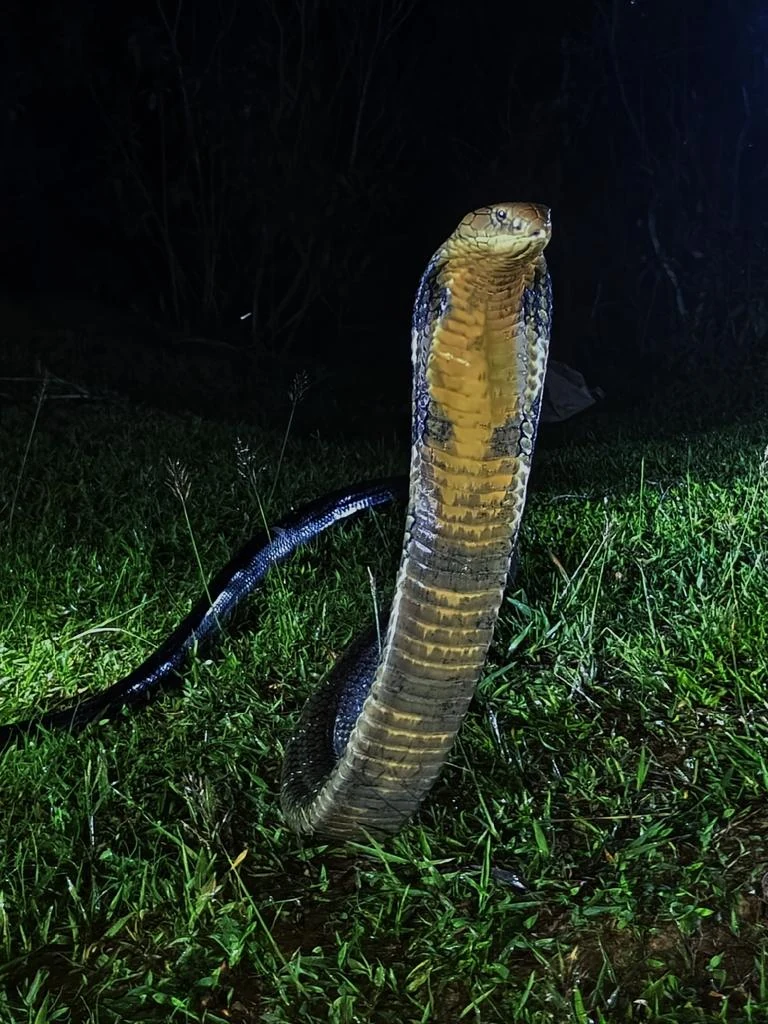
VenomousPotentially life-threateningBhutan: the 2019–2020 Trashigang study found king cobras in dense and degraded forest, forest edges, farmland and scrub from 650–2,057 m. Fifteen of 18 records were within 500 m of permanent water. A guarded nest was monitored on a shaded forest trail at Lumang; these observations do not demonstrate exclusive habitat preference.
Venom & human effects
A published case explicitly attributed to Ophiophagus hannah in the strict sense involved cardiopulmonary arrest and myocardial injury. The patient required mechanical ventilation and recovered.
One 50-year-old man in Yunnan, China. The 2025 report explicitly uses O. hannah sensu stricto after the king-cobra revision; its accessible abstract does not describe the snake-identification procedure. This documents a reported life-threatening outcome, not its frequency. It is not extrapolated to the other three king-cobra species.
Zhao et al. (2025), title and Abstract, case description. Published online 3 June 2025; Wilderness & Environmental Medicine 36(4):559-563.
These are editorial summaries of the linked evidence, not toxicity rankings or WHO antivenom-priority categories. Effects vary with the bite and patient. Non-venomous does not mean safe to handle.
The scientific identity
Reliable identification uses the published combination of scale characters, proportions and other diagnostic evidence. Colour or a photograph alone may not separate closely related species.
Taxonomic treatment & original-description references ↗
Hamadryas hannah · Hamadryas ophiophagus · Naja vittata · Dendraspis bungarus · Hamadryas elaps · Ophiophagus elaps · Naja hannah · Dendraspis hannah
Names trace the literature, including older combinations and historical usages. Their appearance here does not mean they are all currently accepted synonyms.
From observations & literature
No sourced size & measurements summary has yet been added to this account.
Other snakes are the characteristic prey, including rat snakes, pythons and other venomous snakes. The Smithsonian account describes king cobras in the broader historical sense; it is not a survey of Lao or Vietnamese diet.
[2]Daytime activity is reported. Climbing and time spent in shrubs or trees form part of the described behaviour.
[2]Females gather plant material into a nest and guard their eggs. The account reports 21–40 eggs, a literature range rather than a country-specific breeding estimate.
[2]Bhutan: the 2019–2020 Trashigang study found king cobras in dense and degraded forest, forest edges, farmland and scrub from 650–2,057 m. Fifteen of 18 records were within 500 m of permanent water. A guarded nest was monitored on a shaded forest trail at Lumang; these observations do not demonstrate exclusive habitat preference.
[8]The taxonomic treatment explicitly identifies this species as venomous. That designation does not, by itself, establish the severity of every bite.
[1]Myanmar is explicitly listed in the checked individual taxonomic treatment.
[3]India is explicitly listed in the checked individual taxonomic treatment. The national ZSI checklist independently lists Ophiophagus hannah. Regional evidence: Assam, Arunachal Pradesh, Meghalaya, Mizoram, Tripura, Sikkim; Bihar, Odisha, West Bengal, Orissa; Madhya Pradesh; Andhra Pradesh; Andaman. Named records do not imply continuous occurrence throughout a region.
[3][4]Confirmed occurrence in the 2025 Bangladesh review, Table 1. The paper explicitly relates its regional labels to the named administrative divisions. Regional evidence: Chattogram; Sylhet; Khulna. Named records do not imply continuous occurrence throughout a region.
[3][5]Bhutan is explicitly listed in the checked individual taxonomic treatment.
[3]Nepal is explicitly listed in the checked individual taxonomic treatment.
[3]China is explicitly recorded in the checked individual species treatment. The accepted identity is also represented in the 2025 checklist; regional inclusion here is based on explicit locality evidence, not the checklist’s broader geographical scope. Named regional records: Fujian, Fukien; Hunan; Kwangtung, Kwangsi; Sichuan, Yunnan; Xizang; Hong Kong. These localities do not imply continuous occupation of the entire region.
[6][7]The 2024 provincial checklist explicitly lists this species in Thanh Hoa. The 2026 provincial checklist explicitly lists this species in Ha Tinh. The 2020 provincial checklist explicitly lists this species in Son La. This establishes a provincial record; it does not imply occurrence in every protected area or across the whole editorial region.
[9][10][11]Bhutan: selected named 2019–2020 records from Table 1: Radi (2,057 m), Rolong (650 m), Lumang (1,030 m), Yangtse (1,810 m) and Bayling (2,032 m).
[12]A reported observation is not necessarily the full ecological range of a species. Where reproduction is inferred in a source dataset, the account identifies that limitation.
One species · Across borders
Explore the recorded countries and islands. Select a highlighted area to see its distribution evidence.
Loading geographic boundaries…
Click a highlighted country to zoom in and explore its records.
Shading identifies recorded countries or named islands, not continuous habitat coverage. Uncoloured areas do not establish absence.
Natural Earth · 1:50m · public domain; Gibraltar: geoBoundaries. Small islands may lack an outline.
Explore the distribution
Select a highlighted area to see its status, island records and sources. Each country and island links to the same shared species collection.
Use “Worldwide records” to include distant introduced and uncertain records in the map view.
Laos: national occurrence; no finer locality is assigned in this atlas.
Locality source 1 ↗Vietnam: Hoa Binh, Yen Bai. The 2024 provincial checklist explicitly lists this species in Thanh Hoa. The 2026 provincial checklist explicitly lists this species in Ha Tinh. The 2020 provincial checklist explicitly lists this species in Son La. This establishes a provincial record; it does not imply occurrence in every protected area or across the whole editorial region.
Northwest mountains → · Hoa Binh, Yen Bai, Son La
North Central Coast & Annamites → · Thanh Hoa, Ha Tinh
Locality source 1 ↗ Locality source 2 ↗ Locality source 3 ↗ Locality source 4 ↗Thailand: country-level record; no named guide locality extracted.
Locality source 1 ↗Myanmar is explicitly listed in the checked individual taxonomic treatment.
Locality source 1 ↗Confirmed occurrence in the 2025 Bangladesh review, Table 1. The paper explicitly relates its regional labels to the named administrative divisions. Regional evidence: Chattogram; Sylhet; Khulna. Named records do not imply continuous occurrence throughout a region.
Chattogram → · Chattogram
Sylhet → · Sylhet
Khulna → · Khulna
Locality source 1 ↗ Locality source 2 ↗Bhutan is explicitly listed in the checked individual taxonomic treatment. Bhutan: selected named 2019–2020 records from Table 1: Radi (2,057 m), Rolong (650 m), Lumang (1,030 m), Yangtse (1,810 m) and Bayling (2,032 m).
Eastern valleys & forest corridors → · Radi, Rolong, Lumang, Yangtse, Bayling
Locality source 1 ↗ Locality source 2 ↗Country occurrence belongs to the northern king cobra following the 2024 revision; Sunda and Philippine king cobras are separate canonical species.
Locality source 1 ↗ Locality source 2 ↗China is explicitly recorded in the checked individual species treatment. The accepted identity is also represented in the 2025 checklist; regional inclusion here is based on explicit locality evidence, not the checklist’s broader geographical scope. Named regional records: Fujian, Fukien; Hunan; Kwangtung, Kwangsi; Sichuan, Yunnan; Xizang; Hong Kong. These localities do not imply continuous occupation of the entire region.
Eastern hills, rivers & coast → · Fujian, Fukien
Central river basins & mountains → · Hunan
Guangdong & Guangxi → · Kwangtung, Kwangsi
Southwestern mountains & basins → · Sichuan, Yunnan
Tibetan Plateau & Qinghai → · Xizang
Hong Kong → · Hong Kong
Locality source 1 ↗ Locality source 2 ↗India is explicitly listed in the checked individual taxonomic treatment. The national ZSI checklist independently lists Ophiophagus hannah. Regional evidence: Assam, Arunachal Pradesh, Meghalaya, Mizoram, Tripura, Sikkim; Bihar, Odisha, West Bengal, Orissa; Madhya Pradesh; Andhra Pradesh; Andaman. Named records do not imply continuous occurrence throughout a region.
Northeastern hills & Brahmaputra → · Assam, Arunachal Pradesh, Meghalaya, Mizoram, Tripura, Sikkim
Eastern plains & plateau → · Bihar, Odisha, West Bengal, Orissa
Central highlands → · Madhya Pradesh
Southern peninsula → · Andhra Pradesh
Andaman, Nicobar & Lakshadweep → · Andaman
Locality source 1 ↗ Locality source 2 ↗Nepal is explicitly listed in the checked individual taxonomic treatment.
Locality source 1 ↗Bangladesh, Myanmar (= Burma), Cambodia, China (Fukien, Kwangtung, Hong Kong, Kwangsi, Hainan, Yunnan, SW Sichuan, SE Xizang = Tibet, Fujian, Hunan), India (Assam, Tripura, Meghalaya, Arunachal Pradesh [A. Captain, pers. Comm.], Sikkim, West Bengal, Bihar, Orissa = Odisha, Andhra Pradesh, Madhya Pradesh, Mizoram, Andaman Islands), Nepal, Bhutan, Laos, Thailand, Vietnam (Hoa Binh, Yen Bai etc.). [1]
The text retains the source’s geographic qualifications. The map shows countries with atlas occurrence records; it is not a complete global range model. A type locality is a nomenclatural reference, not the only place the species occurs.
Status & its meaning
Vulnerable
Global IUCN category indexed by iNaturalist for this scientific name. It is not a separate assessment of a national population, and its assessment date may predate later taxonomic changes.
Read the IUCN assessment ↗ · Taxon index & assessment link ↗
Locality coverage in the atlas does not measure abundance, population trends or national legal protection.
Follow the evidence
Latest evidence added 2026-10-11. Taxonomic and distribution treatments may change.
The linked taxonomic treatment provides its original descriptions, revisions and bibliography. Observations from other countries are not relabelled as local field studies.