Forest conversion
The Cardamom programme reports land encroachment and forest clearing.
Sources: Conservation International · Central Cardamom landscape
Cambodia · Habitat field guide
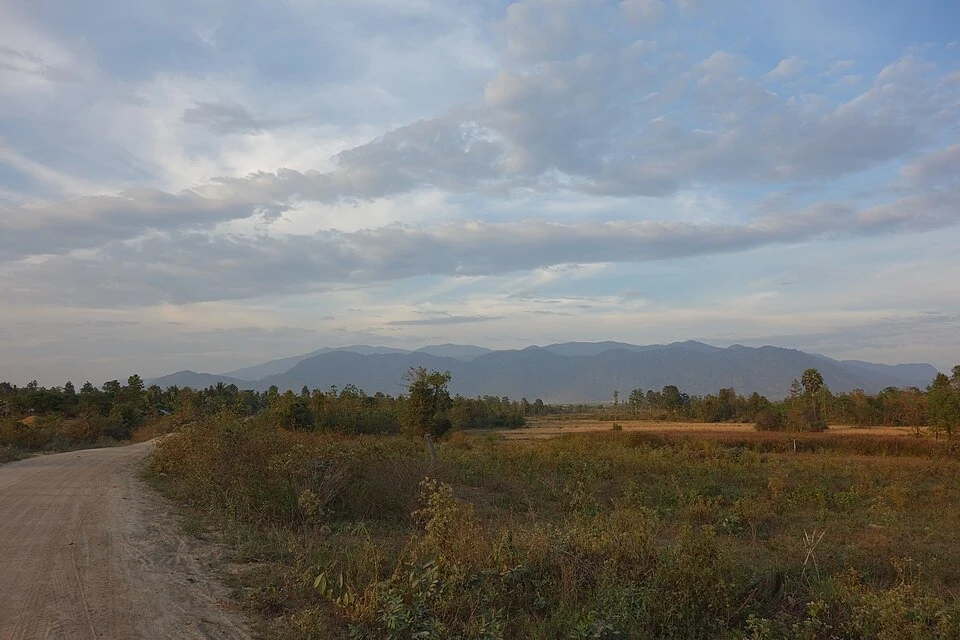
Mountain habitats occur in both the Cardamom landscape and the northeastern highlands. Neither should be represented by one uniform band of forest.
Phnom Aural and the Cardamom uplands seen from the surrounding lowlands, Cambodia.
Understanding the environment
Mountain habitats occur in both the Cardamom landscape and the northeastern highlands. Neither should be represented by one uniform band of forest.
Explore the structure · Explore three connected parts of this landscape.
Select a zone to see what changes.
Begin below the ridge
Describe the valley, drainage and surrounding land use.
An altitude is incomplete without the vegetation and exact locality.
A conceptual reading guide, not a measured transect, access route or snake occurrence map.
Sources: ASEAN Centre for Biodiversity · Virachey National Park · Conservation International · Central Cardamom landscape
Field notes · 01
ASEAN’s park account describes montane and semi-evergreen lowland forest alongside upland savannah, bamboo and other vegetation. The mountain guide therefore includes transitions and openings, rather than assuming every upper slope has dense tree cover.
Sources: ASEAN Centre for Biodiversity · Virachey National Park
Field notes · 02
The Central Cardamom programme links forest protection with water flowing toward lowland farms and Tonle Sap. Compare a ridge observation with the stream and valley below it; protecting an isolated summit cannot describe the needs of the whole drainage.
Sources: Conservation International · Central Cardamom landscape
Pressures on Cambodia’s habitats
The Cardamom programme reports land encroachment and forest clearing.
Sources: Conservation International · Central Cardamom landscape
Logging and hunting require continuing management; elevation alone offers no guarantee of protection.
Sources: Conservation International · Central Cardamom landscape
Read conservation across the ridge-to-river connection, with local communities involved in access and land management.
The connected collection
These 3 species have supported country occurrence and an explicit habitat association in the shared account. The association may come from elsewhere in their range. This is not a complete local habitat inventory; the places above are landscape examples, not asserted collecting sites.
3 species · showing 3
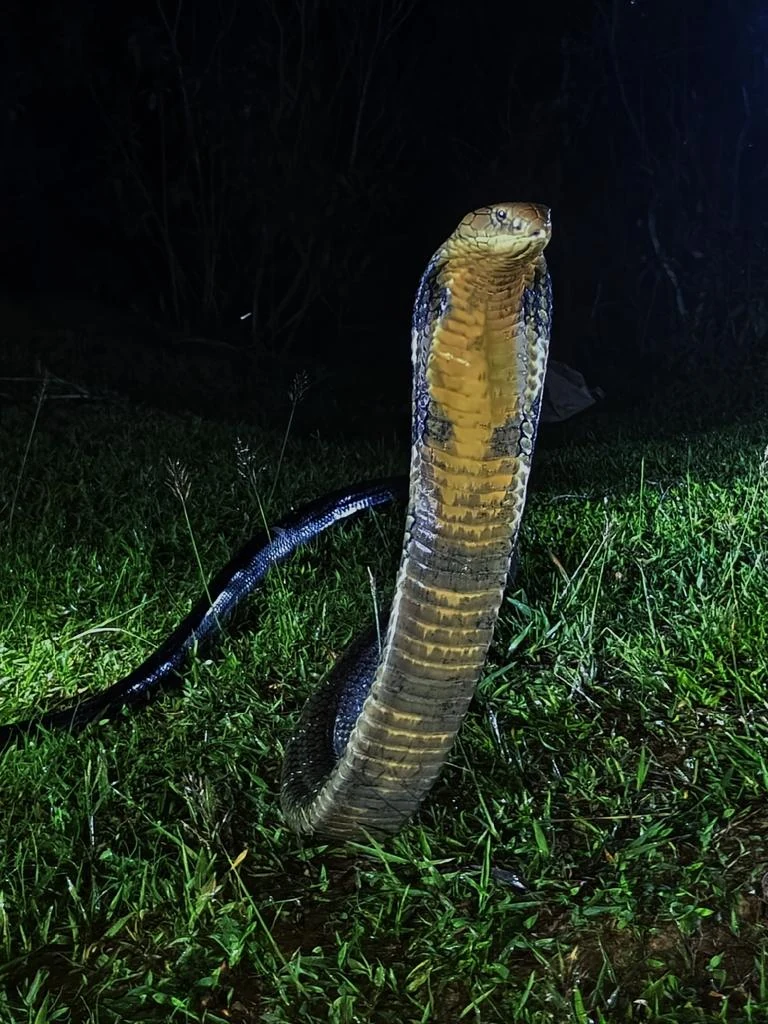
001 · Elapidae
Hamadryad, King Cobra
Country occurrence belongs to the northern king cobra following the 2024 revision; Sunda and Philippine king cobras are separate canonical species.
Read the species account →Ankur Nandi · CC BY 4.0 · https://creativecommons.org/licenses/by/4.0/
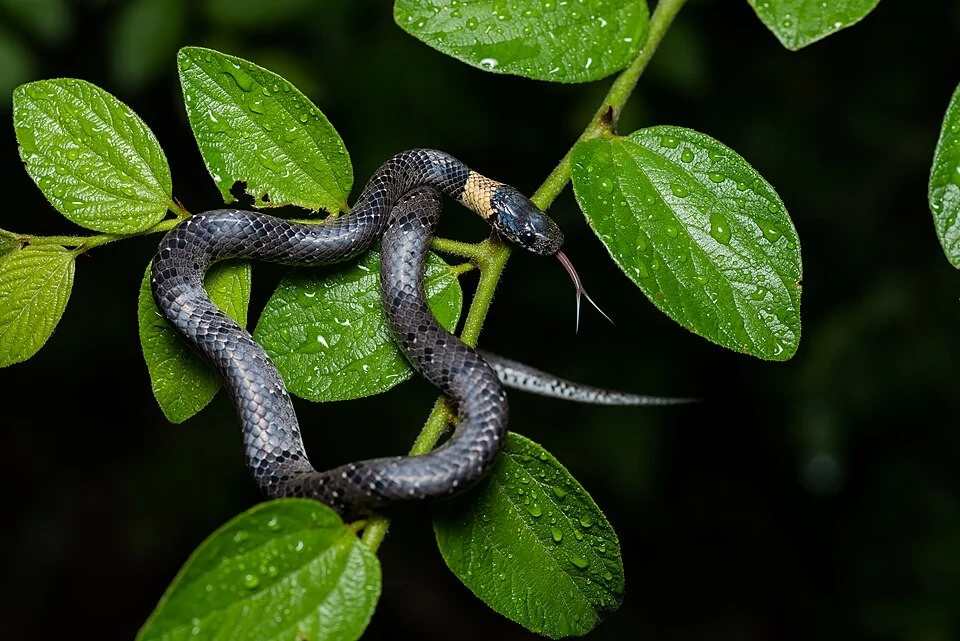
002 · Pareidae
Mountain Slug Snake
Listed in the checked distribution source. FMNH 267738; Stuart & Emmett (2006), 22. LSUHC 7463; Grismer et al. (2007), August 2005 survey.
Read the species account →Rushenb · CC BY-SA 4.0 · https://creativecommons.org/licenses/by-sa/4.0
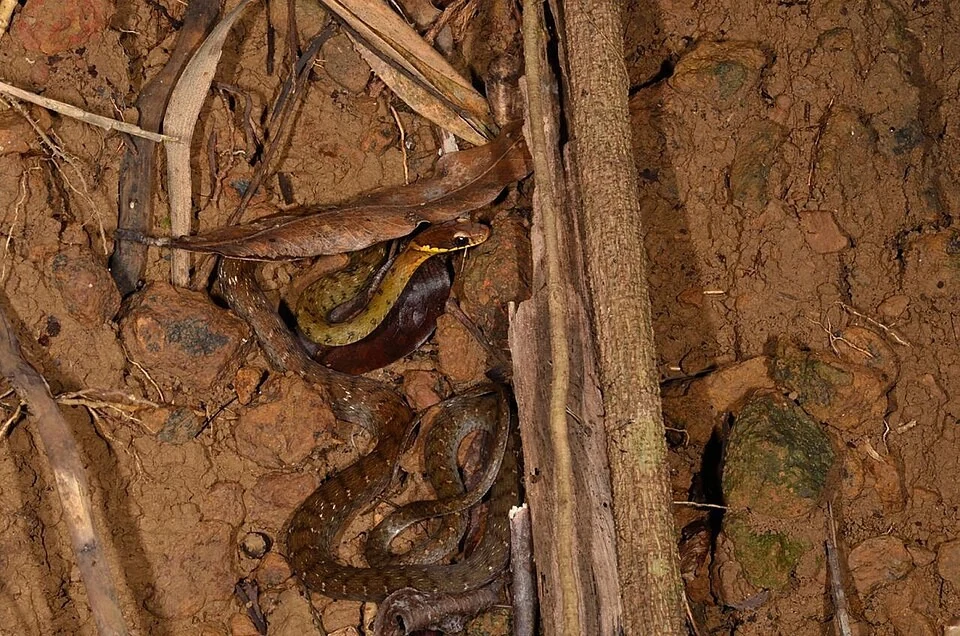
003 · Colubridae
Specklebelly Keelback
Listed in the checked distribution source. The 2024 Fauna & Flora / Ministry of Environment Virachey biodiversity survey reports this species from the 2021–2023 field programme in Virachey National Park. This is reserve-level evidence, not a claim that every northeastern province is occupied. FMNH 263381–382; Stuart & Emmett (2006), 22. LSUHC 7461;…
Read the species account →Eugene Popov · CC BY 4.0 · https://creativecommons.org/licenses/by/4.0
Read further
Guide reviewed 11 October 2026. Source dates and geographic scope matter; landscape photographs do not establish species occurrence.
Lowland and montane vegetation mosaic; no snake elevation limit inferred.
Programme account of rainforest, catchments, Indigenous communities and documented pressures.
Continue through Cambodia
Cambodia’s forest habitats range from open seasonal woodland to wet mountain rainforest. Tree cover, water and season need to be read together.
02Cambodian karst includes isolated limestone hills, forested surfaces and underground habitats. Recent surveys show why small outcrops deserve individual attention.
03Seasonal inundation connects the Tonle Sap lake, flooded woodland, marshes and working landscapes. The changing waterline is part of the habitat.
04Koh Kong’s mangroves connect tidal forest, fishing livelihoods and the Gulf of Thailand. These are working coastal landscapes as well as wildlife habitat.
05The Gulf of Thailand chapter brings together island shores, seagrass and coral reefs. A coastal map needs these habitat differences as well as island names.