Quarrying
Fauna & Flora identifies limestone extraction for cement as a threat to karst biodiversity.
Cambodia · Habitat field guide
Cambodian karst includes isolated limestone hills, forested surfaces and underground habitats. Recent surveys show why small outcrops deserve individual attention.
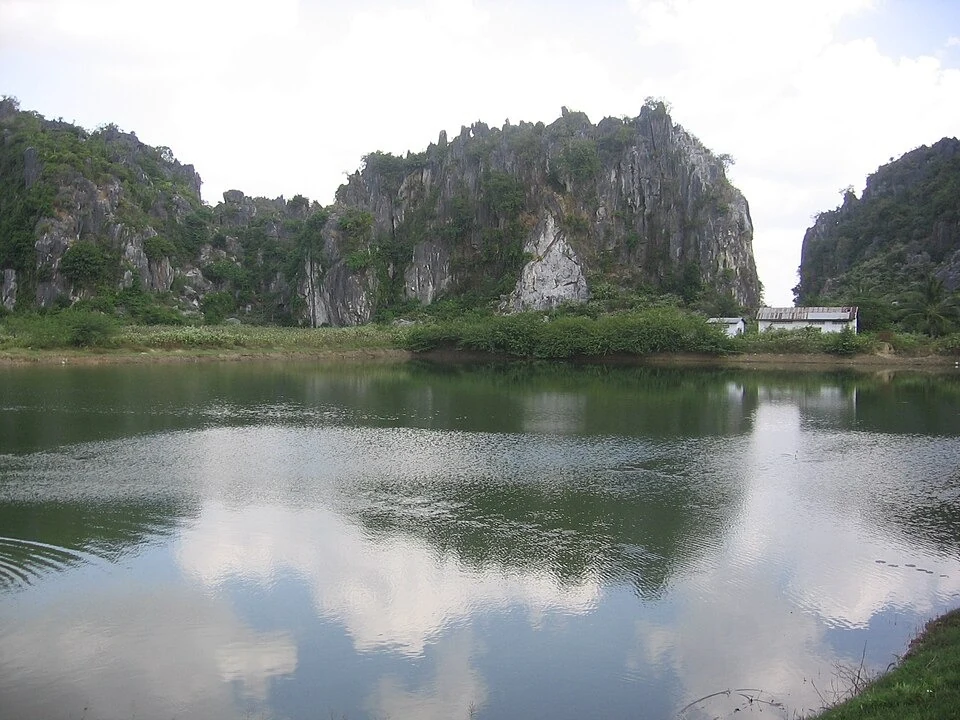
Limestone hills, caves and vegetation at Kampong Trach, Kampot Province, Cambodia.
Understanding the environment
Cambodian karst includes isolated limestone hills, forested surfaces and underground habitats. Recent surveys show why small outcrops deserve individual attention.
Explore the structure · Explore three connected parts of this landscape.
Select a zone to see what changes.
Above the rock
Notice the vegetation rooted around outcrops and slopes.
Karst includes the surface landscape as well as caves.
A conceptual reading guide, not a measured transect, access route or snake occurrence map.
Sources: Fauna & Flora · Cambodia karst biodiversity report (2026) · Fauna & Flora · Wildlife of Cambodia’s karst caves
Field notes · 01
Fauna & Flora’s 2026 report covers surveys in Banan and Phnom Proek in Battambang, and Thalabarivat in Stung Treng. Preserve the individual hill or cave name when recording a locality; results from one outcrop should not be stretched across the province.
Sources: Fauna & Flora · Cambodia karst biodiversity report (2026)
Field notes · 02
Survey coverage varied among sites, groups and seasons. Some Banan sampling was limited to the dry season. A species missing from a brief survey is not demonstrated absent, and new gecko or invertebrate discoveries do not establish the presence of a snake.
Sources: Fauna & Flora · Cambodia karst biodiversity report (2026)
Pressures on Cambodia’s habitats
Fauna & Flora identifies limestone extraction for cement as a threat to karst biodiversity.
Unmanaged tourism, fire, logging and hunting are also reported pressures; protecting only the entrance leaves the surrounding habitat exposed.
Assess each outcrop and its vegetation before development, retain cave drainage, and manage visits with local specialists.
The connected collection
These 2 species have supported country occurrence and an explicit habitat association in the shared account. The association may come from elsewhere in their range. This is not a complete local habitat inventory; the places above are landscape examples, not asserted collecting sites.
2 species · showing 2
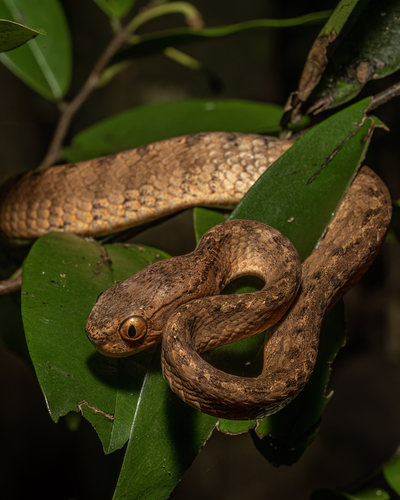
001 · Pareidae
Mengla Snail-eating Snake
The 2022 revision establishes this country within Pareas berdmorei, separated from the older broad Pareas carinatus concept.
Read the species account →James Hunt · CC-BY · https://www.inaturalist.org/photos/320100175
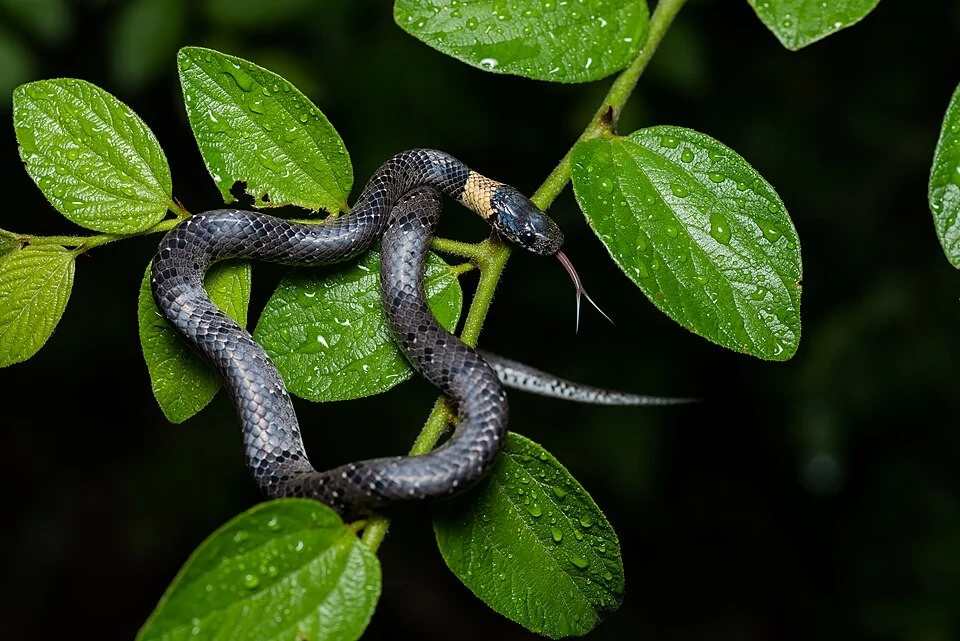
002 · Pareidae
Mountain Slug Snake
Listed in the checked distribution source. FMNH 267738; Stuart & Emmett (2006), 22. LSUHC 7463; Grismer et al. (2007), August 2005 survey.
Read the species account →Rushenb · CC BY-SA 4.0 · https://creativecommons.org/licenses/by-sa/4.0
Read further
Guide reviewed 11 October 2026. Source dates and geographic scope matter; landscape photographs do not establish species occurrence.
Surveys during 2023–2025 in Battambang and Stung Treng. Some groups and sites were sampled in only one season.
Cave biodiversity and quarrying, tourism, fire and extraction pressures. Cave discoveries are not automatically snake records.
Continue through Cambodia
Cambodia’s forest habitats range from open seasonal woodland to wet mountain rainforest. Tree cover, water and season need to be read together.
02Mountain habitats occur in both the Cardamom landscape and the northeastern highlands. Neither should be represented by one uniform band of forest.
03Seasonal inundation connects the Tonle Sap lake, flooded woodland, marshes and working landscapes. The changing waterline is part of the habitat.
04Koh Kong’s mangroves connect tidal forest, fishing livelihoods and the Gulf of Thailand. These are working coastal landscapes as well as wildlife habitat.
05The Gulf of Thailand chapter brings together island shores, seagrass and coral reefs. A coastal map needs these habitat differences as well as island names.