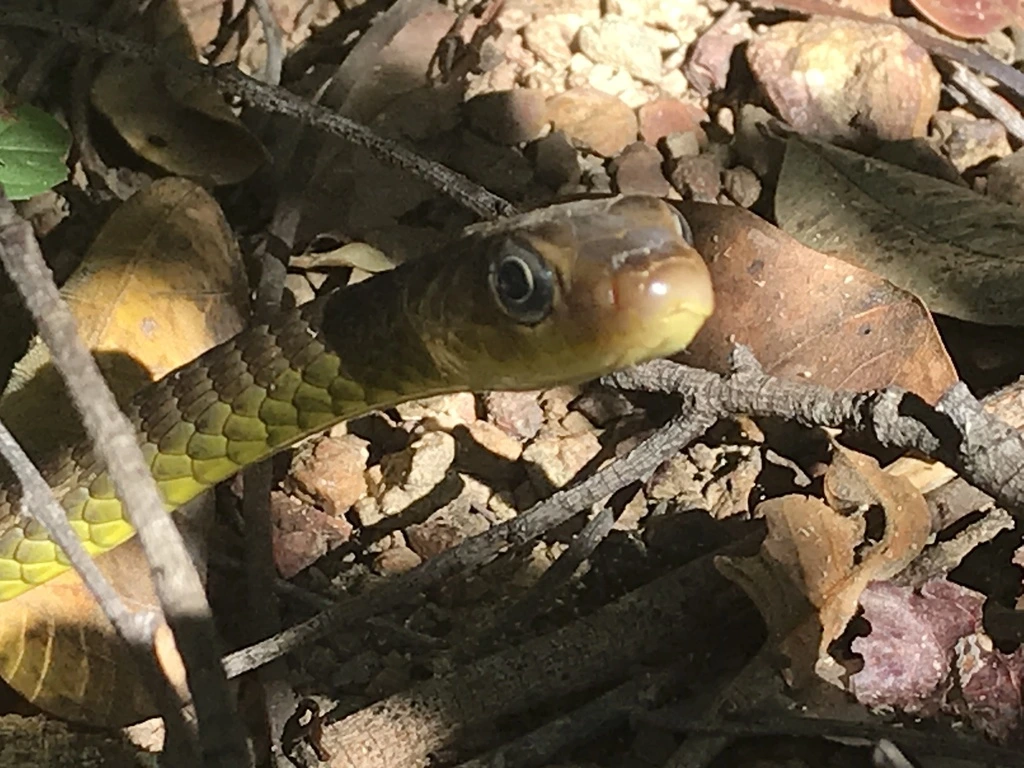
Colubridae · Species account

Linnaeus' Sipo

Chironius exoletus(LINNAEUS, 1758)

Venom unknownNot yet assessed

Evergreen lowland and foothill woodland and modified settings are documented. The paragraph’s flooded-plain and dry-forest examples explicitly concern Brazil and are not transferred to Ecuador. This is an authored habitat synthesis; it creates no additional occurrence or province assignment.

FamilyColubridae
ReproductionEgg-laying
Country chaptersCosta Rica · Panama · Argentina · Bolivia · Brazil · Colombia · Ecuador · Guyana · Paraguay · Peru · Suriname · Venezuela
Evidence updated2026-10-19
Explore its biology ↓

Venom & human effects

What is documented?

Venom unknownNot yet assessed

Venom status has not yet been established from the reviewed evidence for this account.

Missing evidence is not a non-venomous classification or a statement of low risk.

How to read these badges
Limited documented effects
The cited human cases reported limited effects. Sparse observations cannot exclude a severe reaction.
Medically significant effects
The cited human cases document clinically important injury or illness. This is not an upper limit on severity.
Potentially life-threatening
Species-specific clinical evidence documents life-threatening illness or deaths after bites. The account explains the affected patients and any uncertainty about the cause.
Clinical severity not established
Venom presence is documented, but the reviewed evidence does not establish a clinical tier. When human effects are reported under an unresolved historical species name, the badge and account say so explicitly.
Venom status uncertain
The reviewed sources are inconclusive or conflicting about venom presence. The account explains the uncertainty.
Venom status not assessed
The atlas lacks a reviewed venom-presence classification for this species.

These are editorial summaries of the linked evidence, not toxicity rankings or WHO antivenom-priority categories. Effects vary with the bite and patient. Non-venomous does not mean safe to handle.

The scientific identity

Taxonomy & recognition

From observations & literature

Natural history

Size & measurements

The compilation reports a maximum total length of 154.5 cm. This is a recorded maximum, not a typical adult size.

Exact-name entry in the 2024 SquamBase literature compilation, using an explicitly populated trait and its cited metadata. Records reflect the studied populations; they do not establish uniform behaviour across all seasons, ages or localities. Historical species concepts requiring review and imputed/uncertain metadata are excluded. Length is the compiler's largest accepted reported total length, not a new measurement, average, or current absolute biological limit. No allometric mass estimate is used.

Study & evidence

SquamBase 1.0, Supplementary Table S1, row 8440: Chironius exoletus; columns maximum total length (mm) and size metadata. Recorded value: 1545. Original source metadata: 1545 mm total length (Feldman et al. 2016), Cabral et al. 2022 (max Total length 1531 mm, Max SVL: 973 mm)

Study source 1 ↗

Study source 2 ↗

The northern Bahia study examined specimens with snout–vent lengths of 19–62 cm. This is the study sample range, excluding the tail; it is not a typical adult range or the species maximum.

Observations and specimen measurements from northern coastal Bahia, Brazil. Local sample ranges, observation times and individual reproductive records do not establish species-wide limits.

Study & evidence

Marques et al. (2016), Composition and natural history notes of the coastal snake assemblage from Northern Bahia, Brazil, ZooKeys 611:93–142; Results > Natural history notes of species > Chironius exoletus. Voucher lists: Appendix 1.

Study source 1 ↗

Study source 2 ↗

At Etá Farm in southeastern Brazil, the largest measured snout–vent length in the sample of 1 individual was 79 cm. This excludes the tail and is a local sample measurement, not the maximum adult size of the species.

Original observations from the Etá Farm region, Sete Barras, São Paulo. Counts and seasonal records describe this local sample.

Study & evidence

Fiorillo et al. (2020), ZooKeys 931:115–153, Natural history accounts, Chironius exoletus; original observations in the species account.

Study source 1 ↗

Diet & feeding

Recorded prey include amphibians and reptiles. This is a compiled list of food records, not an exclusive diet.

Exact-name row in the 2024 literature compilation. These are records from studied populations, not typical values, an exhaustive biological account, or evidence of occurrence in every region.

Study & evidence

SquamBase 1.0, Supplementary Table S1, row 8440: Chironius exoletus; columns Diet, Diet metadata.

Study source 1 ↗

Identified stomach contents in the local sample included frogs; Table 06 reports 3 individuals with identifiable prey.

Original observations from Caxiuanã and adjacent areas, Pará, Brazil, reported in Maschio’s 2008 doctoral thesis. Local records do not establish species-wide preferences, breeding seasons or typical clutch sizes.

Study & evidence

Maschio (2008), printed p. 70 / PDF page 70, Table 06, row Chironius exoletus; sample count in parentheses.

Study source 1 ↗

Study source 2 ↗

Activity & behaviour

Climbing activity

Arboreal activity is explicitly described in the treatment. This does not establish forest occupancy at every locality or imply that the species spends all its time above ground.

[1]

In northern Bahia, one individual was observed foraging on bromeliads at 08:33 in September.

Observations and specimen measurements from northern coastal Bahia, Brazil. Local sample ranges, observation times and individual reproductive records do not establish species-wide limits.

Study & evidence

Marques et al. (2016), Composition and natural history notes of the coastal snake assemblage from Northern Bahia, Brazil, ZooKeys 611:93–142; Results > Natural history notes of species > Chironius exoletus. Voucher lists: Appendix 1.

Study source 1 ↗

Study source 2 ↗

At Etá Farm in southeastern Brazil, when handled, the recorded individual opened its mouth, struck, and raised its head while forming an S-shaped bend in the front of its body.

Original observations from the Etá Farm region, Sete Barras, São Paulo. Counts and seasonal records describe this local sample.

Study & evidence

Fiorillo et al. (2020), ZooKeys 931:115–153, Natural history accounts, Chironius exoletus; original observations in the species account.

Study source 1 ↗

Snakes were recorded active both by day and at night in logged forest.

Original observations from Caxiuanã and adjacent areas, Pará, Brazil, reported in Maschio’s 2008 doctoral thesis. Local records do not establish species-wide preferences, breeding seasons or typical clutch sizes.

Study & evidence

Maschio (2008), printed pp. 98–99, species account Chironius exoletus; original observations, excluding separately attributed literature.

Study source 1 ↗

Study source 2 ↗

Reproduction

Published records compiled in SquamBase report 4–12 eggs per clutch. These are the smallest and largest reported broods in the compilation, not a typical brood size or a complete limit for the species.

Exact-name row in the 2024 literature compilation. These are records from studied populations, not typical values, an exhaustive biological account, or evidence of occurrence in every region.

Study & evidence

SquamBase 1.0, Supplementary Table S1, row 8440: Chironius exoletus; columns Mode of reproduction, Mode of reproduction metadata, smallest brood, largest brood, brood size metadata.

Study source 1 ↗

The 2021 Museo de La Plata checklist summarises eggs found in the oviducts of 28 females collected in January, February, April and July. The cited eggs measured 18.3–46.1 mm long and 6.3–20.1 mm wide; these month records are not a complete breeding season.

Attributed synthesis of published natural-history reports from Argentina and neighbouring countries. Sample-specific results, captive observations and uncertainties retain their stated limits; the earlier cited studies were not independently re-examined here.

Study & evidence

Williams, Vera & Di Pietro (2021), Revista del Museo de La Plata 6(1):26–124, species account Chironius exoletus, Tipo de reproducción section. Original works cited in that section: (1993).

Study source 1 ↗

A female collected in May contained developed ovarian follicles; the reported measurement was 7.38 mm. This was not a laid clutch.

Original observations from Caxiuanã and adjacent areas, Pará, Brazil, reported in Maschio’s 2008 doctoral thesis. Local records do not establish species-wide preferences, breeding seasons or typical clutch sizes.

Study & evidence

Maschio (2008), printed pp. 99, species account Chironius exoletus; original observations, excluding separately attributed literature.

Study source 1 ↗

Study source 2 ↗

Habitat & ecology

Habitat & microhabitat · Ecuador

Evergreen lowland and foothill woodland and modified settings are documented. The paragraph’s flooded-plain and dry-forest examples explicitly concern Brazil and are not transferred to Ecuador. This is an authored habitat synthesis; it creates no additional occurrence or province assignment.

[2]

Habitat & microhabitat · Brazil

Records at Sao Caitano and Mata do Pau Ferro are explicitly associated with forest remnants. Country-scoped literature evidence only; no regional occurrence is added.

[3][4]

Habitat & microhabitat · Argentina

The Argentine population is described as strictly associated with forest; evergreen and gallery forest are discussed. Country-scoped literature evidence only; no regional occurrence is added.

[5][6]

Habitat & microhabitat · Guyana

Table 1 records this species at forest sites (Kartabo, Konawaruk Camp). These are broad survey-landscape categories, not exclusive habitat preferences or precise microhabitat records. Mixed Dubulay Ranch records alone are not assigned to a category. No new country or regional occurrence is added.

[7][8][9]

Habitat & microhabitat · Bolivia

Aparicio et al. (2025), Table 2, report Chironius exoletus in the Sub-Andean Amazon Forests ecoregions of Madidi, Bolivia. These are broad ecological settings, not demonstrated microhabitat preferences. Only non-bold in/bo entries are used: modelled presence and outside-only records are excluded. The study counts a 1-km boundary buffer as inside; no new locality or countrywide distribution is inferred.

[10]

Habitat & microhabitat · Peru

The Manu National Park and buffer-zone checklist records floodplain forest, terra firme forest. This broad habitat record is scoped to Peru; it does not establish a new regional occurrence or continuous occupancy.

[11][12]

Habitat & microhabitat · Colombia

Collection habitat record: Bosque de tierra firme; Sabana. Country-scoped locality context; this is not a complete habitat range, and no regional occurrence or aquatic behaviour is inferred.

[13][14]

Habitat & microhabitat · Panama

The species was observed on the Cerro Azul survey transects beside streams and the Indio River in mature secondary tropical wet forest, during the February–July 2009 field study. This documents the sampled forest landscape, not an aquatic specialization. Country-scoped evidence; no new regional occurrence or continuous occupancy is inferred.

[15]

The northern Bahia study recorded specimens in coastal restinga vegetation and humid forest; the bromeliad-foraging observation was in restinga dry forest.

Observations and specimen measurements from northern coastal Bahia, Brazil. Local sample ranges, observation times and individual reproductive records do not establish species-wide limits.

Study & evidence

Marques et al. (2016), Composition and natural history notes of the coastal snake assemblage from Northern Bahia, Brazil, ZooKeys 611:93–142; Results > Natural history notes of species > Chironius exoletus. Voucher lists: Appendix 1.

Study source 1 ↗

Study source 2 ↗

At Etá Farm in southeastern Brazil, one individual was found on vegetation 0.5 m above the ground in a peach-palm plantation, during daylight in November.

Original observations from the Etá Farm region, Sete Barras, São Paulo. Counts and seasonal records describe this local sample.

Study & evidence

Fiorillo et al. (2020), ZooKeys 931:115–153, Natural history accounts, Chironius exoletus; original observations in the species account.

Study source 1 ↗

A reported observation is not necessarily the full ecological range of a species. Where reproduction is inferred in a source dataset, the account identifies that limitation.

One species · Across borders

Global distribution

Explore the recorded countries and islands. Select a highlighted area to see its distribution evidence.

Recorded distribution
Chironius exoletus — select a recorded country or island

Loading geographic boundaries…

ListedIntroducedUncertain

Click a highlighted country to zoom in and explore its records.

Shading identifies recorded countries or named islands, not continuous habitat coverage. Uncoloured areas do not establish absence.

Natural Earth · 1:50m · public domain; Gibraltar: geoBoundaries. Small islands may lack an outline.

Explore the distribution

Across borders

12 recorded countries & territories

Select a highlighted area to see its status, island records and sources. Each country and island links to the same shared species collection.

Use “Worldwide records” to include distant introduced and uncertain records in the map view.

Costa Rica · regional locality evidence

The checked taxonomic distribution account explicitly lists Costa Rica. Country-level evidence does not establish continuous occupancy or a complete national inventory.

Locality source 1 ↗
Panama · regional locality evidence

The checked taxonomic distribution account explicitly lists Panama. Country-level evidence does not establish continuous occupancy or a complete national inventory.

Locality source 1 ↗
Argentina · regional locality evidence

The checked taxonomic distribution account explicitly lists Argentina. Country-level evidence does not establish continuous occupancy or a complete national inventory.

Locality source 1 ↗
Bolivia · regional locality evidence

The checked taxonomic distribution account explicitly lists Bolivia. Country-level evidence does not establish continuous occupancy or a complete national inventory.

Locality source 1 ↗
Brazil · regional locality evidence

The checked taxonomic distribution account explicitly lists Brazil. Country-level evidence does not establish continuous occupancy or a complete national inventory.

Locality source 1 ↗
Colombia · regional locality evidence

The checked taxonomic distribution account explicitly lists Colombia. Country-level evidence does not establish continuous occupancy or a complete national inventory.

Locality source 1 ↗
Ecuador · regional locality evidence

The checked taxonomic distribution account explicitly lists Ecuador. Country-level evidence does not establish continuous occupancy or a complete national inventory.

Locality source 1 ↗
Guyana · regional locality evidence

The checked taxonomic distribution account explicitly lists Guyana. Country-level evidence does not establish continuous occupancy or a complete national inventory.

Locality source 1 ↗
Paraguay · regional locality evidence

The checked taxonomic distribution account explicitly lists Paraguay. Country-level evidence does not establish continuous occupancy or a complete national inventory.

Locality source 1 ↗
Peru · regional locality evidence

The checked taxonomic distribution account explicitly lists Peru. Country-level evidence does not establish continuous occupancy or a complete national inventory.

Locality source 1 ↗
Suriname · regional locality evidence

The checked taxonomic distribution account explicitly lists Suriname. Country-level evidence does not establish continuous occupancy or a complete national inventory.

Locality source 1 ↗
Venezuela · regional locality evidence

The checked taxonomic distribution account explicitly lists Venezuela. Country-level evidence does not establish continuous occupancy or a complete national inventory.

Locality source 1 ↗

Geographic scope of the source

Country entries supported by this Americas review: Costa Rica, Panama. These are reviewed atlas entries, not a complete global distribution. [1]

The text retains the source’s geographic qualifications. The map shows countries with atlas occurrence records; it is not a complete global range model. A type locality is a nomenclatural reference, not the only place the species occurs.

Status & its meaning

Conservation

No matching global assessment was verified for this account. This is an unresolved assessment link, not an IUCN “Not Evaluated” classification and not evidence that the species is secure.

Locality coverage in the atlas does not measure abundance, population trends or national legal protection.

Follow the evidence

Sources & further reading

The linked taxonomic treatment provides its original descriptions, revisions and bibliography. Observations from other countries are not relabelled as local field studies.