Size & measurements
Recorded size
SquamBase 1.0 records a literature maximum of 70 cm total length, including the tail. This is a compiled maximum, not a typical adult size or a measurement specific to this country.
[2]Viperidae · Species account
Causus maculatus(HALLOWELL, 1842)
VenomousClinical severity not establishedEniang, Ebin & Luiselli (2002), Table 1 p. 81 explicitly records this species in both forest and open savanna at Okwangwo Division during 1998–2001. This is species-specific local evidence, not an assignment of every park species to both habitats.
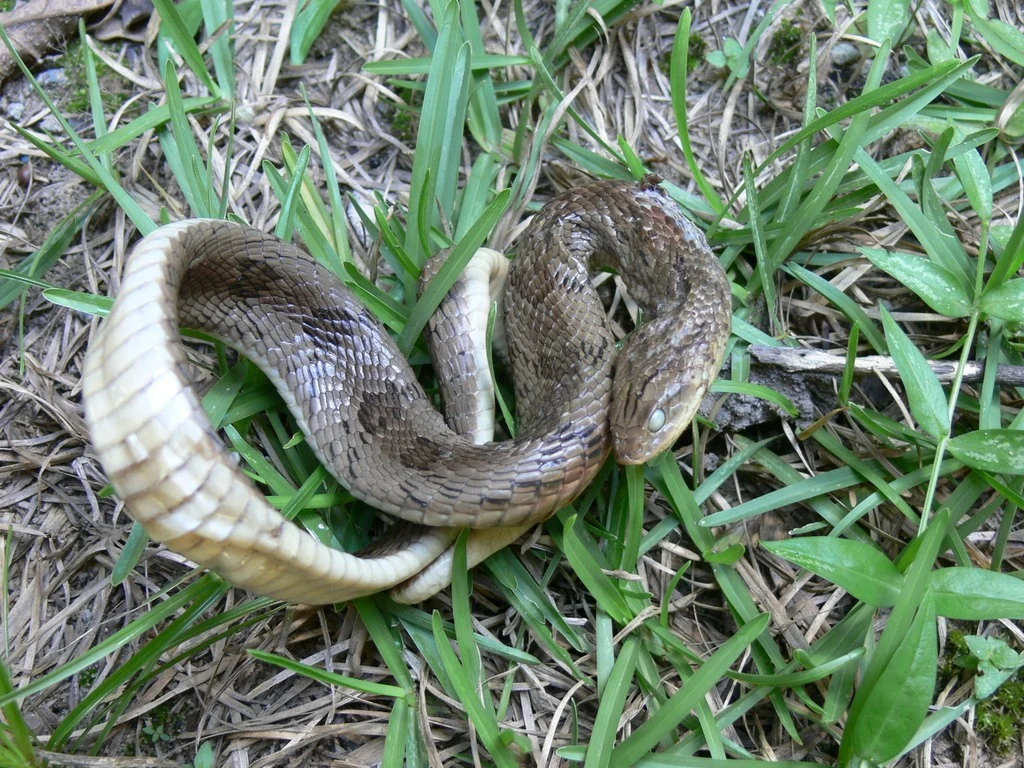
Venom & human effects
The species account explicitly identifies this snake as venomous. Human medical effects have not yet been assessed for this atlas.
Exact-species statement in the retained Reptile Database treatment; this review establishes venom presence only, not human bite severity.
Comment field: Venomous.
These are editorial summaries of the linked evidence, not toxicity rankings or WHO antivenom-priority categories. Effects vary with the bite and patient. Non-venomous does not mean safe to handle.
The scientific identity
Reliable identification uses the published combination of scale characters, proportions and other diagnostic evidence. Colour or a photograph alone may not separate closely related species.
From observations & literature
Size and ecological traits credited to SquamBase summarize published studies across the species’ range in its 2024 edition. They are complemented by the locality-specific observations below.
SquamBase 1.0 records a literature maximum of 70 cm total length, including the tail. This is a compiled maximum, not a typical adult size or a measurement specific to this country.
[2]Recorded prey include anurans. This is a compiled list of food records, not an exclusive diet.
Exact-name row in the 2024 literature compilation. These are records from studied populations, not typical values, an exhaustive biological account, or evidence of occurrence in every region.
SquamBase 1.0, Supplementary Table S1, row 8387: Causus maculatus; columns Diet, Diet metadata.
The 2024 compilation classifies activity as mainly during daylight and after dark. This range-wide summary does not exclude activity at other times.
[2]Ground-dwelling activity is reported in the studies compiled by SquamBase. This describes the species across its studied range, not a record from every country or region.
[2]Published records compiled in SquamBase report 6–20 eggs per clutch. These are the smallest and largest reported broods in the compilation, not a typical brood size or a complete limit for the species.
Exact-name row in the 2024 literature compilation. These are records from studied populations, not typical values, an exhaustive biological account, or evidence of occurrence in every region.
SquamBase 1.0, Supplementary Table S1, row 8387: Causus maculatus; columns Mode of reproduction, Mode of reproduction metadata, smallest brood, largest brood, brood size metadata.
A pregnant museum specimen (RBINS 20274) contained five eggs, aligned within the body between ventral scales 81 and 113.
One female from Saniamoridou, Guinea. This is a dissection-based egg count, not an observed laid clutch, a typical clutch size or a complete fecundity estimate for the species. It complements the older compiled 6–20 range with a separate primary record.
Pauwels et al. (2022), Bulletin of the Chicago Herpetological Society 57(8):117–123; Causus maculatus account, p.121, paragraph on pregnant female RBINS 20274.
Eniang, Ebin & Luiselli (2002), Table 1 p. 81 explicitly records this species in both forest and open savanna at Okwangwo Division during 1998–2001. This is species-specific local evidence, not an assignment of every park species to both habitats.
[3]Cabinda: observation GBIF 6130923290 (2026). The original iNaturalist entry was rechecked for research-grade identification, wild status and unrestricted coordinates; its reported uncertainty footprint lies within the mapped region. This is a community-reviewed observation, not a museum voucher. These are dated locality records, not evidence of occurrence throughout every part of a region or a complete present-day inventory.
[4][5]Atakora: observation GBIF 4892028579 (2024). The original iNaturalist entry was rechecked for research-grade identification, wild status and unrestricted coordinates; its reported uncertainty footprint lies within the mapped region. This is a community-reviewed observation, not a museum voucher. Atakora: observation GBIF 4516919789 (2024). The original iNaturalist entry was rechecked for research-grade identification, wild status and unrestricted coordinates; its reported uncertainty footprint lies within the mapped region. This is a community-reviewed observation, not a museum voucher. Littoral: museum voucher YPM YPM HERR 008074 (1968). The museum record's reported coordinate uncertainty footprint lies within the mapped region. These are dated locality records, not evidence of occurrence throughout every part of a region or a complete present-day inventory. Oueme: observation 9308098, 2017-12-26. Original records have agreeing research-grade identifications, wild status and open coordinates. Points and sampled reported uncertainty envelopes fall within the mapped region. These are dated community-reviewed observations, not museum vouchers or evidence of presence throughout the region. Exact coordinates are not republished.
[6][7][8][9][10][11][12]South: observation GBIF 6413174393 (2026). The original iNaturalist entry was rechecked for research-grade identification, wild status and unrestricted coordinates; its reported uncertainty footprint lies within the mapped region. This is a community-reviewed observation, not a museum voucher. Centre: observation GBIF 3059022619 (2021). The original iNaturalist entry was rechecked for research-grade identification, wild status and unrestricted coordinates; its reported uncertainty footprint lies within the mapped region. This is a community-reviewed observation, not a museum voucher. Centre: observation GBIF 3097393462 (2021). The original iNaturalist entry was rechecked for research-grade identification, wild status and unrestricted coordinates; its reported uncertainty footprint lies within the mapped region. This is a community-reviewed observation, not a museum voucher. South-West: museum voucher YPM YPM HERR 008555 (1973). The museum record's reported coordinate uncertainty footprint lies within the mapped region. South-West: museum voucher YPM YPM HERR 008556 (1973). The museum record's reported coordinate uncertainty footprint lies within the mapped region. These are dated locality records, not evidence of occurrence throughout every part of a region or a complete present-day inventory.
[13][14][15][16][17][18][19][20]Southeastern regions: observation GBIF 5188090050 (2025). The original iNaturalist entry was rechecked for research-grade identification, wild status and unrestricted coordinates; its reported uncertainty footprint lies within the mapped region. This is a community-reviewed observation, not a museum voucher. These are dated locality records, not evidence of occurrence throughout every part of a region or a complete present-day inventory. Southeastern regions: observation 103149353, 2021-12-16. Original records have agreeing research-grade identifications, wild status and open coordinates. Points and sampled reported uncertainty envelopes fall within the mapped region. These are dated community-reviewed observations, not museum vouchers or evidence of presence throughout the region. Exact coordinates are not republished.
[21][22][23][24]Uele & Ubangi: museum voucher RBINS 10299 (1946). The museum record's reported coordinate uncertainty footprint lies within the mapped region. Uele & Ubangi: museum voucher RBINS-Scientific Heritage 10299 (1946). The museum record's reported coordinate uncertainty footprint lies within the mapped region. Central forest basin: museum voucher UTEP UTEP:Herp:21947 (2013). The museum record's reported coordinate uncertainty footprint lies within the mapped region. Lower Congo & western provinces: museum voucher MCZ R-170352 (1980). The museum record's reported coordinate uncertainty footprint lies within the mapped region. Lower Congo & western provinces: museum voucher MCZ R-170353 (1980). The museum record's reported coordinate uncertainty footprint lies within the mapped region. These are dated locality records, not evidence of occurrence throughout every part of a region or a complete present-day inventory.
[25][26][27][28][29]Gambela: observation GBIF 1993709963 (1992). The original iNaturalist entry was rechecked for research-grade identification, wild status and unrestricted coordinates; its reported uncertainty footprint lies within the mapped region. This is a community-reviewed observation, not a museum voucher. Gambela: observation GBIF 3327921301 (1992). The original iNaturalist entry was rechecked for research-grade identification, wild status and unrestricted coordinates; its reported uncertainty footprint lies within the mapped region. This is a community-reviewed observation, not a museum voucher. These are dated locality records, not evidence of occurrence throughout every part of a region or a complete present-day inventory.
[30][31][32][33]Haut-Ogooué: observation GBIF 4936024193 (2022). The original iNaturalist entry was rechecked for research-grade identification, wild status and unrestricted coordinates; its reported uncertainty footprint lies within the mapped region. This is a community-reviewed observation, not a museum voucher. Ogooué-Ivindo: observation GBIF 3456029041 (2021). The original iNaturalist entry was rechecked for research-grade identification, wild status and unrestricted coordinates; its reported uncertainty footprint lies within the mapped region. This is a community-reviewed observation, not a museum voucher. These are dated locality records, not evidence of occurrence throughout every part of a region or a complete present-day inventory.
[34][35][36][37]Western regions: museum voucher CAS 97567 (1962). The museum record's reported coordinate uncertainty footprint lies within the mapped region. Western regions: observation GBIF 6186064162 (2026). The original iNaturalist entry was rechecked for research-grade identification, wild status and unrestricted coordinates; its reported uncertainty footprint lies within the mapped region. This is a community-reviewed observation, not a museum voucher. Eastern & coastal regions: museum voucher MVZ MVZ:Herp:176465 (1981). The museum record's reported coordinate uncertainty footprint lies within the mapped region. Eastern & coastal regions: museum voucher MVZ MVZ:Herp:176459 (1981). The museum record's reported coordinate uncertainty footprint lies within the mapped region. Central & Ashanti: observation GBIF 2813941063 (2012). The original iNaturalist entry was rechecked for research-grade identification, wild status and unrestricted coordinates; its reported uncertainty footprint lies within the mapped region. This is a community-reviewed observation, not a museum voucher. Northern regions: museum voucher CAS 154803 (1981). The museum record's reported coordinate uncertainty footprint lies within the mapped region. Northern regions: museum voucher MVZ MVZ:Herp:176467 (1981). The museum record's reported coordinate uncertainty footprint lies within the mapped region. These are dated locality records, not evidence of occurrence throughout every part of a region or a complete present-day inventory.
[38][39][40][41][42][43][44][45][46]Kindia: observation GBIF 5759568733 (2025). The original iNaturalist entry was rechecked for research-grade identification, wild status and unrestricted coordinates; its reported uncertainty footprint lies within the mapped region. This is a community-reviewed observation, not a museum voucher. Kindia: observation GBIF 5231811321 (2025). The original iNaturalist entry was rechecked for research-grade identification, wild status and unrestricted coordinates; its reported uncertainty footprint lies within the mapped region. This is a community-reviewed observation, not a museum voucher. Labe: observation GBIF 4127148400 (2023). The original iNaturalist entry was rechecked for research-grade identification, wild status and unrestricted coordinates; its reported uncertainty footprint lies within the mapped region. This is a community-reviewed observation, not a museum voucher. Faranah: observation GBIF 5077014149 (2013). The original iNaturalist entry was rechecked for research-grade identification, wild status and unrestricted coordinates; its reported uncertainty footprint lies within the mapped region. This is a community-reviewed observation, not a museum voucher. These are dated locality records, not evidence of occurrence throughout every part of a region or a complete present-day inventory.
[47][48][49][50][51][52][53][54]Western districts: observation GBIF 6498349948 (2026). The original iNaturalist entry was rechecked for research-grade identification, wild status and unrestricted coordinates; its reported uncertainty footprint lies within the mapped region. This is a community-reviewed observation, not a museum voucher. Western districts: observation GBIF 5890153815 (2025). The original iNaturalist entry was rechecked for research-grade identification, wild status and unrestricted coordinates; its reported uncertainty footprint lies within the mapped region. This is a community-reviewed observation, not a museum voucher. Eastern districts: observation GBIF 4910949894 (2024). The original iNaturalist entry was rechecked for research-grade identification, wild status and unrestricted coordinates; its reported uncertainty footprint lies within the mapped region. This is a community-reviewed observation, not a museum voucher. Eastern districts: observation GBIF 3923672093 (2022). The original iNaturalist entry was rechecked for research-grade identification, wild status and unrestricted coordinates; its reported uncertainty footprint lies within the mapped region. This is a community-reviewed observation, not a museum voucher. Abidjan & Lagunes: observation GBIF 4438955736 (2023). The original iNaturalist entry was rechecked for research-grade identification, wild status and unrestricted coordinates; its reported uncertainty footprint lies within the mapped region. This is a community-reviewed observation, not a museum voucher. These are dated locality records, not evidence of occurrence throughout every part of a region or a complete present-day inventory. Eastern districts: observation 19731137, 2019-01-19. Original records have agreeing research-grade identifications, wild status and open coordinates. Points and sampled reported uncertainty envelopes fall within the mapped region. These are dated community-reviewed observations, not museum vouchers or evidence of presence throughout the region. Exact coordinates are not republished.
[55][56][57][58][59][60][61][62][63][64][65][66]Tambacounda & Kédougou: iNaturalist observation 141529243, recorded 2022-11-09. The current original record has agreeing research-grade identification, wild status and unrestricted coordinates; its entire reported uncertainty footprint lies within this mapped region. This community observation is not a museum voucher. These are dated locality records, not evidence of occurrence throughout every part of a region or a complete present-day inventory.
[67][68]Western Area: iNaturalist observation 329994327, recorded 2025-11-13. The current original record has agreeing research-grade identification, wild status and unrestricted coordinates; its entire reported uncertainty footprint lies within this mapped region. This community observation is not a museum voucher. Western Area: iNaturalist observation 162508799, recorded 2023-05-09. The current original record has agreeing research-grade identification, wild status and unrestricted coordinates; its entire reported uncertainty footprint lies within this mapped region. This community observation is not a museum voucher. These are dated locality records, not evidence of occurrence throughout every part of a region or a complete present-day inventory.
[69][70][71][72]Central Equatoria: iNaturalist observation 401459897, recorded 2026-09-19. The current original record has agreeing research-grade identification, wild status and unrestricted coordinates; its entire reported uncertainty footprint lies within this mapped region. This community observation is not a museum voucher. Jonglei: iNaturalist observation 365105347, recorded 2026-05-25. The current original record has agreeing research-grade identification, wild status and unrestricted coordinates; its entire reported uncertainty footprint lies within this mapped region. This community observation is not a museum voucher. These are dated locality records, not evidence of occurrence throughout every part of a region or a complete present-day inventory.
[73][74][75][76]Barnett & Emms (2007), p.12, discuss three MacCarthy Island specimens reported by Andersson (1937) as C. rhombeatus and subsequently assigned to C. maculatus by Hughes (1977). Historical locality and revised identification; no recent sighting implied.
[77]Trape & Mané (2017), species account p. 121, locality coordinates in Tables 1–2 and specimen appendix: Bangaya; Djinagué; Doussoudiana; Koundian; Laminina; Mamoroubougou; Niamou; Npiébougou; Sébékourani; Titiéna; Zamoko; Kati; Saré Malé; Taga Diabozo; Dogo; Bamako; Naréna; Bougouni. Historical, explicitly named records mapped to the chapter’s 2021 boundary snapshot; they do not establish current occupancy or complete regional coverage.
[78]Trape & Mané (2015), account p. 48: examined specimens from Piliki. Table 1 locates the 2004–2008 survey sites; separately examined museum material may be older. Minute-scale coordinates are accepted only where their 2 km envelope fits one atlas region. These dated records do not establish current occupancy or complete regional coverage.
[79]Okwangwo Division, Cross River National Park, Nigeria, 1998–2001: Table 1 records this species with voucher catalogue number(s) 008, 010, 011, 021, 027. Cross River State belongs to the South South atlas group. The park division is the supported locality; the collection centre at Butatong is not assumed to be every capture site. These dated records do not prove current occupancy.
[80]A reported observation is not necessarily the full ecological range of a species. Where reproduction is inferred in a source dataset, the account identifies that limitation.
One species · Across borders
Explore the recorded countries and islands. Select a highlighted area to see its distribution evidence.
Loading geographic boundaries…
Click a highlighted country to zoom in and explore its records.
Shading identifies recorded countries or named islands, not continuous habitat coverage. Uncoloured areas do not establish absence.
Natural Earth · 1:50m · public domain; Gibraltar: geoBoundaries. Small islands may lack an outline.
Explore the distribution
Select a highlighted area to see its status, island records and sources. Each country and island links to the same shared species collection.
Use “Worldwide records” to include distant introduced and uncertain records in the map view.
The current taxonomic treatment explicitly lists this country. This is country-scale checklist evidence, not a claim of continuous occupancy or a complete regional inventory. Cabinda: observation GBIF 6130923290 (2026). The original iNaturalist entry was rechecked for research-grade identification, wild status and unrestricted coordinates; its reported uncertainty footprint lies within the mapped region. This is a community-reviewed observation, not a museum voucher. These are dated locality records, not evidence of occurrence throughout every part of a region or a complete present-day inventory.
Cabinda → · Cabinda
Locality source 1 ↗ Locality source 2 ↗ Locality source 3 ↗The current taxonomic treatment explicitly lists this country. This is country-scale checklist evidence, not a claim of continuous occupancy or a complete regional inventory. Atakora: observation GBIF 4892028579 (2024). The original iNaturalist entry was rechecked for research-grade identification, wild status and unrestricted coordinates; its reported uncertainty footprint lies within the mapped region. This is a community-reviewed observation, not a museum voucher. Atakora: observation GBIF 4516919789 (2024). The original iNaturalist entry was rechecked for research-grade identification, wild status and unrestricted coordinates; its reported uncertainty footprint lies within the mapped region. This is a community-reviewed observation, not a museum voucher. Littoral: museum voucher YPM YPM HERR 008074 (1968). The museum record's reported coordinate uncertainty footprint lies within the mapped region. These are dated locality records, not evidence of occurrence throughout every part of a region or a complete present-day inventory. Oueme: observation 9308098, 2017-12-26. Original records have agreeing research-grade identifications, wild status and open coordinates. Points and sampled reported uncertainty envelopes fall within the mapped region. These are dated community-reviewed observations, not museum vouchers or evidence of presence throughout the region. Exact coordinates are not republished.
Atakora → · Atakora
Littoral → · Littoral
Oueme → · Oueme
Locality source 1 ↗ Locality source 2 ↗ Locality source 3 ↗ Locality source 4 ↗ Locality source 5 ↗ Locality source 6 ↗ Locality source 7 ↗ Locality source 8 ↗The current taxonomic treatment explicitly lists this country. This is country-scale checklist evidence, not a claim of continuous occupancy or a complete regional inventory.
Locality source 1 ↗The current taxonomic treatment explicitly lists this country. This is country-scale checklist evidence, not a claim of continuous occupancy or a complete regional inventory. South: observation GBIF 6413174393 (2026). The original iNaturalist entry was rechecked for research-grade identification, wild status and unrestricted coordinates; its reported uncertainty footprint lies within the mapped region. This is a community-reviewed observation, not a museum voucher. Centre: observation GBIF 3059022619 (2021). The original iNaturalist entry was rechecked for research-grade identification, wild status and unrestricted coordinates; its reported uncertainty footprint lies within the mapped region. This is a community-reviewed observation, not a museum voucher. Centre: observation GBIF 3097393462 (2021). The original iNaturalist entry was rechecked for research-grade identification, wild status and unrestricted coordinates; its reported uncertainty footprint lies within the mapped region. This is a community-reviewed observation, not a museum voucher. South-West: museum voucher YPM YPM HERR 008555 (1973). The museum record's reported coordinate uncertainty footprint lies within the mapped region. South-West: museum voucher YPM YPM HERR 008556 (1973). The museum record's reported coordinate uncertainty footprint lies within the mapped region. These are dated locality records, not evidence of occurrence throughout every part of a region or a complete present-day inventory.
South → · South
Centre → · Centre
South-West → · South-West
Locality source 1 ↗ Locality source 2 ↗ Locality source 3 ↗ Locality source 4 ↗ Locality source 5 ↗ Locality source 6 ↗ Locality source 7 ↗ Locality source 8 ↗ Locality source 9 ↗The current taxonomic treatment explicitly lists this country. This is country-scale checklist evidence, not a claim of continuous occupancy or a complete regional inventory. Southeastern regions: observation GBIF 5188090050 (2025). The original iNaturalist entry was rechecked for research-grade identification, wild status and unrestricted coordinates; its reported uncertainty footprint lies within the mapped region. This is a community-reviewed observation, not a museum voucher. These are dated locality records, not evidence of occurrence throughout every part of a region or a complete present-day inventory. Southeastern regions: observation 103149353, 2021-12-16. Original records have agreeing research-grade identifications, wild status and open coordinates. Points and sampled reported uncertainty envelopes fall within the mapped region. These are dated community-reviewed observations, not museum vouchers or evidence of presence throughout the region. Exact coordinates are not republished.
Southeastern regions → · Southeastern regions
Locality source 1 ↗ Locality source 2 ↗ Locality source 3 ↗ Locality source 4 ↗ Locality source 5 ↗The current taxonomic treatment explicitly lists this country. This is country-scale checklist evidence, not a claim of continuous occupancy or a complete regional inventory.
Locality source 1 ↗The current taxonomic treatment explicitly lists this country. This is country-scale checklist evidence, not a claim of continuous occupancy or a complete regional inventory. Uele & Ubangi: museum voucher RBINS 10299 (1946). The museum record's reported coordinate uncertainty footprint lies within the mapped region. Uele & Ubangi: museum voucher RBINS-Scientific Heritage 10299 (1946). The museum record's reported coordinate uncertainty footprint lies within the mapped region. Central forest basin: museum voucher UTEP UTEP:Herp:21947 (2013). The museum record's reported coordinate uncertainty footprint lies within the mapped region. Lower Congo & western provinces: museum voucher MCZ R-170352 (1980). The museum record's reported coordinate uncertainty footprint lies within the mapped region. Lower Congo & western provinces: museum voucher MCZ R-170353 (1980). The museum record's reported coordinate uncertainty footprint lies within the mapped region. These are dated locality records, not evidence of occurrence throughout every part of a region or a complete present-day inventory.
Uele & Ubangi → · Uele & Ubangi
Central forest basin → · Central forest basin
Lower Congo & western provinces → · Lower Congo & western provinces
Locality source 1 ↗ Locality source 2 ↗ Locality source 3 ↗ Locality source 4 ↗ Locality source 5 ↗ Locality source 6 ↗The current taxonomic treatment explicitly lists this country. This is country-scale checklist evidence, not a claim of continuous occupancy or a complete regional inventory.
Locality source 1 ↗The current taxonomic treatment explicitly lists this country. This is country-scale checklist evidence, not a claim of continuous occupancy or a complete regional inventory. Gambela: observation GBIF 1993709963 (1992). The original iNaturalist entry was rechecked for research-grade identification, wild status and unrestricted coordinates; its reported uncertainty footprint lies within the mapped region. This is a community-reviewed observation, not a museum voucher. Gambela: observation GBIF 3327921301 (1992). The original iNaturalist entry was rechecked for research-grade identification, wild status and unrestricted coordinates; its reported uncertainty footprint lies within the mapped region. This is a community-reviewed observation, not a museum voucher. These are dated locality records, not evidence of occurrence throughout every part of a region or a complete present-day inventory.
Gambela → · Gambela
Locality source 1 ↗ Locality source 2 ↗ Locality source 3 ↗ Locality source 4 ↗ Locality source 5 ↗The current taxonomic treatment explicitly lists this country. This is country-scale checklist evidence, not a claim of continuous occupancy or a complete regional inventory. Haut-Ogooué: observation GBIF 4936024193 (2022). The original iNaturalist entry was rechecked for research-grade identification, wild status and unrestricted coordinates; its reported uncertainty footprint lies within the mapped region. This is a community-reviewed observation, not a museum voucher. Ogooué-Ivindo: observation GBIF 3456029041 (2021). The original iNaturalist entry was rechecked for research-grade identification, wild status and unrestricted coordinates; its reported uncertainty footprint lies within the mapped region. This is a community-reviewed observation, not a museum voucher. These are dated locality records, not evidence of occurrence throughout every part of a region or a complete present-day inventory.
Haut-Ogooué → · Haut-Ogooué
Ogooué-Ivindo → · Ogooué-Ivindo
Locality source 1 ↗ Locality source 2 ↗ Locality source 3 ↗ Locality source 4 ↗ Locality source 5 ↗The current taxonomic treatment explicitly lists this country. This is country-scale checklist evidence, not a claim of continuous occupancy or a complete regional inventory. Barnett & Emms (2007), p.12, discuss three MacCarthy Island specimens reported by Andersson (1937) as C. rhombeatus and subsequently assigned to C. maculatus by Hughes (1977). Historical locality and revised identification; no recent sighting implied.
Janjanbureh → · MacCarthy Island
Locality source 1 ↗ Locality source 2 ↗The current taxonomic treatment explicitly lists this country. This is country-scale checklist evidence, not a claim of continuous occupancy or a complete regional inventory. Western regions: museum voucher CAS 97567 (1962). The museum record's reported coordinate uncertainty footprint lies within the mapped region. Western regions: observation GBIF 6186064162 (2026). The original iNaturalist entry was rechecked for research-grade identification, wild status and unrestricted coordinates; its reported uncertainty footprint lies within the mapped region. This is a community-reviewed observation, not a museum voucher. Eastern & coastal regions: museum voucher MVZ MVZ:Herp:176465 (1981). The museum record's reported coordinate uncertainty footprint lies within the mapped region. Eastern & coastal regions: museum voucher MVZ MVZ:Herp:176459 (1981). The museum record's reported coordinate uncertainty footprint lies within the mapped region. Central & Ashanti: observation GBIF 2813941063 (2012). The original iNaturalist entry was rechecked for research-grade identification, wild status and unrestricted coordinates; its reported uncertainty footprint lies within the mapped region. This is a community-reviewed observation, not a museum voucher. Northern regions: museum voucher CAS 154803 (1981). The museum record's reported coordinate uncertainty footprint lies within the mapped region. Northern regions: museum voucher MVZ MVZ:Herp:176467 (1981). The museum record's reported coordinate uncertainty footprint lies within the mapped region. These are dated locality records, not evidence of occurrence throughout every part of a region or a complete present-day inventory.
Western regions → · Western regions
Eastern & coastal regions → · Eastern & coastal regions
Central & Ashanti → · Central & Ashanti
Northern regions → · Northern regions
Locality source 1 ↗ Locality source 2 ↗ Locality source 3 ↗ Locality source 4 ↗ Locality source 5 ↗ Locality source 6 ↗ Locality source 7 ↗ Locality source 8 ↗ Locality source 9 ↗ Locality source 10 ↗The current taxonomic treatment explicitly lists this country. This is country-scale checklist evidence, not a claim of continuous occupancy or a complete regional inventory. Kindia: observation GBIF 5759568733 (2025). The original iNaturalist entry was rechecked for research-grade identification, wild status and unrestricted coordinates; its reported uncertainty footprint lies within the mapped region. This is a community-reviewed observation, not a museum voucher. Kindia: observation GBIF 5231811321 (2025). The original iNaturalist entry was rechecked for research-grade identification, wild status and unrestricted coordinates; its reported uncertainty footprint lies within the mapped region. This is a community-reviewed observation, not a museum voucher. Labe: observation GBIF 4127148400 (2023). The original iNaturalist entry was rechecked for research-grade identification, wild status and unrestricted coordinates; its reported uncertainty footprint lies within the mapped region. This is a community-reviewed observation, not a museum voucher. Faranah: observation GBIF 5077014149 (2013). The original iNaturalist entry was rechecked for research-grade identification, wild status and unrestricted coordinates; its reported uncertainty footprint lies within the mapped region. This is a community-reviewed observation, not a museum voucher. These are dated locality records, not evidence of occurrence throughout every part of a region or a complete present-day inventory.
Kindia → · Kindia
Labe → · Labe
Faranah → · Faranah
Locality source 1 ↗ Locality source 2 ↗ Locality source 3 ↗ Locality source 4 ↗ Locality source 5 ↗ Locality source 6 ↗ Locality source 7 ↗ Locality source 8 ↗ Locality source 9 ↗The current taxonomic treatment explicitly lists this country. This is country-scale checklist evidence, not a claim of continuous occupancy or a complete regional inventory. Western districts: observation GBIF 6498349948 (2026). The original iNaturalist entry was rechecked for research-grade identification, wild status and unrestricted coordinates; its reported uncertainty footprint lies within the mapped region. This is a community-reviewed observation, not a museum voucher. Western districts: observation GBIF 5890153815 (2025). The original iNaturalist entry was rechecked for research-grade identification, wild status and unrestricted coordinates; its reported uncertainty footprint lies within the mapped region. This is a community-reviewed observation, not a museum voucher. Eastern districts: observation GBIF 4910949894 (2024). The original iNaturalist entry was rechecked for research-grade identification, wild status and unrestricted coordinates; its reported uncertainty footprint lies within the mapped region. This is a community-reviewed observation, not a museum voucher. Eastern districts: observation GBIF 3923672093 (2022). The original iNaturalist entry was rechecked for research-grade identification, wild status and unrestricted coordinates; its reported uncertainty footprint lies within the mapped region. This is a community-reviewed observation, not a museum voucher. Abidjan & Lagunes: observation GBIF 4438955736 (2023). The original iNaturalist entry was rechecked for research-grade identification, wild status and unrestricted coordinates; its reported uncertainty footprint lies within the mapped region. This is a community-reviewed observation, not a museum voucher. These are dated locality records, not evidence of occurrence throughout every part of a region or a complete present-day inventory. Eastern districts: observation 19731137, 2019-01-19. Original records have agreeing research-grade identifications, wild status and open coordinates. Points and sampled reported uncertainty envelopes fall within the mapped region. These are dated community-reviewed observations, not museum vouchers or evidence of presence throughout the region. Exact coordinates are not republished.
Western districts → · Western districts
Eastern districts → · Eastern districts
Abidjan & Lagunes → · Abidjan & Lagunes
Locality source 1 ↗ Locality source 2 ↗ Locality source 3 ↗ Locality source 4 ↗ Locality source 5 ↗ Locality source 6 ↗ Locality source 7 ↗ Locality source 8 ↗ Locality source 9 ↗ Locality source 10 ↗ Locality source 11 ↗ Locality source 12 ↗ Locality source 13 ↗The current taxonomic treatment explicitly lists this country. This is country-scale checklist evidence, not a claim of continuous occupancy or a complete regional inventory. Trape & Mané (2017), species account p. 121, locality coordinates in Tables 1–2 and specimen appendix: Bangaya; Djinagué; Doussoudiana; Koundian; Laminina; Mamoroubougou; Niamou; Npiébougou; Sébékourani; Titiéna; Zamoko; Kati; Saré Malé; Taga Diabozo; Dogo; Bamako; Naréna; Bougouni. Historical, explicitly named records mapped to the chapter’s 2021 boundary snapshot; they do not establish current occupancy or complete regional coverage.
Kayes → · Bangaya, Djinagué, Koundian
Sikasso → · Doussoudiana, Laminina, Mamoroubougou, Titiéna, Bougouni
Koulikoro → · Niamou, Npiébougou, Sébékourani, Zamoko, Kati, Naréna
Mopti → · Saré Malé, Taga Diabozo, Dogo
Bamako → · Bamako
Locality source 1 ↗ Locality source 2 ↗The current taxonomic treatment explicitly lists this country. This is country-scale checklist evidence, not a claim of continuous occupancy or a complete regional inventory.
Locality source 1 ↗The current taxonomic treatment explicitly lists this country. This is country-scale checklist evidence, not a claim of continuous occupancy or a complete regional inventory. Trape & Mané (2015), account p. 48: examined specimens from Piliki. Table 1 locates the 2004–2008 survey sites; separately examined museum material may be older. Minute-scale coordinates are accepted only where their 2 km envelope fits one atlas region. These dated records do not establish current occupancy or complete regional coverage.
Tillaberi → · Piliki
Locality source 1 ↗ Locality source 2 ↗The current taxonomic treatment explicitly lists this country. This is country-scale checklist evidence, not a claim of continuous occupancy or a complete regional inventory. Okwangwo Division, Cross River National Park, Nigeria, 1998–2001: Table 1 records this species with voucher catalogue number(s) 008, 010, 011, 021, 027. Cross River State belongs to the South South atlas group. The park division is the supported locality; the collection centre at Butatong is not assumed to be every capture site. These dated records do not prove current occupancy.
South South states → · Okwangwo Division, Cross River National Park
Locality source 1 ↗ Locality source 2 ↗The current taxonomic treatment explicitly lists this country. This is country-scale checklist evidence, not a claim of continuous occupancy or a complete regional inventory. Tambacounda & Kédougou: iNaturalist observation 141529243, recorded 2022-11-09. The current original record has agreeing research-grade identification, wild status and unrestricted coordinates; its entire reported uncertainty footprint lies within this mapped region. This community observation is not a museum voucher. These are dated locality records, not evidence of occurrence throughout every part of a region or a complete present-day inventory.
Tambacounda & Kédougou → · Tambacounda & Kédougou
Locality source 1 ↗ Locality source 2 ↗ Locality source 3 ↗The current taxonomic treatment explicitly lists this country. This is country-scale checklist evidence, not a claim of continuous occupancy or a complete regional inventory. Western Area: iNaturalist observation 329994327, recorded 2025-11-13. The current original record has agreeing research-grade identification, wild status and unrestricted coordinates; its entire reported uncertainty footprint lies within this mapped region. This community observation is not a museum voucher. Western Area: iNaturalist observation 162508799, recorded 2023-05-09. The current original record has agreeing research-grade identification, wild status and unrestricted coordinates; its entire reported uncertainty footprint lies within this mapped region. This community observation is not a museum voucher. These are dated locality records, not evidence of occurrence throughout every part of a region or a complete present-day inventory.
Western Area → · Western Area
Locality source 1 ↗ Locality source 2 ↗ Locality source 3 ↗ Locality source 4 ↗ Locality source 5 ↗The current taxonomic treatment explicitly lists this country. This is country-scale checklist evidence, not a claim of continuous occupancy or a complete regional inventory. Central Equatoria: iNaturalist observation 401459897, recorded 2026-09-19. The current original record has agreeing research-grade identification, wild status and unrestricted coordinates; its entire reported uncertainty footprint lies within this mapped region. This community observation is not a museum voucher. Jonglei: iNaturalist observation 365105347, recorded 2026-05-25. The current original record has agreeing research-grade identification, wild status and unrestricted coordinates; its entire reported uncertainty footprint lies within this mapped region. This community observation is not a museum voucher. These are dated locality records, not evidence of occurrence throughout every part of a region or a complete present-day inventory.
Central Equatoria → · Central Equatoria
Jonglei → · Jonglei
Locality source 1 ↗ Locality source 2 ↗ Locality source 3 ↗ Locality source 4 ↗ Locality source 5 ↗The current taxonomic treatment explicitly lists this country. This is country-scale checklist evidence, not a claim of continuous occupancy or a complete regional inventory.
Locality source 1 ↗The current taxonomic treatment explicitly lists this country. This is country-scale checklist evidence, not a claim of continuous occupancy or a complete regional inventory.
Locality source 1 ↗The current taxonomic treatment explicitly lists this country. This is country-scale checklist evidence, not a claim of continuous occupancy or a complete regional inventory.
Locality source 1 ↗Country entries documented in this Africa review: Angola, Benin, Burkina Faso, Cameroon, Central African Republic, Chad, Democratic Republic of the Congo, Equatorial Guinea, Ethiopia, Gabon, Gambia, Ghana, Guinea, Ivory Coast, Mali, Mauritania, Niger, Nigeria, Senegal, Sierra Leone, South Sudan, Sudan, Togo, Uganda. Consult individual occurrence records for qualifications. These entries are not a complete global range polygon. [1]
The text retains the source’s geographic qualifications. The map shows countries with atlas occurrence records; it is not a complete global range model. A type locality is a nomenclatural reference, not the only place the species occurs.
Status & its meaning
No matching global assessment was verified for this account. This is an unresolved assessment link, not an IUCN “Not Evaluated” classification and not evidence that the species is secure.
Locality coverage in the atlas does not measure abundance, population trends or national legal protection.
Follow the evidence
Latest evidence added 2026-10-13. Taxonomic and distribution treatments may change.
The linked taxonomic treatment provides its original descriptions, revisions and bibliography. Observations from other countries are not relabelled as local field studies.