
Size & measurements
No sourced size & measurements summary has yet been added to this account.
Elapidae · Species account
Bungarus fasciatus(SCHNEIDER, 1801)
VenomousPotentially life-threateningHong Kong observations associate this nocturnal snake with vegetated lowlands near water, including marshes, cultivated ground and scrub. These are regional field observations, not a complete habitat inventory for Laos or Vietnam.
Venom & human effects
In a Thai clinical series, five of nine patients attributed to banded-krait bites required intubation and assisted ventilation. Three had no clinical envenoming; none of these nine patients died.
Nine Thai cases within a 78-patient krait study. Snake identification used specimens, photographs or patient descriptions, and sometimes clinical/ecological inference; individual certainty was not reported. Findings concern Thai populations, not every lineage in the B. fasciatus complex.
Tongpoo et al.2018, Methods, Results and Table3 (banded krait column).
These are editorial summaries of the linked evidence, not toxicity rankings or WHO antivenom-priority categories. Effects vary with the bite and patient. Non-venomous does not mean safe to handle.
The scientific identity
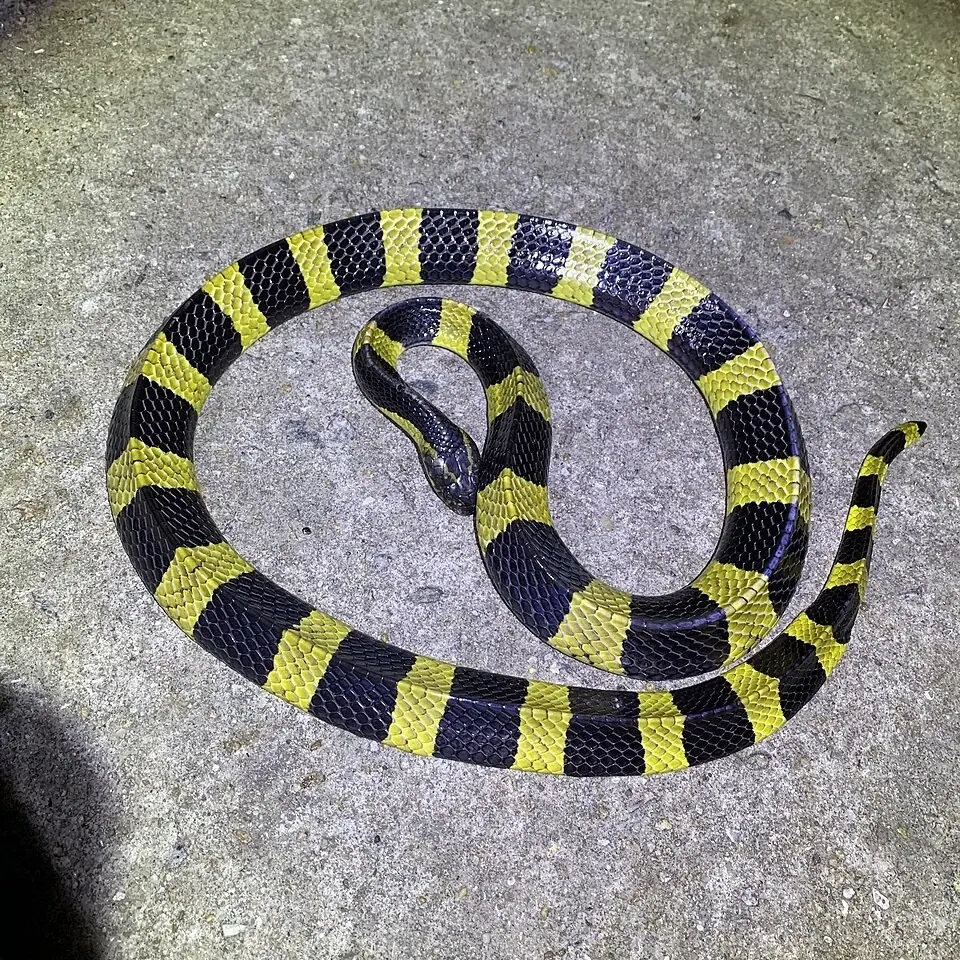
Broad yellow and black bands encircle a body with a pronounced vertebral ridge and triangular cross-section. The Hong Kong account gives a usual length of 105–135 cm, with larger individuals recorded. [3]
Specimen measurements describe the cited material, rather than a population maximum. Snout-to-vent length excludes the tail; adult size ranges are identified separately.
Reliable identification uses the published combination of scale characters, proportions and other diagnostic evidence. Colour or a photograph alone may not separate closely related species.
Taxonomic treatment & original-description references ↗
Boa fasciata · Bungarus annularis · Aspidoclonion annulare · Bungarus fasiatus
Names trace the literature, including older combinations and historical usages. Their appearance here does not mean they are all currently accepted synonyms.
From observations & literature
Size and ecological traits credited to SquamBase summarize published studies across the species’ range in its 2024 edition. They are complemented by the locality-specific observations below.
No sourced size & measurements summary has yet been added to this account.
Activity is predominantly after dark. This is the range-wide classification in the 2024 compilation; it does not exclude occasional activity at other times.
[2]Hong Kong observations associate this nocturnal snake with vegetated lowlands near water, including marshes, cultivated ground and scrub. These are regional field observations, not a complete habitat inventory for Laos or Vietnam.
[3]The 2024 compilation classifies activity as mainly after dark. This range-wide summary does not exclude activity at other times.
[2]Ground-dwelling activity is reported in the studies compiled by SquamBase. This describes the species across its studied range, not a record from every island.
[2]The compilation records 3–19 eggs per clutch. These published records need not represent the full variation between populations, and are not a separate estimate for Laos or Vietnam.
[2]No sourced habitat & ecology summary has yet been added to this account.
The taxonomic treatment explicitly identifies this species as venomous. That designation does not, by itself, establish the severity of every bite.
[1]Myanmar is explicitly listed in the checked individual taxonomic treatment.
[4]India is explicitly listed in the checked individual taxonomic treatment. The national ZSI checklist independently lists Bungarus fasciatus. Regional evidence: Haryana, Uttar Pradesh; Assam, Arunachal Pradesh, Meghalaya, Mizoram, Tripura; Bihar, Odisha, West Bengal, Orissa; Madhya Pradesh; Maharashtra; Andhra Pradesh, Telangana. Named records do not imply continuous occurrence throughout a region.
[4][5]Confirmed occurrence in the 2025 Bangladesh review, Table 1. The paper explicitly relates its regional labels to the named administrative divisions. Regional evidence: Chattogram; Sylhet; Dhaka; Mymensingh; Barishal; Rangpur; Rajshahi; Khulna. Named records do not imply continuous occurrence throughout a region.
[4][6]Bhutan is explicitly listed in the checked individual taxonomic treatment.
[4]Nepal is explicitly listed in the checked individual taxonomic treatment.
[4]China is explicitly recorded in the checked individual species treatment. The accepted identity is also represented in the 2025 checklist; regional inclusion here is based on explicit locality evidence, not the checklist’s broader geographical scope. Named regional records: Fujian; Hong Kong. These localities do not imply continuous occupation of the entire region.
[7][8]The Thai government Red Data account (2005, p. 151–152) documents these named Thai localities. These are historical locality records, not a complete present-day range survey.
[9]The 2024 provincial checklist explicitly lists this species in Thanh Hoa. The 2026 provincial checklist explicitly lists this species in Ha Tinh. The 2020 provincial checklist explicitly lists this species in Son La. This establishes a provincial record; it does not imply occurrence in every protected area or across the whole editorial region.
[10][11][12]The 2023 annotated review explicitly lists these Singapore sites. They are selected named-locality evidence, not a full range polygon or a guarantee of current presence at every point. Sites marked as historical in that review are omitted from this mapped selection.
[13]P. 106: historical vouchers BM56.1995, BM36.2001, BM117.1985, BM178.1985, BM19.1994, BM200.1992 and BM88.2006.
[14][15]Egg-laying (oviparous). [1]
A reported observation is not necessarily the full ecological range of a species. Where reproduction is inferred in a source dataset, the account identifies that limitation.
One species · Across borders
Explore the recorded countries and islands. Select a highlighted area to see its distribution evidence.
Loading geographic boundaries…
Click a highlighted country to zoom in and explore its records.
Shading identifies recorded countries or named islands, not continuous habitat coverage. Uncoloured areas do not establish absence.
Natural Earth · 1:50m · public domain; Gibraltar: geoBoundaries. Small islands may lack an outline.
Explore the distribution
Select a highlighted area to see its status, island records and sources. Each country and island links to the same shared species collection.
Use “Worldwide records” to include distant introduced and uncertain records in the map view.
Confirmed occurrence in the 2025 Bangladesh review, Table 1. The paper explicitly relates its regional labels to the named administrative divisions. Regional evidence: Chattogram; Sylhet; Dhaka; Mymensingh; Barishal; Rangpur; Rajshahi; Khulna. Named records do not imply continuous occurrence throughout a region.
Chattogram → · Chattogram
Sylhet → · Sylhet
Dhaka → · Dhaka
Mymensingh → · Mymensingh
Barishal → · Barishal
Rangpur → · Rangpur
Rajshahi → · Rajshahi
Khulna → · Khulna
Locality source 1 ↗ Locality source 2 ↗Bhutan is explicitly listed in the checked individual taxonomic treatment.
Locality source 1 ↗The national checklist of Ahmad Sah et al. (published July 2026) includes this taxon for Brunei. The checklist combines historical literature with observations from 2021–2025; inclusion is not a claim of a recent sighting. P. 106: historical vouchers BM56.1995, BM36.2001, BM117.1985, BM178.1985, BM19.1994, BM200.1992 and BM88.2006.
Belait · forests, peatlands & rivers → · Kampung Melilas
Brunei-Muara · bay & lowland forests → · Jalan Selayun, Kampung Anggrek Desa, Kampung Tamoi Tengah
Temburong · rainforest headwaters → · Jalan Labu
Tutong · lakes & coastal forests → · Near Tasek Merimbun
Locality source 1 ↗ Locality source 2 ↗ Locality source 3 ↗ Locality source 4 ↗The source reports a possibly introduced Micronesian record without resolving a country or island; retained as uncertain, not an established native range.
Locality source 1 ↗China is explicitly recorded in the checked individual species treatment. The accepted identity is also represented in the 2025 checklist; regional inclusion here is based on explicit locality evidence, not the checklist’s broader geographical scope. Named regional records: Fujian; Hong Kong. These localities do not imply continuous occupation of the entire region.
Eastern hills, rivers & coast → · Fujian
Hong Kong → · Hong Kong
Locality source 1 ↗ Locality source 2 ↗India is explicitly listed in the checked individual taxonomic treatment. The national ZSI checklist independently lists Bungarus fasciatus. Regional evidence: Haryana, Uttar Pradesh; Assam, Arunachal Pradesh, Meghalaya, Mizoram, Tripura; Bihar, Odisha, West Bengal, Orissa; Madhya Pradesh; Maharashtra; Andhra Pradesh, Telangana. Named records do not imply continuous occurrence throughout a region.
Northern plains & Himalaya → · Haryana, Uttar Pradesh
Northeastern hills & Brahmaputra → · Assam, Arunachal Pradesh, Meghalaya, Mizoram, Tripura
Eastern plains & plateau → · Bihar, Odisha, West Bengal, Orissa
Central highlands → · Madhya Pradesh
Western drylands & coast → · Maharashtra
Southern peninsula → · Andhra Pradesh, Telangana
Locality source 1 ↗ Locality source 2 ↗Laos: national occurrence; no finer locality is assigned in this atlas.
Locality source 1 ↗Nepal is explicitly listed in the checked individual taxonomic treatment.
Locality source 1 ↗Figueroa, Low & Lim (2023), the annotated national review, accepts this species for Singapore. The 2023 annotated review explicitly lists these Singapore sites. They are selected named-locality evidence, not a full range polygon or a guarantee of current presence at every point. Sites marked as historical in that review are omitted from this mapped selection.
Northeast waterways & offshore islands → · Pulau Tekong, Pulau Ubin
Northern catchments & wetlands → · Sungei Buloh Wetland Reserve
Locality source 1 ↗ Locality source 2 ↗Vietnam: Hoa Binh, Yen Bai. The 2024 provincial checklist explicitly lists this species in Thanh Hoa. The 2026 provincial checklist explicitly lists this species in Ha Tinh. The 2020 provincial checklist explicitly lists this species in Son La. This establishes a provincial record; it does not imply occurrence in every protected area or across the whole editorial region.
Northwest mountains → · Hoa Binh, Yen Bai, Son La
North Central Coast & Annamites → · Thanh Hoa, Ha Tinh
Locality source 1 ↗ Locality source 2 ↗ Locality source 3 ↗ Locality source 4 ↗Malaysia: Malaya.
Peninsular Malaysia → · Malaya
Locality source 1 ↗Thailand: country-level record; no named guide locality extracted. The Thai government Red Data account (2005, p. 151–152) documents these named Thai localities. These are historical locality records, not a complete present-day range survey.
Northern mountains → · Chiang Mai
Central plains → · Phetchabun (Nam Nao), Bangkok (Bangkok Noi, Bangkok Yai, Nong Chok), Uthai Thani (Huai Kha Khaeng)
Northeastern plateau → · Chaiyaphum (Phu Khiao), Loei (Phu Luang), Kalasin (Phu Si Than), Ubon Ratchathani (Kaeng Tana, Yot Dom), Roi Et (Nong Phok), Nakhon Ratchasima (Khao Yai)
Eastern coast & hills → · Chanthaburi (Khao Khitchakut, Khao Sabap)
Western mountains → · Kanchanaburi (Khao Laem)
Southern peninsula → · Ranong (Khlong Naka), Surat Thani (Khao Tha Phet, Nong Thung Thong, Thung Tao), Nakhon Si Thammarat (Phrom Khiri), Narathiwat (Tak Bai)
Locality source 1 ↗ Locality source 2 ↗Myanmar is explicitly listed in the checked individual taxonomic treatment.
Locality source 1 ↗Source explicitly lists Indonesian occurrence; no contrary country-level exclusion in Comment.
Bangladesh, Brunei Darussalam; Burma (Myanmar), Cambodia, S China (incl. Hong Kong, Hainan, Fujian), NE India (Meghalaya, Assam, West Bengal, Bihar, Orissa = Odisha, Uttar Pradesh, Maharashtra, Haryana, Madhya Pradesh, Arunachal Pradesh (Chessa – Papum Pare district) [A. Captain, pers. Comm.], Andhra Pradesh, Tripura, Mizoram, Telangana), Bhutan, Nepal, Indonesia (Sumatra, Java, Borneo, Bali) Laos, Macau; Malaysia (Malaya and East Malaysia); Singapore; Thailand, Vietnam (Hoa Binh, Yen Bai etc.) [1]
The text retains the source’s geographic qualifications. The map shows countries with atlas occurrence records; it is not a complete global range model. A type locality is a nomenclatural reference, not the only place the species occurs.
Status & its meaning
Least Concern
Global IUCN category indexed by iNaturalist for this scientific name. It is not a separate assessment of a national population, and its assessment date may predate later taxonomic changes.
Read the IUCN assessment ↗ · Taxon index & assessment link ↗
Locality coverage in the atlas does not measure abundance, population trends or national legal protection.
Follow the evidence
Latest evidence added 2026-10-11. Taxonomic and distribution treatments may change.
The linked taxonomic treatment provides its original descriptions, revisions and bibliography. Observations from other countries are not relabelled as local field studies.