Size & measurements
No sourced size & measurements summary has yet been added to this account.
Colubridae · Species account
Lytorhynchus diadema(DUMÉRIL, BIBRON & DUMÉRIL, 1854)
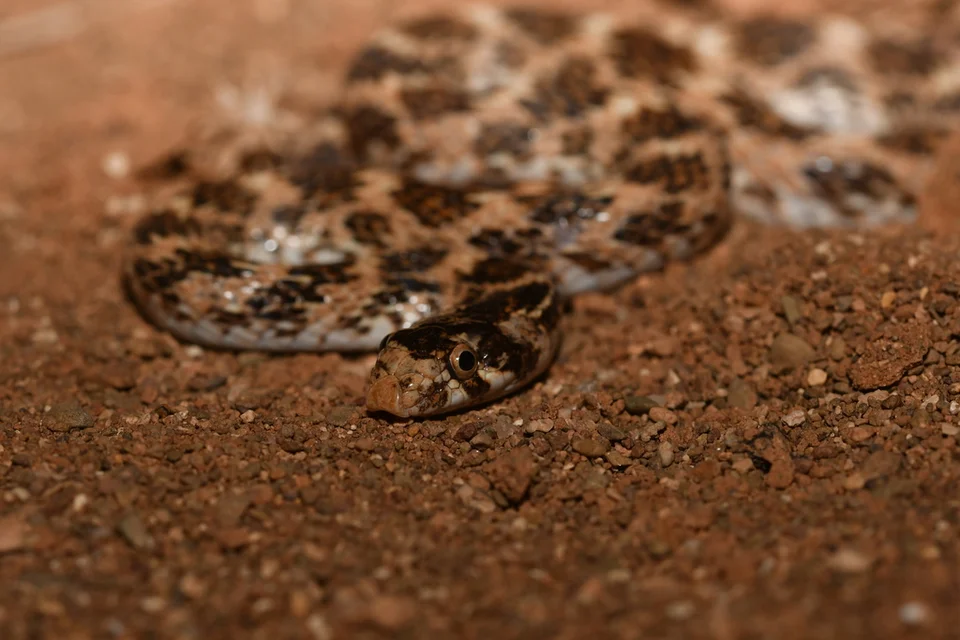
Venom unknownNot yet assessedThe recorded hillside combined soft sand, dunes, rocks and shrubs.
Venom & human effects
Venom status has not yet been established from the reviewed evidence for this account.
Missing evidence is not a non-venomous classification or a statement of low risk.
These are editorial summaries of the linked evidence, not toxicity rankings or WHO antivenom-priority categories. Effects vary with the bite and patient. Non-venomous does not mean safe to handle.
The scientific identity
Reliable identification uses the published combination of scale characters, proportions and other diagnostic evidence. Colour or a photograph alone may not separate closely related species.
From observations & literature
No sourced size & measurements summary has yet been added to this account.
No sourced diet & feeding summary has yet been added to this account.
No sourced activity & behaviour summary has yet been added to this account.
The recorded hillside combined soft sand, dunes, rocks and shrubs.
[11]The cited regional study reports: Nocturnal observation on sand.
[12]Genetic sampling confirms this country under the revised identity.
[1][2]Genetic sampling confirms this country under the revised identity.
[1][3]Genetic sampling confirms this country under the revised identity.
[1][4]Genetic sampling confirms this country under the revised identity.
[1][5]Country record: 2016 survey.
[1][6]Included in the national nature inventory.
[1][7]Genetic sampling confirms this country under the revised identity.
[1][8]An animal was active on the ground on 17 October 2019.
[14]Documented by the Batna atlas (2025).
[15]Historical records compiled in the 2017 atlas.
[16]The cited regional study reports: Recorded in the survey.
[17]Turaif survey, 2014–2015; reported under the publication’s historical nomenclature. Historical localities cited in the Turaif paper; not whole-region occupancy.
[18]Southern chotts, coast & desert: museum voucher CAS 138945 (1974). The museum record's reported coordinate uncertainty footprint lies within the mapped region. These are dated locality records, not evidence of occurrence throughout every part of a region or a complete present-day inventory.
[19]Dubai: observation GBIF 6253206065 (2026). The original iNaturalist entry was rechecked for research-grade identification, wild status and unrestricted coordinates; its reported uncertainty footprint lies within the mapped region. This is a community-reviewed observation, not a museum voucher. Dubai: observation GBIF 5868048252 (2025). The original iNaturalist entry was rechecked for research-grade identification, wild status and unrestricted coordinates; its reported uncertainty footprint lies within the mapped region. This is a community-reviewed observation, not a museum voucher. Northern emirates: observation GBIF 6398726197 (2026). The original iNaturalist entry was rechecked for research-grade identification, wild status and unrestricted coordinates; its reported uncertainty footprint lies within the mapped region. This is a community-reviewed observation, not a museum voucher. Northern emirates: observation GBIF 5087673989 (2025). The original iNaturalist entry was rechecked for research-grade identification, wild status and unrestricted coordinates; its reported uncertainty footprint lies within the mapped region. This is a community-reviewed observation, not a museum voucher. Abu Dhabi: observation GBIF 5935526355 (2025). The original iNaturalist entry was rechecked for research-grade identification, wild status and unrestricted coordinates; its reported uncertainty footprint lies within the mapped region. This is a community-reviewed observation, not a museum voucher. Abu Dhabi: observation GBIF 4421062276 (2023). The original iNaturalist entry was rechecked for research-grade identification, wild status and unrestricted coordinates; its reported uncertainty footprint lies within the mapped region. This is a community-reviewed observation, not a museum voucher. These are dated locality records, not evidence of occurrence throughout every part of a region or a complete present-day inventory.
[20][21][22][23][24][25][26][27][28][29][30][31]Central districts: museum voucher MVZ MVZ:Herp:33594 (1939). The published collecting label names Tel Aviv; this is a locality-label assignment, not a reconstructed coordinate. Central districts: museum voucher MHNG MHNG-HERP-1379.021 (1910). The published collecting label names Central District; this is a locality-label assignment, not a reconstructed coordinate. These are dated locality records, not evidence of occurrence throughout every part of a region or a complete present-day inventory.
[32][33]Amr et al. (2022), p. 104, explicitly list Al Jahrah and Al Wafrah among Kuwaiti records of Lytorhynchus diadema. The account uses the subspecific name gaddi; the shared species identity is retained. Amr et al. (2022), p. 104, explicitly list Al Jahrah and Al Wafrah among Kuwaiti records of Lytorhynchus diadema. The account uses the subspecific name gaddi; the shared species identity is retained. These are dated locality records, not evidence of occurrence throughout every part of a region or a complete present-day inventory.
[34]Laayoune: iNaturalist observation 397165611, recorded 2026-09-04. The current original record has agreeing research-grade identification, wild status and unrestricted coordinates; its entire reported uncertainty footprint lies within this mapped region. This community observation is not a museum voucher. Oued el Dahab: iNaturalist observation 260811864, recorded 2025-02-04. The current original record has agreeing research-grade identification, wild status and unrestricted coordinates; its entire reported uncertainty footprint lies within this mapped region. This community observation is not a museum voucher. Oued el Dahab: iNaturalist observation 268081151, recorded 2025-02-04. The current original record has agreeing research-grade identification, wild status and unrestricted coordinates; its entire reported uncertainty footprint lies within this mapped region. This community observation is not a museum voucher. These are dated locality records, not evidence of occurrence throughout every part of a region or a complete present-day inventory.
[35][36][37][38][39][40]A reported observation is not necessarily the full ecological range of a species. Where reproduction is inferred in a source dataset, the account identifies that limitation.
One species · Across borders
Explore the recorded countries and islands. Select a highlighted area to see its distribution evidence.
Loading geographic boundaries…
Click a highlighted country to zoom in and explore its records.
Shading identifies recorded countries or named islands, not continuous habitat coverage. Uncoloured areas do not establish absence.
Natural Earth · 1:50m · public domain; Gibraltar: geoBoundaries. Small islands may lack an outline.
Explore the distribution
Select a highlighted area to see its status, island records and sources. Each country and island links to the same shared species collection.
Use “Worldwide records” to include distant introduced and uncertain records in the map view.
Genetic sampling confirms this country under the revised identity. The cited regional study reports: Recorded in the survey.
Western Desert & oases → · El Omayed, sites C/2/3/4
Locality source 1 ↗ Locality source 2 ↗ Locality source 3 ↗Genetic sampling confirms this country under the revised identity. Central districts: museum voucher MVZ MVZ:Herp:33594 (1939). The published collecting label names Tel Aviv; this is a locality-label assignment, not a reconstructed coordinate. Central districts: museum voucher MHNG MHNG-HERP-1379.021 (1910). The published collecting label names Central District; this is a locality-label assignment, not a reconstructed coordinate. These are dated locality records, not evidence of occurrence throughout every part of a region or a complete present-day inventory.
Central districts → · Tel Aviv, Central District
Locality source 1 ↗ Locality source 2 ↗ Locality source 3 ↗ Locality source 4 ↗Explicit country record in the checked taxonomic treatment.
Locality source 1 ↗Genetic sampling confirms this country under the revised identity. Amr et al. (2022), p. 104, explicitly list Al Jahrah and Al Wafrah among Kuwaiti records of Lytorhynchus diadema. The account uses the subspecific name gaddi; the shared species identity is retained. Amr et al. (2022), p. 104, explicitly list Al Jahrah and Al Wafrah among Kuwaiti records of Lytorhynchus diadema. The account uses the subspecific name gaddi; the shared species identity is retained. These are dated locality records, not evidence of occurrence throughout every part of a region or a complete present-day inventory.
Jahra & northern wetlands → · Al Jahrah
Ahmadi & southern coast → · Al Wafrah
Locality source 1 ↗ Locality source 2 ↗ Locality source 3 ↗Genetic sampling confirms this country under the revised identity.
Locality source 1 ↗ Locality source 2 ↗Country record: 2016 survey.
Locality source 1 ↗ Locality source 2 ↗Included in the national nature inventory.
Locality source 1 ↗ Locality source 2 ↗Genetic sampling confirms this country under the revised identity. Turaif survey, 2014–2015; reported under the publication’s historical nomenclature. Historical localities cited in the Turaif paper; not whole-region occupancy.
Northern deserts → · Turaif, Northern Borders
Eastern Region → · Dhahran, Abqaiq
Central plateau → · Riyadh, Al-Zulfi
Western mountains & coast → · Jeddah, Zaymah
Locality source 1 ↗ Locality source 2 ↗ Locality source 3 ↗Explicit country record in the checked taxonomic treatment.
Locality source 1 ↗Explicit country record in the checked taxonomic treatment. Dubai: observation GBIF 6253206065 (2026). The original iNaturalist entry was rechecked for research-grade identification, wild status and unrestricted coordinates; its reported uncertainty footprint lies within the mapped region. This is a community-reviewed observation, not a museum voucher. Dubai: observation GBIF 5868048252 (2025). The original iNaturalist entry was rechecked for research-grade identification, wild status and unrestricted coordinates; its reported uncertainty footprint lies within the mapped region. This is a community-reviewed observation, not a museum voucher. Northern emirates: observation GBIF 6398726197 (2026). The original iNaturalist entry was rechecked for research-grade identification, wild status and unrestricted coordinates; its reported uncertainty footprint lies within the mapped region. This is a community-reviewed observation, not a museum voucher. Northern emirates: observation GBIF 5087673989 (2025). The original iNaturalist entry was rechecked for research-grade identification, wild status and unrestricted coordinates; its reported uncertainty footprint lies within the mapped region. This is a community-reviewed observation, not a museum voucher. Abu Dhabi: observation GBIF 5935526355 (2025). The original iNaturalist entry was rechecked for research-grade identification, wild status and unrestricted coordinates; its reported uncertainty footprint lies within the mapped region. This is a community-reviewed observation, not a museum voucher. Abu Dhabi: observation GBIF 4421062276 (2023). The original iNaturalist entry was rechecked for research-grade identification, wild status and unrestricted coordinates; its reported uncertainty footprint lies within the mapped region. This is a community-reviewed observation, not a museum voucher. These are dated locality records, not evidence of occurrence throughout every part of a region or a complete present-day inventory.
Dubai → · Dubai
Northern emirates → · Ras al-Khaimah
Abu Dhabi → · Abu Dhabi
Locality source 1 ↗ Locality source 2 ↗ Locality source 3 ↗ Locality source 4 ↗ Locality source 5 ↗ Locality source 6 ↗ Locality source 7 ↗ Locality source 8 ↗ Locality source 9 ↗ Locality source 10 ↗ Locality source 11 ↗ Locality source 12 ↗ Locality source 13 ↗Listed in the reviewed taxonomic treatment. An animal was active on the ground on 17 October 2019.
Souss, Draa & southern basins → · Kasbat Id Moussa (site 8)
Locality source 1 ↗ Locality source 2 ↗Listed in the reviewed taxonomic treatment. Documented by the Batna atlas (2025).
Eastern Tell & Aures → · M’doukal
Locality source 1 ↗ Locality source 2 ↗Listed in the reviewed taxonomic treatment. Southern chotts, coast & desert: museum voucher CAS 138945 (1974). The museum record's reported coordinate uncertainty footprint lies within the mapped region. These are dated locality records, not evidence of occurrence throughout every part of a region or a complete present-day inventory.
Southern chotts, coast & desert → · Southern chotts, coast & desert
Locality source 1 ↗ Locality source 2 ↗Listed in the reviewed taxonomic treatment. Historical records compiled in the 2017 atlas.
Tripolitania & western uplands → · Tripoli (atlas locality 45)
Gulf of Sidra & central basins → · Jufra district (atlas locality 222)
Southern Sahara & oases → · Sabha district (atlas locality 291)
Cyrenaica & Jabal al Akhdar → · Marj district (atlas locality 384)
Locality source 1 ↗ Locality source 2 ↗The current taxonomic treatment explicitly lists this country. This is country-scale checklist evidence, not a claim of continuous occupancy or a complete regional inventory.
Locality source 1 ↗The current taxonomic treatment explicitly lists this country. This is country-scale checklist evidence, not a claim of continuous occupancy or a complete regional inventory.
Locality source 1 ↗The current taxonomic treatment explicitly lists this country. This is country-scale checklist evidence, not a claim of continuous occupancy or a complete regional inventory. Laayoune: iNaturalist observation 397165611, recorded 2026-09-04. The current original record has agreeing research-grade identification, wild status and unrestricted coordinates; its entire reported uncertainty footprint lies within this mapped region. This community observation is not a museum voucher. Oued el Dahab: iNaturalist observation 260811864, recorded 2025-02-04. The current original record has agreeing research-grade identification, wild status and unrestricted coordinates; its entire reported uncertainty footprint lies within this mapped region. This community observation is not a museum voucher. Oued el Dahab: iNaturalist observation 268081151, recorded 2025-02-04. The current original record has agreeing research-grade identification, wild status and unrestricted coordinates; its entire reported uncertainty footprint lies within this mapped region. This community observation is not a museum voucher. These are dated locality records, not evidence of occurrence throughout every part of a region or a complete present-day inventory.
Laayoune → · Laayoune
Oued el Dahab → · Oued el Dahab
Locality source 1 ↗ Locality source 2 ↗ Locality source 3 ↗ Locality source 4 ↗ Locality source 5 ↗ Locality source 6 ↗ Locality source 7 ↗Country records reviewed for this expansion: Egypt, Israel, Jordan, Kuwait, Oman, Palestine, Qatar, Saudi Arabia, Syria, United Arab Emirates. These records do not imply continuous occupancy; unresolved identities are excluded from confirmed counts. North Africa review (12 October 2026): additional country evidence for Morocco, Algeria, Tunisia, Libya. See the dated locality and source records below. [43][44][45][46]
The text retains the source’s geographic qualifications. The map shows countries with atlas occurrence records; it is not a complete global range model. A type locality is a nomenclatural reference, not the only place the species occurs.
Status & its meaning
No matching global assessment was verified for this account. This is an unresolved assessment link, not an IUCN “Not Evaluated” classification and not evidence that the species is secure.
Locality coverage in the atlas does not measure abundance, population trends or national legal protection.
Follow the evidence
Latest evidence added 2026-10-12. Taxonomic and distribution treatments may change.
The linked taxonomic treatment provides its original descriptions, revisions and bibliography. Observations from other countries are not relabelled as local field studies.