Typhlopidae · Species account

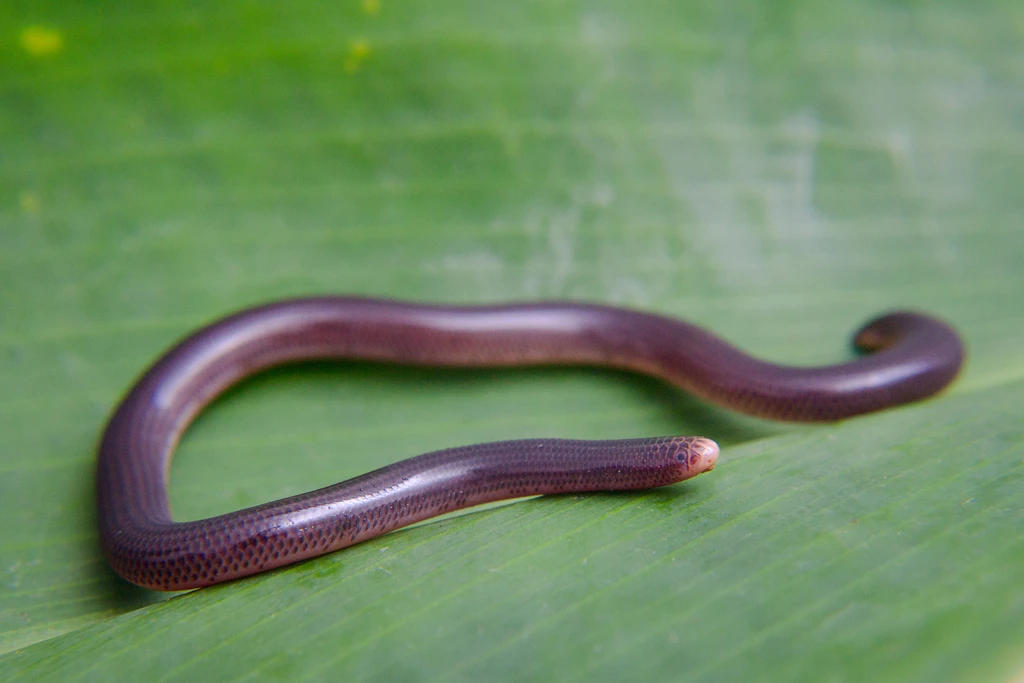
South American Striped Blindsnake, Brongersma's Worm Snake

Amerotyphlops brongersmianus(VANZOLINI, 1976)

Non-venomous

Aparicio et al. (2025), Table 2, report Amerotyphlops brongersmianus in the Sub-Andean Amazon Forests ecoregions of Madidi, Bolivia. These are broad ecological settings, not demonstrated microhabitat preferences. Only non-bold in/bo entries are used: modelled presence and outside-only records are excluded. The study counts a 1-km boundary buffer as inside; no new locality or countrywide distribution is inferred.

FamilyTyphlopidae
ReproductionEgg-laying
Country chaptersTrinidad and Tobago · Argentina · Bolivia · Brazil · Colombia · Guyana · Paraguay · Peru · Venezuela
Evidence updated2026-10-19
Explore its biology ↓

Venom & human effects

What is documented?

Non-venomous

Assessed as non-venomous from an explicit worldwide account of Typhlopidae, with this species’ membership verified separately.

Historical group-level assessment from Julian White (1988), not an experimental venom study of Amerotyphlops brongersmianus. The source explicitly covers the family worldwide. Current exact-species membership is checked in the Reptile Database; historical species totals and other former family members are not imported. No human-effects tier is inferred.

Evidence & scope · checked 2026-10-29

White, Studies in Clinical Toxinology in South Australia, printed p.318 (PDF p.33), Section I.3(b), The Snake Families: Typhlopidae paragraph explicitly says non-venomous. Membership: exact-species Higher Taxa field (Typhlopidae (Typhlopinae), Typhlopoidea, Serpentes, Squamata (snakes)).

How to read these badges
Limited documented effects
The cited human cases reported limited effects. Sparse observations cannot exclude a severe reaction.
Medically significant effects
The cited human cases document clinically important injury or illness. This is not an upper limit on severity.
Potentially life-threatening
Species-specific clinical evidence documents life-threatening illness or deaths after bites. The account explains the affected patients and any uncertainty about the cause.
Clinical severity not established
Venom presence is documented, but the reviewed evidence does not establish a clinical tier. When human effects are reported under an unresolved historical species name, the badge and account say so explicitly.
Venom status uncertain
The reviewed sources are inconclusive or conflicting about venom presence. The account explains the uncertainty.
Venom status not assessed
The atlas lacks a reviewed venom-presence classification for this species.

These are editorial summaries of the linked evidence, not toxicity rankings or WHO antivenom-priority categories. Effects vary with the bite and patient. Non-venomous does not mean safe to handle.

The scientific identity

Taxonomy & recognition

From observations & literature

Natural history

Size & measurements

The specimen measured in this coastal Paraíba survey was 212 mm from snout to vent, excluding the tail. The report provides no age or sex for this measurement.

Southern coast of Paraíba, northeastern Brazil. Field surveys at Barra de Gramame ran from January 2012 through December 2013; the study also examined regional museum material. Measurements and encounters are reported as local observations, not species-wide limits.

Study & evidence

Sampaio et al. (2018), ZooKeys 787; Natural history of species, Amerotyphlops brongersmianus account; Materials and methods.

Study source 1 ↗

Study source 2 ↗

Diet & feeding

No sourced diet & feeding summary has yet been added to this account.

Activity & behaviour

No sourced activity & behaviour summary has yet been added to this account.

Reproduction

Egg-laying.

Habitat & ecology

Habitat & microhabitat · Bolivia

Aparicio et al. (2025), Table 2, report Amerotyphlops brongersmianus in the Sub-Andean Amazon Forests ecoregions of Madidi, Bolivia. These are broad ecological settings, not demonstrated microhabitat preferences. Only non-bold in/bo entries are used: modelled presence and outside-only records are excluded. The study counts a 1-km boundary buffer as inside; no new locality or countrywide distribution is inferred.

[2]

Habitat & microhabitat · Brazil

The field-habitat synthesis in Nogueira et al. (2019) supports woodland for Amerotyphlops brongersmianus in the Brazilian account. These are broad habitat associations, not exclusive preferences or new collecting localities. The atlas distinguishes field observations from mapped ecoregions; only its explicit field-habitat statements are classified here.

[3]

Habitat & microhabitat · Venezuela

The Orinoco Delta survey in Venezuela records this species in Mauritia palm swamp habitat. Country-scoped evidence; no additional regional occurrence or continuous occupancy is inferred.

[4][5]
Further observations & source notes (4)

Documented localities · Trinidad and Tobago

The treatment names these subdivisions in its Trinidad and Tobago distribution clause: Trinidad. They are assigned to the declared atlas navigation groups; this is not a field observation, a whole-region range polygon or a complete local inventory.

[6]

Documented localities · Argentina

The treatment names these subdivisions in its Argentina distribution clause: Entre Ríos, Entre Rios, Salta, Formosa, Misiones, Chaco, Corrientes, Buenos Aires, Tucumán, Tucuman, Córdoba, Cordoba. They are assigned to the declared atlas navigation groups; this is not a field observation, a whole-region range polygon or a complete local inventory.

[7]

Documented localities · Bolivia

The treatment names these subdivisions in its Bolivia distribution clause: Beni. They are assigned to the declared atlas navigation groups; this is not a field observation, a whole-region range polygon or a complete local inventory.

[8]

Documented localities · Brazil

The treatment names these subdivisions in its Brazil distribution clause: Maranhao, Ceara, Paraiba, Piaui, Pernambuco, Alagoas, Sergipe, Tocantins, Bahia, Mato Grosso, Goias, Minas Gerais, Espirito Santo, Mato Grosso do Sul, Rio de Janeiro, Sao Paulo, Santa Catarina, Rio Grande do Sul. They are assigned to the declared atlas navigation groups; this is not a field observation, a whole-region range polygon or a complete local inventory.

[9]

A reported observation is not necessarily the full ecological range of a species. Where reproduction is inferred in a source dataset, the account identifies that limitation.

One species · Across borders

Global distribution

Explore the recorded countries and islands. Select a highlighted area to see its distribution evidence.

Recorded distribution
Amerotyphlops brongersmianus — select a recorded country or island

Loading geographic boundaries…

ListedIntroducedUncertain

Click a highlighted country to zoom in and explore its records.

Shading identifies recorded countries or named islands, not continuous habitat coverage. Uncoloured areas do not establish absence.

Natural Earth · 1:50m · public domain; Gibraltar: geoBoundaries. Small islands may lack an outline.

Explore the distribution

Across borders

9 recorded countries & territories

Select a highlighted area to see its status, island records and sources. Each country and island links to the same shared species collection.

Use “Worldwide records” to include distant introduced and uncertain records in the map view.

Trinidad and Tobago · regional locality evidence

The checked taxonomic distribution account explicitly lists Trinidad and Tobago. Country-level evidence does not establish continuous occupancy or a complete national inventory. The treatment names these subdivisions in its Trinidad and Tobago distribution clause: Trinidad. They are assigned to the declared atlas navigation groups; this is not a field observation, a whole-region range polygon or a complete local inventory.

Trinidad → · Trinidad

Locality source 1 ↗
Argentina · regional locality evidence

The checked taxonomic distribution account explicitly lists Argentina. Country-level evidence does not establish continuous occupancy or a complete national inventory. The treatment names these subdivisions in its Argentina distribution clause: Entre Ríos, Entre Rios, Salta, Formosa, Misiones, Chaco, Corrientes, Buenos Aires, Tucumán, Tucuman, Córdoba, Cordoba. They are assigned to the declared atlas navigation groups; this is not a field observation, a whole-region range polygon or a complete local inventory.

Entre Ríos → · Entre Ríos, Entre Rios

Salta → · Salta

Formosa → · Formosa

Misiones → · Misiones

Chaco → · Chaco

Corrientes → · Corrientes

Buenos Aires → · Buenos Aires

Tucumán → · Tucumán, Tucuman

Córdoba → · Córdoba, Cordoba

Locality source 1 ↗
Bolivia · regional locality evidence

The checked taxonomic distribution account explicitly lists Bolivia. Country-level evidence does not establish continuous occupancy or a complete national inventory. The treatment names these subdivisions in its Bolivia distribution clause: Beni. They are assigned to the declared atlas navigation groups; this is not a field observation, a whole-region range polygon or a complete local inventory.

Beni → · Beni

Locality source 1 ↗
Brazil · regional locality evidence

The checked taxonomic distribution account explicitly lists Brazil. Country-level evidence does not establish continuous occupancy or a complete national inventory. The treatment names these subdivisions in its Brazil distribution clause: Maranhao, Ceara, Paraiba, Piaui, Pernambuco, Alagoas, Sergipe, Tocantins, Bahia, Mato Grosso, Goias, Minas Gerais, Espirito Santo, Mato Grosso do Sul, Rio de Janeiro, Sao Paulo, Santa Catarina, Rio Grande do Sul. They are assigned to the declared atlas navigation groups; this is not a field observation, a whole-region range polygon or a complete local inventory.

Maranhao → · Maranhao

Ceara → · Ceara

Paraiba → · Paraiba

Piaui → · Piaui

Pernambuco → · Pernambuco

Alagoas → · Alagoas

Sergipe → · Sergipe

Tocantins → · Tocantins

Bahia → · Bahia

Mato Grosso → · Mato Grosso

Goias → · Goias

Minas Gerais → · Minas Gerais

Espirito Santo → · Espirito Santo

Mato Grosso do Sul → · Mato Grosso do Sul

Rio de Janeiro → · Rio de Janeiro

Sao Paulo → · Sao Paulo

Santa Catarina → · Santa Catarina

Rio Grande do Sul → · Rio Grande do Sul

Locality source 1 ↗
Colombia · regional locality evidence

The checked taxonomic distribution account explicitly lists Colombia. Country-level evidence does not establish continuous occupancy or a complete national inventory.

Locality source 1 ↗
Guyana · regional locality evidence

The checked taxonomic distribution account explicitly lists Guyana. Country-level evidence does not establish continuous occupancy or a complete national inventory.

Locality source 1 ↗
Paraguay · regional locality evidence

The checked taxonomic distribution account explicitly lists Paraguay. Country-level evidence does not establish continuous occupancy or a complete national inventory.

Locality source 1 ↗
Peru · regional locality evidence

The checked taxonomic distribution account explicitly lists Peru. Country-level evidence does not establish continuous occupancy or a complete national inventory.

Locality source 1 ↗
Venezuela · regional locality evidence

The checked taxonomic distribution account explicitly lists Venezuela. Country-level evidence does not establish continuous occupancy or a complete national inventory.

Locality source 1 ↗

Geographic scope of the source

Country entries supported by this Americas review: Trinidad and Tobago. These are reviewed atlas entries, not a complete global distribution. [1]

The text retains the source’s geographic qualifications. The map shows countries with atlas occurrence records; it is not a complete global range model. A type locality is a nomenclatural reference, not the only place the species occurs.

Status & its meaning

Conservation

No matching global assessment was verified for this account. This is an unresolved assessment link, not an IUCN “Not Evaluated” classification and not evidence that the species is secure.

Locality coverage in the atlas does not measure abundance, population trends or national legal protection.

Follow the evidence

Sources & further reading

The linked taxonomic treatment provides its original descriptions, revisions and bibliography. Observations from other countries are not relabelled as local field studies.