Country links use a single accepted species identity. Revised names and disputed records are kept visible here; uncertain records do not enter the listed collection or regional totals.
Supported country occurrence
Figueroa, Low & Lim (2023), the annotated national review, accepts this species for Singapore.
The 2023 annotated review explicitly lists these Singapore sites. They are selected named-locality evidence, not a full range polygon or a guarantee of current presence at every point. Sites marked as historical in that review are omitted from this mapped selection.
Source 1 ↗
Source 2 ↗
Supported country occurrence
Figueroa, Low & Lim (2023), the annotated national review, accepts this species for Singapore. The accepted national record is a specimen predating 1891. The review excludes the separate offshore Horsburgh records and requests further substantiation.
Source 1 ↗
Source 2 ↗
Supported country occurrence
Figueroa, Low & Lim (2023), the annotated national review, accepts this species for Singapore.
The 2023 annotated review explicitly lists these Singapore sites. They are selected named-locality evidence, not a full range polygon or a guarantee of current presence at every point. Sites marked as historical in that review are omitted from this mapped selection.
Source 1 ↗
Source 2 ↗
Source 3 ↗
Supported country occurrence
Figueroa, Low & Lim (2023), the annotated national review, accepts this species for Singapore.
The 2023 annotated review explicitly lists these Singapore sites. They are selected named-locality evidence, not a full range polygon or a guarantee of current presence at every point. Sites marked as historical in that review are omitted from this mapped selection.
Source 1 ↗
Source 2 ↗
Source 3 ↗
Source 4 ↗
Supported country occurrence
Figueroa, Low & Lim (2023), the annotated national review, accepts this species for Singapore.
The 2023 annotated review explicitly lists these Singapore sites. They are selected named-locality evidence, not a full range polygon or a guarantee of current presence at every point. Sites marked as historical in that review are omitted from this mapped selection.
Source 1 ↗
Source 2 ↗
Supported country occurrence
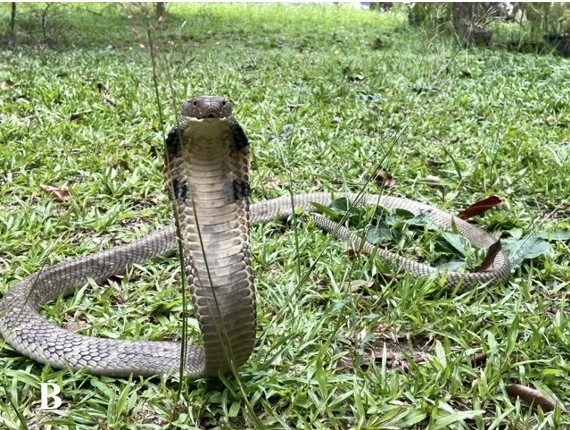
Figueroa, Low & Lim (2023), the annotated national review, accepts this species for Singapore. The review used O. hannah before the king-cobra split; the Singapore population is assigned to O. bungarus in the current taxonomic treatment.
The 2023 annotated review explicitly lists these Singapore sites. They are selected named-locality evidence, not a full range polygon or a guarantee of current presence at every point. Sites marked as historical in that review are omitted from this mapped selection. The source uses the pre-split name Ophiophagus hannah; the Singapore population belongs to O. bungarus under the current revision.
Source 1 ↗
Source 2 ↗
Supported country occurrence
Figueroa, Low & Lim (2023), the annotated national review, accepts this species for Singapore.
The 2023 annotated review explicitly lists these Singapore sites. They are selected named-locality evidence, not a full range polygon or a guarantee of current presence at every point. Sites marked as historical in that review are omitted from this mapped selection.
Source 1 ↗
Source 2 ↗
Supported country occurrence
Figueroa, Low & Lim (2023), the annotated national review, accepts this species for Singapore. Accepted historical Singapore material is retained. The review distinguishes records from Singapore from poorly localized offshore specimens; there is no mapped local site here.
Source 1 ↗
Source 2 ↗
Supported country occurrence
Figueroa, Low & Lim (2023), the annotated national review, accepts this species for Singapore.
The 2023 annotated review explicitly lists these Singapore sites. They are selected named-locality evidence, not a full range polygon or a guarantee of current presence at every point. Sites marked as historical in that review are omitted from this mapped selection.
Source 1 ↗
Source 2 ↗
Supported country occurrence
Figueroa, Low & Lim (2023), the annotated national review, accepts this species for Singapore. The authors report four specimens predating 1897 and one undated specimen, and consider it likely extirpated. No current site occupancy is asserted.
Pp. 163–164: historical vouchers ZRC.2.2842 (26 May 1894) and ZRC.2.2843 (1897); the review considers the species likely extirpated locally.
Source 1 ↗
Source 2 ↗
Supported country occurrence
Figueroa, Low & Lim (2023), the annotated national review, accepts this species for Singapore.
The 2023 annotated review explicitly lists these Singapore sites. They are selected named-locality evidence, not a full range polygon or a guarantee of current presence at every point. Sites marked as historical in that review are omitted from this mapped selection.
Source 1 ↗
Source 2 ↗
Supported country occurrence
Figueroa, Low & Lim (2023), the annotated national review, accepts this species for Singapore.
Source 1 ↗
Source 2 ↗
Supported country occurrence
Figueroa, Low & Lim (2023), the annotated national review, accepts this species for Singapore.
The 2023 annotated review explicitly lists these Singapore sites. They are selected named-locality evidence, not a full range polygon or a guarantee of current presence at every point. Sites marked as historical in that review are omitted from this mapped selection.
Source 1 ↗
Source 2 ↗
Supported country occurrence
Figueroa, Low & Lim (2023), the annotated national review, accepts this species for Singapore.
The 2023 annotated review explicitly lists these Singapore sites. They are selected named-locality evidence, not a full range polygon or a guarantee of current presence at every point. Sites marked as historical in that review are omitted from this mapped selection.
Source 1 ↗
Source 2 ↗
Supported country occurrence
Figueroa, Low & Lim (2023), the annotated national review, accepts this species for Singapore. The accepted national record is a single 1906 specimen; the authors consider it likely extirpated and give no published locality.
Source 1 ↗
Supported country occurrence
Figueroa, Low & Lim (2023), the annotated national review, accepts this species for Singapore.
The 2023 annotated review explicitly lists these Singapore sites. They are selected named-locality evidence, not a full range polygon or a guarantee of current presence at every point. Sites marked as historical in that review are omitted from this mapped selection.
Source 1 ↗
Source 2 ↗
Supported country occurrence
Figueroa, Low & Lim (2023), the annotated national review, accepts this species for Singapore. Its 2023 account predates the 2024 rediscovery; the subsequent Herpetological Society checklist retains it as present.
Chantong et al. (2024, p. 1) documented a live snake in the Lorong Banir area of Upper Seletar on 12 October 2024, photographed and released after it was found above a stream. The record supersedes the earlier presumed local disappearance. The published named area maps to the North planning region; no exact snake coordinates or occurrence across the entire region are implied.
Source 1 ↗
Source 2 ↗
Source 3 ↗
Source 4 ↗
Source 5 ↗
Supported country occurrence
Figueroa, Low & Lim (2023), the annotated national review, accepts this species for Singapore.
The 2023 annotated review explicitly lists these Singapore sites. They are selected named-locality evidence, not a full range polygon or a guarantee of current presence at every point. Sites marked as historical in that review are omitted from this mapped selection.
Source 1 ↗
Source 2 ↗
Supported country occurrence
Figueroa, Low & Lim (2023), the annotated national review, accepts this species for Singapore. The authors accept two specimens predating 1899 and consider it likely extirpated; no published locality is available.
Source 1 ↗
Source 2 ↗
Supported country occurrence
Figueroa, Low & Lim (2023), the annotated national review, accepts this species for Singapore.
The 2023 annotated review explicitly lists these Singapore sites. They are selected named-locality evidence, not a full range polygon or a guarantee of current presence at every point. Sites marked as historical in that review are omitted from this mapped selection.
Source 1 ↗
Source 2 ↗
Supported country occurrence
Figueroa, Low & Lim (2023), the annotated national review, accepts this species for Singapore. The review accepts two specimens predating 1896 and one collected in 1971, considers it likely extirpated, and gives no published locality. Historical occurrence is retained without claiming a surviving population.
Source 1 ↗
Uncertain — excluded from the listed total
The source treats this country record as uncertain or conflicting.
Source 1 ↗
Supported country occurrence
Figueroa, Low & Lim (2023), the annotated national review, accepts this species for Singapore.
The 2023 annotated review explicitly lists these Singapore sites. They are selected named-locality evidence, not a full range polygon or a guarantee of current presence at every point. Sites marked as historical in that review are omitted from this mapped selection.
Source 1 ↗
Source 2 ↗
Supported country occurrence
Figueroa, Low & Lim (2023), the annotated national review, accepts this species for Singapore.
The 2023 annotated review explicitly lists these Singapore sites. They are selected named-locality evidence, not a full range polygon or a guarantee of current presence at every point. Sites marked as historical in that review are omitted from this mapped selection.
Source 1 ↗
Source 2 ↗
Introduced occurrence
Figueroa, Low & Lim (2023), the annotated national review, accepts this species for Singapore. The source treats it as non-native; the country link preserves that distinction.
The 2023 annotated review explicitly lists these Singapore sites. They are selected named-locality evidence, not a full range polygon or a guarantee of current presence at every point. Sites marked as historical in that review are omitted from this mapped selection.
Source 1 ↗
Source 2 ↗
Supported country occurrence
Figueroa, Low & Lim (2023), the annotated national review, accepts this species for Singapore.
The 2023 annotated review explicitly lists these Singapore sites. They are selected named-locality evidence, not a full range polygon or a guarantee of current presence at every point. Sites marked as historical in that review are omitted from this mapped selection.
Source 1 ↗
Source 2 ↗
Supported country occurrence
Figueroa, Low & Lim (2023), the annotated national review, accepts this species for Singapore.
The 2023 annotated review explicitly lists these Singapore sites. They are selected named-locality evidence, not a full range polygon or a guarantee of current presence at every point. Sites marked as historical in that review are omitted from this mapped selection.
Source 1 ↗
Supported country occurrence
Figueroa, Low & Lim (2023), the annotated national review, accepts this species for Singapore.
Pp. 215–217: a free-ranging snake was found in a zoo drain in 1978; its preserved specimen was lost, and rediscovered field notes were published in 2009.
Source 1 ↗
Source 2 ↗
Supported country occurrence
Figueroa, Low & Lim (2023), the annotated national review, accepts this species for Singapore.
The 2023 annotated review explicitly lists these Singapore sites. They are selected named-locality evidence, not a full range polygon or a guarantee of current presence at every point. Sites marked as historical in that review are omitted from this mapped selection.
Source 1 ↗
Source 2 ↗
Supported country occurrence
Figueroa, Low & Lim (2023), the annotated national review, accepts this species for Singapore. The later Herpetological Society checklist uses C. cf. ruffus; the local population’s exact limits remain under study.
The 2023 annotated review explicitly lists these Singapore sites. They are selected named-locality evidence, not a full range polygon or a guarantee of current presence at every point. Sites marked as historical in that review are omitted from this mapped selection.
Source 1 ↗
Source 2 ↗
Source 3 ↗
Supported country occurrence
Figueroa, Low & Lim (2023), the annotated national review, accepts this species for Singapore.
The 2023 annotated review explicitly lists these Singapore sites. They are selected named-locality evidence, not a full range polygon or a guarantee of current presence at every point. Sites marked as historical in that review are omitted from this mapped selection.
Source 1 ↗
Source 2 ↗
Supported country occurrence
Figueroa, Low & Lim (2023), the annotated national review, accepts this species for Singapore. Origin remains disputed: this primary review argues for native status, whereas the Herpetological Society’s 2024 checklist labels it introduced. Country occurrence itself is supported.
The 2023 annotated review explicitly lists these Singapore sites. They are selected named-locality evidence, not a full range polygon or a guarantee of current presence at every point. Sites marked as historical in that review are omitted from this mapped selection. Origin is disputed between the primary review and the later expert checklist; these records establish presence.
Source 1 ↗
Source 2 ↗
Supported country occurrence
Figueroa, Low & Lim (2023), the annotated national review, accepts this species for Singapore.
The 2023 annotated review explicitly lists these Singapore sites. They are selected named-locality evidence, not a full range polygon or a guarantee of current presence at every point. Sites marked as historical in that review are omitted from this mapped selection.
Source 1 ↗
Source 2 ↗
Supported country occurrence
Figueroa, Low & Lim (2023), the annotated national review, accepts this species for Singapore. The review retains the historical national record but requests further substantiation; no modern local population is implied.
Source 1 ↗
Source 2 ↗
Supported country occurrence
Figueroa, Low & Lim (2023), the annotated national review, accepts this species for Singapore.
The 2023 annotated review explicitly lists these Singapore sites. They are selected named-locality evidence, not a full range polygon or a guarantee of current presence at every point. Sites marked as historical in that review are omitted from this mapped selection.
Source 1 ↗
Source 2 ↗
Supported country occurrence
Figueroa, Low & Lim (2023), the annotated national review, accepts this species for Singapore.
The 2023 annotated review explicitly lists these Singapore sites. They are selected named-locality evidence, not a full range polygon or a guarantee of current presence at every point. Sites marked as historical in that review are omitted from this mapped selection.
Source 1 ↗
Supported country occurrence
Figueroa, Low & Lim (2023), the annotated national review, accepts this species for Singapore.
Pp. 169–171: the zoo-ground photograph was published in 1992; Botanic Gardens voucher ZRC.2.3879 dates to March 1897, without demonstrating present occupancy.
Source 1 ↗
Source 2 ↗
Supported country occurrence
Figueroa, Low & Lim (2023), the annotated national review, accepts this species for Singapore.
The 2023 annotated review explicitly lists these Singapore sites. They are selected named-locality evidence, not a full range polygon or a guarantee of current presence at every point. Sites marked as historical in that review are omitted from this mapped selection.
Source 1 ↗
Source 2 ↗
Supported country occurrence
Figueroa, Low & Lim (2023), the annotated national review, accepts this species for Singapore. Known from historical specimens predating 1898. The supposed Nee Soon locality is contradicted by the museum catalogue and is not mapped; present survival is unresolved.
Source 1 ↗
Source 2 ↗
Supported country occurrence
Figueroa, Low & Lim (2023), the annotated national review, accepts this species for Singapore.
The 2023 annotated review explicitly lists these Singapore sites. They are selected named-locality evidence, not a full range polygon or a guarantee of current presence at every point. Sites marked as historical in that review are omitted from this mapped selection.
Source 1 ↗
Source 2 ↗
Supported country occurrence
Figueroa, Low & Lim (2023), the annotated national review, accepts this species for Singapore.
The 2023 annotated review explicitly lists these Singapore sites. They are selected named-locality evidence, not a full range polygon or a guarantee of current presence at every point. Sites marked as historical in that review are omitted from this mapped selection.
Source 1 ↗
Supported country occurrence
Figueroa, Low & Lim (2023), the annotated national review, accepts this species for Singapore.
Source 1 ↗
Introduced occurrence
Figueroa, Low & Lim (2023), the annotated national review, accepts this species for Singapore. The source treats it as non-native; the country link preserves that distinction.
Ng (2017, p. 14) photographed a free-ranging snake at Gardens by the Bay on 1 January 2017. Chua (2021, p. 1) documented two there on 13 August 2021, around the Sun Pavilion. These reports treat the species as introduced; the locality does not imply native status or prove how it arrived.
Source 1 ↗
Source 2 ↗
Source 3 ↗
Supported country occurrence
Figueroa, Low & Lim (2023), the annotated national review, accepts this species for Singapore. The authors accept nine historical specimens, with no confirmed record since at least 1908, and consider it likely extirpated. Historical native occurrence is retained without implying a living population.
Pp. 221–222: historical voucher ZRC.2.3090 (16 December 1901); likely extirpated locally, while the separate imprecise Bukit Timah record remains unmapped.
Source 1 ↗