The cited human cases reported limited effects. Sparse observations cannot exclude a severe reaction.
Medically significant effects
The cited human cases document clinically important injury or illness. This is not an upper limit on severity.
Potentially life-threatening
Species-specific clinical evidence documents life-threatening illness or deaths after bites. The account explains the affected patients and any uncertainty about the cause.
Clinical severity not established
Venom presence is documented, but the reviewed evidence does not establish a clinical tier. When human effects are reported under an unresolved historical species name, the badge and account say so explicitly.
Venom status uncertain
The reviewed sources are inconclusive or conflicting about venom presence. The account explains the uncertainty.
Venom status not assessed
The atlas lacks a reviewed venom-presence classification for this species.
These are editorial summaries of the linked evidence, not toxicity rankings or WHO antivenom-priority categories. Effects vary with the bite and patient. Non-venomous does not mean safe to handle.
The scientific identity
Taxonomy & recognition
Accepted name in this edition
Homalopsis buccata
Authority
(LINNAEUS, 1758)
Family
Homalopsidae
Type-locality statement
“Indiis” (in error); restricted to Singapore by by MURPHY et al. 2012.
Reliable identification uses the published combination of scale characters, proportions and other diagnostic evidence. Colour or a photograph alone may not separate closely related species.
Names trace the literature, including older combinations and historical usages. Their appearance here does not mean they are all currently accepted synonyms.
From observations & literature
Natural history
Size and ecological traits credited to SquamBase summarize published studies across the species’ range in its 2024 edition. They are complemented by the locality-specific observations below.
Size & measurements
Recorded size
The largest measurements compiled in SquamBase 1.0 are 140 cm total length (including the tail). These are separate literature maxima, not typical adult sizes or necessarily measurements of the same animal.
SquamBase 1.0 records a literature maximum of 140 cm total length, including the tail. This is a compiled maximum, not a typical adult size or a measurement specific to this country.
Activity is predominantly after dark. This is the range-wide classification in the 2024 compilation; it does not exclude occasional activity at other times.
Aquatic activity is reported in the studies compiled by SquamBase. This describes the species across its studied range, not a record from every island.
The compilation records 4–37 young per litter. These published records need not represent the full variation between populations, and are not a separate estimate for Laos or Vietnam.
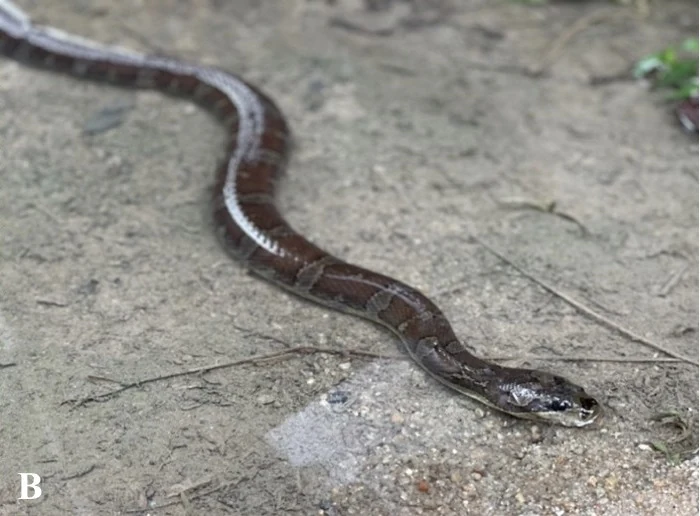
A June 2023 Singapore observation found a juvenile on disturbed ground beside a lawn and pavement at Lower Seletar Reservoir Park, about 30 metres from the reservoir. The report places this unusual land observation in the context of the species’ freshwater association; it does not demonstrate permanent occupation of dry urban ground.
The 2021–2023 field survey documented this species on Ko Pha-ngan, Surat Thani (published 2026, Table 1 and species treatment). This island record does not delimit its wider Thai range.
The 2023 annotated review explicitly lists these Singapore sites. They are selected named-locality evidence, not a full range polygon or a guarantee of current presence at every point. Sites marked as historical in that review are omitted from this mapped selection.
A reported observation is not necessarily the full ecological range of a species. Where reproduction is inferred in a source dataset, the account identifies that limitation.
One species · Across borders
Global distribution
Explore the recorded countries and islands. Select a highlighted area to see its distribution evidence.
Recorded distributionN ↑
Loading geographic boundaries…
ListedIntroducedUncertain
Click a highlighted country to zoom in and explore its records.
Shading identifies recorded countries or named islands, not continuous habitat coverage. Uncoloured areas do not establish absence.
Figueroa, Low & Lim (2023), the annotated national review, accepts this species for Singapore.
The 2023 annotated review explicitly lists these Singapore sites. They are selected named-locality evidence, not a full range polygon or a guarantee of current presence at every point. Sites marked as historical in that review are omitted from this mapped selection.
Thailand: country-level record; no named guide locality extracted.
The 2021–2023 field survey documented this species on Ko Pha-ngan, Surat Thani (published 2026, Table 1 and species treatment). This island record does not delimit its wider Thai range.
Sumatra, Java and Kalimantan supported; doubtful Sulawesi records are omitted.
Geographic scope of the source
Cambodia; Thailand; Vietnam; Indonesia (Bangka, Belitung, Borneo, Java, Kalimantan, Riau Archipelago, Sulawesi, Sumatra, Natuna islands); Laos; W Malaysia (Malaya); Singapore; Pulau Bangka [1]
The text retains the source’s geographic qualifications. The map shows countries with atlas occurrence records; it is not a complete global range model. A type locality is a nomenclatural reference, not the only place the species occurs.
Status & its meaning
Conservation
No matching global assessment was verified for this account. This is an unresolved assessment link, not an IUCN “Not Evaluated” classification and not evidence that the species is secure.
Locality coverage in the atlas does not measure abundance, population trends or national legal protection.
Follow the evidence
Sources & further reading
Latest evidence added 2026-10-11. Taxonomic and distribution treatments may change.
The linked taxonomic treatment provides its original descriptions, revisions and bibliography. Observations from other countries are not relabelled as local field studies.