Size & measurements
No sourced size & measurements summary has yet been added to this account.
Colubridae · Species account
Dendrelaphis haasiVAN ROOIJEN & VOGEL, 2008
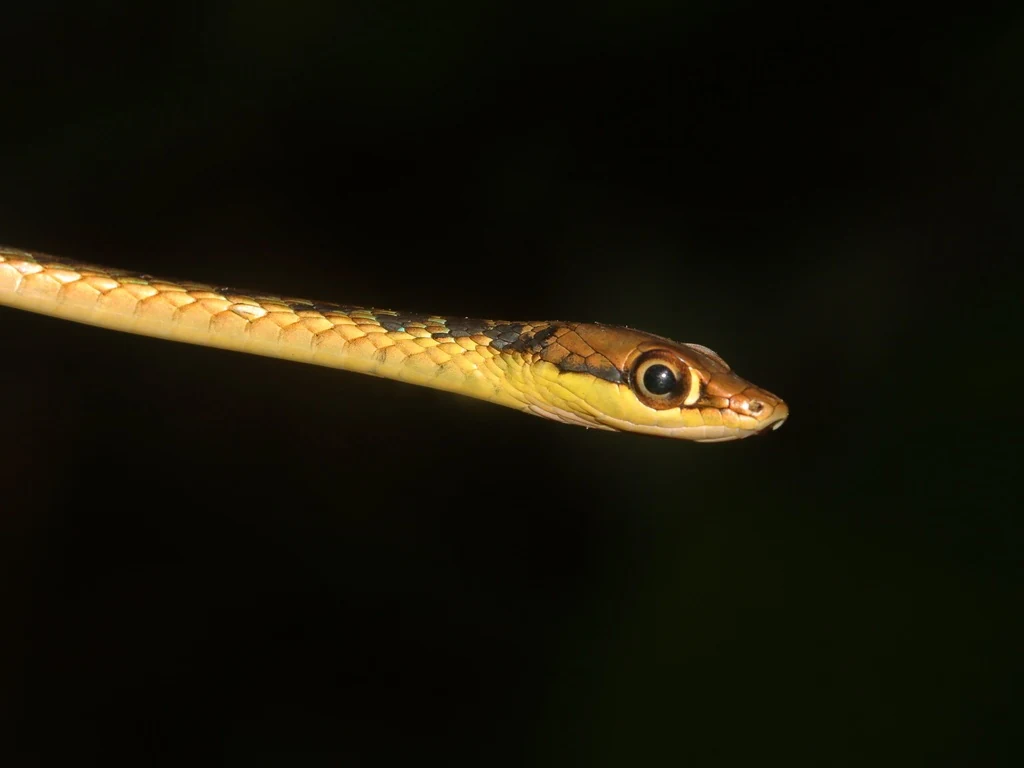
Non-venomousThe Singapore records include a snake on a rattan leaf stalk beside a stream in Nee Soon freshwater swamp forest in October 2010. An earlier Lower Peirce observation involved a snake among ferns that subsequently climbed a tree. These field observations document use of low vegetation within forest, including swamp habitat.
Venom & human effects
Classified as non-venomous in the cited genus description; this species’ current membership is verified separately.
Explicit genus-level venom-presence classification applied to a verified accepted member. This is not a species-specific venom assay or a human clinical severity assessment.
McCoy (1980), Reptiles of the Solomon Islands, Wau Ecology Institute Handbook 7. Genus Dendrelaphis diagnosis, printed p.63 (PDF page90); explicit non-venomous genus description. Current membership: Reptile Database genus search, exact accepted listing Dendrelaphis haasi, checked 2026-10-30.
These are editorial summaries of the linked evidence, not toxicity rankings or WHO antivenom-priority categories. Effects vary with the bite and patient. Non-venomous does not mean safe to handle.
The scientific identity
Reliable identification uses the published combination of scale characters, proportions and other diagnostic evidence. Colour or a photograph alone may not separate closely related species.
Taxonomic treatment & original-description references ↗
Dendrelaphis pictus
Names trace the literature, including older combinations and historical usages. Their appearance here does not mean they are all currently accepted synonyms.
From observations & literature
No sourced size & measurements summary has yet been added to this account.
No sourced diet & feeding summary has yet been added to this account.
The source classification reports tree-dwelling habits. This does not establish occurrence in every forest.
[1]The Singapore records include a snake on a rattan leaf stalk beside a stream in Nee Soon freshwater swamp forest in October 2010. An earlier Lower Peirce observation involved a snake among ferns that subsequently climbed a tree. These field observations document use of low vegetation within forest, including swamp habitat.
[2]The 2023 annotated review explicitly lists these Singapore sites. They are selected named-locality evidence, not a full range polygon or a guarantee of current presence at every point. Sites marked as historical in that review are omitted from this mapped selection.
[3]Egg-laying (oviparous). [1]
The database classifies its habitat use as fully arboreal. [1]
Activity is described as diurnal in the source. [1]
A reported observation is not necessarily the full ecological range of a species. Where reproduction is inferred in a source dataset, the account identifies that limitation.
One species · Across borders
Explore the recorded countries and islands. Select a highlighted area to see its distribution evidence.
Loading geographic boundaries…
Click a highlighted country to zoom in and explore its records.
Shading identifies recorded countries or named islands, not continuous habitat coverage. Uncoloured areas do not establish absence.
Natural Earth · 1:50m · public domain; Gibraltar: geoBoundaries. Small islands may lack an outline.
Explore the distribution
Select a highlighted area to see its status, island records and sources. Each country and island links to the same shared species collection.
Use “Worldwide records” to include distant introduced and uncertain records in the map view.
Figueroa, Low & Lim (2023), the annotated national review, accepts this species for Singapore. The 2023 annotated review explicitly lists these Singapore sites. They are selected named-locality evidence, not a full range polygon or a guarantee of current presence at every point. Sites marked as historical in that review are omitted from this mapped selection.
Northern catchments & wetlands → · Upper Seletar Reservoir Park
Locality source 1 ↗ Locality source 2 ↗Malaysia: W Malaysia, Tioman.
Peninsular Malaysia → · W Malaysia, Tioman
Locality source 1 ↗The national checklist of Ahmad Sah et al. (published July 2026) includes this taxon for Brunei. The checklist combines historical literature with observations from 2021–2025; inclusion is not a claim of a recent sighting.
Locality source 1 ↗Source explicitly lists Indonesian occurrence; no contrary country-level exclusion in Comment.
W Malaysia (incl. Tioman Island), Indonesia (Sumatra, Nias, Mentawei Archipelago, Billiton, Java, Borneo), Singapore [1]
The text retains the source’s geographic qualifications. The map shows countries with atlas occurrence records; it is not a complete global range model. A type locality is a nomenclatural reference, not the only place the species occurs.
Status & its meaning
No matching global assessment was verified for this account. This is an unresolved assessment link, not an IUCN “Not Evaluated” classification and not evidence that the species is secure.
Locality coverage in the atlas does not measure abundance, population trends or national legal protection.
Follow the evidence
Latest evidence added 2026-10-11. Taxonomic and distribution treatments may change.
The linked taxonomic treatment provides its original descriptions, revisions and bibliography. Observations from other countries are not relabelled as local field studies.