Venom effects and medical significance are different from toxicity rankings. Do not handle a snake on the basis of this summary.
The equatorial spitting cobra has geographically variable venom. Comparative research helps explain why findings from one population cannot simply be transferred to another.
OccurrenceConfirmed
Islands named2
Natural history5 sourced entries
References5
Literature updated 2026-10-07 · Editorial review pending
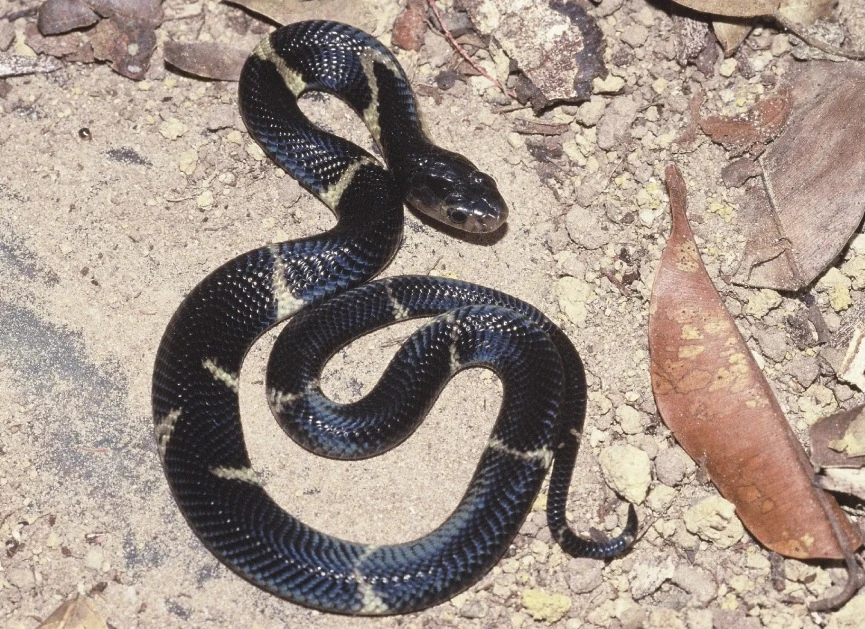
Reserved for a contributor imageCredit and usage rights will accompany the image.Naja sumatrana — juvenile photographed on the Santubong Peninsula, Sarawak, Malaysian Borneo.Johan van Rooijen · CC BY 3.0 · https://creativecommons.org/licenses/by/3.0
Life stages will be labelled from the contributor’s information. Images alone do not establish identification or a locality record.
Media provenance
Every image carries its source.
Naja sumatrana — juvenile photographed on the Santubong Peninsula, Sarawak, Malaysian Borneo.
Commons file metadata identifies Naja sumatrana. Caption/category attribution retained; not an independent specimen diagnosis. Resized and converted to WebP. Source checked 2026-10-11. This photograph does not establish occurrence in every country displaying the profile; age and sex are not inferred.
A species-specific clinical report describes abnormal heart beats followed by drooping eyelids after a bite, demonstrating systemic envenoming in addition to local effects.
Cardiac rhythm disturbance
Neurotoxic signs
One reported Naja sumatrana bite in Malaysia. This confirms medical significance; a single recovering patient does not establish a maximum possible severity or a typical outcome.
The cited human cases reported limited effects. Sparse observations cannot exclude a severe reaction.
Medically significant effects
The cited human cases document clinically important injury or illness. This is not an upper limit on severity.
Potentially life-threatening
Species-specific clinical evidence documents life-threatening illness or deaths after bites. The account explains the affected patients and any uncertainty about the cause.
Clinical severity not established
Venom presence is documented, but the reviewed evidence does not establish a clinical tier. When human effects are reported under an unresolved historical species name, the badge and account say so explicitly.
Venom status uncertain
The reviewed sources are inconclusive or conflicting about venom presence. The account explains the uncertainty.
Venom status not assessed
The atlas lacks a reviewed venom-presence classification for this species.
These are editorial summaries of the linked evidence, not toxicity rankings or WHO antivenom-priority categories. Effects vary with the bite and patient. Non-venomous does not mean safe to handle.
A closer look
Natural history & identification
Venom research
Three-finger toxins and phospholipases A₂ are major venom components. A 2022 comparison found substantial differences in alpha-neurotoxin abundance between samples from four locations.
Geographic venom variation · 2022 study
Comparative venom proteomics and experimental cross-neutralisation.
Antivenom findings
Thai Naja kaouthia monovalent antivenom cross-neutralised venom lethality to differing degrees in experimental tests.
Clinical interpretation These results do not establish a Philippine patient dose or effectiveness against Palawan envenoming.
Percentage of total venom proteins in the studied samples, not population averages or a Palawan venom profile.
Malaysia, southern Thailand and Sumatra; no Palawan sample.
Reproduction
The species account records egg-laying reproduction. A verified Philippine clutch-size range, incubation interval and breeding calendar are not established here.
Reproductive mode reported for this named species.
Mode alone does not establish litter or clutch size, seasonal timing, or captive husbandry requirements.
Philippine distribution
The atlas records Naja sumatrana from these named Philippine areas: Palawan, Calamian. These are literature areas rather than a continuous range boundary.
Literature documented · Existing checklist occurrence statement and distribution review
The original evidence level is retained.
A country listing cannot establish an island or a precise locality.
Taxonomic context
Naja sumatrana is retained in the atlas’s dated checklist under Elapidae. The authority is MÜLLER 1887. Earlier names and the original source notes are preserved below for comparison.
Literature documented · Checklist identity and nomenclatural trail
Checklist verified 2026-09-05; not a newly revised taxonomic backbone.
Historical names can cover different biological concepts; synonyms should not be used to transfer records automatically.
Additional sourced biology
Biology & natural history
Diet & feeding
Recorded prey include amphibians, reptiles, mammals and chicks. This is a compiled list of food records, not an exclusive diet.
Exact-name row in the 2024 literature compilation. These are records from studied populations, not typical values, an exhaustive biological account, or evidence of occurrence in every region.
These literature summaries retain their study locations and dates. Range-wide measurements and ecological categories are not separate Philippine observations.
Recorded size
SquamBase 1.0 records a literature maximum of 160 cm total length, including the tail. This is a compiled maximum, not a typical adult size or a measurement specific to this country.
Ground-dwelling activity is reported in the studies compiled by SquamBase. This describes the species across its studied range, not a record from every island.
A Berlayer Creek observation in October 2021 documented a cobra consuming a rat on leaf litter immediately beside the mangrove boardwalk in late morning. It is direct evidence of feeding within mangroves in Singapore, not a claim that this widespread snake is restricted to tidal forest.
The Thai government Red Data account (2005, p. 152) documents these named Thai localities. These are historical locality records, not a complete present-day range survey.
The 2023 annotated review explicitly lists these Singapore sites. They are selected named-locality evidence, not a full range polygon or a guarantee of current presence at every point. Sites marked as historical in that review are omitted from this mapped selection.
Select a highlighted area to see its status, island records and sources. Each country and island links to the same shared species collection.
Use “Worldwide records” to include distant introduced and uncertain records in the map view.
Singapore · regional locality evidence
Figueroa, Low & Lim (2023), the annotated national review, accepts this species for Singapore.
The 2023 annotated review explicitly lists these Singapore sites. They are selected named-locality evidence, not a full range polygon or a guarantee of current presence at every point. Sites marked as historical in that review are omitted from this mapped selection.
Thailand: country-level record; no named guide locality extracted.
The Thai government Red Data account (2005, p. 152) documents these named Thai localities. These are historical locality records, not a complete present-day range survey.
Southern peninsula → · Phang Nga (Khao Lak), Krabi (Khao Nor Chuchi), Nakhon Si Thammarat (Khao Luang), Songkhla (Ton Nga Chang), Yala (Bannang Sata), Narathiwat (Waeng)
The national checklist of Ahmad Sah et al. (published July 2026) includes this taxon for Brunei. The checklist combines historical literature with observations from 2021–2025; inclusion is not a claim of a recent sighting.
P. 107: historical vouchers BM04.1999, BM114.1986, UBD430 and BM86–87.2006; Batu Apoi attributed to Rader & Hemens (2002), without voucher number.
Explicit field-survey evidence from Tanjung Puting, Central Kalimantan, and an oil-palm estate in East Kalimantan. These are Indonesian records, not an inference from Malaysian Borneo.
Kalimantan coverage is supported by field records from Indonesian Borneo, not by extrapolating Malaysian localities.
The accepted authority is Müller, 1887; the 2026 synthesis contains a conflicting year in its heading.
Sumatra supported. Indonesian Kalimantan confirmed by field records; source specimen text mislabels Sarawak as Indonesian.
Across the archipelago
Where this species is recorded
PhilippinesN ↑
Documented islands: gold · island groups: dashed circles
Island-level records · not continuous habitat coverage. Dashed circles locate groups, not individual observations.
Philippine distribution
Documented places
2 named islands / island groups
Select an island to read its distribution record and sources. Uncoloured islands are not evidence of absence.
Distribution record & sources
Malaysia (Peninsula, East Malaysia, Pulau Pangkor, Pulau Tioman), Thailand, Singapore, Indonesia (Sumatra, Borneo, Bangka, Belitung),
Philippines (Palawan: Calamian Islands etc.)
Type locality: Solok, Sumatra.
The atlas records Naja sumatrana from these named Philippine areas: Palawan, Calamian. These are literature areas rather than a continuous range boundary.
Observe from a distance. Do not handle, corner or capture a snake to identify it. An incomplete venom account is not evidence that a species is safe to handle.
After a suspected snakebite, keep the person still and arrange urgent medical care. Avoid tight tourniquets, cutting, suction and unproven remedies. Do not wait to identify the snake before seeking help.
Equatorial Spitting cobra, Golden Spitting Cobra · Äquatoriale Speikobra, Sumatra-Kobra
Authority
MÜLLER 1887
Year described
1887
Taxonomic status
Accepted species
Family
Elapidae
Genus
Naja
Species epithet
sumatrana
Persistent ID
PH-SERP-7CE97CB5F4
Checklist checked
2026-09-05
Philippine occurrence
Status
Present
Confidence
Confirmed
Basis
2018 Philippine synopsis treatment plus current RDB listing
Islands named
Palawan, Calamian
Range noteCountry/island text is not a range polygon or locality record.
Source distribution statement
Malaysia (Peninsula, East Malaysia, Pulau Pangkor, Pulau Tioman), Thailand, Singapore, Indonesia (Sumatra, Borneo, Bangka, Belitung),
Philippines (Palawan: Calamian Islands etc.)
Type locality: Solok, Sumatra.
Venomous!
Distribution: Populations from the Malayan Peninsula were for a long time referred to as Naja naja sputatrix, those from Borneo as Naja naja miolepis. For a map see Shi et al. 2022: 3 (Fig. 1).
N. tripudans var. nigra: type: ZMB 7098, terra typica: Sarawak Borneo Indonesia, leg Doria.
References attached to this record
2026
The Reptile Database — species checklist, 17 June 2026
Equatorial Spitting Cobra (Naja sumatrana) from Malaysia (Negeri Sembilan and Penang), Southern Thailand, and Sumatra: Comparative Venom Proteomics, Immunoreactivity and Cross-Neutralization by Antivenom
Tan, C. H.; Tan, K. Y.; Wong, K. Y.; Tan, N. H.; Chong, H. P.
Naja sumatrana — The Reptile Database species account
Uetz, P.; Hallermann, J. et al. (editors)
Public species fields consulted for bounded biological summaries. Primary sources quoted within the database were not independently examined unless explicitly stated. The catalogue name may differ from the current source title.