Size & measurements
No sourced size & measurements summary has yet been added to this account.
Boidae · Species account
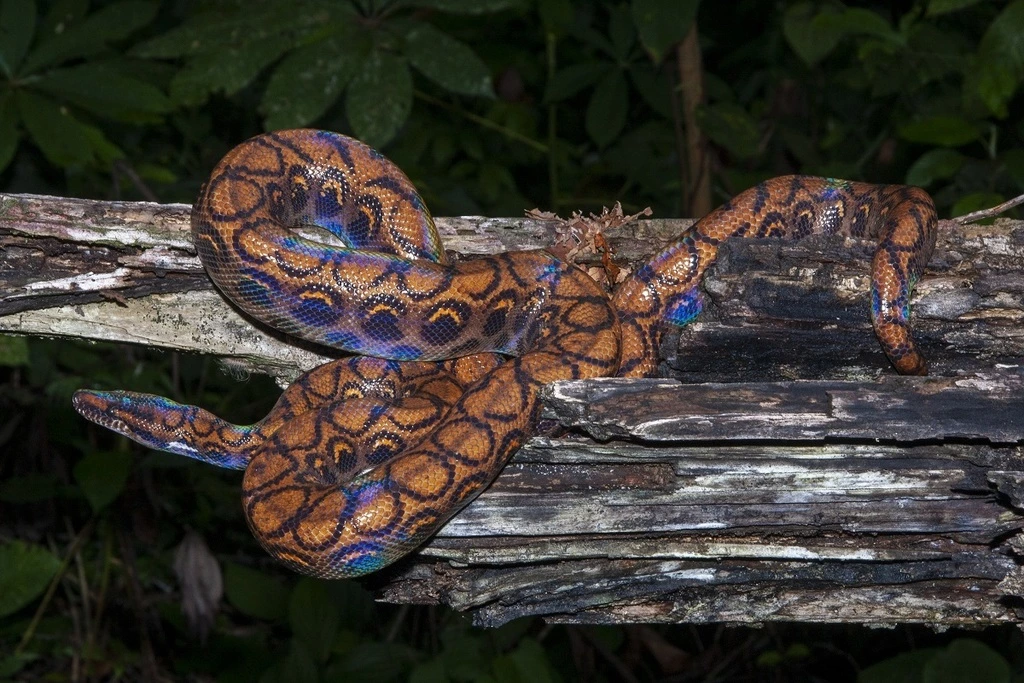
Epicrates cenchria(LINNAEUS, 1758)
Non-venomousThe treatment documents rainforest use in Suriname and describes climbing as well as ground activity. This habitat statement is limited to the country explicitly named by the source. Habitat categories do not create a new country or regional occurrence.
Venom & human effects
Assessed as non-venomous from an explicit source statement about boas, with this species’ membership checked separately.
Group-level assessment, not an individual venom study of Epicrates cenchria. The zoo account explicitly names Boidae and discusses boas across continents. Its old species totals are not used. Only exact Boidae membership in the retained taxonomy is used; other families with boa in a common name are excluded. This classification does not describe other possible injuries from a bite or constriction.
Family: Boidae; About section, paragraph beginning Not the bad guys. Membership: exact-species Reptile Database Higher Taxa field (Boidae (Boinae), Booidea, Henophidia, Alethinophidia, Serpentes, Squamata (snakes)).
These are editorial summaries of the linked evidence, not toxicity rankings or WHO antivenom-priority categories. Effects vary with the bite and patient. Non-venomous does not mean safe to handle.
The scientific identity
Reliable identification uses the published combination of scale characters, proportions and other diagnostic evidence. Colour or a photograph alone may not separate closely related species.
From observations & literature
No sourced size & measurements summary has yet been added to this account.
Identified stomach contents in the local sample included birds; Table 06 reports 1 individual with identifiable prey.
Original observations from Caxiuanã and adjacent areas, Pará, Brazil, reported in Maschio’s 2008 doctoral thesis. Local records do not establish species-wide preferences, breeding seasons or typical clutch sizes.
Maschio (2008), printed p. 70 / PDF page 70, Table 06, row Epicrates cenchria; sample count in parentheses.
No sourced activity & behaviour summary has yet been added to this account.
Live-bearing.
The treatment documents rainforest use in Suriname and describes climbing as well as ground activity. This habitat statement is limited to the country explicitly named by the source. Habitat categories do not create a new country or regional occurrence.
[2]Amazonian humid forests and occasional Orinoco savanna records. Bernal (2025), Colombia country account; no new regional occurrence is inferred.
[3][4]Table I records this species in the non-riparian part of the FEX-UFAM rainforest landscape near Manaus, through an occasional encounter within the study area. The forest category follows the study-site vegetation in Methods; it does not establish an aquatic habit, continuous occupancy or a new state record. Country-scoped literature evidence; no new regional occurrence or exclusive habitat preference is inferred.
[5]Aparicio et al. (2025), Table 2, report Epicrates cenchria in the Sub-Andean Amazon Forests, Pre-Andean Amazon Forests ecoregions of Madidi, Bolivia. These are broad ecological settings, not demonstrated microhabitat preferences. Only non-bold in/bo entries are used: modelled presence and outside-only records are excluded. The study counts a 1-km boundary buffer as inside; no new locality or countrywide distribution is inferred.
[6]A reported observation is not necessarily the full ecological range of a species. Where reproduction is inferred in a source dataset, the account identifies that limitation.
One species · Across borders
Explore the recorded countries and islands. Select a highlighted area to see its distribution evidence.
Loading geographic boundaries…
Click a highlighted country to zoom in and explore its records.
Shading identifies recorded countries or named islands, not continuous habitat coverage. Uncoloured areas do not establish absence.
Natural Earth · 1:50m · public domain; Gibraltar: geoBoundaries. Small islands may lack an outline.
Explore the distribution
Select a highlighted area to see its status, island records and sources. Each country and island links to the same shared species collection.
Use “Worldwide records” to include distant introduced and uncertain records in the map view.
The checked taxonomic distribution account explicitly lists Argentina. Country-level evidence does not establish continuous occupancy or a complete national inventory.
Locality source 1 ↗The checked taxonomic distribution account explicitly lists Bolivia. Country-level evidence does not establish continuous occupancy or a complete national inventory.
Locality source 1 ↗The checked taxonomic distribution account explicitly lists Brazil. Country-level evidence does not establish continuous occupancy or a complete national inventory.
Locality source 1 ↗The checked taxonomic distribution account explicitly lists Colombia. Country-level evidence does not establish continuous occupancy or a complete national inventory.
Locality source 1 ↗The checked taxonomic distribution account explicitly lists Guyana. Country-level evidence does not establish continuous occupancy or a complete national inventory.
Locality source 1 ↗The checked taxonomic distribution account explicitly lists Peru. Country-level evidence does not establish continuous occupancy or a complete national inventory.
Locality source 1 ↗The checked taxonomic distribution account explicitly lists Suriname. Country-level evidence does not establish continuous occupancy or a complete national inventory.
Locality source 1 ↗The checked taxonomic distribution account explicitly lists Venezuela. Country-level evidence does not establish continuous occupancy or a complete national inventory.
Locality source 1 ↗Country entries supported by this Americas review: Argentina, Bolivia, Brazil, Colombia, Guyana, Peru, Suriname, Venezuela. These are reviewed atlas entries, not a complete global distribution. [1]
The text retains the source’s geographic qualifications. The map shows countries with atlas occurrence records; it is not a complete global range model. A type locality is a nomenclatural reference, not the only place the species occurs.
Status & its meaning
No matching global assessment was verified for this account. This is an unresolved assessment link, not an IUCN “Not Evaluated” classification and not evidence that the species is secure.
Locality coverage in the atlas does not measure abundance, population trends or national legal protection.
Follow the evidence
Latest evidence added 2026-10-19. Taxonomic and distribution treatments may change.
The linked taxonomic treatment provides its original descriptions, revisions and bibliography. Observations from other countries are not relabelled as local field studies.