Colubridae · Species account

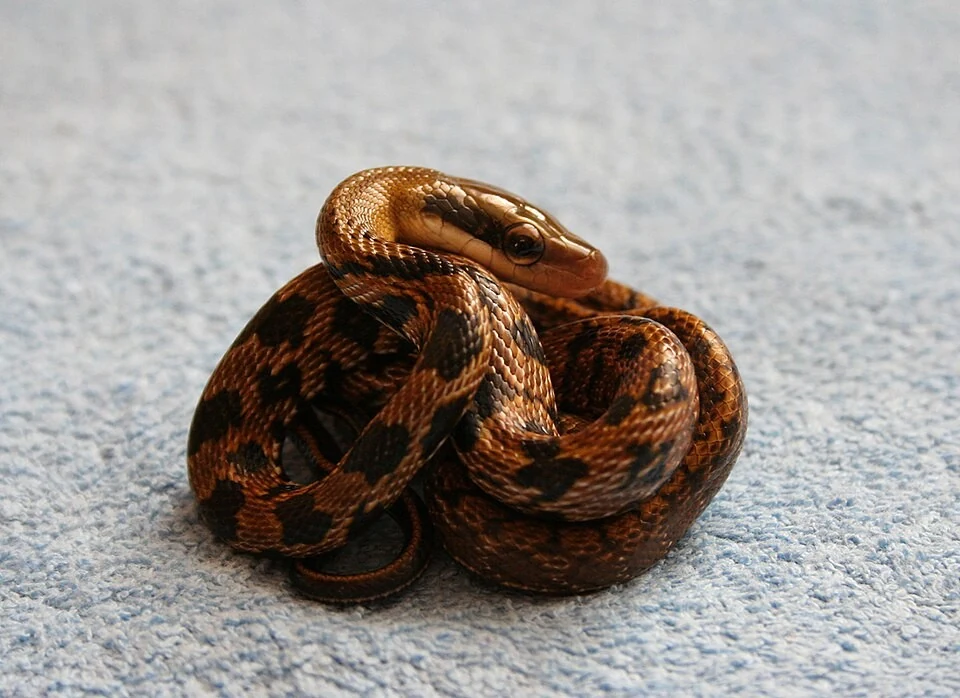
Beauty Snake (friesei: Taiwan Beauty Snake; schmackeri: Sakishima Beauty Snake; callicyanous: Blue Beauty Ratsnake)

Elaphe taeniuraCOPE, 1861

Non-venomous

Taiwan: New Taipei farmers recorded this species in cultivated fields during the 2024 monitoring programme; this establishes use of a farm setting, not dependence on it.

FamilyColubridae
ReproductionEgg-laying
Country chaptersBelgium · Cambodia · China · India · Indonesia · Japan · Laos · Taiwan · Vietnam · Malaysia · Thailand · Myanmar · Brunei · North Korea
Evidence updated2026-10-12
Explore its biology ↓

Venom & human effects

What is documented?

Non-venomous

Classified as non-venomous in the cited account of genus Elaphe; this species’ membership of that genus is verified separately.

Explicit genus-level classification applied to an exact listed member, not a species-specific venom assay or human clinical study of Elaphe taeniura. The group statement does not transfer diet, body size, behaviour or medical severity. No human-harm tier is inferred.

Evidence & scope · checked 2026-10-29

Jablonski et al. (2023), A new, rare, small-ranged, and endangered mountain snake of the genus Elaphe from the Southern Levant, Scientific Reports 13:4839, Abstract opening sentence and Introduction explicitly characterise the genus Elaphe as non-venomous. Membership: exact-species taxonomic account Elaphe taeniura.

How to read these badges
Limited documented effects
The cited human cases reported limited effects. Sparse observations cannot exclude a severe reaction.
Medically significant effects
The cited human cases document clinically important injury or illness. This is not an upper limit on severity.
Potentially life-threatening
Species-specific clinical evidence documents life-threatening illness or deaths after bites. The account explains the affected patients and any uncertainty about the cause.
Clinical severity not established
Venom presence is documented, but the reviewed evidence does not establish a clinical tier. When human effects are reported under an unresolved historical species name, the badge and account say so explicitly.
Venom status uncertain
The reviewed sources are inconclusive or conflicting about venom presence. The account explains the uncertainty.
Venom status not assessed
The atlas lacks a reviewed venom-presence classification for this species.

These are editorial summaries of the linked evidence, not toxicity rankings or WHO antivenom-priority categories. Effects vary with the bite and patient. Non-venomous does not mean safe to handle.

The scientific identity

Taxonomy & recognition

From observations & literature

Natural history

Size and ecological traits credited to SquamBase summarize published studies across the species’ range in its 2024 edition. They are complemented by the locality-specific observations below.

Size & measurements

Recorded size

The largest measurements compiled in SquamBase 1.0 are 270 cm total length (including the tail). These are separate literature maxima, not typical adult sizes or necessarily measurements of the same animal.

[2]

Recorded size

SquamBase 1.0 records a literature maximum of 270 cm total length, including the tail. This is a compiled maximum, not a typical adult size or a measurement specific to this country.

[2]

Diet & feeding

Feeding

Prey reported in the studies compiled by SquamBase include amphibians, mammals, birds and eggs. The list describes documented food rather than an exclusive diet.

[2]

Activity & behaviour

Use of the landscape

The cited ecological classification includes climbing as part of this species’ use of its environment. It does not imply that individuals remain exclusively in trees.

[1]

Activity

Daytime activity is reported.

[1]

Use of the landscape

The source classification reports partial use of trees. This does not establish occurrence in every forest.

[1]

Use of the landscape

Climbing and ground-dwelling activity is reported in the studies compiled by SquamBase. This describes the species across its studied range, not a record from every island.

[2]

Microhabitat and activity

Explicit traits in the habitat account include tree and shrub use.

[3]

Reproduction

Reproduction

Egg-laying.

[1]

Brood size

The compilation records 2–25 eggs per clutch. These published records need not represent the full variation between populations, and are not a separate estimate for Laos or Vietnam.

[2]

Habitat & ecology

Habitat & microhabitat · Taiwan

Taiwan: New Taipei farmers recorded this species in cultivated fields during the 2024 monitoring programme; this establishes use of a farm setting, not dependence on it.

[12]

Habitat & microhabitat · Belgium

In Belgium, the Hasselt study describes sunny railway embankments and adjacent built areas. Cable trays provide shelter and rodents provide prey. This local artificial habitat does not establish occupancy of Belgian forests; railway infrastructure is not a public wildlife-viewing site.

[13]
Further observations & source notes (12)

Range evidence · Myanmar

Myanmar is explicitly listed in the checked individual taxonomic treatment.

[3]

Range evidence · India

India is explicitly listed in the checked individual taxonomic treatment. The national ZSI checklist independently lists Elaphe taeniura. Regional evidence: Assam, Arunachal Pradesh, Mizoram, Sikkim. Named records do not imply continuous occurrence throughout a region.

[3][4]

Range evidence · Taiwan

Taiwan is explicitly listed in the checked individual taxonomic treatment.

[3]

Range evidence · China

China is explicitly recorded in the checked individual species treatment. The accepted identity is also represented in the 2025 checklist; regional inclusion here is based on explicit locality evidence, not the checklist’s broader geographical scope. Named regional records: Fujian. These localities do not imply continuous occupation of the entire region.

[5][6]

Range evidence · Japan

Japan has native schmackeri in the southern Ryukyus and introduced friesei on Okinawajima. Both belong to this shared species profile; the species count remains one.

[5][7][8]

Reviewed range - North Korea

Explicitly marked as a North Korean record.

[9][10]

Documented localities · Thailand

The Thai government Red Data account (2005, p. 143) documents these named Thai localities. The source uses the name Orthriophis taeniura yunnanensis and O. t. ridleyi. These are historical locality records, not a complete present-day range survey.

[14]

Documented localities · Vietnam

The 2024 provincial checklist explicitly lists this species in Thanh Hoa. The 2026 provincial checklist explicitly lists this species in Ha Tinh. The 2020 provincial checklist explicitly lists this species in Son La. This establishes a provincial record; it does not imply occurrence in every protected area or across the whole editorial region.

[15][16][17]

Documented localities · Taiwan

Taiwan: city-level New Taipei records from the 2024 farm-monitoring programme; individual farms are not assigned.

[18]

Documented localities · Japan

Japan has native schmackeri in the southern Ryukyus and introduced friesei on Okinawajima. Both belong to this shared species profile; the species count remains one.

[19][20]

Documented localities · Belgium

The study documents an introduced, reproducing population concentrated around western Hasselt. Records through 2019 include eggs and juveniles; they are a historical survey baseline, not a present-day population census.

[21]

Documented localities · Myanmar

Type locality of helfenbergeri. Historical “Tenasserim” here means Sukli in present-day Kayin. Chin Xai belongs to a Vietnamese locality and does not establish a Chin State record.

[22]
Further natural-history studies from Indonesia

Egg-laying (oviparous). [1]

The database classifies its habitat use as partly arboreal. [1]

Activity is described as diurnal in the source. [1]

A reported observation is not necessarily the full ecological range of a species. Where reproduction is inferred in a source dataset, the account identifies that limitation.

One species · Across borders

Global distribution

Explore the recorded countries and islands. Select a highlighted area to see its distribution evidence.

Recorded distribution
Elaphe taeniura — select a recorded country or island

Loading geographic boundaries…

ListedIntroducedUncertain

Click a highlighted country to zoom in and explore its records.

Shading identifies recorded countries or named islands, not continuous habitat coverage. Uncoloured areas do not establish absence.

Natural Earth · 1:50m · public domain; Gibraltar: geoBoundaries. Small islands may lack an outline.

Explore the distribution

Across borders

14 recorded countries & territories

Select a highlighted area to see its status, island records and sources. Each country and island links to the same shared species collection.

Use “Worldwide records” to include distant introduced and uncertain records in the map view.

Belgium · regional locality evidence

Introduced Belgian population, not native. The study documents an introduced, reproducing population concentrated around western Hasselt. Records through 2019 include eggs and juveniles; they are a historical survey baseline, not a present-day population census.

Flanders → · Hasselt, Limburg (records 2006–2019)

Locality source 1 ↗ Locality source 2 ↗
Cambodia · regional locality evidence

Japan has native schmackeri and introduced friesei; Bhutan is only possible. Korea remains an unresolved country label.

Locality source 1 ↗
China · regional locality evidence

China is explicitly recorded in the checked individual species treatment. The accepted identity is also represented in the 2025 checklist; regional inclusion here is based on explicit locality evidence, not the checklist’s broader geographical scope. Named regional records: Fujian. These localities do not imply continuous occupation of the entire region.

Eastern hills, rivers & coast → · Fujian

Locality source 1 ↗ Locality source 2 ↗
India · regional locality evidence

India is explicitly listed in the checked individual taxonomic treatment. The national ZSI checklist independently lists Elaphe taeniura. Regional evidence: Assam, Arunachal Pradesh, Mizoram, Sikkim. Named records do not imply continuous occurrence throughout a region.

Northeastern hills & Brahmaputra → · Assam, Arunachal Pradesh, Mizoram, Sikkim

Locality source 1 ↗ Locality source 2 ↗
Japan · regional locality evidence

Japan has native schmackeri in the southern Ryukyus and introduced friesei on Okinawajima. Both belong to this shared species profile; the species count remains one.

Okinawa, Miyako & Yaeyama → · Miyakojima (native schmackeri), Okinawajima (introduced friesei)

Locality source 1 ↗ Locality source 2 ↗
Laos · regional locality evidence

Laos: national occurrence; no finer locality is assigned in this atlas.

Locality source 1 ↗
Taiwan · regional locality evidence

Taiwan is explicitly listed in the checked individual taxonomic treatment. Taiwan: city-level New Taipei records from the 2024 farm-monitoring programme; individual farms are not assigned.

Northern Taiwan → · New Taipei farm monitoring sites

Locality source 1 ↗ Locality source 2 ↗
Vietnam · regional locality evidence

Vietnam: Cao Bang; Ha Tinh. The 2024 provincial checklist explicitly lists this species in Thanh Hoa. The 2026 provincial checklist explicitly lists this species in Ha Tinh. The 2020 provincial checklist explicitly lists this species in Son La. This establishes a provincial record; it does not imply occurrence in every protected area or across the whole editorial region.

Northeast mountains & karst → · Cao Bang

North Central Coast & Annamites → · Ha Tinh, Thanh Hoa

Northwest mountains → · Son La

Locality source 1 ↗ Locality source 2 ↗ Locality source 3 ↗ Locality source 4 ↗
Malaysia · regional locality evidence

Malaysia: W Malaysia, Malaya, Selangor, Kuala Lumpur, Tioman.

Peninsular Malaysia → · W Malaysia, Malaya, Selangor, Kuala Lumpur, Tioman

Locality source 1 ↗
Thailand · regional locality evidence

Thailand: country-level record; no named guide locality extracted. The Thai government Red Data account (2005, p. 143) documents these named Thai localities. The source uses the name Orthriophis taeniura yunnanensis and O. t. ridleyi. These are historical locality records, not a complete present-day range survey.

Northeastern plateau → · Loei (Phu Luang)

Western mountains → · Kanchanaburi (Sai Yok, Salak Phra), Phetchaburi (Khao Yoi)

Southern peninsula → · Surat Thani (Khlong Saeng), Nakhon Si Thammarat (Kaeo Surakan Cave), Songkhla (Ton Nga Chang), Satun, Yala (Bannang Sata, Than To), Narathiwat (Waeng)

Locality source 1 ↗ Locality source 2 ↗
Myanmar · regional locality evidence

Myanmar is explicitly listed in the checked individual taxonomic treatment. Type locality of helfenbergeri. Historical “Tenasserim” here means Sukli in present-day Kayin. Chin Xai belongs to a Vietnamese locality and does not establish a Chin State record.

Eastern uplands → · Kayin, Karen, Sukli, Dawna Mountains, Kayin

Locality source 1 ↗
Brunei · regional locality evidence

The national checklist of Ahmad Sah et al. (published July 2026) includes this taxon for Brunei. The checklist combines historical literature with observations from 2021–2025; inclusion is not a claim of a recent sighting.

Locality source 1 ↗
North Korea · regional locality evidence

Explicitly marked as a North Korean record.

Locality source 1 ↗ Locality source 2 ↗
Indonesian locality notes and qualifications
Sumatra
Sumatra
Kalimantan
Batu Hapu; Pengaron, Kalimantan

Explicit Indonesian country or island locality supports inclusion.

Geographic scope of the source

Documented country records: Belgium, Brunei, Cambodia, China, India, Indonesia, Japan, Laos, Malaysia, Myanmar, North Korea, Taiwan, Thailand, Vietnam. Country records do not imply continuous occupancy. Records held for identity or occurrence review: Bhutan, South Korea. [25][26][27][28][29][30][31][32][33][34][35]

The text retains the source’s geographic qualifications. The map shows countries with atlas occurrence records; it is not a complete global range model. A type locality is a nomenclatural reference, not the only place the species occurs.

Status & its meaning

Conservation

Vulnerable

Global IUCN category indexed by iNaturalist for this scientific name. It is not a separate assessment of a national population, and its assessment date may predate later taxonomic changes.

Read the IUCN assessment ↗ · Taxon index & assessment link ↗

Locality coverage in the atlas does not measure abundance, population trends or national legal protection.

Follow the evidence

Sources & further reading

Latest evidence added 2026-10-12. Taxonomic and distribution treatments may change.

  1. The Reptile Database: Elaphe taeniura
  2. Meiri (2024), SquamBase 1.0 — data row: Elaphe taeniura (CC0)
  3. The Reptile Database: Elaphe taeniura
  4. Zoological Survey of India: Fauna of India Checklist, Reptilia (2025)
  5. The Reptile Database: Elaphe taeniura
  6. Jiang et al. (2025): updated snake checklist, Appendix I
  7. Herpetological Society of Japan: checklist, 2 July 2026
  8. Herpetological Society of Japan: checklist, 2 July 2026
  9. The Reptile Database: Elaphe taeniura
  10. Korean Society of Herpetologists: April 2025 checklist
  11. The Reptile Database: Elaphe taeniura
  12. New Taipei Agriculture Department (16 July 2025): farm biodiversity observations
  13. Van Doorn et al. (2022): Aesthetic aliens — Elaphe taeniura in Belgium
  14. ONEP: Thailand Red Data — Mammals, Reptiles and Amphibians (2005), named locality tables
  15. Dau et al. (2024): New records and an updated list of reptiles from Thanh Hoa Province, Vietnam
  16. Pham et al. (2026): New records and an updated list of snakes from Ha Tinh Province, Vietnam
  17. Pham et al. (2020): New records and an updated checklist of snakes from Son La Province, Vietnam
  18. New Taipei Agriculture Department (16 July 2025): farm biodiversity observations
  19. The Reptile Database: Elaphe taeniura
  20. Herpetological Society of Japan: checklist, 2 July 2026
  21. Van Doorn et al. (2022): Aesthetic aliens — Elaphe taeniura in Belgium
  22. The Reptile Database · Elaphe taeniura · locality and synonymy review
  23. Photograph provenance — Elaphe taeniura (source 1)
  24. Photograph provenance — Elaphe taeniura (source 2)
  25. Reviewed country treatments and primary evidence
  26. Jiang et al. (2025): updated snake checklist, Appendix I
  27. Zoological Survey of India: Fauna of India Checklist, Reptilia (2025)
  28. Herpetological Society of Japan: checklist, 2 July 2026
  29. Distribution evidence — Elaphe taeniura (source 5)
  30. Distribution evidence — Elaphe taeniura (source 6)
  31. Distribution evidence — Elaphe taeniura (source 7)
  32. Distribution evidence — Elaphe taeniura (source 8)
  33. Distribution evidence — Elaphe taeniura (source 9)
  34. Distribution evidence — Elaphe taeniura (source 10)
  35. Korean Society of Herpetologists: April 2025 checklist

The linked taxonomic treatment provides its original descriptions, revisions and bibliography. Observations from other countries are not relabelled as local field studies.