Size & measurements
Recorded size
SquamBase 1.0 records a literature maximum of 95 cm total length, including the tail. This is a compiled maximum, not a typical adult size or a measurement specific to this country.
[2]Viperidae · Species account
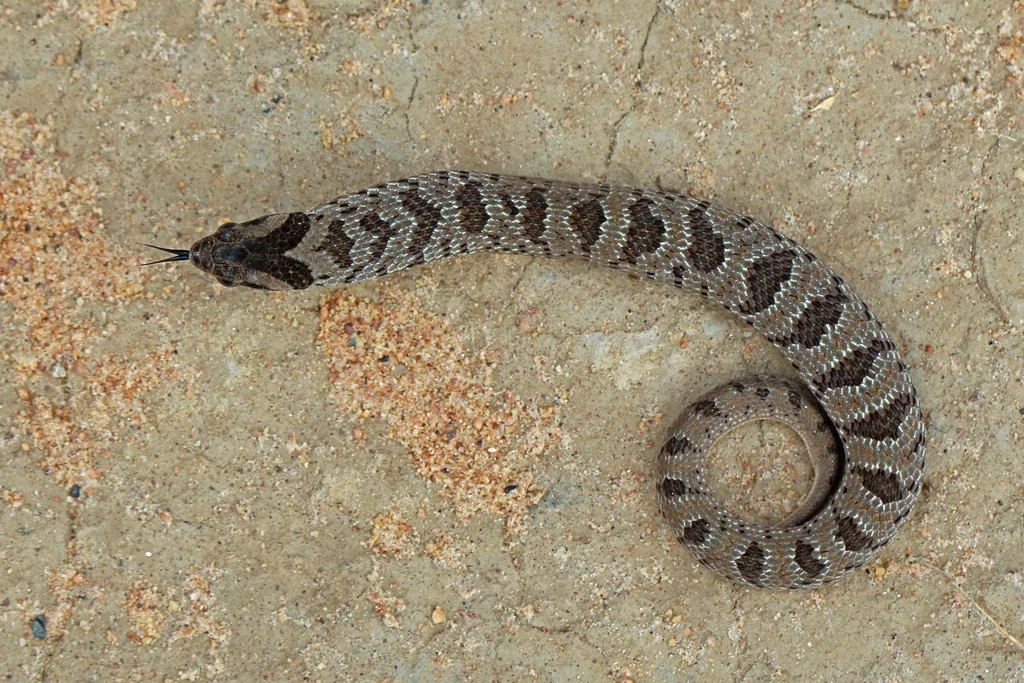
Causus rhombeatus(LICHTENSTEIN, 1823)
VenomousClinical severity not establishedGround-dwelling activity is reported in the studies compiled by SquamBase. This describes the species across its studied range, not a record from every country or region.
Venom & human effects
The species account explicitly identifies this snake as venomous. Human medical effects have not yet been assessed for this atlas.
Exact-species statement in the retained Reptile Database treatment; this review establishes venom presence only, not human bite severity.
Comment field: Venomous.
These are editorial summaries of the linked evidence, not toxicity rankings or WHO antivenom-priority categories. Effects vary with the bite and patient. Non-venomous does not mean safe to handle.
The scientific identity
Reliable identification uses the published combination of scale characters, proportions and other diagnostic evidence. Colour or a photograph alone may not separate closely related species.
From observations & literature
Size and ecological traits credited to SquamBase summarize published studies across the species’ range in its 2024 edition. They are complemented by the locality-specific observations below.
SquamBase 1.0 records a literature maximum of 95 cm total length, including the tail. This is a compiled maximum, not a typical adult size or a measurement specific to this country.
[2]Documented wild feeding records include anuran amphibians. These are recorded prey groups, not an exclusive diet.
Published observations compiled in SquamataBase, restricted to natural settings and successful feeding. Original and current predator names match exactly; historical species concepts flagged by the retained taxonomic treatments are excluded. These prey records do not establish a complete diet, prey preferences, proportions, or the diet of every age or population.
SquamataBase diet.csv at commit 97cf7d756f59e3ee0fb72d4c3fe5e1c1fccb42ec; CSV data records (header is row 1): 8056, 8193, 8194, 8556, 8836, 8837, 9257. Original published sources, as cited in the compilation: Contributions to the herpetology of the Belgian Congo based on the collection of the American Museum Congo Expedition, 1909-1915. Part II. Snakes, with field notes by Herbert Lang and James P. Chapin. 1923. Bulletin of the American Museum of Natural History 49(1): 1-146 | Herpetological results of the Vernay Angola expedition: with notes on African reptiles in other collections. Part 1, Snakes, including an arrangement of African Colubridae. 1940. Bulletin of the American Museum of Natural History 77(1): 1-107 | Notes on a collection of reptiles from Zambia and adjacent areas of the Democratic Republic of the Congo. 2000. Annals of the Eastern Cape Museums 1: 1-25 | Reptiles from Nyasaland and Tete. 1953. Bulletin of the Museum of Comparative Zoology 110: 143-322 | The Snakes of Sierra Leone. 1966. Copeia 1966(2): 169-179
Ground-dwelling activity is reported in the studies compiled by SquamBase. This describes the species across its studied range, not a record from every country or region.
[2]Published records compiled in SquamBase report 1–28 eggs per clutch. These are the smallest and largest reported broods in the compilation, not a typical brood size or a complete limit for the species.
Exact-name row in the 2024 literature compilation. These are records from studied populations, not typical values, an exhaustive biological account, or evidence of occurrence in every region.
SquamBase 1.0, Supplementary Table S1, row 8390: Causus rhombeatus; columns Mode of reproduction, Mode of reproduction metadata, smallest brood, largest brood, brood size metadata.
The cited compilation records microhabitat use including ground-level habitats.
Exact-name entry in the 2024 SquamBase literature compilation, using an explicitly populated trait and its cited metadata. Records reflect the studied populations; they do not establish uniform behaviour across all seasons, ages or localities. Historical species concepts requiring review and imputed/uncertain metadata are excluded. This describes substrate or microhabitat use, not vegetation, a geographical range, or use of every habitat in that range.
SquamBase 1.0, Supplementary Table S1, row 8390: Causus rhombeatus; columns substrate and substrate metadata. Recorded value: Terrestrial. Original source metadata: "surficial (terrestrial, non-scansorial)" (Gearty et al. 2021), terrestrial (Wilkey and Terrell 2017, van Huyssteen 2023, Trape 2023), largely terrestrial (Marais 2022, Malonza and Bwong 2023), terrestrial but will climb when chasing frogs (Spawls et al. 2023)
Cabinda: observation GBIF 6273156343 (2026). The original iNaturalist entry was rechecked for research-grade identification, wild status and unrestricted coordinates; its reported uncertainty footprint lies within the mapped region. This is a community-reviewed observation, not a museum voucher. Central highlands: observation GBIF 5062999789 (2025). The original iNaturalist entry was rechecked for research-grade identification, wild status and unrestricted coordinates; its reported uncertainty footprint lies within the mapped region. This is a community-reviewed observation, not a museum voucher. Eastern plateaus: museum voucher MUHNAC IICT/R Angola4 (1968). The museum record's reported coordinate uncertainty footprint lies within the mapped region. Eastern plateaus: museum voucher MUHNAC IICT/R Angola19 (1968). The museum record's reported coordinate uncertainty footprint lies within the mapped region. Southern interior: museum voucher MCZ R-74125 (1962). The museum record's reported coordinate uncertainty footprint lies within the mapped region. These are dated locality records, not evidence of occurrence throughout every part of a region or a complete present-day inventory.
[3][4][5][6][7][8][9]North-West District: observation GBIF 2851290864 (2013). The original iNaturalist entry was rechecked for research-grade identification, wild status and unrestricted coordinates; its reported uncertainty footprint lies within the mapped region. This is a community-reviewed observation, not a museum voucher. These are dated locality records, not evidence of occurrence throughout every part of a region or a complete present-day inventory.
[10][11]South-West: museum voucher YPM YPM HERR 008052 (1971). The museum record's reported coordinate uncertainty footprint lies within the mapped region. These are dated locality records, not evidence of occurrence throughout every part of a region or a complete present-day inventory.
[12]Southeastern plateaus: museum voucher RBINS 9380 (1949). The museum record's reported coordinate uncertainty footprint lies within the mapped region. Southeastern plateaus: museum voucher RBINS 9379 (1949). The museum record's reported coordinate uncertainty footprint lies within the mapped region. Uele & Ubangi: museum voucher RBINS 9537 (1954). The museum record's reported coordinate uncertainty footprint lies within the mapped region. Uele & Ubangi: museum voucher RBINS-Scientific Heritage 9537 (1954). The museum record's reported coordinate uncertainty footprint lies within the mapped region. Kasai & Lomami: museum voucher RBINS 10291 (1949). The museum record's reported coordinate uncertainty footprint lies within the mapped region. Kasai & Lomami: museum voucher RBINS-Scientific Heritage 10291 (1949). The museum record's reported coordinate uncertainty footprint lies within the mapped region. These are dated locality records, not evidence of occurrence throughout every part of a region or a complete present-day inventory.
[13][14][15][16][17][18]Hhohho: observation GBIF 6188673123 (2026). The original iNaturalist entry was rechecked for research-grade identification, wild status and unrestricted coordinates; its reported uncertainty footprint lies within the mapped region. This is a community-reviewed observation, not a museum voucher. Shiselweni: observation GBIF 1802704899 (2017). The original iNaturalist entry was rechecked for research-grade identification, wild status and unrestricted coordinates; its reported uncertainty footprint lies within the mapped region. This is a community-reviewed observation, not a museum voucher. These are dated locality records, not evidence of occurrence throughout every part of a region or a complete present-day inventory.
[19][20][21][22]SNNPR: observation GBIF 1993709965 (2013). The original iNaturalist entry was rechecked for research-grade identification, wild status and unrestricted coordinates; its reported uncertainty footprint lies within the mapped region. This is a community-reviewed observation, not a museum voucher. These are dated locality records, not evidence of occurrence throughout every part of a region or a complete present-day inventory. MCZ catalogue R-80986: 40km S.Inda Selassie; 1964-07-25. Institution-published preserved-specimen record, rechecked through GBIF. Assignment uses the named locality and province, not an assumed precise coordinate or a country-wide range. Historical occurrence; current population status is not established.
[23][24][25][26]Southern Rift & Nairobi: museum voucher UMMZ 61253 (1915). The museum record's reported coordinate uncertainty footprint lies within the mapped region. Southern Rift & Nairobi: observation GBIF 2451717085 (2010). The original iNaturalist entry was rechecked for research-grade identification, wild status and unrestricted coordinates; its reported uncertainty footprint lies within the mapped region. This is a community-reviewed observation, not a museum voucher. Central highlands: museum voucher MCZ R-8168 (1909). The museum record's reported coordinate uncertainty footprint lies within the mapped region. These are dated locality records, not evidence of occurrence throughout every part of a region or a complete present-day inventory.
[27][28][29][30]KwaZulu-Natal: observation 367768080, 2026-06-02. North West: observation 337672706, 2026-02-07. North West: observation 331523273, 2025-12-21. Gauteng: observation 400177256, 2026-09-14. Gauteng: observation 398382491, 2026-09-06. Mpumalanga: observation 383905102, 2026-07-21. Original records have agreeing research-grade identifications, wild status and open coordinates. Points and sampled reported uncertainty envelopes fall within the mapped region. These are dated community-reviewed observations, not museum vouchers or evidence of presence throughout the region. Exact coordinates are not republished.
[31][32][33][34][35][36][37][38][39][40][41][42]Western mainland: observation 101522851, 2021-11-17. Original records have agreeing research-grade identifications, wild status and open coordinates. Points and sampled reported uncertainty envelopes fall within the mapped region. These are dated community-reviewed observations, not museum vouchers or evidence of presence throughout the region. Exact coordinates are not republished.
[43][44]Lusaka: observation 401558945, 2026-09-19. Lusaka: observation 118478680, 2022-05-22. Muchinga: observation 256358949, 2024-12-27. Muchinga: observation 141782988, 2022-04-02. Copperbelt: observation 45850837, 2020-05-09. Copperbelt: observation 11979655, 2018-04-28. Original records have agreeing research-grade identifications, wild status and open coordinates. Points and sampled reported uncertainty envelopes fall within the mapped region. These are dated community-reviewed observations, not museum vouchers or evidence of presence throughout the region. Exact coordinates are not republished.
[45][46][47][48][49][50][51][52][53][54][55][56]Harare: observation 267926619, 2025-03-30. Harare: observation 105542202, 1967-02-04. Matabeleland South: observation 29456406, 2019-04-15. Original records have agreeing research-grade identifications, wild status and open coordinates. Points and sampled reported uncertainty envelopes fall within the mapped region. These are dated community-reviewed observations, not museum vouchers or evidence of presence throughout the region. Exact coordinates are not republished.
[57][58][59][60][61][62]A reported observation is not necessarily the full ecological range of a species. Where reproduction is inferred in a source dataset, the account identifies that limitation.
One species · Across borders
Explore the recorded countries and islands. Select a highlighted area to see its distribution evidence.
Loading geographic boundaries…
Click a highlighted country to zoom in and explore its records.
Shading identifies recorded countries or named islands, not continuous habitat coverage. Uncoloured areas do not establish absence.
Natural Earth · 1:50m · public domain; Gibraltar: geoBoundaries. Small islands may lack an outline.
Explore the distribution
Select a highlighted area to see its status, island records and sources. Each country and island links to the same shared species collection.
Use “Worldwide records” to include distant introduced and uncertain records in the map view.
The current taxonomic treatment explicitly lists this country. This is country-scale checklist evidence, not a claim of continuous occupancy or a complete regional inventory. Cabinda: observation GBIF 6273156343 (2026). The original iNaturalist entry was rechecked for research-grade identification, wild status and unrestricted coordinates; its reported uncertainty footprint lies within the mapped region. This is a community-reviewed observation, not a museum voucher. Central highlands: observation GBIF 5062999789 (2025). The original iNaturalist entry was rechecked for research-grade identification, wild status and unrestricted coordinates; its reported uncertainty footprint lies within the mapped region. This is a community-reviewed observation, not a museum voucher. Eastern plateaus: museum voucher MUHNAC IICT/R Angola4 (1968). The museum record's reported coordinate uncertainty footprint lies within the mapped region. Eastern plateaus: museum voucher MUHNAC IICT/R Angola19 (1968). The museum record's reported coordinate uncertainty footprint lies within the mapped region. Southern interior: museum voucher MCZ R-74125 (1962). The museum record's reported coordinate uncertainty footprint lies within the mapped region. These are dated locality records, not evidence of occurrence throughout every part of a region or a complete present-day inventory.
Cabinda → · Cabinda
Central highlands → · Central highlands
Eastern plateaus → · Eastern plateaus
Southern interior → · Southern interior
Locality source 1 ↗ Locality source 2 ↗ Locality source 3 ↗ Locality source 4 ↗ Locality source 5 ↗ Locality source 6 ↗ Locality source 7 ↗ Locality source 8 ↗The current taxonomic treatment explicitly lists this country. This is country-scale checklist evidence, not a claim of continuous occupancy or a complete regional inventory. North-West District: observation GBIF 2851290864 (2013). The original iNaturalist entry was rechecked for research-grade identification, wild status and unrestricted coordinates; its reported uncertainty footprint lies within the mapped region. This is a community-reviewed observation, not a museum voucher. These are dated locality records, not evidence of occurrence throughout every part of a region or a complete present-day inventory.
North-West District → · North-West District
Locality source 1 ↗ Locality source 2 ↗ Locality source 3 ↗The current taxonomic treatment explicitly lists this country. This is country-scale checklist evidence, not a claim of continuous occupancy or a complete regional inventory.
Locality source 1 ↗The current taxonomic treatment explicitly lists this country. This is country-scale checklist evidence, not a claim of continuous occupancy or a complete regional inventory. South-West: museum voucher YPM YPM HERR 008052 (1971). The museum record's reported coordinate uncertainty footprint lies within the mapped region. These are dated locality records, not evidence of occurrence throughout every part of a region or a complete present-day inventory.
South-West → · South-West
Locality source 1 ↗ Locality source 2 ↗The current taxonomic treatment explicitly lists this country. This is country-scale checklist evidence, not a claim of continuous occupancy or a complete regional inventory.
Locality source 1 ↗The current taxonomic treatment explicitly lists this country. This is country-scale checklist evidence, not a claim of continuous occupancy or a complete regional inventory. Southeastern plateaus: museum voucher RBINS 9380 (1949). The museum record's reported coordinate uncertainty footprint lies within the mapped region. Southeastern plateaus: museum voucher RBINS 9379 (1949). The museum record's reported coordinate uncertainty footprint lies within the mapped region. Uele & Ubangi: museum voucher RBINS 9537 (1954). The museum record's reported coordinate uncertainty footprint lies within the mapped region. Uele & Ubangi: museum voucher RBINS-Scientific Heritage 9537 (1954). The museum record's reported coordinate uncertainty footprint lies within the mapped region. Kasai & Lomami: museum voucher RBINS 10291 (1949). The museum record's reported coordinate uncertainty footprint lies within the mapped region. Kasai & Lomami: museum voucher RBINS-Scientific Heritage 10291 (1949). The museum record's reported coordinate uncertainty footprint lies within the mapped region. These are dated locality records, not evidence of occurrence throughout every part of a region or a complete present-day inventory.
Southeastern plateaus → · Southeastern plateaus
Uele & Ubangi → · Uele & Ubangi
Kasai & Lomami → · Kasai & Lomami
Locality source 1 ↗ Locality source 2 ↗ Locality source 3 ↗ Locality source 4 ↗ Locality source 5 ↗ Locality source 6 ↗ Locality source 7 ↗The current taxonomic treatment explicitly lists this country. This is country-scale checklist evidence, not a claim of continuous occupancy or a complete regional inventory. SNNPR: observation GBIF 1993709965 (2013). The original iNaturalist entry was rechecked for research-grade identification, wild status and unrestricted coordinates; its reported uncertainty footprint lies within the mapped region. This is a community-reviewed observation, not a museum voucher. These are dated locality records, not evidence of occurrence throughout every part of a region or a complete present-day inventory. MCZ catalogue R-80986: 40km S.Inda Selassie; 1964-07-25. Institution-published preserved-specimen record, rechecked through GBIF. Assignment uses the named locality and province, not an assumed precise coordinate or a country-wide range. Historical occurrence; current population status is not established.
SNNPR → · SNNPR
Tigray → · 40km S.Inda Selassie
Locality source 1 ↗ Locality source 2 ↗ Locality source 3 ↗ Locality source 4 ↗ Locality source 5 ↗The current taxonomic treatment explicitly lists this country. This is country-scale checklist evidence, not a claim of continuous occupancy or a complete regional inventory. Southern Rift & Nairobi: museum voucher UMMZ 61253 (1915). The museum record's reported coordinate uncertainty footprint lies within the mapped region. Southern Rift & Nairobi: observation GBIF 2451717085 (2010). The original iNaturalist entry was rechecked for research-grade identification, wild status and unrestricted coordinates; its reported uncertainty footprint lies within the mapped region. This is a community-reviewed observation, not a museum voucher. Central highlands: museum voucher MCZ R-8168 (1909). The museum record's reported coordinate uncertainty footprint lies within the mapped region. These are dated locality records, not evidence of occurrence throughout every part of a region or a complete present-day inventory.
Southern Rift & Nairobi → · Southern Rift & Nairobi
Central highlands → · Central highlands
Locality source 1 ↗ Locality source 2 ↗ Locality source 3 ↗ Locality source 4 ↗ Locality source 5 ↗The current taxonomic treatment explicitly lists this country. This is country-scale checklist evidence, not a claim of continuous occupancy or a complete regional inventory.
Locality source 1 ↗The current taxonomic treatment explicitly lists this country. This is country-scale checklist evidence, not a claim of continuous occupancy or a complete regional inventory.
Locality source 1 ↗The current taxonomic treatment explicitly lists this country. This is country-scale checklist evidence, not a claim of continuous occupancy or a complete regional inventory.
Locality source 1 ↗The current taxonomic treatment explicitly lists this country. This is country-scale checklist evidence, not a claim of continuous occupancy or a complete regional inventory.
Locality source 1 ↗The current taxonomic treatment explicitly lists this country. This is country-scale checklist evidence, not a claim of continuous occupancy or a complete regional inventory.
Locality source 1 ↗The current taxonomic treatment explicitly lists this country. This is country-scale checklist evidence, not a claim of continuous occupancy or a complete regional inventory.
Locality source 1 ↗The current taxonomic treatment explicitly lists this country. This is country-scale checklist evidence, not a claim of continuous occupancy or a complete regional inventory.
Locality source 1 ↗The current taxonomic treatment explicitly lists this country. This is country-scale checklist evidence, not a claim of continuous occupancy or a complete regional inventory. The country-scale source may cover a wider area than the separately labelled Somalia outline in this geographic atlas; regional placements require their own localities.
Locality source 1 ↗The current taxonomic treatment explicitly lists this country. This is country-scale checklist evidence, not a claim of continuous occupancy or a complete regional inventory. KwaZulu-Natal: observation 367768080, 2026-06-02. North West: observation 337672706, 2026-02-07. North West: observation 331523273, 2025-12-21. Gauteng: observation 400177256, 2026-09-14. Gauteng: observation 398382491, 2026-09-06. Mpumalanga: observation 383905102, 2026-07-21. Original records have agreeing research-grade identifications, wild status and open coordinates. Points and sampled reported uncertainty envelopes fall within the mapped region. These are dated community-reviewed observations, not museum vouchers or evidence of presence throughout the region. Exact coordinates are not republished.
KwaZulu-Natal → · KwaZulu-Natal
North West → · North West
Gauteng → · Gauteng
Mpumalanga → · Mpumalanga
Locality source 1 ↗ Locality source 2 ↗ Locality source 3 ↗ Locality source 4 ↗ Locality source 5 ↗ Locality source 6 ↗ Locality source 7 ↗ Locality source 8 ↗ Locality source 9 ↗ Locality source 10 ↗ Locality source 11 ↗ Locality source 12 ↗ Locality source 13 ↗The current taxonomic treatment explicitly lists this country. This is country-scale checklist evidence, not a claim of continuous occupancy or a complete regional inventory.
Locality source 1 ↗The current taxonomic treatment explicitly lists this country. This is country-scale checklist evidence, not a claim of continuous occupancy or a complete regional inventory.
Locality source 1 ↗The current taxonomic treatment explicitly lists this country. This is country-scale checklist evidence, not a claim of continuous occupancy or a complete regional inventory.
Locality source 1 ↗The current taxonomic treatment explicitly lists this country. This is country-scale checklist evidence, not a claim of continuous occupancy or a complete regional inventory. Western mainland: observation 101522851, 2021-11-17. Original records have agreeing research-grade identifications, wild status and open coordinates. Points and sampled reported uncertainty envelopes fall within the mapped region. These are dated community-reviewed observations, not museum vouchers or evidence of presence throughout the region. Exact coordinates are not republished.
Western mainland → · Western mainland
Locality source 1 ↗ Locality source 2 ↗ Locality source 3 ↗The current taxonomic treatment explicitly lists this country. This is country-scale checklist evidence, not a claim of continuous occupancy or a complete regional inventory. Lusaka: observation 401558945, 2026-09-19. Lusaka: observation 118478680, 2022-05-22. Muchinga: observation 256358949, 2024-12-27. Muchinga: observation 141782988, 2022-04-02. Copperbelt: observation 45850837, 2020-05-09. Copperbelt: observation 11979655, 2018-04-28. Original records have agreeing research-grade identifications, wild status and open coordinates. Points and sampled reported uncertainty envelopes fall within the mapped region. These are dated community-reviewed observations, not museum vouchers or evidence of presence throughout the region. Exact coordinates are not republished.
Lusaka → · Lusaka
Muchinga → · Muchinga
Copperbelt → · Copperbelt
Locality source 1 ↗ Locality source 2 ↗ Locality source 3 ↗ Locality source 4 ↗ Locality source 5 ↗ Locality source 6 ↗ Locality source 7 ↗ Locality source 8 ↗ Locality source 9 ↗ Locality source 10 ↗ Locality source 11 ↗ Locality source 12 ↗ Locality source 13 ↗The current taxonomic treatment explicitly lists this country. This is country-scale checklist evidence, not a claim of continuous occupancy or a complete regional inventory. Harare: observation 267926619, 2025-03-30. Harare: observation 105542202, 1967-02-04. Matabeleland South: observation 29456406, 2019-04-15. Original records have agreeing research-grade identifications, wild status and open coordinates. Points and sampled reported uncertainty envelopes fall within the mapped region. These are dated community-reviewed observations, not museum vouchers or evidence of presence throughout the region. Exact coordinates are not republished.
Harare → · Harare
Matabeleland South → · Matabeleland South
Locality source 1 ↗ Locality source 2 ↗ Locality source 3 ↗ Locality source 4 ↗ Locality source 5 ↗ Locality source 6 ↗ Locality source 7 ↗The current taxonomic treatment explicitly lists this country. This is country-scale checklist evidence, not a claim of continuous occupancy or a complete regional inventory. Hhohho: observation GBIF 6188673123 (2026). The original iNaturalist entry was rechecked for research-grade identification, wild status and unrestricted coordinates; its reported uncertainty footprint lies within the mapped region. This is a community-reviewed observation, not a museum voucher. Shiselweni: observation GBIF 1802704899 (2017). The original iNaturalist entry was rechecked for research-grade identification, wild status and unrestricted coordinates; its reported uncertainty footprint lies within the mapped region. This is a community-reviewed observation, not a museum voucher. These are dated locality records, not evidence of occurrence throughout every part of a region or a complete present-day inventory.
Hhohho → · Hhohho
Shiselweni → · Shiselweni
Locality source 1 ↗ Locality source 2 ↗ Locality source 3 ↗ Locality source 4 ↗ Locality source 5 ↗Country entries documented in this Africa review: Angola, Botswana, Burundi, Cameroon, Central African Republic, Democratic Republic of the Congo, Ethiopia, Kenya, Lesotho, Malawi, Mozambique, Namibia, Nigeria, Republic of the Congo, Rwanda, Somalia, South Africa, South Sudan, Sudan, Uganda, United Republic of Tanzania, Zambia, Zimbabwe, eSwatini. Consult individual occurrence records for qualifications. These entries are not a complete global range polygon. [1]
The text retains the source’s geographic qualifications. The map shows countries with atlas occurrence records; it is not a complete global range model. A type locality is a nomenclatural reference, not the only place the species occurs.
Status & its meaning
No matching global assessment was verified for this account. This is an unresolved assessment link, not an IUCN “Not Evaluated” classification and not evidence that the species is secure.
Locality coverage in the atlas does not measure abundance, population trends or national legal protection.
Follow the evidence
Latest evidence added 2026-10-13. Taxonomic and distribution treatments may change.
The linked taxonomic treatment provides its original descriptions, revisions and bibliography. Observations from other countries are not relabelled as local field studies.