
Size & measurements
No sourced size & measurements summary has yet been added to this account.
Viperidae · Species account
Echis carinatus(SCHNEIDER, 1801)
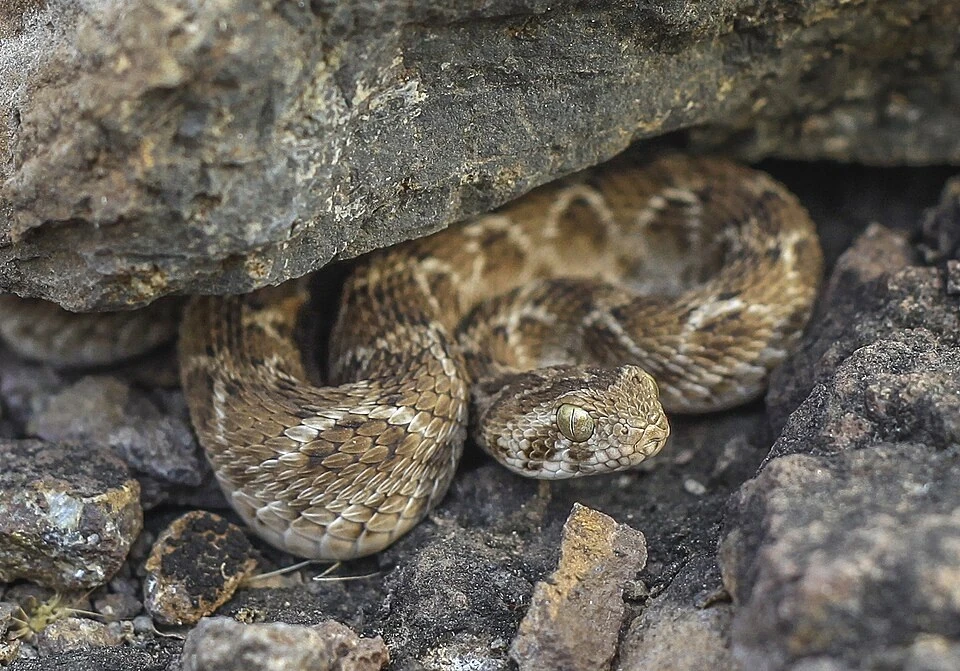
VenomousClinical severity not establishedKandahar, Afghanistan: a March 2009 field observation documented adults, subadults and juveniles in desert vegetation with bushes near the airfield. This is a locality observation, not a country-wide habitat or abundance assessment.
Venom & human effects
The species account explicitly identifies this snake as venomous. Human medical effects have not yet been assessed for this atlas.
Exact-species statement in the retained Reptile Database treatment; this review establishes venom presence only, not human bite severity.
Comment field: Venomous.
These are editorial summaries of the linked evidence, not toxicity rankings or WHO antivenom-priority categories. Effects vary with the bite and patient. Non-venomous does not mean safe to handle.
The scientific identity
Reliable identification uses the published combination of scale characters, proportions and other diagnostic evidence. Colour or a photograph alone may not separate closely related species.
Taxonomic treatment & original-description references ↗
Pseudoboa carinata · Echis carinata · Echis multisquamatus · Echis sochureki
Names trace the literature, including older combinations and historical usages. Their appearance here does not mean they are all currently accepted synonyms.
From observations & literature
No sourced size & measurements summary has yet been added to this account.
No sourced diet & feeding summary has yet been added to this account.
No sourced activity & behaviour summary has yet been added to this account.
Kandahar, Afghanistan: a March 2009 field observation documented adults, subadults and juveniles in desert vegetation with bushes near the airfield. This is a locality observation, not a country-wide habitat or abundance assessment.
[8]Chagai field expeditions (1998–2000) recorded this species in sand dunes (Table I). The paper distinguishes these records from merely predicted species.
[9]India is explicitly listed in the checked individual taxonomic treatment. The national ZSI checklist independently lists Echis carinatus. Regional evidence: Jammu and Kashmir, Himachal Pradesh, Himachal; Madhya Pradesh; Rajasthan, Gujarat, Maharashtra; Kerala, Tamil Nadu, Andhra Pradesh, Telangana. Named records do not imply continuous occurrence throughout a region.
[1][2]The 2025 field-study Table 1 documents Chamkani, Paktia, at 1,787 m, with archived photographic vouchers from 2012.
[3][4]Pakistan is explicitly recorded in the checked individual species treatment.
[3]Documented in the EPA/IUCN national species accounts.
[5][6]Included in the national nature inventory.
[5][7]The 2025 field-study Table 1 documents Chamkani, Paktia, at 1,787 m, with archived photographic vouchers from 2012.
[10][11]Observed/collected in the published Chagai inventory; no species-specific dune coordinate is supplied. Listed in the March 2011–July 2013 field survey; no specimen-level locality or habitat assignment is supplied.
[12][13]Khatlon: observation GBIF 4875109709 (2024). The original iNaturalist entry was rechecked for research-grade identification, wild status and unrestricted coordinates; its reported uncertainty footprint lies within the mapped region. This is a community-reviewed observation, not a museum voucher. These are dated locality records, not evidence of occurrence throughout every part of a region or a complete present-day inventory.
[14][15]Dubai: observation GBIF 6273200506 (2026). The original iNaturalist entry was rechecked for research-grade identification, wild status and unrestricted coordinates; its reported uncertainty footprint lies within the mapped region. This is a community-reviewed observation, not a museum voucher. Dubai: observation GBIF 6321216770 (2026). The original iNaturalist entry was rechecked for research-grade identification, wild status and unrestricted coordinates; its reported uncertainty footprint lies within the mapped region. This is a community-reviewed observation, not a museum voucher. Northern emirates: observation GBIF 6253322529 (2026). The original iNaturalist entry was rechecked for research-grade identification, wild status and unrestricted coordinates; its reported uncertainty footprint lies within the mapped region. This is a community-reviewed observation, not a museum voucher. Northern emirates: observation GBIF 6566451181 (2026). The original iNaturalist entry was rechecked for research-grade identification, wild status and unrestricted coordinates; its reported uncertainty footprint lies within the mapped region. This is a community-reviewed observation, not a museum voucher. Abu Dhabi: observation GBIF 6334607793 (2026). The original iNaturalist entry was rechecked for research-grade identification, wild status and unrestricted coordinates; its reported uncertainty footprint lies within the mapped region. This is a community-reviewed observation, not a museum voucher. Abu Dhabi: observation GBIF 6400944755 (2026). The original iNaturalist entry was rechecked for research-grade identification, wild status and unrestricted coordinates; its reported uncertainty footprint lies within the mapped region. This is a community-reviewed observation, not a museum voucher. These are dated locality records, not evidence of occurrence throughout every part of a region or a complete present-day inventory.
[16][17][18][19][20][21][22][23][24][25][26][27]Southern mountains & valleys: observation GBIF 5153063041 (2025). The original iNaturalist entry was rechecked for research-grade identification, wild status and unrestricted coordinates; its reported uncertainty footprint lies within the mapped region. This is a community-reviewed observation, not a museum voucher. Southern mountains & valleys: observation GBIF 3860436741 (2022). The original iNaturalist entry was rechecked for research-grade identification, wild status and unrestricted coordinates; its reported uncertainty footprint lies within the mapped region. This is a community-reviewed observation, not a museum voucher. Central deserts & oases: observation GBIF 5216549741 (2023). The original iNaturalist entry was rechecked for research-grade identification, wild status and unrestricted coordinates; its reported uncertainty footprint lies within the mapped region. This is a community-reviewed observation, not a museum voucher. These are dated locality records, not evidence of occurrence throughout every part of a region or a complete present-day inventory.
[28][29][30][31][32][33]Balkan & Caspian: museum voucher CAS 184840 (1992). The published collecting label names Balkan Prov.; this is a locality-label assignment, not a reconstructed coordinate. Balkan & Caspian: museum voucher CAS 184841 (1992). The published collecting label names Balkan Prov.; this is a locality-label assignment, not a reconstructed coordinate. Lebap & Mary: museum voucher CAS 179124 (1989). The published collecting label names Lebap Prov.; this is a locality-label assignment, not a reconstructed coordinate. Lebap & Mary: museum voucher CAS 179144 (1989). The published collecting label names Lebap Prov.; this is a locality-label assignment, not a reconstructed coordinate. These are dated locality records, not evidence of occurrence throughout every part of a region or a complete present-day inventory.
[34][35][36][37]A reported observation is not necessarily the full ecological range of a species. Where reproduction is inferred in a source dataset, the account identifies that limitation.
One species · Across borders
Explore the recorded countries and islands. Select a highlighted area to see its distribution evidence.
Loading geographic boundaries…
Click a highlighted country to zoom in and explore its records.
Shading identifies recorded countries or named islands, not continuous habitat coverage. Uncoloured areas do not establish absence.
Natural Earth · 1:50m · public domain; Gibraltar: geoBoundaries. Small islands may lack an outline.
Explore the distribution
Select a highlighted area to see its status, island records and sources. Each country and island links to the same shared species collection.
Use “Worldwide records” to include distant introduced and uncertain records in the map view.
India is explicitly listed in the checked individual taxonomic treatment. The national ZSI checklist independently lists Echis carinatus. Regional evidence: Jammu and Kashmir, Himachal Pradesh, Himachal; Madhya Pradesh; Rajasthan, Gujarat, Maharashtra; Kerala, Tamil Nadu, Andhra Pradesh, Telangana. Named records do not imply continuous occurrence throughout a region.
Northern plains & Himalaya → · Jammu and Kashmir, Himachal Pradesh, Himachal
Central highlands → · Madhya Pradesh
Western drylands & coast → · Rajasthan, Gujarat, Maharashtra
Southern peninsula → · Kerala, Tamil Nadu, Andhra Pradesh, Telangana
Locality source 1 ↗ Locality source 2 ↗The 2025 field-study Table 1 documents Chamkani, Paktia, at 1,787 m, with archived photographic vouchers from 2012.
Eastern forested slopes & valleys → · Chamkani, Paktia
Locality source 1 ↗ Locality source 2 ↗Explicit country record in the checked taxonomic treatment.
Locality source 1 ↗Explicit country record in the checked taxonomic treatment.
Locality source 1 ↗Explicit country record in the checked taxonomic treatment.
Locality source 1 ↗Pakistan is explicitly recorded in the checked individual species treatment. Observed/collected in the published Chagai inventory; no species-specific dune coordinate is supplied. Listed in the March 2011–July 2013 field survey; no specimen-level locality or habitat assignment is supplied.
Balochistan → · Chagai Desert
Punjab → · Chakwal Tehsil, Chakwal District
Locality source 1 ↗ Locality source 2 ↗ Locality source 3 ↗Explicit country record in the checked taxonomic treatment.
Locality source 1 ↗Explicit country record in the checked taxonomic treatment. Khatlon: observation GBIF 4875109709 (2024). The original iNaturalist entry was rechecked for research-grade identification, wild status and unrestricted coordinates; its reported uncertainty footprint lies within the mapped region. This is a community-reviewed observation, not a museum voucher. These are dated locality records, not evidence of occurrence throughout every part of a region or a complete present-day inventory.
Khatlon → · Khatlon Region
Locality source 1 ↗ Locality source 2 ↗ Locality source 3 ↗Explicit country record in the checked taxonomic treatment. Balkan & Caspian: museum voucher CAS 184840 (1992). The published collecting label names Balkan Prov.; this is a locality-label assignment, not a reconstructed coordinate. Balkan & Caspian: museum voucher CAS 184841 (1992). The published collecting label names Balkan Prov.; this is a locality-label assignment, not a reconstructed coordinate. Lebap & Mary: museum voucher CAS 179124 (1989). The published collecting label names Lebap Prov.; this is a locality-label assignment, not a reconstructed coordinate. Lebap & Mary: museum voucher CAS 179144 (1989). The published collecting label names Lebap Prov.; this is a locality-label assignment, not a reconstructed coordinate. These are dated locality records, not evidence of occurrence throughout every part of a region or a complete present-day inventory.
Balkan & Caspian → · Balkan Prov.
Lebap & Mary → · Lebap Prov.
Locality source 1 ↗ Locality source 2 ↗ Locality source 3 ↗ Locality source 4 ↗ Locality source 5 ↗Explicit country record in the checked taxonomic treatment. Dubai: observation GBIF 6273200506 (2026). The original iNaturalist entry was rechecked for research-grade identification, wild status and unrestricted coordinates; its reported uncertainty footprint lies within the mapped region. This is a community-reviewed observation, not a museum voucher. Dubai: observation GBIF 6321216770 (2026). The original iNaturalist entry was rechecked for research-grade identification, wild status and unrestricted coordinates; its reported uncertainty footprint lies within the mapped region. This is a community-reviewed observation, not a museum voucher. Northern emirates: observation GBIF 6253322529 (2026). The original iNaturalist entry was rechecked for research-grade identification, wild status and unrestricted coordinates; its reported uncertainty footprint lies within the mapped region. This is a community-reviewed observation, not a museum voucher. Northern emirates: observation GBIF 6566451181 (2026). The original iNaturalist entry was rechecked for research-grade identification, wild status and unrestricted coordinates; its reported uncertainty footprint lies within the mapped region. This is a community-reviewed observation, not a museum voucher. Abu Dhabi: observation GBIF 6334607793 (2026). The original iNaturalist entry was rechecked for research-grade identification, wild status and unrestricted coordinates; its reported uncertainty footprint lies within the mapped region. This is a community-reviewed observation, not a museum voucher. Abu Dhabi: observation GBIF 6400944755 (2026). The original iNaturalist entry was rechecked for research-grade identification, wild status and unrestricted coordinates; its reported uncertainty footprint lies within the mapped region. This is a community-reviewed observation, not a museum voucher. These are dated locality records, not evidence of occurrence throughout every part of a region or a complete present-day inventory.
Dubai → · Dubai
Northern emirates → · Sharjah, Ras al-Khaimah
Abu Dhabi → · Abu Dhabi
Locality source 1 ↗ Locality source 2 ↗ Locality source 3 ↗ Locality source 4 ↗ Locality source 5 ↗ Locality source 6 ↗ Locality source 7 ↗ Locality source 8 ↗ Locality source 9 ↗ Locality source 10 ↗ Locality source 11 ↗ Locality source 12 ↗ Locality source 13 ↗Explicit country record in the checked taxonomic treatment. Southern mountains & valleys: observation GBIF 5153063041 (2025). The original iNaturalist entry was rechecked for research-grade identification, wild status and unrestricted coordinates; its reported uncertainty footprint lies within the mapped region. This is a community-reviewed observation, not a museum voucher. Southern mountains & valleys: observation GBIF 3860436741 (2022). The original iNaturalist entry was rechecked for research-grade identification, wild status and unrestricted coordinates; its reported uncertainty footprint lies within the mapped region. This is a community-reviewed observation, not a museum voucher. Central deserts & oases: observation GBIF 5216549741 (2023). The original iNaturalist entry was rechecked for research-grade identification, wild status and unrestricted coordinates; its reported uncertainty footprint lies within the mapped region. This is a community-reviewed observation, not a museum voucher. These are dated locality records, not evidence of occurrence throughout every part of a region or a complete present-day inventory.
Southern mountains & valleys → · Surxondaryo Region
Central deserts & oases → · Bukhara Region
Locality source 1 ↗ Locality source 2 ↗ Locality source 3 ↗ Locality source 4 ↗ Locality source 5 ↗ Locality source 6 ↗ Locality source 7 ↗Documented in the EPA/IUCN national species accounts.
Locality source 1 ↗ Locality source 2 ↗Included in the national nature inventory.
Locality source 1 ↗ Locality source 2 ↗Verified country records in this account: India, Afghanistan, Iran, Iraq, Oman, Pakistan, Sri Lanka, Tajikistan, Turkmenistan, United Arab Emirates, Uzbekistan. These are occurrence records, not continuous range polygons. Detailed locality evidence and taxonomic qualifications are documented below. [1][2]
The text retains the source’s geographic qualifications. The map shows countries with atlas occurrence records; it is not a complete global range model. A type locality is a nomenclatural reference, not the only place the species occurs.
Status & its meaning
No matching global assessment was verified for this account. This is an unresolved assessment link, not an IUCN “Not Evaluated” classification and not evidence that the species is secure.
Locality coverage in the atlas does not measure abundance, population trends or national legal protection.
Follow the evidence
Latest evidence added 2026-10-12. Taxonomic and distribution treatments may change.
The linked taxonomic treatment provides its original descriptions, revisions and bibliography. Observations from other countries are not relabelled as local field studies.