Size & measurements
No sourced size & measurements summary has yet been added to this account.
Psammophiidae · Species account
Psammophis elegans(SHAW, 1802)
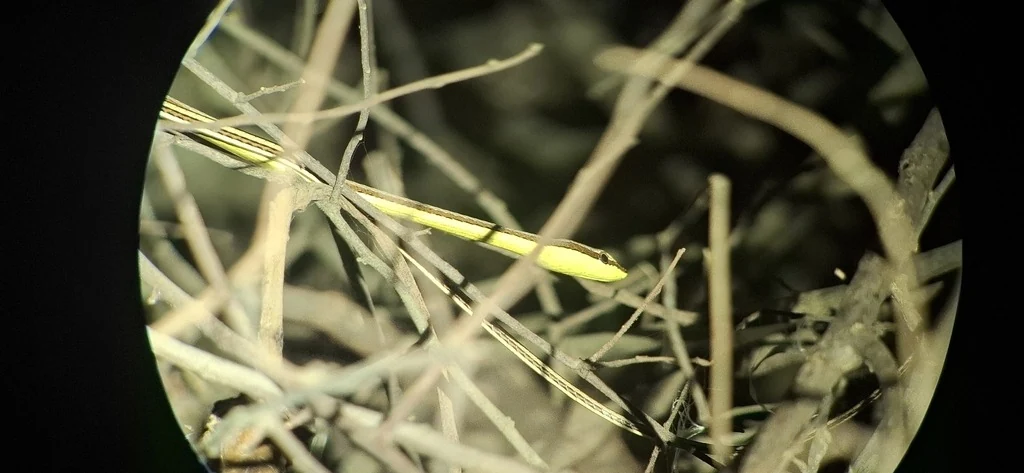
VenomousClinical severity not establishedCotonou outskirts, 11 May 2002: an uncatalogued specimen was found immediately outside a house (p.43).
Venom & human effects
Classified as venomous in the cited account of genus Psammophis; this species’ membership of that genus is verified separately.
Explicit genus-level classification applied to an exact listed member, not a species-specific venom assay or human clinical study of Psammophis elegans. The group statement does not transfer diet, body size, behaviour or medical severity. No human-harm tier is inferred.
Ineich, Girard and Weinstein (2020), Local envenoming by the Schokari sand racer and a brief review of reported bites by sand racers, Toxicon 185:72–75, Introduction opening paragraph describes Psammophis as a genus with low-pressure venom glands; following paragraph explicitly states the snakes use venom to subjugate prey. Clinical observations on particular species are not transferred to other genus members. Membership: exact-species taxonomic account Psammophis elegans.
These are editorial summaries of the linked evidence, not toxicity rankings or WHO antivenom-priority categories. Effects vary with the bite and patient. Non-venomous does not mean safe to handle.
The scientific identity
Reliable identification uses the published combination of scale characters, proportions and other diagnostic evidence. Colour or a photograph alone may not separate closely related species.
From observations & literature
No sourced size & measurements summary has yet been added to this account.
No sourced diet & feeding summary has yet been added to this account.
No sourced activity & behaviour summary has yet been added to this account.
Egg-laying.
Cotonou outskirts, 11 May 2002: an uncatalogued specimen was found immediately outside a house (p.43).
[2]Atakora: museum voucher RBINS 17164 (2005). The museum record's reported coordinate uncertainty footprint lies within the mapped region. Atakora: museum voucher RBINS-Scientific Heritage 17164 (2005). The museum record's reported coordinate uncertainty footprint lies within the mapped region. Plateau: museum voucher CAS 165595 (1969). The museum record's reported coordinate uncertainty footprint lies within the mapped region. These are dated locality records, not evidence of occurrence throughout every part of a region or a complete present-day inventory. Donga: observation 216914460, 2024-05-11. Original records have agreeing research-grade identifications, wild status and open coordinates. Points and sampled reported uncertainty envelopes fall within the mapped region. These are dated community-reviewed observations, not museum vouchers or evidence of presence throughout the region. Exact coordinates are not republished.
[3][4][5][6][7]Central regions: observation GBIF 5935668041 (2025). The original iNaturalist entry was rechecked for research-grade identification, wild status and unrestricted coordinates; its reported uncertainty footprint lies within the mapped region. This is a community-reviewed observation, not a museum voucher. Western regions: observation GBIF 5069827799 (2009). The original iNaturalist entry was rechecked for research-grade identification, wild status and unrestricted coordinates; its reported uncertainty footprint lies within the mapped region. This is a community-reviewed observation, not a museum voucher. These are dated locality records, not evidence of occurrence throughout every part of a region or a complete present-day inventory.
[8][9][10][11]Brikama: observation GBIF 5062906506 (2012). The original iNaturalist entry was rechecked for research-grade identification, wild status and unrestricted coordinates; its reported uncertainty footprint lies within the mapped region. This is a community-reviewed observation, not a museum voucher. These are dated locality records, not evidence of occurrence throughout every part of a region or a complete present-day inventory.
[12][13]Eastern & coastal regions: museum voucher MVZ MVZ:Herp:176445 (1981). The museum record's reported coordinate uncertainty footprint lies within the mapped region. Eastern & coastal regions: museum voucher CAS 136269 (1973). The museum record's reported coordinate uncertainty footprint lies within the mapped region. Central & Ashanti: observation GBIF 4597274934 (2024). The original iNaturalist entry was rechecked for research-grade identification, wild status and unrestricted coordinates; its reported uncertainty footprint lies within the mapped region. This is a community-reviewed observation, not a museum voucher. Northern regions: museum voucher CAS 154791 (1981). The museum record's reported coordinate uncertainty footprint lies within the mapped region. Northern regions: museum voucher CAS 146202 (1975). The museum record's reported coordinate uncertainty footprint lies within the mapped region. These are dated locality records, not evidence of occurrence throughout every part of a region or a complete present-day inventory.
[14][15][16][17][18][19]Kindia: observation GBIF 5759585262 (2025). The original iNaturalist entry was rechecked for research-grade identification, wild status and unrestricted coordinates; its reported uncertainty footprint lies within the mapped region. This is a community-reviewed observation, not a museum voucher. Kindia: observation GBIF 5206666349 (2025). The original iNaturalist entry was rechecked for research-grade identification, wild status and unrestricted coordinates; its reported uncertainty footprint lies within the mapped region. This is a community-reviewed observation, not a museum voucher. Mamou: observation GBIF 5908831379 (2025). The original iNaturalist entry was rechecked for research-grade identification, wild status and unrestricted coordinates; its reported uncertainty footprint lies within the mapped region. This is a community-reviewed observation, not a museum voucher. Boke: observation GBIF 4976462993 (2024). The original iNaturalist entry was rechecked for research-grade identification, wild status and unrestricted coordinates; its reported uncertainty footprint lies within the mapped region. This is a community-reviewed observation, not a museum voucher. Boke: observation GBIF 4901313376 (2024). The original iNaturalist entry was rechecked for research-grade identification, wild status and unrestricted coordinates; its reported uncertainty footprint lies within the mapped region. This is a community-reviewed observation, not a museum voucher. Faranah: observation GBIF 4908692005 (2024). The original iNaturalist entry was rechecked for research-grade identification, wild status and unrestricted coordinates; its reported uncertainty footprint lies within the mapped region. This is a community-reviewed observation, not a museum voucher. These are dated locality records, not evidence of occurrence throughout every part of a region or a complete present-day inventory.
[20][21][22][23][24][25][26][27][28][29][30][31]Tombali: museum voucher MUHNAC IICT/R 36-1946 (1946). The museum record's reported coordinate uncertainty footprint lies within the mapped region. Biombo: museum voucher MUHNAC IICT/R 117-1945 (1945). The museum record's reported coordinate uncertainty footprint lies within the mapped region. Biombo: museum voucher MUHNAC IICT/R 88-1945 (1945). The museum record's reported coordinate uncertainty footprint lies within the mapped region. These are dated locality records, not evidence of occurrence throughout every part of a region or a complete present-day inventory.
[32][33][34]Central districts: observation GBIF 5188153405 (2025). The original iNaturalist entry was rechecked for research-grade identification, wild status and unrestricted coordinates; its reported uncertainty footprint lies within the mapped region. This is a community-reviewed observation, not a museum voucher. Central districts: observation GBIF 3994211999 (2022). The original iNaturalist entry was rechecked for research-grade identification, wild status and unrestricted coordinates; its reported uncertainty footprint lies within the mapped region. This is a community-reviewed observation, not a museum voucher. These are dated locality records, not evidence of occurrence throughout every part of a region or a complete present-day inventory.
[35][36][37][38]Southwestern states: observation GBIF 5897361266 (2025). The original iNaturalist entry was rechecked for research-grade identification, wild status and unrestricted coordinates; its reported uncertainty footprint lies within the mapped region. This is a community-reviewed observation, not a museum voucher. Southwestern states: observation GBIF 4607287140 (2024). The original iNaturalist entry was rechecked for research-grade identification, wild status and unrestricted coordinates; its reported uncertainty footprint lies within the mapped region. This is a community-reviewed observation, not a museum voucher. North Central & Abuja: observation GBIF 2626576792 (2020). The original iNaturalist entry was rechecked for research-grade identification, wild status and unrestricted coordinates; its reported uncertainty footprint lies within the mapped region. This is a community-reviewed observation, not a museum voucher. These are dated locality records, not evidence of occurrence throughout every part of a region or a complete present-day inventory.
[39][40][41][42][43][44]Northern regions: iNaturalist observation 258231147, recorded 2025-01-10. The current original record has agreeing research-grade identification, wild status and unrestricted coordinates; its entire reported uncertainty footprint lies within this mapped region. This community observation is not a museum voucher. Northern regions: iNaturalist observation 277511337, recorded 2016-02-22. The current original record has agreeing research-grade identification, wild status and unrestricted coordinates; its entire reported uncertainty footprint lies within this mapped region. This community observation is not a museum voucher. Central regions: iNaturalist observation 239456776, recorded 2009-03-03. The current original record has agreeing research-grade identification, wild status and unrestricted coordinates; its entire reported uncertainty footprint lies within this mapped region. This community observation is not a museum voucher. These are dated locality records, not evidence of occurrence throughout every part of a region or a complete present-day inventory.
[45][46][47][48][49][50]Southern: iNaturalist observation 406338883, recorded 2026-10-01. The current original record has agreeing research-grade identification, wild status and unrestricted coordinates; its entire reported uncertainty footprint lies within this mapped region. This community observation is not a museum voucher. Eastern: iNaturalist observation 259065434, recorded 2025-01-20. The current original record has agreeing research-grade identification, wild status and unrestricted coordinates; its entire reported uncertainty footprint lies within this mapped region. This community observation is not a museum voucher. Eastern: iNaturalist observation 225714485, recorded 2019-05-03. The current original record has agreeing research-grade identification, wild status and unrestricted coordinates; its entire reported uncertainty footprint lies within this mapped region. This community observation is not a museum voucher. Northern: iNaturalist observation 224855245, recorded 2024-06-24. The current original record has agreeing research-grade identification, wild status and unrestricted coordinates; its entire reported uncertainty footprint lies within this mapped region. This community observation is not a museum voucher. Northern: iNaturalist observation 143961817, recorded 2004-12-09. The current original record has agreeing research-grade identification, wild status and unrestricted coordinates; its entire reported uncertainty footprint lies within this mapped region. This community observation is not a museum voucher. These are dated locality records, not evidence of occurrence throughout every part of a region or a complete present-day inventory.
[51][52][53][54][55][56][57][58][59][60]Plateaux Region: iNaturalist observation 261107841, recorded 2009-03-16. The current original record has agreeing research-grade identification, wild status and unrestricted coordinates; its entire reported uncertainty footprint lies within this mapped region. This community observation is not a museum voucher. These are dated locality records, not evidence of occurrence throughout every part of a region or a complete present-day inventory.
[61][62]Trape & Mané (2017), species account p. 120, locality coordinates in Tables 1–2 and specimen appendix: Bangaya; Bouyanga; Doussoudiana; Kinani; Koundian; Laminina; Mamoroubougou; Npiébougou; Sadjouroubougou; Samé Ouolof; Saré-Soma; Sébékourani; Séoulasso; Ténintou; Titiéna; Zamoko; Kati; Diré; Dogo; Kita; Mourdiah. Historical, explicitly named records mapped to the chapter’s 2021 boundary snapshot; they do not establish current occupancy or complete regional coverage.
[63]Trape & Mané (2015), account p. 44: examined specimens from Baboul; Cissia; Goudoumaria; Kellé; Kusa; Piliki; Téla. Table 1 locates the 2004–2008 survey sites; separately examined museum material may be older. Minute-scale coordinates are accepted only where their 2 km envelope fits one atlas region. These dated records do not establish current occupancy or complete regional coverage. Published as Psammophis elegans univittatus; linked to the existing Psammophis elegans identity.
[64]A reported observation is not necessarily the full ecological range of a species. Where reproduction is inferred in a source dataset, the account identifies that limitation.
One species · Across borders
Explore the recorded countries and islands. Select a highlighted area to see its distribution evidence.
Loading geographic boundaries…
Click a highlighted country to zoom in and explore its records.
Shading identifies recorded countries or named islands, not continuous habitat coverage. Uncoloured areas do not establish absence.
Natural Earth · 1:50m · public domain; Gibraltar: geoBoundaries. Small islands may lack an outline.
Explore the distribution
Select a highlighted area to see its status, island records and sources. Each country and island links to the same shared species collection.
Use “Worldwide records” to include distant introduced and uncertain records in the map view.
The current taxonomic treatment explicitly lists this country. This is country-scale checklist evidence, not a claim of continuous occupancy or a complete regional inventory. Atakora: museum voucher RBINS 17164 (2005). The museum record's reported coordinate uncertainty footprint lies within the mapped region. Atakora: museum voucher RBINS-Scientific Heritage 17164 (2005). The museum record's reported coordinate uncertainty footprint lies within the mapped region. Plateau: museum voucher CAS 165595 (1969). The museum record's reported coordinate uncertainty footprint lies within the mapped region. These are dated locality records, not evidence of occurrence throughout every part of a region or a complete present-day inventory. Donga: observation 216914460, 2024-05-11. Original records have agreeing research-grade identifications, wild status and open coordinates. Points and sampled reported uncertainty envelopes fall within the mapped region. These are dated community-reviewed observations, not museum vouchers or evidence of presence throughout the region. Exact coordinates are not republished.
Atakora → · Atakora
Plateau → · Plateau
Donga → · Donga
Locality source 1 ↗ Locality source 2 ↗ Locality source 3 ↗ Locality source 4 ↗ Locality source 5 ↗ Locality source 6 ↗The current taxonomic treatment explicitly lists this country. This is country-scale checklist evidence, not a claim of continuous occupancy or a complete regional inventory. Central regions: observation GBIF 5935668041 (2025). The original iNaturalist entry was rechecked for research-grade identification, wild status and unrestricted coordinates; its reported uncertainty footprint lies within the mapped region. This is a community-reviewed observation, not a museum voucher. Western regions: observation GBIF 5069827799 (2009). The original iNaturalist entry was rechecked for research-grade identification, wild status and unrestricted coordinates; its reported uncertainty footprint lies within the mapped region. This is a community-reviewed observation, not a museum voucher. These are dated locality records, not evidence of occurrence throughout every part of a region or a complete present-day inventory.
Central regions → · Central regions
Western regions → · Western regions
Locality source 1 ↗ Locality source 2 ↗ Locality source 3 ↗ Locality source 4 ↗ Locality source 5 ↗The current taxonomic treatment explicitly lists this country. This is country-scale checklist evidence, not a claim of continuous occupancy or a complete regional inventory.
Locality source 1 ↗The current taxonomic treatment explicitly lists this country. This is country-scale checklist evidence, not a claim of continuous occupancy or a complete regional inventory.
Locality source 1 ↗The current taxonomic treatment explicitly lists this country. This is country-scale checklist evidence, not a claim of continuous occupancy or a complete regional inventory. Brikama: observation GBIF 5062906506 (2012). The original iNaturalist entry was rechecked for research-grade identification, wild status and unrestricted coordinates; its reported uncertainty footprint lies within the mapped region. This is a community-reviewed observation, not a museum voucher. These are dated locality records, not evidence of occurrence throughout every part of a region or a complete present-day inventory.
Brikama → · Brikama
Locality source 1 ↗ Locality source 2 ↗ Locality source 3 ↗The current taxonomic treatment explicitly lists this country. This is country-scale checklist evidence, not a claim of continuous occupancy or a complete regional inventory. Eastern & coastal regions: museum voucher MVZ MVZ:Herp:176445 (1981). The museum record's reported coordinate uncertainty footprint lies within the mapped region. Eastern & coastal regions: museum voucher CAS 136269 (1973). The museum record's reported coordinate uncertainty footprint lies within the mapped region. Central & Ashanti: observation GBIF 4597274934 (2024). The original iNaturalist entry was rechecked for research-grade identification, wild status and unrestricted coordinates; its reported uncertainty footprint lies within the mapped region. This is a community-reviewed observation, not a museum voucher. Northern regions: museum voucher CAS 154791 (1981). The museum record's reported coordinate uncertainty footprint lies within the mapped region. Northern regions: museum voucher CAS 146202 (1975). The museum record's reported coordinate uncertainty footprint lies within the mapped region. These are dated locality records, not evidence of occurrence throughout every part of a region or a complete present-day inventory.
Eastern & coastal regions → · Eastern & coastal regions
Central & Ashanti → · Central & Ashanti
Northern regions → · Northern regions
Locality source 1 ↗ Locality source 2 ↗ Locality source 3 ↗ Locality source 4 ↗ Locality source 5 ↗ Locality source 6 ↗ Locality source 7 ↗The current taxonomic treatment explicitly lists this country. This is country-scale checklist evidence, not a claim of continuous occupancy or a complete regional inventory. Kindia: observation GBIF 5759585262 (2025). The original iNaturalist entry was rechecked for research-grade identification, wild status and unrestricted coordinates; its reported uncertainty footprint lies within the mapped region. This is a community-reviewed observation, not a museum voucher. Kindia: observation GBIF 5206666349 (2025). The original iNaturalist entry was rechecked for research-grade identification, wild status and unrestricted coordinates; its reported uncertainty footprint lies within the mapped region. This is a community-reviewed observation, not a museum voucher. Mamou: observation GBIF 5908831379 (2025). The original iNaturalist entry was rechecked for research-grade identification, wild status and unrestricted coordinates; its reported uncertainty footprint lies within the mapped region. This is a community-reviewed observation, not a museum voucher. Boke: observation GBIF 4976462993 (2024). The original iNaturalist entry was rechecked for research-grade identification, wild status and unrestricted coordinates; its reported uncertainty footprint lies within the mapped region. This is a community-reviewed observation, not a museum voucher. Boke: observation GBIF 4901313376 (2024). The original iNaturalist entry was rechecked for research-grade identification, wild status and unrestricted coordinates; its reported uncertainty footprint lies within the mapped region. This is a community-reviewed observation, not a museum voucher. Faranah: observation GBIF 4908692005 (2024). The original iNaturalist entry was rechecked for research-grade identification, wild status and unrestricted coordinates; its reported uncertainty footprint lies within the mapped region. This is a community-reviewed observation, not a museum voucher. These are dated locality records, not evidence of occurrence throughout every part of a region or a complete present-day inventory.
Kindia → · Kindia
Mamou → · Mamou
Boke → · Boke
Faranah → · Faranah
Locality source 1 ↗ Locality source 2 ↗ Locality source 3 ↗ Locality source 4 ↗ Locality source 5 ↗ Locality source 6 ↗ Locality source 7 ↗ Locality source 8 ↗ Locality source 9 ↗ Locality source 10 ↗ Locality source 11 ↗ Locality source 12 ↗ Locality source 13 ↗The current taxonomic treatment explicitly lists this country. This is country-scale checklist evidence, not a claim of continuous occupancy or a complete regional inventory. Tombali: museum voucher MUHNAC IICT/R 36-1946 (1946). The museum record's reported coordinate uncertainty footprint lies within the mapped region. Biombo: museum voucher MUHNAC IICT/R 117-1945 (1945). The museum record's reported coordinate uncertainty footprint lies within the mapped region. Biombo: museum voucher MUHNAC IICT/R 88-1945 (1945). The museum record's reported coordinate uncertainty footprint lies within the mapped region. These are dated locality records, not evidence of occurrence throughout every part of a region or a complete present-day inventory.
Tombali → · Tombali
Biombo → · Biombo
Locality source 1 ↗ Locality source 2 ↗ Locality source 3 ↗ Locality source 4 ↗The current taxonomic treatment explicitly lists this country. This is country-scale checklist evidence, not a claim of continuous occupancy or a complete regional inventory. Central districts: observation GBIF 5188153405 (2025). The original iNaturalist entry was rechecked for research-grade identification, wild status and unrestricted coordinates; its reported uncertainty footprint lies within the mapped region. This is a community-reviewed observation, not a museum voucher. Central districts: observation GBIF 3994211999 (2022). The original iNaturalist entry was rechecked for research-grade identification, wild status and unrestricted coordinates; its reported uncertainty footprint lies within the mapped region. This is a community-reviewed observation, not a museum voucher. These are dated locality records, not evidence of occurrence throughout every part of a region or a complete present-day inventory.
Central districts → · Central districts
Locality source 1 ↗ Locality source 2 ↗ Locality source 3 ↗ Locality source 4 ↗ Locality source 5 ↗The current taxonomic treatment explicitly lists this country. This is country-scale checklist evidence, not a claim of continuous occupancy or a complete regional inventory. Trape & Mané (2017), species account p. 120, locality coordinates in Tables 1–2 and specimen appendix: Bangaya; Bouyanga; Doussoudiana; Kinani; Koundian; Laminina; Mamoroubougou; Npiébougou; Sadjouroubougou; Samé Ouolof; Saré-Soma; Sébékourani; Séoulasso; Ténintou; Titiéna; Zamoko; Kati; Diré; Dogo; Kita; Mourdiah. Historical, explicitly named records mapped to the chapter’s 2021 boundary snapshot; they do not establish current occupancy or complete regional coverage.
Kayes → · Bangaya, Bouyanga, Koundian, Samé Ouolof, Kita
Sikasso → · Doussoudiana, Laminina, Mamoroubougou, Ténintou, Titiéna
Mopti → · Kinani, Saré-Soma, Dogo
Koulikoro → · Npiébougou, Sadjouroubougou, Sébékourani, Zamoko, Kati, Mourdiah
Segou → · Séoulasso
Tombouctou → · Diré
Locality source 1 ↗ Locality source 2 ↗The current taxonomic treatment explicitly lists this country. This is country-scale checklist evidence, not a claim of continuous occupancy or a complete regional inventory.
Locality source 1 ↗The current taxonomic treatment explicitly lists this country. This is country-scale checklist evidence, not a claim of continuous occupancy or a complete regional inventory. Trape & Mané (2015), account p. 44: examined specimens from Baboul; Cissia; Goudoumaria; Kellé; Kusa; Piliki; Téla. Table 1 locates the 2004–2008 survey sites; separately examined museum material may be older. Minute-scale coordinates are accepted only where their 2 km envelope fits one atlas region. These dated records do not establish current occupancy or complete regional coverage. Published as Psammophis elegans univittatus; linked to the existing Psammophis elegans identity.
Zinder/Diffa → · Baboul, Cissia, Goudoumaria, Kellé, Kusa
Tillaberi → · Piliki
Dossa → · Téla
Locality source 1 ↗ Locality source 2 ↗The current taxonomic treatment explicitly lists this country. This is country-scale checklist evidence, not a claim of continuous occupancy or a complete regional inventory. Southwestern states: observation GBIF 5897361266 (2025). The original iNaturalist entry was rechecked for research-grade identification, wild status and unrestricted coordinates; its reported uncertainty footprint lies within the mapped region. This is a community-reviewed observation, not a museum voucher. Southwestern states: observation GBIF 4607287140 (2024). The original iNaturalist entry was rechecked for research-grade identification, wild status and unrestricted coordinates; its reported uncertainty footprint lies within the mapped region. This is a community-reviewed observation, not a museum voucher. North Central & Abuja: observation GBIF 2626576792 (2020). The original iNaturalist entry was rechecked for research-grade identification, wild status and unrestricted coordinates; its reported uncertainty footprint lies within the mapped region. This is a community-reviewed observation, not a museum voucher. These are dated locality records, not evidence of occurrence throughout every part of a region or a complete present-day inventory.
Southwestern states → · Southwestern states
North Central & Abuja → · North Central & Abuja
Locality source 1 ↗ Locality source 2 ↗ Locality source 3 ↗ Locality source 4 ↗ Locality source 5 ↗ Locality source 6 ↗ Locality source 7 ↗The current taxonomic treatment explicitly lists this country. This is country-scale checklist evidence, not a claim of continuous occupancy or a complete regional inventory. Northern regions: iNaturalist observation 258231147, recorded 2025-01-10. The current original record has agreeing research-grade identification, wild status and unrestricted coordinates; its entire reported uncertainty footprint lies within this mapped region. This community observation is not a museum voucher. Northern regions: iNaturalist observation 277511337, recorded 2016-02-22. The current original record has agreeing research-grade identification, wild status and unrestricted coordinates; its entire reported uncertainty footprint lies within this mapped region. This community observation is not a museum voucher. Central regions: iNaturalist observation 239456776, recorded 2009-03-03. The current original record has agreeing research-grade identification, wild status and unrestricted coordinates; its entire reported uncertainty footprint lies within this mapped region. This community observation is not a museum voucher. These are dated locality records, not evidence of occurrence throughout every part of a region or a complete present-day inventory.
Northern regions → · Northern regions
Central regions → · Central regions
Locality source 1 ↗ Locality source 2 ↗ Locality source 3 ↗ Locality source 4 ↗ Locality source 5 ↗ Locality source 6 ↗ Locality source 7 ↗The current taxonomic treatment explicitly lists this country. This is country-scale checklist evidence, not a claim of continuous occupancy or a complete regional inventory. Southern: iNaturalist observation 406338883, recorded 2026-10-01. The current original record has agreeing research-grade identification, wild status and unrestricted coordinates; its entire reported uncertainty footprint lies within this mapped region. This community observation is not a museum voucher. Eastern: iNaturalist observation 259065434, recorded 2025-01-20. The current original record has agreeing research-grade identification, wild status and unrestricted coordinates; its entire reported uncertainty footprint lies within this mapped region. This community observation is not a museum voucher. Eastern: iNaturalist observation 225714485, recorded 2019-05-03. The current original record has agreeing research-grade identification, wild status and unrestricted coordinates; its entire reported uncertainty footprint lies within this mapped region. This community observation is not a museum voucher. Northern: iNaturalist observation 224855245, recorded 2024-06-24. The current original record has agreeing research-grade identification, wild status and unrestricted coordinates; its entire reported uncertainty footprint lies within this mapped region. This community observation is not a museum voucher. Northern: iNaturalist observation 143961817, recorded 2004-12-09. The current original record has agreeing research-grade identification, wild status and unrestricted coordinates; its entire reported uncertainty footprint lies within this mapped region. This community observation is not a museum voucher. These are dated locality records, not evidence of occurrence throughout every part of a region or a complete present-day inventory.
Southern → · Southern
Eastern → · Eastern
Northern → · Northern
Locality source 1 ↗ Locality source 2 ↗ Locality source 3 ↗ Locality source 4 ↗ Locality source 5 ↗ Locality source 6 ↗ Locality source 7 ↗ Locality source 8 ↗ Locality source 9 ↗ Locality source 10 ↗ Locality source 11 ↗The current taxonomic treatment explicitly lists this country. This is country-scale checklist evidence, not a claim of continuous occupancy or a complete regional inventory.
Locality source 1 ↗The current taxonomic treatment explicitly lists this country. This is country-scale checklist evidence, not a claim of continuous occupancy or a complete regional inventory.
Locality source 1 ↗The current taxonomic treatment explicitly lists this country. This is country-scale checklist evidence, not a claim of continuous occupancy or a complete regional inventory. Plateaux Region: iNaturalist observation 261107841, recorded 2009-03-16. The current original record has agreeing research-grade identification, wild status and unrestricted coordinates; its entire reported uncertainty footprint lies within this mapped region. This community observation is not a museum voucher. These are dated locality records, not evidence of occurrence throughout every part of a region or a complete present-day inventory.
Plateaux Region → · Plateaux Region
Locality source 1 ↗ Locality source 2 ↗ Locality source 3 ↗Country entries documented in this Africa review: Benin, Burkina Faso, Cameroon, Central African Republic, Gambia, Ghana, Guinea, Guinea-Bissau, Ivory Coast, Mali, Mauritania, Niger, Nigeria, Senegal, Sierra Leone, South Sudan, Sudan, Togo. Consult individual occurrence records for qualifications. These entries are not a complete global range polygon. [1]
The text retains the source’s geographic qualifications. The map shows countries with atlas occurrence records; it is not a complete global range model. A type locality is a nomenclatural reference, not the only place the species occurs.
Status & its meaning
No matching global assessment was verified for this account. This is an unresolved assessment link, not an IUCN “Not Evaluated” classification and not evidence that the species is secure.
Locality coverage in the atlas does not measure abundance, population trends or national legal protection.
Follow the evidence
Latest evidence added 2026-10-16. Taxonomic and distribution treatments may change.
The linked taxonomic treatment provides its original descriptions, revisions and bibliography. Observations from other countries are not relabelled as local field studies.