Colubridae · Species account

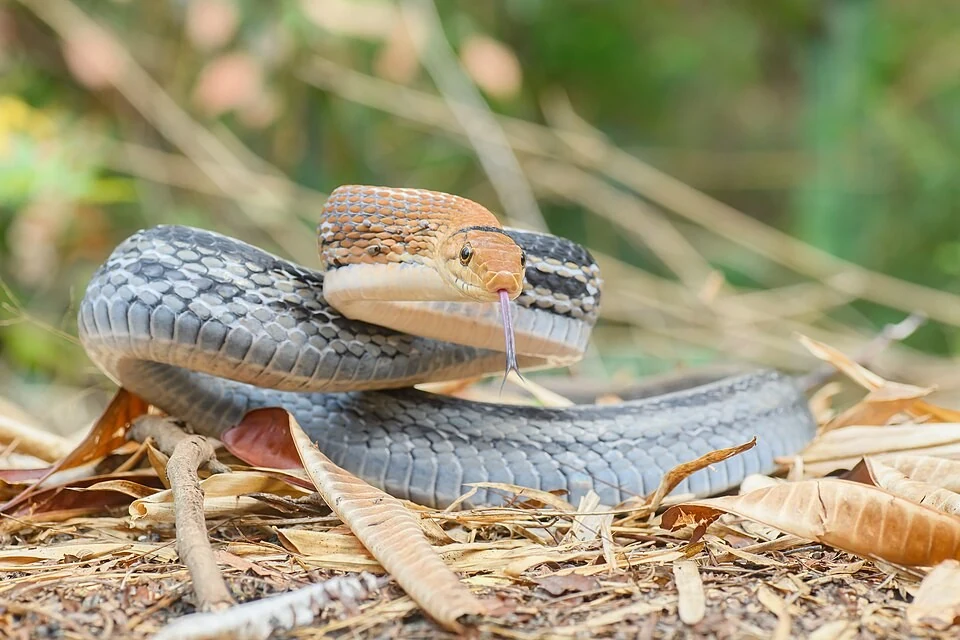
Radiated Ratsnakes

Coelognathus radiatus(BOIE, 1827)

Non-venomous

Forest records on Ko Pha-ngan include disturbed woodland and national-park forest.

FamilyColubridae
ReproductionEgg-laying
Country chaptersBangladesh · Cambodia · China · India · Indonesia · Laos · Nepal · Vietnam · Malaysia · Thailand · Myanmar · Brunei
Evidence updated2026-10-11
Explore its biology ↓

Venom & human effects

What is documented?

Non-venomous

The exact-species university account classifies this snake as non-venomous.

Explicit species-account classification, reviewed separately from the natural-history facts. This does not mean a bite cannot injure.

Evidence & scope · checked 2026-10-29

Species title, parenthetical venom classification.

How to read these badges
Limited documented effects
The cited human cases reported limited effects. Sparse observations cannot exclude a severe reaction.
Medically significant effects
The cited human cases document clinically important injury or illness. This is not an upper limit on severity.
Potentially life-threatening
Species-specific clinical evidence documents life-threatening illness or deaths after bites. The account explains the affected patients and any uncertainty about the cause.
Clinical severity not established
Venom presence is documented, but the reviewed evidence does not establish a clinical tier. When human effects are reported under an unresolved historical species name, the badge and account say so explicitly.
Venom status uncertain
The reviewed sources are inconclusive or conflicting about venom presence. The account explains the uncertainty.
Venom status not assessed
The atlas lacks a reviewed venom-presence classification for this species.

These are editorial summaries of the linked evidence, not toxicity rankings or WHO antivenom-priority categories. Effects vary with the bite and patient. Non-venomous does not mean safe to handle.

The scientific identity

Taxonomy & recognition

From observations & literature

Natural history

Size and ecological traits credited to SquamBase summarize published studies across the species’ range in its 2024 edition. They are complemented by the locality-specific observations below.

Size & measurements

Recorded size

The largest measurements compiled in SquamBase 1.0 are 262 cm total length (including the tail). These are separate literature maxima, not typical adult sizes or necessarily measurements of the same animal.

[2]

Recorded size

SquamBase 1.0 records a literature maximum of 262 cm total length, including the tail. This is a compiled maximum, not a typical adult size or a measurement specific to this country.

[2]

The regional account gives about 150 cm as an average and reports lengths reaching 210 cm.

Regional species account from the University of Hong Kong. Breeding dates, body sizes and habitat observations describe the source population/context and are not universal limits. Captive or tentative evidence is identified in the summary.

Study & evidence

Total length field

Study source 1 ↗

Adult females averaged larger than males in the examined sample: mean snout–vent lengths were 128.2 cm and 122.0 cm, respectively.

Specimens obtained through commercial processing facilities near Cirebon, West Java. This harvest sample was strongly biased towards adults and males; it is not a random population sample or a range-wide estimate.

Study & evidence

Riyanto et al. (2026), Sexual dimorphism and reproductive biology of three species of colubrid snakes from western Java, Indonesia; Table 1; 104 adult females and 154 adult males

Study source 1 ↗

Diet & feeding

Feeding

Prey reported in the studies compiled by SquamBase include rodents, birds, frogs and lizards. The list describes documented food rather than an exclusive diet.

[2]

Reported prey include rodents, birds, lizards and frogs.

Regional species account from the University of Hong Kong. Breeding dates, body sizes and habitat observations describe the source population/context and are not universal limits. Captive or tentative evidence is identified in the summary.

Study & evidence

Diet field

Study source 1 ↗

Activity & behaviour

Activity

Daytime activity is reported.

[1]

Use of the landscape

Climbing and ground-dwelling activity is reported in the studies compiled by SquamBase. This describes the species across its studied range, not a record from every island.

[2]

Active by day. Defensive displays include expanding the neck and looping the front of the body.

Regional species account from the University of Hong Kong. Breeding dates, body sizes and habitat observations describe the source population/context and are not universal limits. Captive or tentative evidence is identified in the summary.

Study & evidence

Behaviour field

Study source 1 ↗

Reproduction

Reproduction

Egg-laying.

[1]

Brood size

The compilation records 5–15 eggs per clutch. These published records need not represent the full variation between populations, and are not a separate estimate for Laos or Vietnam.

[2]

The account reports an egg-laying record of at least seven eggs, with hatching after roughly two months.

Regional species account from the University of Hong Kong. Breeding dates, body sizes and habitat observations describe the source population/context and are not universal limits. Captive or tentative evidence is identified in the summary.

Study & evidence

Reproduction field

Study source 1 ↗

Counts of enlarged ovarian follicles or oviductal eggs in 39 females ranged from 4 to 20, averaging 8.46. These estimates do not represent 39 directly observed laid clutches.

Specimens obtained through commercial processing facilities near Cirebon, West Java. This harvest sample was strongly biased towards adults and males; it is not a random population sample or a range-wide estimate.

Study & evidence

Riyanto et al. (2026), Sexual dimorphism and reproductive biology of three species of colubrid snakes from western Java, Indonesia; Results, Fecundity

Study source 1 ↗

Egg-bearing females occurred in eight of the nine months with available samples. Ovarian evidence of previous ovulation supported the authors’ interpretation of multiple clutches per year.

Specimens obtained through commercial processing facilities near Cirebon, West Java. This harvest sample was strongly biased towards adults and males; it is not a random population sample or a range-wide estimate.

Study & evidence

Riyanto et al. (2026), Sexual dimorphism and reproductive biology of three species of colubrid snakes from western Java, Indonesia; Results, Seasonality and frequency of reproduction

Study source 1 ↗

Habitat & ecology

Habitat & microhabitat · Thailand

Forest records on Ko Pha-ngan include disturbed woodland and national-park forest.

[8]

Associated with open rocky hills, grassland and scrub; reported infrequently in dense forest.

Regional species account from the University of Hong Kong. Breeding dates, body sizes and habitat observations describe the source population/context and are not universal limits. Captive or tentative evidence is identified in the summary.

Study & evidence

Habitat field

Study source 1 ↗

Further observations & source notes (7)

Range evidence · Myanmar

Myanmar is explicitly listed in the checked individual taxonomic treatment.

[3]

Range evidence · India

India is explicitly listed in the checked individual taxonomic treatment. The national ZSI checklist independently lists Coelognathus radiatus. Regional evidence: Himachal Pradesh, Uttarakhand, Himachal; Assam, Arunachal Pradesh, Meghalaya, Nagaland, Manipur, Mizoram, Tripura, Sikkim; Bihar, Odisha, West Bengal, Orissa; Madhya Pradesh, Chhattisgarh. Named records do not imply continuous occurrence throughout a region.

[3][4]

Range evidence · Bangladesh

Confirmed occurrence in the 2025 Bangladesh review, Table 1. The paper explicitly relates its regional labels to the named administrative divisions. Regional evidence: Chattogram; Sylhet; Dhaka; Mymensingh; Barishal; Rangpur; Rajshahi; Khulna. Named records do not imply continuous occurrence throughout a region.

[3][5]

Range evidence · Nepal

Nepal is explicitly listed in the checked individual taxonomic treatment.

[3]

Range evidence · China

China is explicitly recorded in the checked individual species treatment. The accepted identity is also represented in the 2025 checklist; regional inclusion here is based on explicit locality evidence, not the checklist’s broader geographical scope. Named regional records: Fujian; Guangdong, Guangxi; Yunnan; Hong Kong. These localities do not imply continuous occupation of the entire region.

[6][7]

Documented localities · Thailand

The 2021–2023 field survey documented this species on Ko Pha-ngan, Surat Thani (published 2026, Table 1 and species treatment). This island record does not delimit its wider Thai range.

[9]

Documented localities · Vietnam

The 2024 provincial checklist explicitly lists this species in Thanh Hoa. The 2026 provincial checklist explicitly lists this species in Ha Tinh. The 2020 provincial checklist explicitly lists this species in Son La. This establishes a provincial record; it does not imply occurrence in every protected area or across the whole editorial region.

[10][11][12]
Further natural-history studies from Indonesia

Egg-laying (oviparous). [1]

Activity is described as diurnal in the source. [1]

A reported observation is not necessarily the full ecological range of a species. Where reproduction is inferred in a source dataset, the account identifies that limitation.

One species · Across borders

Global distribution

Explore the recorded countries and islands. Select a highlighted area to see its distribution evidence.

Recorded distribution
Coelognathus radiatus — select a recorded country or island

Loading geographic boundaries…

ListedIntroducedUncertain

Click a highlighted country to zoom in and explore its records.

Shading identifies recorded countries or named islands, not continuous habitat coverage. Uncoloured areas do not establish absence.

Natural Earth · 1:50m · public domain; Gibraltar: geoBoundaries. Small islands may lack an outline.

Explore the distribution

Across borders

12 recorded countries & territories

Select a highlighted area to see its status, island records and sources. Each country and island links to the same shared species collection.

Use “Worldwide records” to include distant introduced and uncertain records in the map view.

Bangladesh · regional locality evidence

Confirmed occurrence in the 2025 Bangladesh review, Table 1. The paper explicitly relates its regional labels to the named administrative divisions. Regional evidence: Chattogram; Sylhet; Dhaka; Mymensingh; Barishal; Rangpur; Rajshahi; Khulna. Named records do not imply continuous occurrence throughout a region.

Chattogram → · Chattogram

Sylhet → · Sylhet

Dhaka → · Dhaka

Mymensingh → · Mymensingh

Barishal → · Barishal

Rangpur → · Rangpur

Rajshahi → · Rajshahi

Khulna → · Khulna

Locality source 1 ↗ Locality source 2 ↗
Cambodia · regional locality evidence

Listed in the checked distribution source.

Locality source 1 ↗
China · regional locality evidence

China is explicitly recorded in the checked individual species treatment. The accepted identity is also represented in the 2025 checklist; regional inclusion here is based on explicit locality evidence, not the checklist’s broader geographical scope. Named regional records: Fujian; Guangdong, Guangxi; Yunnan; Hong Kong. These localities do not imply continuous occupation of the entire region.

Eastern hills, rivers & coast → · Fujian

Guangdong & Guangxi → · Guangdong, Guangxi

Southwestern mountains & basins → · Yunnan

Hong Kong → · Hong Kong

Locality source 1 ↗ Locality source 2 ↗
India · regional locality evidence

India is explicitly listed in the checked individual taxonomic treatment. The national ZSI checklist independently lists Coelognathus radiatus. Regional evidence: Himachal Pradesh, Uttarakhand, Himachal; Assam, Arunachal Pradesh, Meghalaya, Nagaland, Manipur, Mizoram, Tripura, Sikkim; Bihar, Odisha, West Bengal, Orissa; Madhya Pradesh, Chhattisgarh. Named records do not imply continuous occurrence throughout a region.

Northern plains & Himalaya → · Himachal Pradesh, Uttarakhand, Himachal

Northeastern hills & Brahmaputra → · Assam, Arunachal Pradesh, Meghalaya, Nagaland, Manipur, Mizoram, Tripura, Sikkim

Eastern plains & plateau → · Bihar, Odisha, West Bengal, Orissa

Central highlands → · Madhya Pradesh, Chhattisgarh

Locality source 1 ↗ Locality source 2 ↗
Laos · regional locality evidence

Laos: national occurrence; no finer locality is assigned in this atlas.

Locality source 1 ↗
Nepal · regional locality evidence

Nepal is explicitly listed in the checked individual taxonomic treatment.

Locality source 1 ↗
Vietnam · regional locality evidence

Vietnam: Hoa Binh. The 2024 provincial checklist explicitly lists this species in Thanh Hoa. The 2026 provincial checklist explicitly lists this species in Ha Tinh. The 2020 provincial checklist explicitly lists this species in Son La. This establishes a provincial record; it does not imply occurrence in every protected area or across the whole editorial region.

Northwest mountains → · Hoa Binh, Son La

North Central Coast & Annamites → · Thanh Hoa, Ha Tinh

Locality source 1 ↗ Locality source 2 ↗ Locality source 3 ↗ Locality source 4 ↗
Malaysia · regional locality evidence

Malaysia: Malaya.

Peninsular Malaysia → · Malaya

Locality source 1 ↗
Thailand · regional locality evidence

Thailand: Phuket. The 2021–2023 field survey documented this species on Ko Pha-ngan, Surat Thani (published 2026, Table 1 and species treatment). This island record does not delimit its wider Thai range.

Southern peninsula → · Phuket, Ko Pha-ngan, Surat Thani

Locality source 1 ↗ Locality source 2 ↗
Myanmar · regional locality evidence

Myanmar is explicitly listed in the checked individual taxonomic treatment.

Locality source 1 ↗
Brunei · regional locality evidence

The national checklist of Ahmad Sah et al. (published July 2026) includes this taxon for Brunei. The checklist combines historical literature with observations from 2021–2025; inclusion is not a claim of a recent sighting.

Locality source 1 ↗
Indonesian locality notes and qualifications
Sumatra
Sumatra, Bangka
Java & Bali
Java, Bali
Kalimantan
Borneo, Kalimantan

Source explicitly lists Indonesian occurrence; no contrary country-level exclusion in Comment.

Geographic scope of the source

Indonesia (Sumatra, Bangka, Borneo/Kalimantan, Java, Bali), Malaysia (Malaya and East Malaysia); Borneo, Burma (Myanmar), Thailand (incl. Phuket), Laos, Cambodia, Vietnam (Hoa Binh), India (Tripura, Manipur, Meghalaya, Assam, Arunachal Pradesh [A. Captain, pers. comm.], Eastern Ghats, from Uttarakhand, Madhya Pradesh, Chhattisgarh, Orissa = Odisha, West Bengal, Sikkim, Bihar, Himachal Pradesh, Mizoram, Nagaland), Bangladesh, Nepal, Bhutan, S China (Fujian, Yunnan, Guangxi, Guangdong, Hong Kong) [1]

The text retains the source’s geographic qualifications. The map shows countries with atlas occurrence records; it is not a complete global range model. A type locality is a nomenclatural reference, not the only place the species occurs.

Status & its meaning

Conservation

Least Concern

Global IUCN category indexed by iNaturalist for this scientific name. It is not a separate assessment of a national population, and its assessment date may predate later taxonomic changes.

Read the IUCN assessment ↗ · Taxon index & assessment link ↗

Locality coverage in the atlas does not measure abundance, population trends or national legal protection.

Follow the evidence

Sources & further reading

The linked taxonomic treatment provides its original descriptions, revisions and bibliography. Observations from other countries are not relabelled as local field studies.