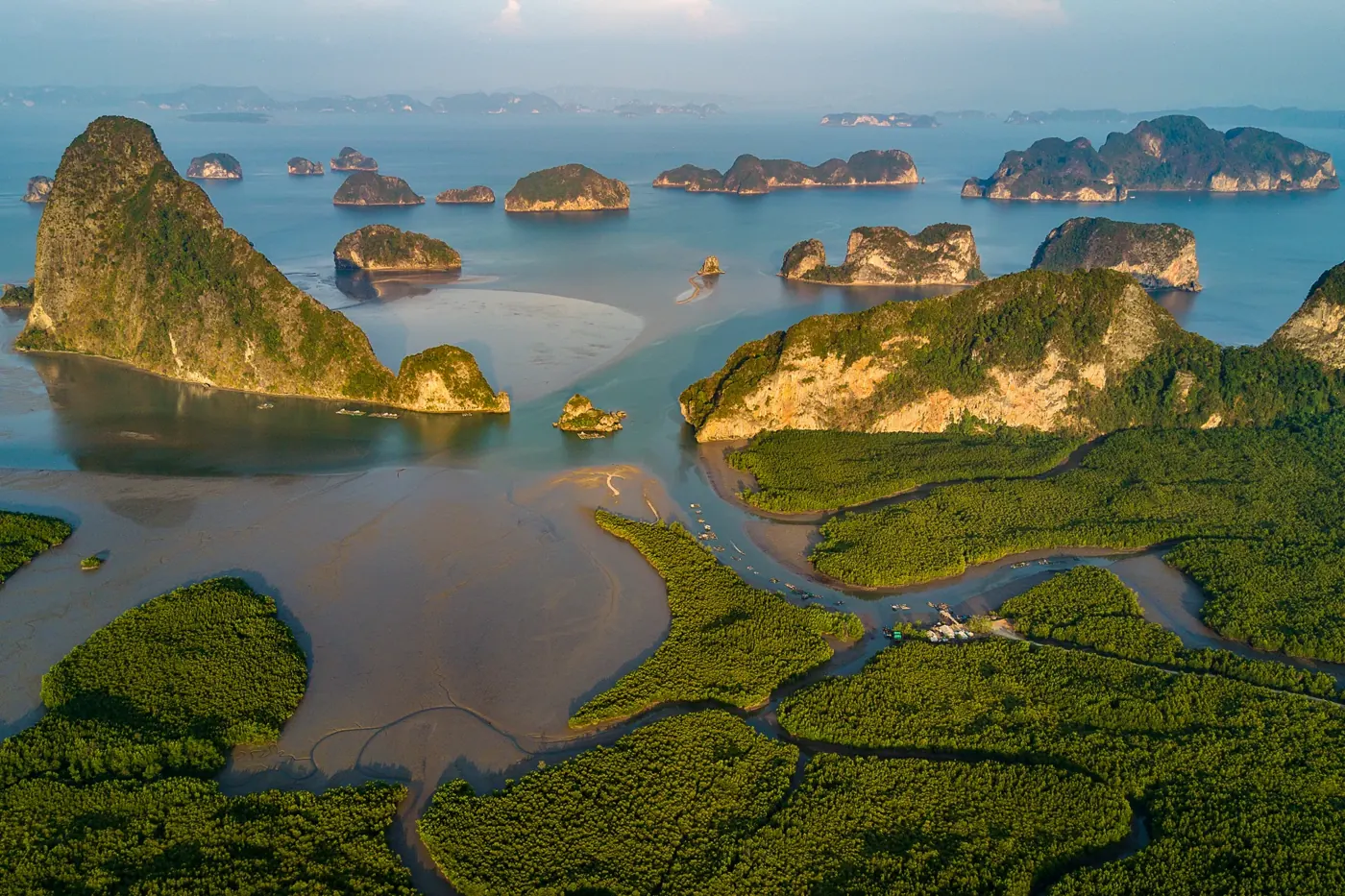
Mangrove channels and limestone islands in Phang Nga Bay, Thailand.

Thailand · Habitat field guide

Mangroves & estuaries

The Andaman coast’s mangroves sit among river mouths, limestone, mudflats and seagrass. Tides and catchments keep those habitats connected.

Mangrove channels and limestone islands in Phang Nga Bay, Thailand.

Photograph: Stéphane Bidouze · Image source · CC BY-SA 4.0. Cropped to fill the hero; darkened for text legibility.

Understanding the environment

A sense of the habitat.

The Andaman coast’s mangroves sit among river mouths, limestone, mudflats and seagrass. Tides and catchments keep those habitats connected.

Water
Estuarine and tidal
Habitat mosaic
Mangroves, mudflats and shallow seabeds
Local examples
Krabi Estuary and Pang Nga Bay

Explore the structure · Compare the channel, rooted forest and exposed flat.

Follow the estuary.

Select a zone to see what changes.

River and tide

Estuarine channel

Look for the route taken by river water toward the bay.

Note tide and recent rain if known; salinity cannot be read reliably from colour.

A conceptual habitat reading guide. The zones are not to scale and do not establish the presence of any snake at a particular site.

Sources: Ramsar · Krabi Estuary Information Sheet (2001) · Ramsar · Pang Nga Bay Information Sheet

Field notes · 01

Krabi is more than a line of trees

The Krabi Ramsar information sheet describes mangrove forest, mudflats, wooded rocky terrain and seagrass. Rivers opening into the sea connect these settings.

Treat the habitat at an observation point separately from the broader site label. “Krabi estuary” alone does not establish that an animal was found in a tree, on mud or in water.

Sources: Ramsar · Krabi Estuary Information Sheet (2001)

Field notes · 02

A bay with several neighbouring habitats

Pang Nga Bay’s site account also includes evergreen island forest and coral reef alongside mangroves. This makes a useful comparison with Krabi without implying identical species lists.

A coastal photograph supplies landscape context. Use a taxonomic or field source to establish snake occurrence and a species account to establish its habitat use.

Sources: Ramsar · Pang Nga Bay Information Sheet

Pressures on Thailand’s habitats

What is at risk?

What helps this habitat

Protect tidal exchange and open flats, manage wastewater and conversion pressures, and monitor habitat condition with coastal communities.

The connected collection

Snakes with habitat evidence.

These 10 species have supported country occurrence and an explicit habitat association in the shared account. The association may come from elsewhere in their range. This is not a complete local habitat inventory; the places above are landscape examples, not asserted collecting sites.

10 species · showing 10

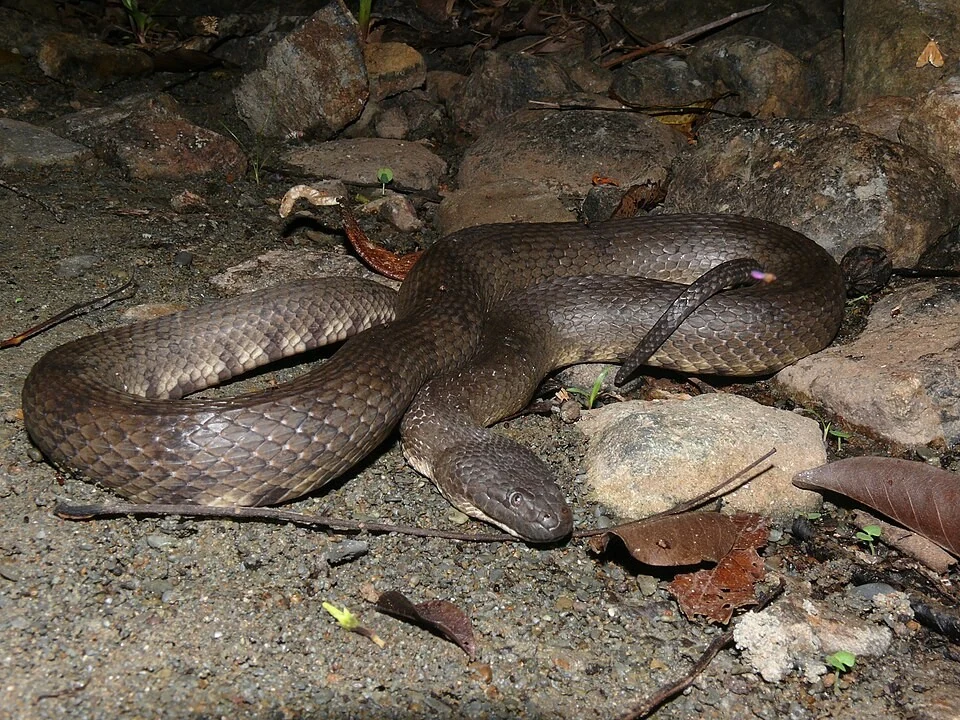
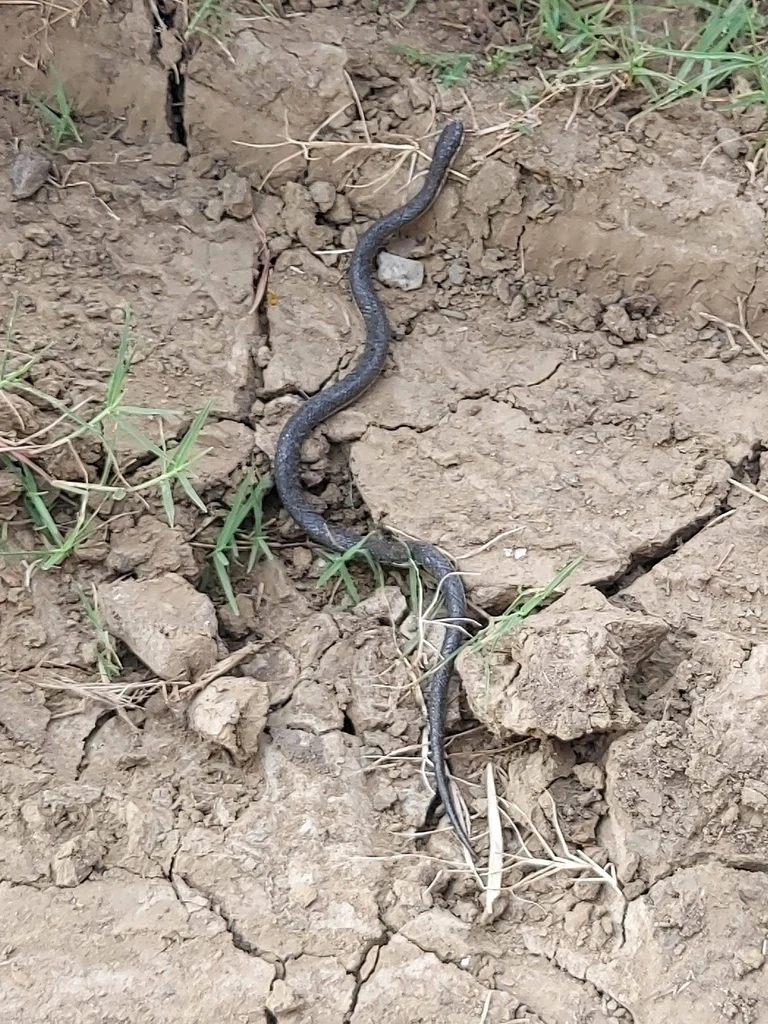
Acrochordus granulatus Portrait

001 · Acrochordidae

Little filesnake

Acrochordus granulatus

(SCHNEIDER, 1799)

Non-venomous

Thailand: country-level record; no named guide locality extracted. The Thai government Red Data account (2005, p. 135) documents these named Thai localities. These are historical locality records, not a complete present-day range survey.

Read the species account →

Mario Lutz · Copyright Mario Lutz. Authorised for display in this atlas; no third-party reuse licence granted.

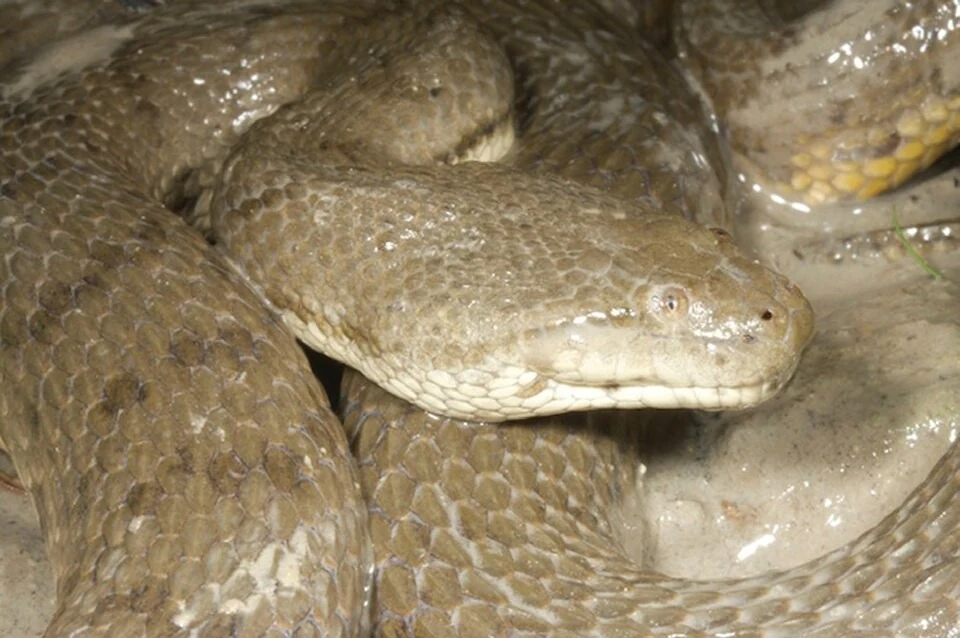
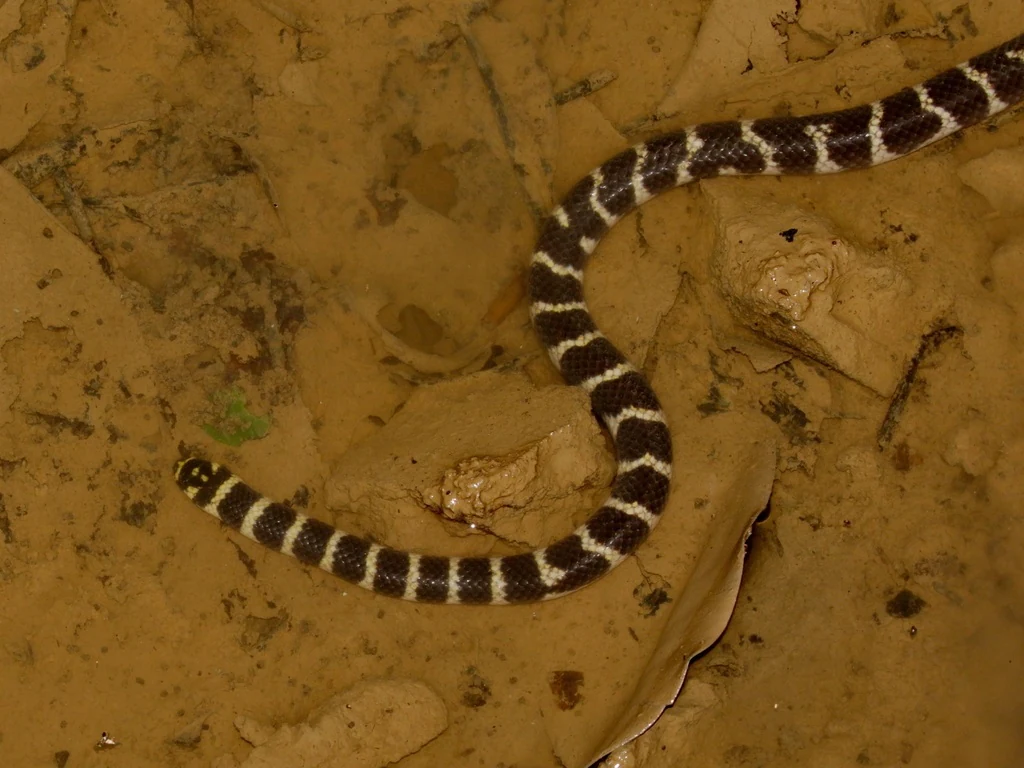
Cantoria violacea — Thailand, 2021-12-17. The head and banded body are visible in shallow muddy water.

002 · Homalopsidae

Cantor's Water Snake

Cantoria violacea

GIRARD, 1858

VenomousClinical severity not established

Thailand: country-level record; no named guide locality extracted. The Thai government Red Data account (2005, p. 163) documents these named Thai localities. These are historical locality records, not a complete present-day range survey.

Read the species account →

Ian Dugdale · CC BY 4.0 · https://creativecommons.org/licenses/by/4.0/

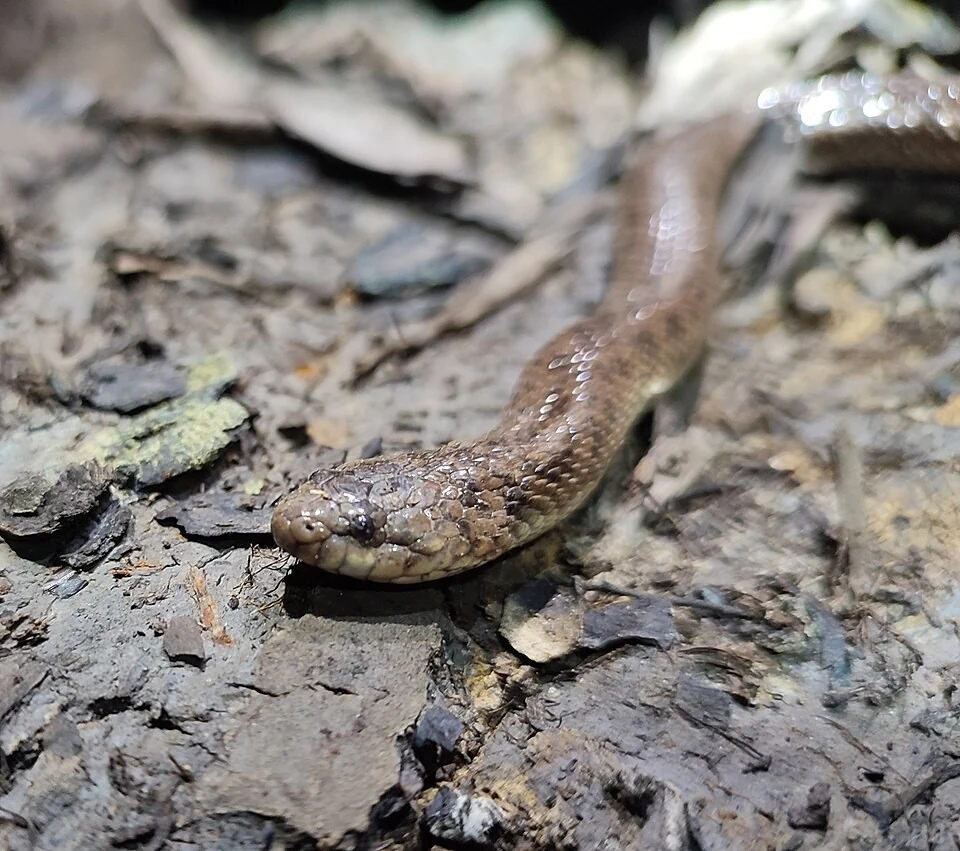
Cerberus rynchops — real specimen photograph; identification follows the linked source.

003 · Homalopsidae

South Asian Bockadam, New Guinea bockadam, Dog-faced Water Snake

Cerberus rynchops

(SCHNEIDER, 1799)

VenomousClinical severity not established

Thailand: country-level record; no named guide locality extracted.

Read the species account →

Swati Sidhu · CC BY-SA 4.0 · https://creativecommons.org/licenses/by-sa/4.0

Cerberus schneiderii — real specimen photograph; identification follows the linked source.

004 · Homalopsidae

Southeast Asian Bockadam

Cerberus schneiderii

(SCHLEGEL, 1837)

VenomousClinical severity not established

Thailand: country-level record; no named guide locality extracted.

Read the species account →

Mark O’Shea · CC BY 3.0 · https://creativecommons.org/licenses/by/3.0

Fordonia leucobalia — real specimen photograph; identification follows the linked source.

006 · Homalopsidae

Crab-eating (Water) Snake

Fordonia leucobalia

(SCHLEGEL, 1837)

VenomousClinical severity not established

Thailand: country-level record; no named guide locality extracted. The Thai government Red Data account (2005, p. 163) documents these named Thai localities. These are historical locality records, not a complete present-day range survey.

Read the species account →

Samuel GUIRAUDOU · CC BY 4.0 · https://creativecommons.org/licenses/by/4.0

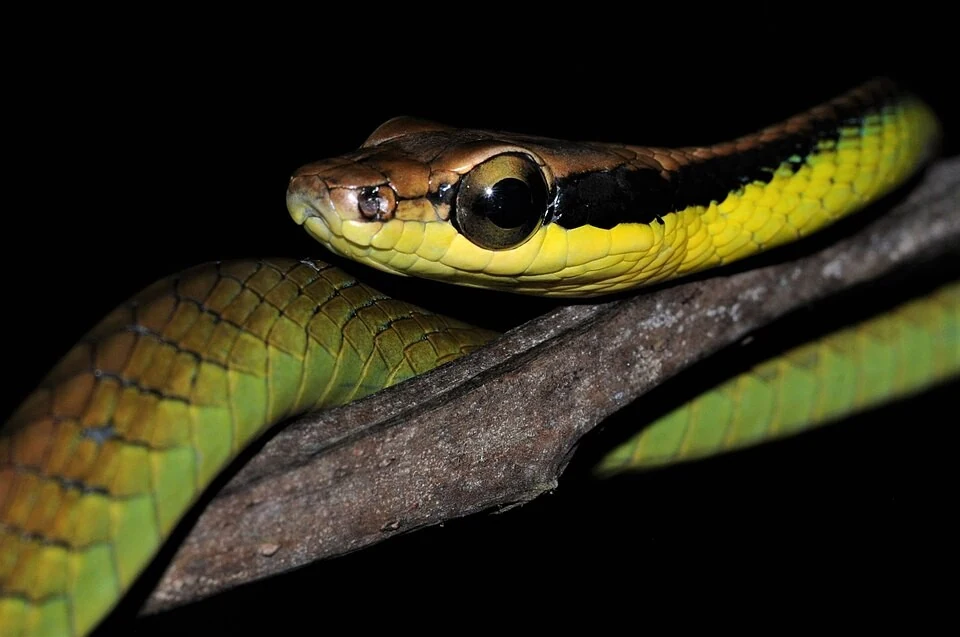
Gerarda prevostiana — India, 2023-10-14.

007 · Homalopsidae

Gerard's Water Snake

Gerarda prevostiana

(EYDOUX & GERVAIS, 1837)

VenomousClinical severity not established

Thailand: country-level record; no named guide locality extracted. The Thai government Red Data account (2005, p. 163) documents these named Thai localities. These are historical locality records, not a complete present-day range survey.

Read the species account →

Ramesh Shenai · CC BY 4.0 · https://creativecommons.org/licenses/by/4.0/

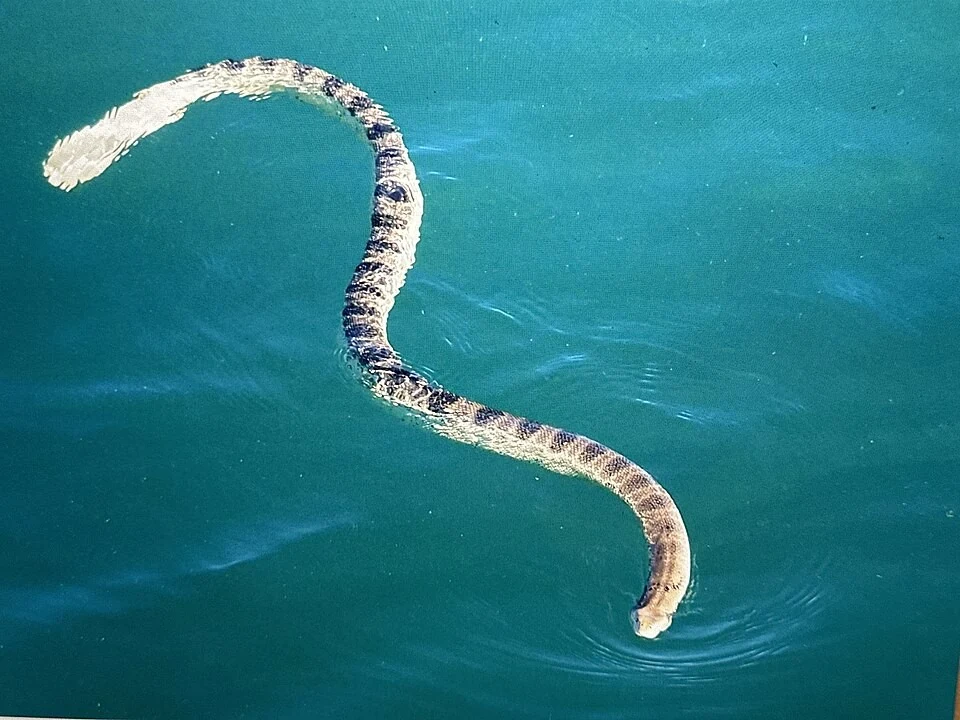
Hydrophis stokesii — real specimen photograph; identification follows the linked source.

008 · Elapidae

Stoke’s seasnake

Hydrophis stokesii

(GRAY, 1846)

VenomousClinical severity not established

Thailand: country-level record; no named guide locality extracted. The Thai government Red Data account (2005, p. 165) documents these named Thai localities. The source uses the name Astrotia stokesii. These are historical locality records, not a complete present-day range survey.

Read the species account →

Rosario · CC BY 4.0 · https://creativecommons.org/licenses/by/4.0

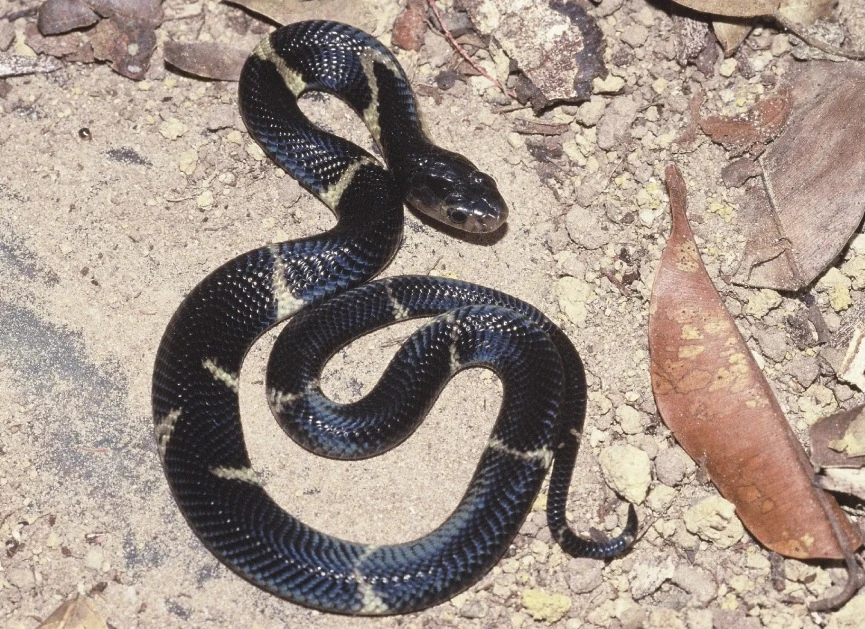
Naja sumatrana — juvenile photographed on the Santubong Peninsula, Sarawak, Malaysian Borneo.

009 · Elapidae

Equatorial Spitting cobra

Naja sumatrana

MÜLLER, 1887

VenomousMedically significant effects

Thailand: country-level record; no named guide locality extracted. The Thai government Red Data account (2005, p. 152) documents these named Thai localities. These are historical locality records, not a complete present-day range survey.

Read the species account →

Johan van Rooijen · CC BY 3.0 · https://creativecommons.org/licenses/by/3.0

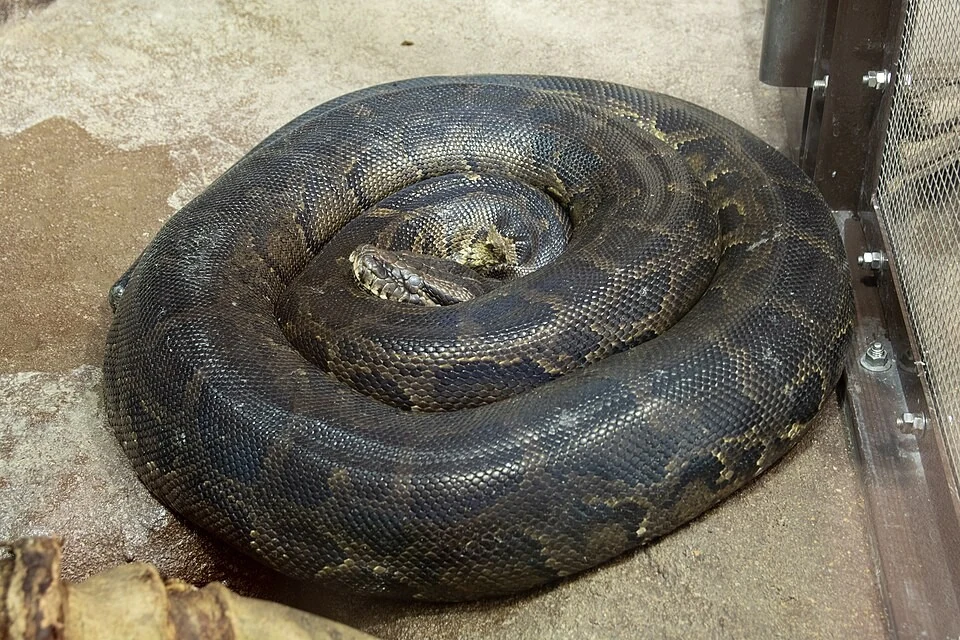
Python bivittatus — real specimen photograph; identification follows the linked source.

010 · Pythonidae

Burmese Python

Python bivittatus

KUHL, 1820

Non-venomous

Thailand: country-level record; no named guide locality extracted. The Thai government Red Data account (2005, p. 135) documents these named Thai localities. The source uses the name Python molurus bivittatus. These are historical locality records, not a complete present-day range survey.

Read the species account →

Σ64 · CC BY 4.0 · https://creativecommons.org/licenses/by/4.0

All 247 species in the country collection →

Read further

Evidence & sources.

Guide reviewed 11 October 2026. Source dates and geographic scope matter; landscape photographs do not establish species occurrence.

  1. Ramsar · Krabi Estuary Information Sheet (2001)

    Mangrove–mudflat–seagrass mosaic, encroachment and water-quality pressures. Historical baseline.

  2. Ramsar · Pang Nga Bay Information Sheet

    Historical record of island, evergreen forest, mangrove, mudflat, reef and seagrass habitats.

  3. Key Biodiversity Areas · Krabi Estuary
    Site assessment of tourism, infrastructure, pollution and mangrove conversion pressures.

Continue through Thailand

Explore another habitat.

01

Forests & woodland

Thailand’s forests include evergreen stands, seasonal woodland and dry dipterocarp formations. Reading their differences is more useful than expecting one national rainforest.

02

Mountain forests

Northern Thailand’s mountain forests change with elevation, landform and moisture. Doi Inthanon and Doi Chiang Dao provide two different ways to read that gradient.

03

Limestone & karst

Thailand’s karst includes northern mountain massifs and southern limestone coasts. Forest, drainage and the position of the sea give the rock its ecological context.

04

Rivers & wetlands

Thailand’s river habitats include seasonal floodplains, marshes and managed lowlands. Their ecological boundaries move with water.

05

Coasts & marine waters

Thailand faces both the Gulf of Thailand and the Andaman Sea. Their islands, shores and seabeds must retain their own locality evidence.