Size & measurements
No sourced size & measurements summary has yet been added to this account.
Colubridae · Species account
Natrix helvetica(LACÉPÈDE, 1789)
Venom unknownNot yet assessedFrench evidence spans riverbanks, ponds, reedbeds and peatlands, together with woodland edges, hedges and gardens. Vegetation provides refuge beside sunny patches; decomposing organic matter can provide warm, damp egg sites.
Venom & human effects
Venom status has not yet been established from the reviewed evidence for this account.
Missing evidence is not a non-venomous classification or a statement of low risk.
These are editorial summaries of the linked evidence, not toxicity rankings or WHO antivenom-priority categories. Effects vary with the bite and patient. Non-venomous does not mean safe to handle.
The scientific identity
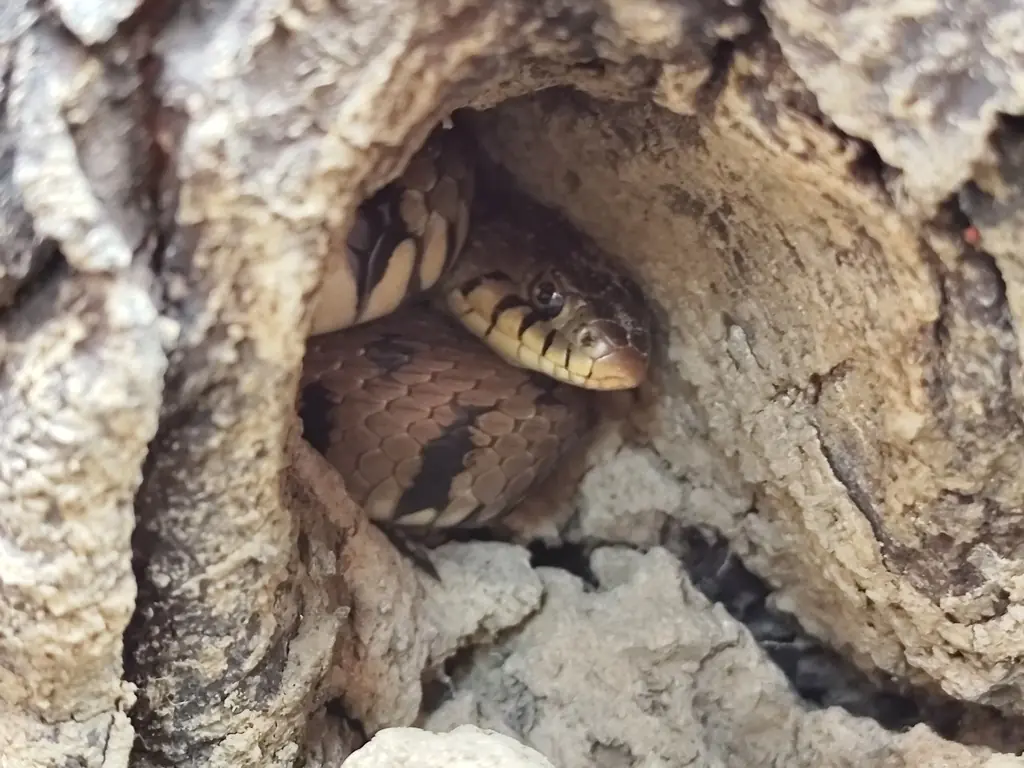
Often shows a pale collar behind the head. Colour and collar visibility vary, so this feature alone does not resolve every grass-snake identity. [3]
Specimen measurements describe the cited material, rather than a population maximum. Snout-to-vent length excludes the tail; adult size ranges are identified separately.
Reliable identification uses the published combination of scale characters, proportions and other diagnostic evidence. Colour or a photograph alone may not separate closely related species.
From observations & literature
No sourced size & measurements summary has yet been added to this account.
No sourced diet & feeding summary has yet been added to this account.
No sourced activity & behaviour summary has yet been added to this account.
Egg-laying.
French evidence spans riverbanks, ponds, reedbeds and peatlands, together with woodland edges, hedges and gardens. Vegetation provides refuge beside sunny patches; decomposing organic matter can provide warm, damp egg sites.
[3]On Jersey, connected vegetation, prey-rich wet areas and undisturbed refuges matter. The government identifies St Ouen’s Bay dunes and Ouaisne Common as important sites.
[4]French evidence spans riverbanks, ponds, reedbeds and peatlands, together with woodland edges, hedges and gardens. Vegetation provides refuge beside sunny patches; decomposing organic matter can provide warm, damp egg sites.
[5]On Jersey, connected vegetation, prey-rich wet areas and undisturbed refuges matter. The government identifies St Ouen’s Bay dunes and Ouaisne Common as important sites.
[6]The Carmarthenshire overview associates the species with wetlands, farmland, brownfield land, lowland grassland and heathland, alongside suitable egg-laying material.
[7]The government identifies the grass snake as the island's only snake; the 2021 wildlife guidance names helvetica.
[2]Sites explicitly identified by the Jersey government.
[8]The 2019 study verified Alpine barred grass snakes genetically at these named Bavarian localities.
[9]The 2019 museum report places the Alpine lineage in Tirol; this province-level evidence does not provide individual Austrian observation sites.
[10]The county’s 2024 review explicitly uses Natrix helvetica. It warns that systematic monitoring is lacking, so no abundance estimate is inferred.
[11]Unterland: observation GBIF 5166904682 (2025). The original iNaturalist entry was rechecked for research-grade identification, wild status and unrestricted coordinates; its reported uncertainty footprint lies within the mapped region. This is a community-reviewed observation, not a museum voucher. Unterland: observation GBIF 4606554115 (2022). The original iNaturalist entry was rechecked for research-grade identification, wild status and unrestricted coordinates; its reported uncertainty footprint lies within the mapped region. This is a community-reviewed observation, not a museum voucher. These are dated locality records, not evidence of occurrence throughout every part of a region or a complete present-day inventory.
[12][13][14][15]Northern cantons: observation GBIF 6413599717 (2026). The original iNaturalist entry was rechecked for research-grade identification, wild status and unrestricted coordinates; its reported uncertainty footprint lies within the mapped region. This is a community-reviewed observation, not a museum voucher. Northern cantons: observation GBIF 6234626487 (2026). The original iNaturalist entry was rechecked for research-grade identification, wild status and unrestricted coordinates; its reported uncertainty footprint lies within the mapped region. This is a community-reviewed observation, not a museum voucher. Eastern cantons: observation GBIF 6553107340 (2026). The original iNaturalist entry was rechecked for research-grade identification, wild status and unrestricted coordinates; its reported uncertainty footprint lies within the mapped region. This is a community-reviewed observation, not a museum voucher. Eastern cantons: observation GBIF 6413005111 (2026). The original iNaturalist entry was rechecked for research-grade identification, wild status and unrestricted coordinates; its reported uncertainty footprint lies within the mapped region. This is a community-reviewed observation, not a museum voucher. Southern cantons: observation GBIF 6518792481 (2026). The original iNaturalist entry was rechecked for research-grade identification, wild status and unrestricted coordinates; its reported uncertainty footprint lies within the mapped region. This is a community-reviewed observation, not a museum voucher. Southern cantons: observation GBIF 6252667982 (2026). The original iNaturalist entry was rechecked for research-grade identification, wild status and unrestricted coordinates; its reported uncertainty footprint lies within the mapped region. This is a community-reviewed observation, not a museum voucher. Central & western cantons: observation GBIF 5844011681 (2025). The original iNaturalist entry was rechecked for research-grade identification, wild status and unrestricted coordinates; its reported uncertainty footprint lies within the mapped region. This is a community-reviewed observation, not a museum voucher. Central & western cantons: observation GBIF 5840284648 (2025). The original iNaturalist entry was rechecked for research-grade identification, wild status and unrestricted coordinates; its reported uncertainty footprint lies within the mapped region. This is a community-reviewed observation, not a museum voucher. These are dated locality records, not evidence of occurrence throughout every part of a region or a complete present-day inventory.
[16][17][18][19][20][21][22][23][24][25][26][27][28][29][30][31]A reported observation is not necessarily the full ecological range of a species. Where reproduction is inferred in a source dataset, the account identifies that limitation.
One species · Across borders
Explore the recorded countries and islands. Select a highlighted area to see its distribution evidence.
Loading geographic boundaries…
Click a highlighted country to zoom in and explore its records.
Shading identifies recorded countries or named islands, not continuous habitat coverage. Uncoloured areas do not establish absence.
Natural Earth · 1:50m · public domain; Gibraltar: geoBoundaries. Small islands may lack an outline.
Explore the distribution
Select a highlighted area to see its status, island records and sources. Each country and island links to the same shared species collection.
Use “Worldwide records” to include distant introduced and uncertain records in the map view.
Country explicitly listed in the checked taxonomic treatment. The 2019 museum report places the Alpine lineage in Tirol; this province-level evidence does not provide individual Austrian observation sites.
Vorarlberg & Tyrol → · Tirol (province-level evidence)
Locality source 1 ↗ Locality source 2 ↗Country explicitly listed in the checked taxonomic treatment.
Locality source 1 ↗Country explicitly listed in the checked taxonomic treatment.
Locality source 1 ↗Country explicitly listed in the checked taxonomic treatment. The 2019 study verified Alpine barred grass snakes genetically at these named Bavarian localities.
Bavaria & Baden-Württemberg → · Upper Isar near Mittenwald, Sachrang
Locality source 1 ↗ Locality source 2 ↗Country explicitly listed in the checked taxonomic treatment.
Locality source 1 ↗The government identifies the grass snake as the island's only snake; the 2021 wildlife guidance names helvetica. Sites explicitly identified by the Jersey government. Sites explicitly identified by the Jersey government.
Jersey → · St Ouen’s Bay dunes, Ouaisne Common
Locality source 1 ↗ Locality source 2 ↗Country explicitly listed in the checked taxonomic treatment. Unterland: observation GBIF 5166904682 (2025). The original iNaturalist entry was rechecked for research-grade identification, wild status and unrestricted coordinates; its reported uncertainty footprint lies within the mapped region. This is a community-reviewed observation, not a museum voucher. Unterland: observation GBIF 4606554115 (2022). The original iNaturalist entry was rechecked for research-grade identification, wild status and unrestricted coordinates; its reported uncertainty footprint lies within the mapped region. This is a community-reviewed observation, not a museum voucher. These are dated locality records, not evidence of occurrence throughout every part of a region or a complete present-day inventory.
Unterland → · Gamprin, Mauren
Locality source 1 ↗ Locality source 2 ↗ Locality source 3 ↗ Locality source 4 ↗ Locality source 5 ↗Country explicitly listed in the checked taxonomic treatment. Northern cantons: observation GBIF 6413599717 (2026). The original iNaturalist entry was rechecked for research-grade identification, wild status and unrestricted coordinates; its reported uncertainty footprint lies within the mapped region. This is a community-reviewed observation, not a museum voucher. Northern cantons: observation GBIF 6234626487 (2026). The original iNaturalist entry was rechecked for research-grade identification, wild status and unrestricted coordinates; its reported uncertainty footprint lies within the mapped region. This is a community-reviewed observation, not a museum voucher. Eastern cantons: observation GBIF 6553107340 (2026). The original iNaturalist entry was rechecked for research-grade identification, wild status and unrestricted coordinates; its reported uncertainty footprint lies within the mapped region. This is a community-reviewed observation, not a museum voucher. Eastern cantons: observation GBIF 6413005111 (2026). The original iNaturalist entry was rechecked for research-grade identification, wild status and unrestricted coordinates; its reported uncertainty footprint lies within the mapped region. This is a community-reviewed observation, not a museum voucher. Southern cantons: observation GBIF 6518792481 (2026). The original iNaturalist entry was rechecked for research-grade identification, wild status and unrestricted coordinates; its reported uncertainty footprint lies within the mapped region. This is a community-reviewed observation, not a museum voucher. Southern cantons: observation GBIF 6252667982 (2026). The original iNaturalist entry was rechecked for research-grade identification, wild status and unrestricted coordinates; its reported uncertainty footprint lies within the mapped region. This is a community-reviewed observation, not a museum voucher. Central & western cantons: observation GBIF 5844011681 (2025). The original iNaturalist entry was rechecked for research-grade identification, wild status and unrestricted coordinates; its reported uncertainty footprint lies within the mapped region. This is a community-reviewed observation, not a museum voucher. Central & western cantons: observation GBIF 5840284648 (2025). The original iNaturalist entry was rechecked for research-grade identification, wild status and unrestricted coordinates; its reported uncertainty footprint lies within the mapped region. This is a community-reviewed observation, not a museum voucher. These are dated locality records, not evidence of occurrence throughout every part of a region or a complete present-day inventory.
Northern cantons → · Canton Clervaux, Canton Vianden
Eastern cantons → · Canton Remich
Southern cantons → · Canton Esch-sur-Alzette
Central & western cantons → · Canton Redange
Locality source 1 ↗ Locality source 2 ↗ Locality source 3 ↗ Locality source 4 ↗ Locality source 5 ↗ Locality source 6 ↗ Locality source 7 ↗ Locality source 8 ↗ Locality source 9 ↗ Locality source 10 ↗ Locality source 11 ↗ Locality source 12 ↗ Locality source 13 ↗ Locality source 14 ↗ Locality source 15 ↗ Locality source 16 ↗ Locality source 17 ↗Country explicitly listed in the checked taxonomic treatment.
Locality source 1 ↗Country explicitly listed in the checked taxonomic treatment.
Locality source 1 ↗Country explicitly listed in the checked taxonomic treatment.
Locality source 1 ↗Country explicitly listed in the checked taxonomic treatment. The county’s 2024 review explicitly uses Natrix helvetica. It warns that systematic monitoring is lacking, so no abundance estimate is inferred.
Wales → · Carmarthenshire (county overview)
Locality source 1 ↗ Locality source 2 ↗Documented country records: Austria, Belgium, France, Germany, Italy, Jersey, Liechtenstein, Luxembourg, Netherlands, Spain, Switzerland, United Kingdom. Country records do not imply continuous occupancy. [34][35]
The text retains the source’s geographic qualifications. The map shows countries with atlas occurrence records; it is not a complete global range model. A type locality is a nomenclatural reference, not the only place the species occurs.
Status & its meaning
No matching global assessment was verified for this account. This is an unresolved assessment link, not an IUCN “Not Evaluated” classification and not evidence that the species is secure.
Locality coverage in the atlas does not measure abundance, population trends or national legal protection.
Follow the evidence
Latest evidence added 2026-10-12. Taxonomic and distribution treatments may change.
The linked taxonomic treatment provides its original descriptions, revisions and bibliography. Observations from other countries are not relabelled as local field studies.