Size & measurements
Recorded size
SquamBase 1.0 records a literature maximum of 40 cm total length, including the tail. This is a compiled maximum, not a typical adult size or a measurement specific to this country.
[2]Colubridae · Species account
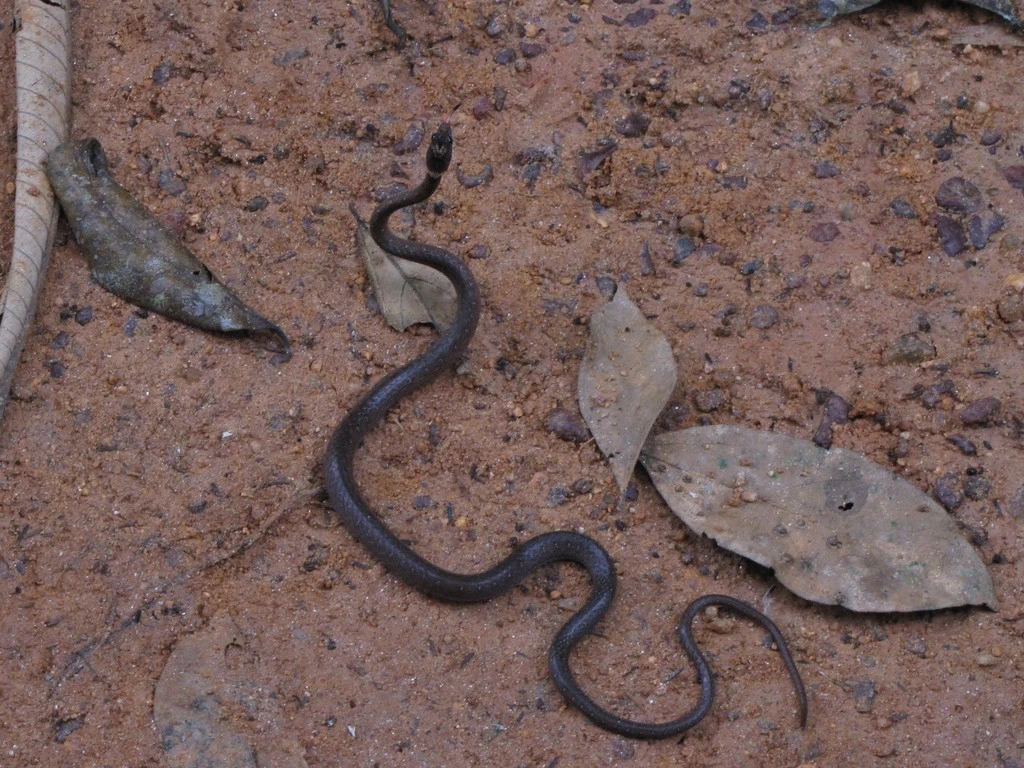
Natriciteres variegata(PETERS, 1861)
Venom unknownNot yet assessedThe habitat paragraph in the checked taxonomic treatment explicitly describes marine settings. This is a species-level association at the source’s stated scale, not a locality assignment for every country.
Venom & human effects
Venom status has not yet been established from the reviewed evidence for this account.
Missing evidence is not a non-venomous classification or a statement of low risk.
These are editorial summaries of the linked evidence, not toxicity rankings or WHO antivenom-priority categories. Effects vary with the bite and patient. Non-venomous does not mean safe to handle.
The scientific identity
Reliable identification uses the published combination of scale characters, proportions and other diagnostic evidence. Colour or a photograph alone may not separate closely related species.
From observations & literature
Size and ecological traits credited to SquamBase summarize published studies across the species’ range in its 2024 edition. They are complemented by the locality-specific observations below.
SquamBase 1.0 records a literature maximum of 40 cm total length, including the tail. This is a compiled maximum, not a typical adult size or a measurement specific to this country.
[2]A juvenile contained two frogs: one Arthroleptis and one too digested for identification.
Museum stomach-content evidence from Damaro, southeastern Guinea. Individual feeding records do not establish the full diet or prey preference.
Pauwels, Chirio & Dekoninck (2022), Bulletin of the Chicago Herpetological Society 57(6):117–123; Results, Natriciteres variegata; p. 120–121; RBINS 20324. Table 1 documents specimen identity.
The 2024 compilation classifies activity as mainly during daylight. This range-wide summary does not exclude activity at other times.
[2]Aquatic activity is reported in the studies compiled by SquamBase. This describes the species across its studied range, not a record from every country or region.
[2]Egg-laying.
The habitat paragraph in the checked taxonomic treatment explicitly describes marine settings. This is a species-level association at the source’s stated scale, not a locality assignment for every country.
[3]Eket vicinity, Akwa-Ibom State, Nigeria, June–September 1997: Table 2 reports 0 observations in dryland rainforest, 8 in freshwater swamp rainforest and 0 in farmland/cultivation. Swamp forest included permanently or seasonally flooded lowland forest (methods, p. 100). These are local habitat-use records, not a complete range-wide description or proof of preference. Zero entries do not establish absence; cultivation is not recoded as savanna.
[4]Lama Forest, May 2002: five vouchers, ZFMK 77042–046, were collected on the forest floor (p.43).
[5]Centre: museum voucher UF 182264 (2017). The museum record's reported coordinate uncertainty footprint lies within the mapped region. South-West: museum voucher YPM YPM HERR 008674 (1971). The museum record's reported coordinate uncertainty footprint lies within the mapped region. These are dated locality records, not evidence of occurrence throughout every part of a region or a complete present-day inventory.
[6][7]Eastern & coastal regions: museum voucher MVZ MVZ:Herp:252557 (2006). The museum record's reported coordinate uncertainty footprint lies within the mapped region. Eastern & coastal regions: museum voucher MVZ MVZ:Herp:245385 (2004). The museum record's reported coordinate uncertainty footprint lies within the mapped region. Western regions: museum voucher CAS 97564 (1962). The museum record's reported coordinate uncertainty footprint lies within the mapped region. Central & Ashanti: museum voucher MCZ R-49692 (1947). The museum record's reported coordinate uncertainty footprint lies within the mapped region. These are dated locality records, not evidence of occurrence throughout every part of a region or a complete present-day inventory.
[8][9][10][11]Abidjan & Lagunes: observation GBIF 6519653340 (2026). The original iNaturalist entry was rechecked for research-grade identification, wild status and unrestricted coordinates; its reported uncertainty footprint lies within the mapped region. This is a community-reviewed observation, not a museum voucher. Abidjan & Lagunes: observation GBIF 4129898433 (2022). The original iNaturalist entry was rechecked for research-grade identification, wild status and unrestricted coordinates; its reported uncertainty footprint lies within the mapped region. This is a community-reviewed observation, not a museum voucher. These are dated locality records, not evidence of occurrence throughout every part of a region or a complete present-day inventory.
[12][13][14][15]Central counties: museum voucher MCZ R-52218 (1952). The museum record's reported coordinate uncertainty footprint lies within the mapped region. Northwestern counties: museum voucher MCZ R-46980 (1944). The museum record's reported coordinate uncertainty footprint lies within the mapped region. These are dated locality records, not evidence of occurrence throughout every part of a region or a complete present-day inventory.
[16][17]Western Area: iNaturalist observation 17807579, recorded 2018-10-24. The current original record has agreeing research-grade identification, wild status and unrestricted coordinates; its entire reported uncertainty footprint lies within this mapped region. This community observation is not a museum voucher. Western Area: iNaturalist observation 143961803, recorded 2004-12-04. The current original record has agreeing research-grade identification, wild status and unrestricted coordinates; its entire reported uncertainty footprint lies within this mapped region. This community observation is not a museum voucher. These are dated locality records, not evidence of occurrence throughout every part of a region or a complete present-day inventory.
[18][19][20][21]Plateaux Region: iNaturalist observation 290703398, recorded 2025-06-18. The current original record has agreeing research-grade identification, wild status and unrestricted coordinates; its entire reported uncertainty footprint lies within this mapped region. This community observation is not a museum voucher. Plateaux Region: iNaturalist observation 289760177, recorded 2025-06-15. The current original record has agreeing research-grade identification, wild status and unrestricted coordinates; its entire reported uncertainty footprint lies within this mapped region. This community observation is not a museum voucher. These are dated locality records, not evidence of occurrence throughout every part of a region or a complete present-day inventory.
[22][23][24][25]Luiselli & Akani (1999), study area p. 100 and species-specific records in Table 2 p. 104, June–September 1997. Akwa-Ibom belongs to the South South atlas group. The surrounding study area is retained as a named locality; no precise capture coordinate is invented. Historical records do not prove current occupancy.
[26]A reported observation is not necessarily the full ecological range of a species. Where reproduction is inferred in a source dataset, the account identifies that limitation.
One species · Across borders
Explore the recorded countries and islands. Select a highlighted area to see its distribution evidence.
Loading geographic boundaries…
Click a highlighted country to zoom in and explore its records.
Shading identifies recorded countries or named islands, not continuous habitat coverage. Uncoloured areas do not establish absence.
Natural Earth · 1:50m · public domain; Gibraltar: geoBoundaries. Small islands may lack an outline.
Explore the distribution
Select a highlighted area to see its status, island records and sources. Each country and island links to the same shared species collection.
Use “Worldwide records” to include distant introduced and uncertain records in the map view.
The current taxonomic treatment explicitly lists this country. This is country-scale checklist evidence, not a claim of continuous occupancy or a complete regional inventory.
Locality source 1 ↗The current taxonomic treatment explicitly lists this country. This is country-scale checklist evidence, not a claim of continuous occupancy or a complete regional inventory.
Locality source 1 ↗The current taxonomic treatment explicitly lists this country. This is country-scale checklist evidence, not a claim of continuous occupancy or a complete regional inventory. Centre: museum voucher UF 182264 (2017). The museum record's reported coordinate uncertainty footprint lies within the mapped region. South-West: museum voucher YPM YPM HERR 008674 (1971). The museum record's reported coordinate uncertainty footprint lies within the mapped region. These are dated locality records, not evidence of occurrence throughout every part of a region or a complete present-day inventory.
Centre → · Centre
South-West → · South-West
Locality source 1 ↗ Locality source 2 ↗ Locality source 3 ↗The current taxonomic treatment explicitly lists this country. This is country-scale checklist evidence, not a claim of continuous occupancy or a complete regional inventory.
Locality source 1 ↗The current taxonomic treatment explicitly lists this country. This is country-scale checklist evidence, not a claim of continuous occupancy or a complete regional inventory.
Locality source 1 ↗The current taxonomic treatment explicitly lists this country. This is country-scale checklist evidence, not a claim of continuous occupancy or a complete regional inventory. Eastern & coastal regions: museum voucher MVZ MVZ:Herp:252557 (2006). The museum record's reported coordinate uncertainty footprint lies within the mapped region. Eastern & coastal regions: museum voucher MVZ MVZ:Herp:245385 (2004). The museum record's reported coordinate uncertainty footprint lies within the mapped region. Western regions: museum voucher CAS 97564 (1962). The museum record's reported coordinate uncertainty footprint lies within the mapped region. Central & Ashanti: museum voucher MCZ R-49692 (1947). The museum record's reported coordinate uncertainty footprint lies within the mapped region. These are dated locality records, not evidence of occurrence throughout every part of a region or a complete present-day inventory.
Eastern & coastal regions → · Eastern & coastal regions
Western regions → · Western regions
Central & Ashanti → · Central & Ashanti
Locality source 1 ↗ Locality source 2 ↗ Locality source 3 ↗ Locality source 4 ↗ Locality source 5 ↗The current taxonomic treatment explicitly lists this country. This is country-scale checklist evidence, not a claim of continuous occupancy or a complete regional inventory.
Locality source 1 ↗The current taxonomic treatment explicitly lists this country. This is country-scale checklist evidence, not a claim of continuous occupancy or a complete regional inventory. Abidjan & Lagunes: observation GBIF 6519653340 (2026). The original iNaturalist entry was rechecked for research-grade identification, wild status and unrestricted coordinates; its reported uncertainty footprint lies within the mapped region. This is a community-reviewed observation, not a museum voucher. Abidjan & Lagunes: observation GBIF 4129898433 (2022). The original iNaturalist entry was rechecked for research-grade identification, wild status and unrestricted coordinates; its reported uncertainty footprint lies within the mapped region. This is a community-reviewed observation, not a museum voucher. These are dated locality records, not evidence of occurrence throughout every part of a region or a complete present-day inventory.
Abidjan & Lagunes → · Abidjan & Lagunes
Locality source 1 ↗ Locality source 2 ↗ Locality source 3 ↗ Locality source 4 ↗ Locality source 5 ↗The current taxonomic treatment explicitly lists this country. This is country-scale checklist evidence, not a claim of continuous occupancy or a complete regional inventory. Central counties: museum voucher MCZ R-52218 (1952). The museum record's reported coordinate uncertainty footprint lies within the mapped region. Northwestern counties: museum voucher MCZ R-46980 (1944). The museum record's reported coordinate uncertainty footprint lies within the mapped region. These are dated locality records, not evidence of occurrence throughout every part of a region or a complete present-day inventory.
Central counties → · Central counties
Northwestern counties → · Northwestern counties
Locality source 1 ↗ Locality source 2 ↗ Locality source 3 ↗The current taxonomic treatment explicitly lists this country. This is country-scale checklist evidence, not a claim of continuous occupancy or a complete regional inventory. Luiselli & Akani (1999), study area p. 100 and species-specific records in Table 2 p. 104, June–September 1997. Akwa-Ibom belongs to the South South atlas group. The surrounding study area is retained as a named locality; no precise capture coordinate is invented. Historical records do not prove current occupancy.
South South states → · Eket vicinity, Akwa-Ibom State
Locality source 1 ↗ Locality source 2 ↗The current taxonomic treatment explicitly lists this country. This is country-scale checklist evidence, not a claim of continuous occupancy or a complete regional inventory. Western Area: iNaturalist observation 17807579, recorded 2018-10-24. The current original record has agreeing research-grade identification, wild status and unrestricted coordinates; its entire reported uncertainty footprint lies within this mapped region. This community observation is not a museum voucher. Western Area: iNaturalist observation 143961803, recorded 2004-12-04. The current original record has agreeing research-grade identification, wild status and unrestricted coordinates; its entire reported uncertainty footprint lies within this mapped region. This community observation is not a museum voucher. These are dated locality records, not evidence of occurrence throughout every part of a region or a complete present-day inventory.
Western Area → · Western Area
Locality source 1 ↗ Locality source 2 ↗ Locality source 3 ↗ Locality source 4 ↗ Locality source 5 ↗The current taxonomic treatment explicitly lists this country. This is country-scale checklist evidence, not a claim of continuous occupancy or a complete regional inventory.
Locality source 1 ↗The current taxonomic treatment explicitly lists this country. This is country-scale checklist evidence, not a claim of continuous occupancy or a complete regional inventory.
Locality source 1 ↗The current taxonomic treatment explicitly lists this country. This is country-scale checklist evidence, not a claim of continuous occupancy or a complete regional inventory. Plateaux Region: iNaturalist observation 290703398, recorded 2025-06-18. The current original record has agreeing research-grade identification, wild status and unrestricted coordinates; its entire reported uncertainty footprint lies within this mapped region. This community observation is not a museum voucher. Plateaux Region: iNaturalist observation 289760177, recorded 2025-06-15. The current original record has agreeing research-grade identification, wild status and unrestricted coordinates; its entire reported uncertainty footprint lies within this mapped region. This community observation is not a museum voucher. These are dated locality records, not evidence of occurrence throughout every part of a region or a complete present-day inventory.
Plateaux Region → · Plateaux Region
Locality source 1 ↗ Locality source 2 ↗ Locality source 3 ↗ Locality source 4 ↗ Locality source 5 ↗Country entries documented in this Africa review: Benin, Burkina Faso, Cameroon, Central African Republic, Democratic Republic of the Congo, Ghana, Guinea, Ivory Coast, Liberia, Nigeria, Sierra Leone, South Sudan, Sudan, Togo. Consult individual occurrence records for qualifications. These entries are not a complete global range polygon. [1]
The text retains the source’s geographic qualifications. The map shows countries with atlas occurrence records; it is not a complete global range model. A type locality is a nomenclatural reference, not the only place the species occurs.
Status & its meaning
No matching global assessment was verified for this account. This is an unresolved assessment link, not an IUCN “Not Evaluated” classification and not evidence that the species is secure.
Locality coverage in the atlas does not measure abundance, population trends or national legal protection.
Follow the evidence
Latest evidence added 2026-10-16. Taxonomic and distribution treatments may change.
The linked taxonomic treatment provides its original descriptions, revisions and bibliography. Observations from other countries are not relabelled as local field studies.