Size & measurements
No sourced size & measurements summary has yet been added to this account.
Elapidae · Species account
Naja kaouthiaLESSON, 1831
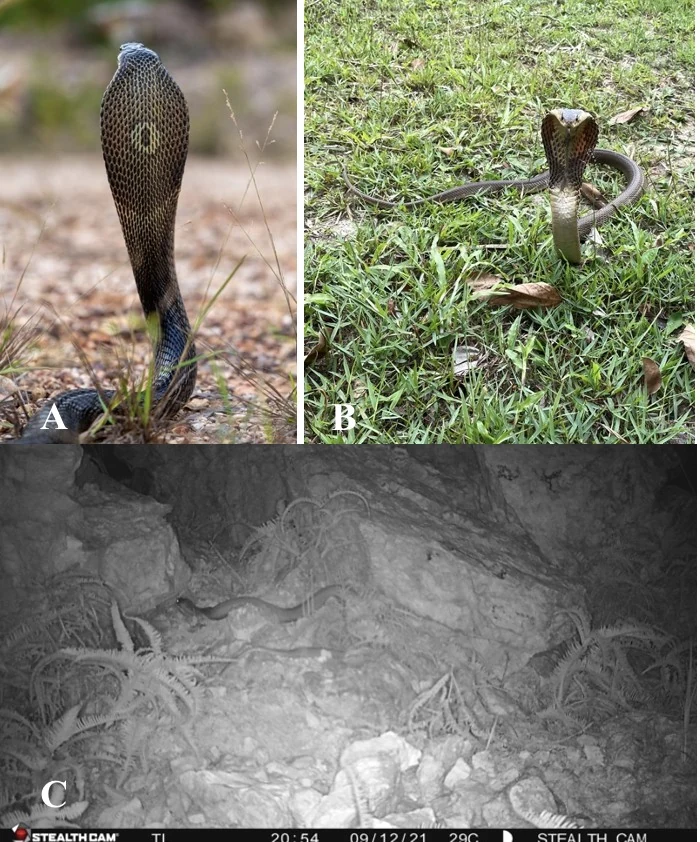
VenomousPotentially life-threateningKo Pha-ngan observations include settlements, disturbed forest and national-park forest.
Venom & human effects
Local and systemic envenoming are documented. A Malaysian clinical cohort recorded a death in the Naja kaouthia group, alongside serious bite complications.
Malaysian hospital consultations, 2020–2023. The reported deaths involved secondary complications. Findings for unidentified Naja bites are not assigned to this species.
Ismail et al. (2025), Results: interventions and outcomes; Discussion.
These are editorial summaries of the linked evidence, not toxicity rankings or WHO antivenom-priority categories. Effects vary with the bite and patient. Non-venomous does not mean safe to handle.
The scientific identity
Reliable identification uses the published combination of scale characters, proportions and other diagnostic evidence. Colour or a photograph alone may not separate closely related species.
Taxonomic treatment & original-description references ↗
Naja tripudians · Naia tripudians · Naja larvata · Naga tripudians · Naja kaothia · Naja naja · Naja kauthia
Names trace the literature, including older combinations and historical usages. Their appearance here does not mean they are all currently accepted synonyms.
From observations & literature
No sourced size & measurements summary has yet been added to this account.
No sourced diet & feeding summary has yet been added to this account.
No sourced activity & behaviour summary has yet been added to this account.
Ko Pha-ngan observations include settlements, disturbed forest and national-park forest.
[7]Tanintharyi survey: a juvenile was photographed in disturbed habitat at Forest 3. A local observation does not delimit the species-wide habitat.
[8]Bhutan: the 2019–2020 Trashigang survey found this species in urban residential settings. The authors suggest microhabitat availability and tolerance of disturbance as explanations, rather than demonstrating either experimentally.
[9]The taxonomic treatment explicitly identifies this species as venomous. That designation does not, by itself, establish the severity of every bite.
[1]Myanmar is explicitly listed in the checked individual taxonomic treatment.
[2]India is explicitly listed in the checked individual taxonomic treatment. The national ZSI checklist independently lists Naja kaouthia. Regional evidence: Uttar Pradesh; Assam, Arunachal Pradesh, Meghalaya, Nagaland, Manipur, Mizoram, Tripura, Sikkim; Bihar, Odisha, West Bengal, Orissa. Named records do not imply continuous occurrence throughout a region.
[2][3]Confirmed occurrence in the 2025 Bangladesh review, Table 1. The paper explicitly relates its regional labels to the named administrative divisions. Regional evidence: Chattogram; Sylhet; Dhaka; Mymensingh; Barishal; Rangpur; Rajshahi; Khulna. Named records do not imply continuous occurrence throughout a region.
[2][4]Bhutan is explicitly listed in the checked individual taxonomic treatment.
[2]China is explicitly recorded in the checked individual species treatment. The accepted identity is also represented in the 2025 checklist; regional inclusion here is based on explicit locality evidence, not the checklist’s broader geographical scope. Named regional records: Yunnan. These localities do not imply continuous occupation of the entire region.
[5][6]The 2021–2023 field survey documented this species on Ko Pha-ngan, Surat Thani (published 2026, Table 1 and species treatment). This island record does not delimit its wider Thai range.
[10]A named locality in the cited account; no continuous regional range is inferred.
[11]Bhutan: named geog-level observations from the 2019–2020 Trashigang survey, Table 2; no continuous range is inferred.
[12]A reported observation is not necessarily the full ecological range of a species. Where reproduction is inferred in a source dataset, the account identifies that limitation.
One species · Across borders
Explore the recorded countries and islands. Select a highlighted area to see its distribution evidence.
Loading geographic boundaries…
Click a highlighted country to zoom in and explore its records.
Shading identifies recorded countries or named islands, not continuous habitat coverage. Uncoloured areas do not establish absence.
Natural Earth · 1:50m · public domain; Gibraltar: geoBoundaries. Small islands may lack an outline.
Explore the distribution
Select a highlighted area to see its status, island records and sources. Each country and island links to the same shared species collection.
Use “Worldwide records” to include distant introduced and uncertain records in the map view.
Vietnam: Son La; Quang Tri, Thua Thien Hue; Dak Lak, Lam Dong; Dong Nai, Ho Chi Minh, Ho Chi Minh City; Kien Giang.
Northwest mountains → · Son La
North Central Coast & Annamites → · Quang Tri, Thua Thien Hue
Central Highlands → · Dak Lak, Lam Dong
Southeast forests & lowlands → · Dong Nai, Ho Chi Minh, Ho Chi Minh City
Mekong Delta → · Kien Giang
Locality source 1 ↗Malaysia: national record; no finer locality assigned.
Locality source 1 ↗Thailand: country-level record; no named guide locality extracted. The 2021–2023 field survey documented this species on Ko Pha-ngan, Surat Thani (published 2026, Table 1 and species treatment). This island record does not delimit its wider Thai range.
Southern peninsula → · Ko Pha-ngan, Surat Thani
Locality source 1 ↗ Locality source 2 ↗Myanmar is explicitly listed in the checked individual taxonomic treatment. A named locality in the cited account; no continuous regional range is inferred.
Tanintharyi & Mon → · Forest 3 near Chaung-nauk-pyan, Tanintharyi
Locality source 1 ↗ Locality source 2 ↗Confirmed occurrence in the 2025 Bangladesh review, Table 1. The paper explicitly relates its regional labels to the named administrative divisions. Regional evidence: Chattogram; Sylhet; Dhaka; Mymensingh; Barishal; Rangpur; Rajshahi; Khulna. Named records do not imply continuous occurrence throughout a region.
Chattogram → · Chattogram
Sylhet → · Sylhet
Dhaka → · Dhaka
Mymensingh → · Mymensingh
Barishal → · Barishal
Rangpur → · Rangpur
Rajshahi → · Rajshahi
Khulna → · Khulna
Locality source 1 ↗ Locality source 2 ↗Bhutan is explicitly listed in the checked individual taxonomic treatment. Bhutan: named geog-level observations from the 2019–2020 Trashigang survey, Table 2; no continuous range is inferred.
Eastern valleys & forest corridors → · Samkhar, Shongphu, Toetsho, Khamdang, Thrimshing, Udzorong
Locality source 1 ↗ Locality source 2 ↗Balchan et al. (2025), distribution review, confirms national occurrence under the revised monocled-cobra concept.
Locality source 1 ↗ Locality source 2 ↗China is explicitly recorded in the checked individual species treatment. The accepted identity is also represented in the 2025 checklist; regional inclusion here is based on explicit locality evidence, not the checklist’s broader geographical scope. Named regional records: Yunnan. These localities do not imply continuous occupation of the entire region.
Southwestern mountains & basins → · Yunnan
Locality source 1 ↗ Locality source 2 ↗India is explicitly listed in the checked individual taxonomic treatment. The national ZSI checklist independently lists Naja kaouthia. Regional evidence: Uttar Pradesh; Assam, Arunachal Pradesh, Meghalaya, Nagaland, Manipur, Mizoram, Tripura, Sikkim; Bihar, Odisha, West Bengal, Orissa. Named records do not imply continuous occurrence throughout a region.
Northern plains & Himalaya → · Uttar Pradesh
Northeastern hills & Brahmaputra → · Assam, Arunachal Pradesh, Meghalaya, Nagaland, Manipur, Mizoram, Tripura, Sikkim
Eastern plains & plateau → · Bihar, Odisha, West Bengal, Orissa
Locality source 1 ↗ Locality source 2 ↗Bangladesh, Myanmar (= Burma), Cambodia, NE India (Manipur, Meghalaya, Assam, Arunachal Pradesh, Uttar Pradesh, Bihar, Sikkim, Assam, West Bengal, Orissa = Odisha, Tripura, Mizoram, Nagaland), Bhutan, Laos, N Malaysia, S China (Yunnan), Thailand, Vietnam (Quang Tri, Thua Thien-Hue, Dak Lak, Lam Dong, Dong Nai, Ho Chi Minh City and Kien Giang, Son La) [1]
The text retains the source’s geographic qualifications. The map shows countries with atlas occurrence records; it is not a complete global range model. A type locality is a nomenclatural reference, not the only place the species occurs.
Status & its meaning
No matching global assessment was verified for this account. This is an unresolved assessment link, not an IUCN “Not Evaluated” classification and not evidence that the species is secure.
Locality coverage in the atlas does not measure abundance, population trends or national legal protection.
Follow the evidence
Latest evidence added 2026-10-11. Taxonomic and distribution treatments may change.
The linked taxonomic treatment provides its original descriptions, revisions and bibliography. Observations from other countries are not relabelled as local field studies.