The Uruguayan Ministry of Environment species database marks confirmed presence (1.0) in forest ecosystems, grasslands and/or wooded grassland. Only confirmed ecosystem rows are used; potential presence (0.5), map-grid cells and protected-area membership are excluded. These are historical national ecosystem assignments, not new locality records or exclusive habitat preferences.
FamilyColubridae
ReproductionEgg-laying
Country chaptersArgentina · Bolivia · Brazil · Paraguay · Uruguay
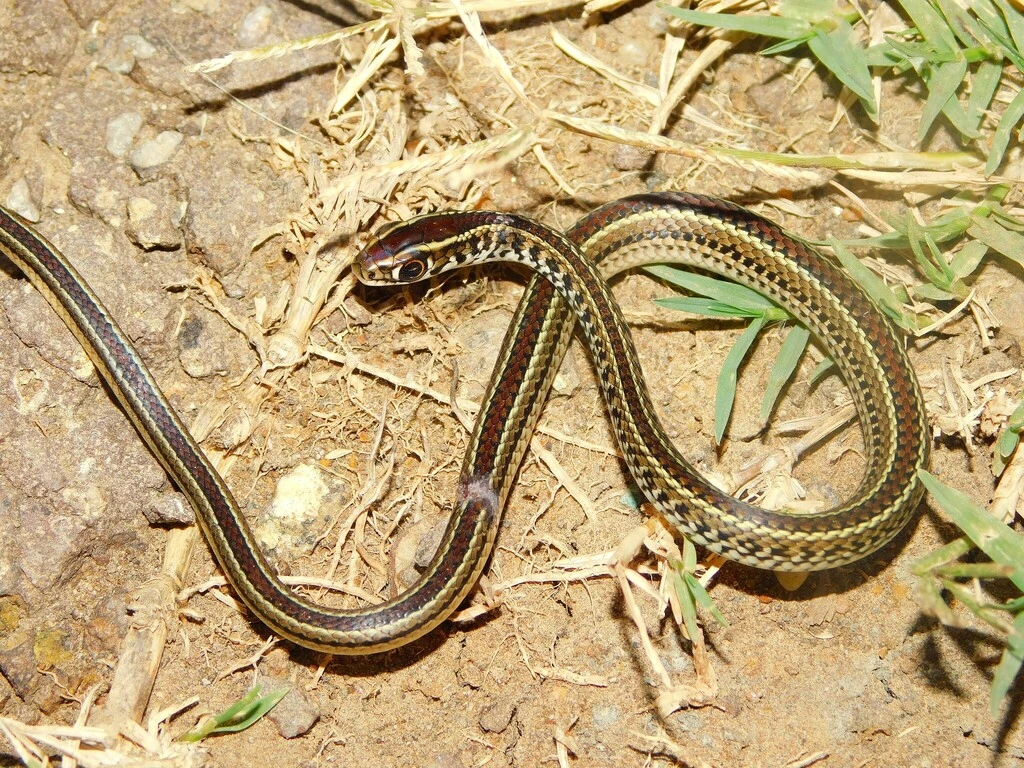
Lygophis flavifrenatus. Coiled body and head on dry soil. Original observation dated 2026-02-23. No additional geographic occurrence is inferred. Sebastián Gómez Barboza Silveira · CC0 1.0. Active exact species or subspecies in the retained original research-grade observation, with at least two distinct current agreeing identifiers. Image, comments, identification notes, attribution and licence manually reviewed. Portraits create no occurrence records. Full source frame resized and converted to WebP; no synthesis or retouching. Cards may crop the display.
Venom & human effects
What is documented?
Venom unknownNot yet assessed
Venom status has not yet been established from the reviewed evidence for this account.
Missing evidence is not a non-venomous classification or a statement of low risk.
How to read these badges
Limited documented effects
The cited human cases reported limited effects. Sparse observations cannot exclude a severe reaction.
Medically significant effects
The cited human cases document clinically important injury or illness. This is not an upper limit on severity.
Potentially life-threatening
Species-specific clinical evidence documents life-threatening illness or deaths after bites. The account explains the affected patients and any uncertainty about the cause.
Clinical severity not established
Venom presence is documented, but the reviewed evidence does not establish a clinical tier. When human effects are reported under an unresolved historical species name, the badge and account say so explicitly.
Venom status uncertain
The reviewed sources are inconclusive or conflicting about venom presence. The account explains the uncertainty.
Venom status not assessed
The atlas lacks a reviewed venom-presence classification for this species.
These are editorial summaries of the linked evidence, not toxicity rankings or WHO antivenom-priority categories. Effects vary with the bite and patient. Non-venomous does not mean safe to handle.
The scientific identity
Taxonomy & recognition
Accepted name in this edition
Lygophis flavifrenatus
Authority
COPE, 1862
Family
Colubridae
Read the complete diagnosis
Reliable identification uses the published combination of scale characters, proportions and other diagnostic evidence. Colour or a photograph alone may not separate closely related species.
The compilation reports a maximum total length of 75.5 cm. This is a recorded maximum, not a typical adult size.
Exact-name entry in the 2024 SquamBase literature compilation, using an explicitly populated trait and its cited metadata. Records reflect the studied populations; they do not establish uniform behaviour across all seasons, ages or localities. Historical species concepts requiring review and imputed/uncertain metadata are excluded. Length is the compiler's largest accepted reported total length, not a new measurement, average, or current absolute biological limit. No allometric mass estimate is used.
Study & evidence
SquamBase 1.0, Supplementary Table S1, row 9670: Lygophis flavifrenatus; columns maximum total length (mm) and size metadata. Recorded value: 755. Original source metadata: 755 mm total length (Feldman et al. 2016), Cabral et al. 2022 (max Total length 746 mm, Max SVL: 627 mm)
No sourced diet & feeding summary has yet been added to this account.
Activity & behaviour
No sourced activity & behaviour summary has yet been added to this account.
Reproduction
Published records compiled in SquamBase report 10 eggs per clutch. These are the smallest and largest reported broods in the compilation, not a typical brood size or a complete limit for the species.
Exact-name row in the 2024 literature compilation. These are records from studied populations, not typical values, an exhaustive biological account, or evidence of occurrence in every region.
Study & evidence
SquamBase 1.0, Supplementary Table S1, row 9670: Lygophis flavifrenatus; columns Mode of reproduction, Mode of reproduction metadata, smallest brood, largest brood, brood size metadata.
The Uruguayan Ministry of Environment species database marks confirmed presence (1.0) in forest ecosystems, grasslands and/or wooded grassland. Only confirmed ecosystem rows are used; potential presence (0.5), map-grid cells and protected-area membership are excluded. These are historical national ecosystem assignments, not new locality records or exclusive habitat preferences.
The treatment names these subdivisions in its Argentina distribution clause: Entre Ríos, Entre Rios, Formosa, Misiones, Chaco, Corrientes. They are assigned to the declared atlas navigation groups; this is not a field observation, a whole-region range polygon or a complete local inventory.
The treatment names these subdivisions in its Bolivia distribution clause: Beni. They are assigned to the declared atlas navigation groups; this is not a field observation, a whole-region range polygon or a complete local inventory.
The treatment names these subdivisions in its Brazil distribution clause: Rio Grande do Sul. They are assigned to the declared atlas navigation groups; this is not a field observation, a whole-region range polygon or a complete local inventory.
A reported observation is not necessarily the full ecological range of a species. Where reproduction is inferred in a source dataset, the account identifies that limitation.
One species · Across borders
Global distribution
Explore the recorded countries and islands. Select a highlighted area to see its distribution evidence.
Recorded distributionN ↑
Loading geographic boundaries…
ListedIntroducedUncertain
Click a highlighted country to zoom in and explore its records.
Shading identifies recorded countries or named islands, not continuous habitat coverage. Uncoloured areas do not establish absence.
Select a highlighted area to see its status, island records and sources. Each country and island links to the same shared species collection.
Use “Worldwide records” to include distant introduced and uncertain records in the map view.
Argentina · regional locality evidence
The checked taxonomic distribution account explicitly lists Argentina. Country-level evidence does not establish continuous occupancy or a complete national inventory.
The treatment names these subdivisions in its Argentina distribution clause: Entre Ríos, Entre Rios, Formosa, Misiones, Chaco, Corrientes. They are assigned to the declared atlas navigation groups; this is not a field observation, a whole-region range polygon or a complete local inventory.
The checked taxonomic distribution account explicitly lists Bolivia. Country-level evidence does not establish continuous occupancy or a complete national inventory.
The treatment names these subdivisions in its Bolivia distribution clause: Beni. They are assigned to the declared atlas navigation groups; this is not a field observation, a whole-region range polygon or a complete local inventory.
The checked taxonomic distribution account explicitly lists Brazil. Country-level evidence does not establish continuous occupancy or a complete national inventory.
The treatment names these subdivisions in its Brazil distribution clause: Rio Grande do Sul. They are assigned to the declared atlas navigation groups; this is not a field observation, a whole-region range polygon or a complete local inventory.
The checked taxonomic distribution account explicitly lists Paraguay. Country-level evidence does not establish continuous occupancy or a complete national inventory.
The checked taxonomic distribution account explicitly lists Uruguay. Country-level evidence does not establish continuous occupancy or a complete national inventory.
Country entries supported by this Americas review: Argentina, Bolivia, Brazil, Paraguay, Uruguay. These are reviewed atlas entries, not a complete global distribution. [1]
The text retains the source’s geographic qualifications. The map shows countries with atlas occurrence records; it is not a complete global range model. A type locality is a nomenclatural reference, not the only place the species occurs.
Status & its meaning
Conservation
No matching global assessment was verified for this account. This is an unresolved assessment link, not an IUCN “Not Evaluated” classification and not evidence that the species is secure.
Locality coverage in the atlas does not measure abundance, population trends or national legal protection.
Follow the evidence
Sources & further reading
Latest evidence added 2026-10-19. Taxonomic and distribution treatments may change.
The linked taxonomic treatment provides its original descriptions, revisions and bibliography. Observations from other countries are not relabelled as local field studies.