Size & measurements
Recorded size
SquamBase 1.0 records a literature maximum of 220 cm total length, including the tail. This is a compiled maximum, not a typical adult size or a measurement specific to this country.
[2]Elapidae · Species account
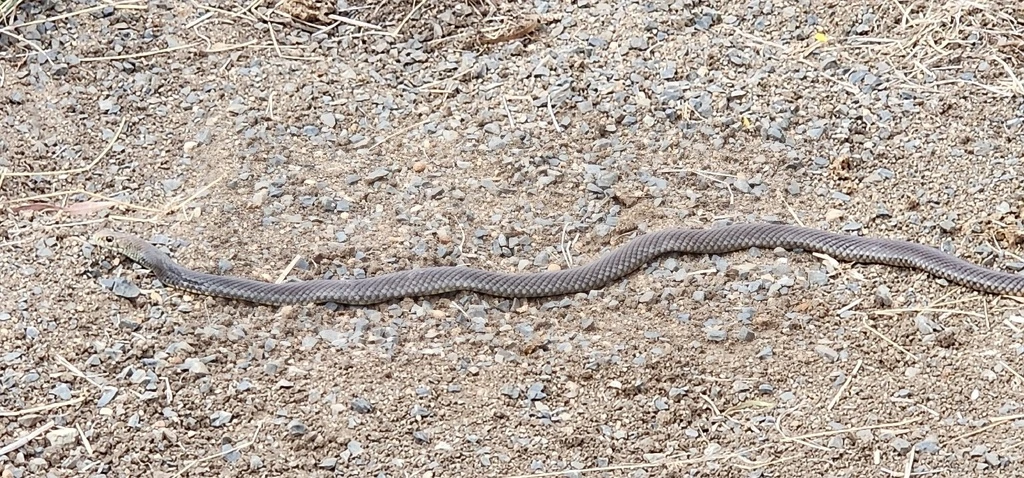
Pseudonaja textilis(DUMÉRIL, BIBRON & DUMÉRIL, 1854)
VenomousPotentially life-threateningGround-dwelling activity is reported in the studies compiled by SquamBase. This describes the species across its studied range, not a record from every island.
Venom & human effects
A prospective Australian study documented coagulation failure and early cardiovascular collapse in brown-snake envenoming, with cardiac arrests occurring in the eastern P. textilis group.
Brown-snake identity was established by snake identification or venom immunoassay. Species subgroup assignment then used non-overlapping geographic regions. These eastern Australian findings are not an Indonesian population-specific frequency estimate.
Isbister et al.2013 ASP14, Methods species groupings and Results geographical variation.
These are editorial summaries of the linked evidence, not toxicity rankings or WHO antivenom-priority categories. Effects vary with the bite and patient. Non-venomous does not mean safe to handle.
The scientific identity
Reliable identification uses the published combination of scale characters, proportions and other diagnostic evidence. Colour or a photograph alone may not separate closely related species.
Taxonomic treatment & original-description references ↗
Furina textilis · Pseudoelaps superciliosus · Demansia annulata · Pseudoelaps kubingii · Pseudoelaps sordellii · Pseudonaia textilis · Pseudoelaps kubinyi · Pseudoelaps supercilliosus · Diemennia superciliosa · Diemenia superciliaris · Pseudoelaps beckeri · Diemenia superciliosa · Furina bicucullata · Cacophis guntheri · Furina cucullata · Pseudechis cupreus · Diemenia textilis · Demansia textilis · Pseudonaja ohnoi · Euprepiosoma textilis · Pseudonaja elliotti
Names trace the literature, including older combinations and historical usages. Their appearance here does not mean they are all currently accepted synonyms.
From observations & literature
Size and ecological traits credited to SquamBase summarize published studies across the species’ range in its 2024 edition. They are complemented by the locality-specific observations below.
SquamBase 1.0 records a literature maximum of 220 cm total length, including the tail. This is a compiled maximum, not a typical adult size or a measurement specific to this country.
[2]Ground-dwelling activity is reported in the studies compiled by SquamBase. This describes the species across its studied range, not a record from every island.
[2]The official ecological account includes low open shrubland, low open woodland, low woodland, open forest, open heath, open scrub, tall forest, tussock grassland, woodland. These are species-level habitat records, not a statement that every state locality contains all these environments.
[5]Australia is listed in the individual taxonomic treatment and the ASH national checklist. Named state/territory evidence: Western Australia, Northern Territory, South Australia, Queensland, New South Wales, Victoria, Australian Capital Territory. These are documented jurisdictions, not continuous range polygons.
[3][4][5]Egg-laying (oviparous). [1]
A reported observation is not necessarily the full ecological range of a species. Where reproduction is inferred in a source dataset, the account identifies that limitation.
One species · Across borders
Explore the recorded countries and islands. Select a highlighted area to see its distribution evidence.
Loading geographic boundaries…
Click a highlighted country to zoom in and explore its records.
Shading identifies recorded countries or named islands, not continuous habitat coverage. Uncoloured areas do not establish absence.
Natural Earth · 1:50m · public domain; Gibraltar: geoBoundaries. Small islands may lack an outline.
Explore the distribution
Select a highlighted area to see its status, island records and sources. Each country and island links to the same shared species collection.
Use “Worldwide records” to include distant introduced and uncertain records in the map view.
Australia is listed in the individual taxonomic treatment and the ASH national checklist. Named state/territory evidence: Western Australia, Northern Territory, South Australia, Queensland, New South Wales, Victoria, Australian Capital Territory. These are documented jurisdictions, not continuous range polygons.
Western Australia → · Western Australia
Northern Territory → · Northern Territory
South Australia → · South Australia
Queensland → · Queensland
New South Wales → · New South Wales
Victoria → · Victoria
Australian Capital Territory → · Australian Capital Territory
Locality source 1 ↗ Locality source 2 ↗ Locality source 3 ↗Papua New Guinea: country-level record; no named guide locality extracted.
Locality source 1 ↗The RDB country field omits Indonesia, but the 2008 primary genetic study explicitly samples the Merauke population in Indonesian Papua.
This expansion documents Papua New Guinea. Consult the original treatment and global occurrence map for the wider range. [1]
The text retains the source’s geographic qualifications. The map shows countries with atlas occurrence records; it is not a complete global range model. A type locality is a nomenclatural reference, not the only place the species occurs.
Status & its meaning
No matching global assessment was verified for this account. This is an unresolved assessment link, not an IUCN “Not Evaluated” classification and not evidence that the species is secure.
Locality coverage in the atlas does not measure abundance, population trends or national legal protection.
Follow the evidence
Latest evidence added 2026-10-11. Taxonomic and distribution treatments may change.
The linked taxonomic treatment provides its original descriptions, revisions and bibliography. Observations from other countries are not relabelled as local field studies.