Elapidae · Species account

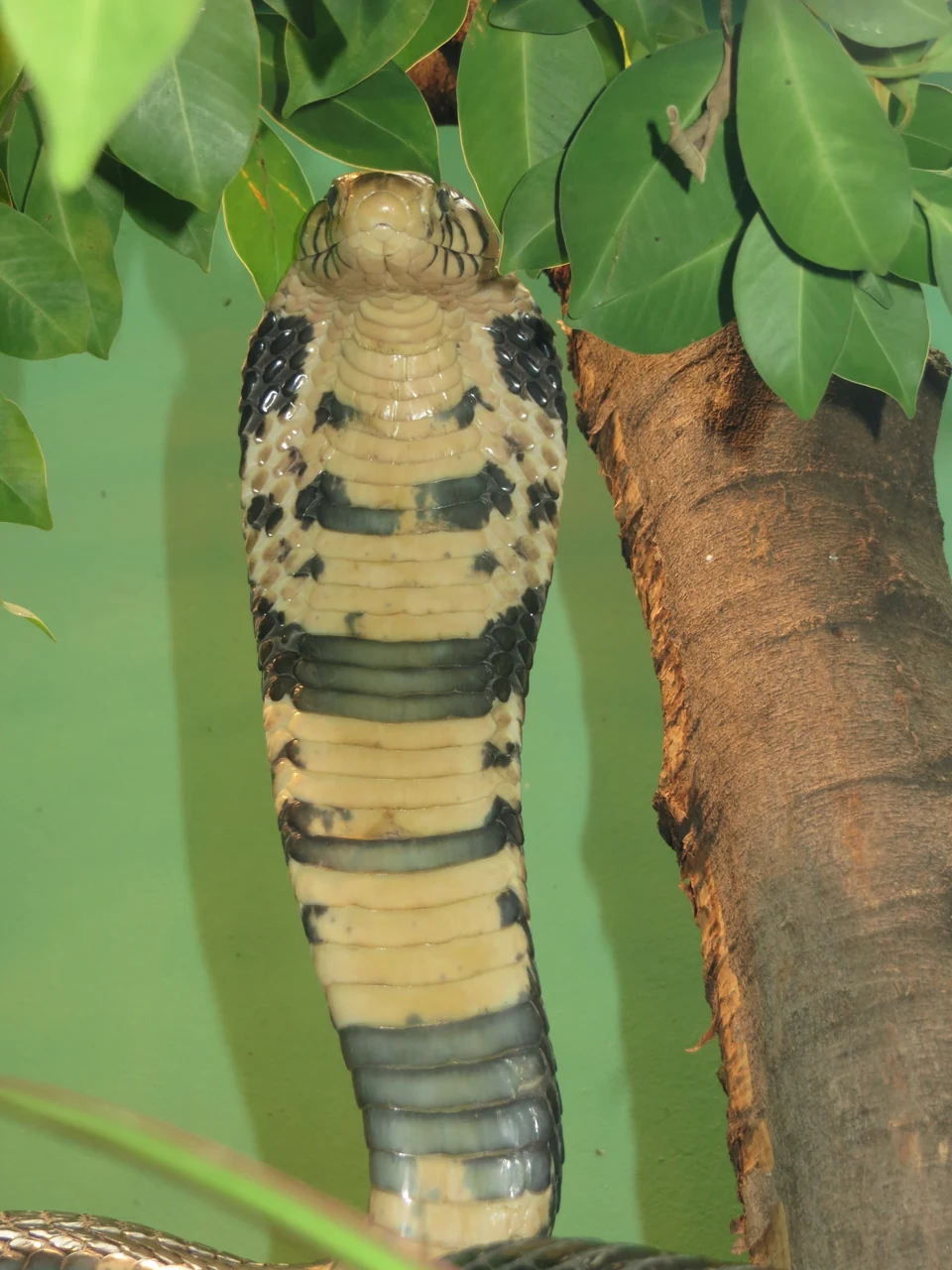
West African banded cobra

Naja savannulaBROADLEY, TRAPE, CHIRIO & WÜSTER, 2018

VenomousClinical severity not established

The original revision places this species in gallery forests within West African forest–savanna mosaics and also discusses wetlands in savanna. These are habitat associations across the treated range; no new local occurrence is inferred.

FamilyElapidae
ReproductionReproductive mode remains to be verified
Country chaptersBenin · Cameroon · Chad · Gambia · Ghana · Guinea · Ivory Coast · Mali · Nigeria · Senegal · Togo
Evidence updated2026-10-16
Explore its biology ↓

Venom & human effects

What is documented?

VenomousClinical severity not established

Classified as venomous in the cited account of genus Naja; this species’ membership of that genus is verified separately.

Explicit genus-level classification applied to an exact listed member, not a species-specific venom assay or human clinical study of Naja savannula. The group statement does not transfer diet, body size, behaviour or medical severity. No human-harm tier is inferred.

Evidence & scope · checked 2026-10-29

The Toxin Diversity, Cytotoxicity, and Enzymatic Activity of Cape Cobra (Naja nivea) Venom (2024), Toxins 16:438, Abstract opening sentence and Introduction explicitly characterise true cobras of genus Naja as venomous. The experimental N. nivea venom results and medical-risk statements are not transferred to other members. Membership: exact-species taxonomic account Naja savannula.

How to read these badges
Limited documented effects
The cited human cases reported limited effects. Sparse observations cannot exclude a severe reaction.
Medically significant effects
The cited human cases document clinically important injury or illness. This is not an upper limit on severity.
Potentially life-threatening
Species-specific clinical evidence documents life-threatening illness or deaths after bites. The account explains the affected patients and any uncertainty about the cause.
Clinical severity not established
Venom presence is documented, but the reviewed evidence does not establish a clinical tier. When human effects are reported under an unresolved historical species name, the badge and account say so explicitly.
Venom status uncertain
The reviewed sources are inconclusive or conflicting about venom presence. The account explains the uncertainty.
Venom status not assessed
The atlas lacks a reviewed venom-presence classification for this species.

These are editorial summaries of the linked evidence, not toxicity rankings or WHO antivenom-priority categories. Effects vary with the bite and patient. Non-venomous does not mean safe to handle.

The scientific identity

Taxonomy & recognition

From observations & literature

Natural history

Size & measurements

The juvenile female museum specimen RBINS 20266 measured 450 mm from snout to vent, with an 89 mm tail.

One preserved specimen from Balagbeni, Guinea. Its age is stated in the species account and sex in Table 1. These measurements do not establish adult size or a species maximum.

Study & evidence

Pauwels et al. (2022), Bulletin of the Chicago Herpetological Society 57(8):117–123; Table 1, p.118, row RBINS 20266; Naja savannula account, p.120.

Study source 1 ↗

Diet & feeding

A juvenile contained a Sclerophrys regularis toad.

Museum stomach-content evidence from Balagbeni, southeastern Guinea. Individual feeding records do not establish the full diet or prey preference.

Study & evidence

Pauwels, Chirio & Dekoninck (2022), Bulletin of the Chicago Herpetological Society 57(6):117–123; Results, Naja savannula; p. 120; Figure 4; RBINS 20266; prey RBINS 18408. Table 1 documents specimen identity.

Study source 1 ↗

Activity & behaviour

The cited compilation records activity during both day and night.

Exact-name entry in the 2024 SquamBase literature compilation, using an explicitly populated trait and its cited metadata. Records reflect the studied populations; they do not establish uniform behaviour across all seasons, ages or localities. Historical species concepts requiring review and imputed/uncertain metadata are excluded.

Study & evidence

SquamBase 1.0, Supplementary Table S1, row 9911: Naja savannula; columns Activity time and Activity time metadata. Recorded value: Cathemeral. Original source metadata: cathemeral (Trape 2023)

Study source 1 ↗

Study source 2 ↗

Reproduction

Reproductive mode remains to be verified.

Habitat & ecology

Habitat & microhabitat

The original revision places this species in gallery forests within West African forest–savanna mosaics and also discusses wetlands in savanna. These are habitat associations across the treated range; no new local occurrence is inferred.

[2]
Further observations & source notes (7)

Documented localities · Benin

Atakora: observation GBIF 2901688481 (2020). The original iNaturalist entry was rechecked for research-grade identification, wild status and unrestricted coordinates; its reported uncertainty footprint lies within the mapped region. This is a community-reviewed observation, not a museum voucher. Borgou: observation GBIF 2005405993 (2012). The original iNaturalist entry was rechecked for research-grade identification, wild status and unrestricted coordinates; its reported uncertainty footprint lies within the mapped region. This is a community-reviewed observation, not a museum voucher. These are dated locality records, not evidence of occurrence throughout every part of a region or a complete present-day inventory.

[3][4][5][6]

Documented localities · Cameroon

North: observation GBIF 5133590441 (2025). The original iNaturalist entry was rechecked for research-grade identification, wild status and unrestricted coordinates; its reported uncertainty footprint lies within the mapped region. This is a community-reviewed observation, not a museum voucher. These are dated locality records, not evidence of occurrence throughout every part of a region or a complete present-day inventory.

[7][8]

Documented localities · Gambia

Brikama: observation GBIF 6133519780 (2026). The original iNaturalist entry was rechecked for research-grade identification, wild status and unrestricted coordinates; its reported uncertainty footprint lies within the mapped region. This is a community-reviewed observation, not a museum voucher. Brikama: observation GBIF 5088166080 (2024). The original iNaturalist entry was rechecked for research-grade identification, wild status and unrestricted coordinates; its reported uncertainty footprint lies within the mapped region. This is a community-reviewed observation, not a museum voucher. Kuntaur: observation GBIF 5844194219 (2025). The original iNaturalist entry was rechecked for research-grade identification, wild status and unrestricted coordinates; its reported uncertainty footprint lies within the mapped region. This is a community-reviewed observation, not a museum voucher. These are dated locality records, not evidence of occurrence throughout every part of a region or a complete present-day inventory. Kuntaur: observation 319571499, 2025-01-18. Original records have agreeing research-grade identifications, wild status and open coordinates. Points and sampled reported uncertainty envelopes fall within the mapped region. These are dated community-reviewed observations, not museum vouchers or evidence of presence throughout the region. Exact coordinates are not republished.

[9][10][11][12][13][14][15]

Documented localities · Guinea

Boke: observation GBIF 5761185466 (2025). The original iNaturalist entry was rechecked for research-grade identification, wild status and unrestricted coordinates; its reported uncertainty footprint lies within the mapped region. This is a community-reviewed observation, not a museum voucher. Kankan: observation GBIF 2236842224 (2013). The original iNaturalist entry was rechecked for research-grade identification, wild status and unrestricted coordinates; its reported uncertainty footprint lies within the mapped region. This is a community-reviewed observation, not a museum voucher. These are dated locality records, not evidence of occurrence throughout every part of a region or a complete present-day inventory.

[16][17][18][19]

Documented localities · Nigeria

North Central & Abuja: observation GBIF 5063100336 (2025). The original iNaturalist entry was rechecked for research-grade identification, wild status and unrestricted coordinates; its reported uncertainty footprint lies within the mapped region. This is a community-reviewed observation, not a museum voucher. Northeastern states: observation GBIF 2611300404 (2008). The original iNaturalist entry was rechecked for research-grade identification, wild status and unrestricted coordinates; its reported uncertainty footprint lies within the mapped region. This is a community-reviewed observation, not a museum voucher. These are dated locality records, not evidence of occurrence throughout every part of a region or a complete present-day inventory.

[20][21][22][23]

Documented localities · Senegal

Tambacounda & Kédougou: iNaturalist observation 338911862, recorded 2026-02-03. The current original record has agreeing research-grade identification, wild status and unrestricted coordinates; its entire reported uncertainty footprint lies within this mapped region. This community observation is not a museum voucher. Tambacounda & Kédougou: iNaturalist observation 351094833, recorded 2026-04-18. The current original record has agreeing research-grade identification, wild status and unrestricted coordinates; its entire reported uncertainty footprint lies within this mapped region. This community observation is not a museum voucher. These are dated locality records, not evidence of occurrence throughout every part of a region or a complete present-day inventory.

[24][25][26][27]

Documented localities · Mali

Trape & Mané (2017), species account p. 121, locality coordinates in Tables 1–2 and specimen appendix: Bangaya; Laminina; Mamoroubougou; Npiébougou; Sébékourani; Titiéna. Historical, explicitly named records mapped to the chapter’s 2021 boundary snapshot; they do not establish current occupancy or complete regional coverage. Published as Naja cf. melanoleuca; attached to the existing Naja savannula account. Nine IRD vouchers match the material reidentified by Wüster et al. (2018), Appendix 2: 245.M, 767.M, 995.M, 1782.M, 2027.M, 2048.M, 2087.M, 2101.M and 3716.M. Three other 2017 vouchers are not reassigned here.

[28][29]

A reported observation is not necessarily the full ecological range of a species. Where reproduction is inferred in a source dataset, the account identifies that limitation.

One species · Across borders

Global distribution

Explore the recorded countries and islands. Select a highlighted area to see its distribution evidence.

Recorded distribution
Naja savannula — select a recorded country or island

Loading geographic boundaries…

ListedIntroducedUncertain

Click a highlighted country to zoom in and explore its records.

Shading identifies recorded countries or named islands, not continuous habitat coverage. Uncoloured areas do not establish absence.

Natural Earth · 1:50m · public domain; Gibraltar: geoBoundaries. Small islands may lack an outline.

Explore the distribution

Across borders

11 recorded countries & territories

Select a highlighted area to see its status, island records and sources. Each country and island links to the same shared species collection.

Use “Worldwide records” to include distant introduced and uncertain records in the map view.

Benin · regional locality evidence

The current taxonomic treatment explicitly lists this country. This is country-scale checklist evidence, not a claim of continuous occupancy or a complete regional inventory. Atakora: observation GBIF 2901688481 (2020). The original iNaturalist entry was rechecked for research-grade identification, wild status and unrestricted coordinates; its reported uncertainty footprint lies within the mapped region. This is a community-reviewed observation, not a museum voucher. Borgou: observation GBIF 2005405993 (2012). The original iNaturalist entry was rechecked for research-grade identification, wild status and unrestricted coordinates; its reported uncertainty footprint lies within the mapped region. This is a community-reviewed observation, not a museum voucher. These are dated locality records, not evidence of occurrence throughout every part of a region or a complete present-day inventory.

Atakora → · Atakora

Borgou → · Borgou

Locality source 1 ↗ Locality source 2 ↗ Locality source 3 ↗ Locality source 4 ↗ Locality source 5 ↗
Cameroon · regional locality evidence

The current taxonomic treatment explicitly lists this country. This is country-scale checklist evidence, not a claim of continuous occupancy or a complete regional inventory. North: observation GBIF 5133590441 (2025). The original iNaturalist entry was rechecked for research-grade identification, wild status and unrestricted coordinates; its reported uncertainty footprint lies within the mapped region. This is a community-reviewed observation, not a museum voucher. These are dated locality records, not evidence of occurrence throughout every part of a region or a complete present-day inventory.

North → · North

Locality source 1 ↗ Locality source 2 ↗ Locality source 3 ↗
Chad · regional locality evidence

The current taxonomic treatment explicitly lists this country. This is country-scale checklist evidence, not a claim of continuous occupancy or a complete regional inventory.

Locality source 1 ↗
Gambia · regional locality evidence

The current taxonomic treatment explicitly lists this country. This is country-scale checklist evidence, not a claim of continuous occupancy or a complete regional inventory. Brikama: observation GBIF 6133519780 (2026). The original iNaturalist entry was rechecked for research-grade identification, wild status and unrestricted coordinates; its reported uncertainty footprint lies within the mapped region. This is a community-reviewed observation, not a museum voucher. Brikama: observation GBIF 5088166080 (2024). The original iNaturalist entry was rechecked for research-grade identification, wild status and unrestricted coordinates; its reported uncertainty footprint lies within the mapped region. This is a community-reviewed observation, not a museum voucher. Kuntaur: observation GBIF 5844194219 (2025). The original iNaturalist entry was rechecked for research-grade identification, wild status and unrestricted coordinates; its reported uncertainty footprint lies within the mapped region. This is a community-reviewed observation, not a museum voucher. These are dated locality records, not evidence of occurrence throughout every part of a region or a complete present-day inventory. Kuntaur: observation 319571499, 2025-01-18. Original records have agreeing research-grade identifications, wild status and open coordinates. Points and sampled reported uncertainty envelopes fall within the mapped region. These are dated community-reviewed observations, not museum vouchers or evidence of presence throughout the region. Exact coordinates are not republished.

Brikama → · Brikama

Kuntaur → · Kuntaur

Locality source 1 ↗ Locality source 2 ↗ Locality source 3 ↗ Locality source 4 ↗ Locality source 5 ↗ Locality source 6 ↗ Locality source 7 ↗ Locality source 8 ↗
Ghana · regional locality evidence

The current taxonomic treatment explicitly lists this country. This is country-scale checklist evidence, not a claim of continuous occupancy or a complete regional inventory.

Locality source 1 ↗
Guinea · regional locality evidence

The current taxonomic treatment explicitly lists this country. This is country-scale checklist evidence, not a claim of continuous occupancy or a complete regional inventory. Boke: observation GBIF 5761185466 (2025). The original iNaturalist entry was rechecked for research-grade identification, wild status and unrestricted coordinates; its reported uncertainty footprint lies within the mapped region. This is a community-reviewed observation, not a museum voucher. Kankan: observation GBIF 2236842224 (2013). The original iNaturalist entry was rechecked for research-grade identification, wild status and unrestricted coordinates; its reported uncertainty footprint lies within the mapped region. This is a community-reviewed observation, not a museum voucher. These are dated locality records, not evidence of occurrence throughout every part of a region or a complete present-day inventory.

Boke → · Boke

Kankan → · Kankan

Locality source 1 ↗ Locality source 2 ↗ Locality source 3 ↗ Locality source 4 ↗ Locality source 5 ↗
Ivory Coast · regional locality evidence

The current taxonomic treatment explicitly lists this country. This is country-scale checklist evidence, not a claim of continuous occupancy or a complete regional inventory.

Locality source 1 ↗
Mali · regional locality evidence

The current taxonomic treatment explicitly lists this country. This is country-scale checklist evidence, not a claim of continuous occupancy or a complete regional inventory. Trape & Mané (2017), species account p. 121, locality coordinates in Tables 1–2 and specimen appendix: Bangaya; Laminina; Mamoroubougou; Npiébougou; Sébékourani; Titiéna. Historical, explicitly named records mapped to the chapter’s 2021 boundary snapshot; they do not establish current occupancy or complete regional coverage. Published as Naja cf. melanoleuca; attached to the existing Naja savannula account. Nine IRD vouchers match the material reidentified by Wüster et al. (2018), Appendix 2: 245.M, 767.M, 995.M, 1782.M, 2027.M, 2048.M, 2087.M, 2101.M and 3716.M. Three other 2017 vouchers are not reassigned here.

Kayes → · Bangaya

Sikasso → · Laminina, Mamoroubougou, Titiéna

Koulikoro → · Npiébougou, Sébékourani

Locality source 1 ↗ Locality source 2 ↗ Locality source 3 ↗
Nigeria · regional locality evidence

The current taxonomic treatment explicitly lists this country. This is country-scale checklist evidence, not a claim of continuous occupancy or a complete regional inventory. North Central & Abuja: observation GBIF 5063100336 (2025). The original iNaturalist entry was rechecked for research-grade identification, wild status and unrestricted coordinates; its reported uncertainty footprint lies within the mapped region. This is a community-reviewed observation, not a museum voucher. Northeastern states: observation GBIF 2611300404 (2008). The original iNaturalist entry was rechecked for research-grade identification, wild status and unrestricted coordinates; its reported uncertainty footprint lies within the mapped region. This is a community-reviewed observation, not a museum voucher. These are dated locality records, not evidence of occurrence throughout every part of a region or a complete present-day inventory.

North Central & Abuja → · North Central & Abuja

Northeastern states → · Northeastern states

Locality source 1 ↗ Locality source 2 ↗ Locality source 3 ↗ Locality source 4 ↗ Locality source 5 ↗
Senegal · regional locality evidence

The current taxonomic treatment explicitly lists this country. This is country-scale checklist evidence, not a claim of continuous occupancy or a complete regional inventory. Tambacounda & Kédougou: iNaturalist observation 338911862, recorded 2026-02-03. The current original record has agreeing research-grade identification, wild status and unrestricted coordinates; its entire reported uncertainty footprint lies within this mapped region. This community observation is not a museum voucher. Tambacounda & Kédougou: iNaturalist observation 351094833, recorded 2026-04-18. The current original record has agreeing research-grade identification, wild status and unrestricted coordinates; its entire reported uncertainty footprint lies within this mapped region. This community observation is not a museum voucher. These are dated locality records, not evidence of occurrence throughout every part of a region or a complete present-day inventory.

Tambacounda & Kédougou → · Tambacounda & Kédougou

Locality source 1 ↗ Locality source 2 ↗ Locality source 3 ↗ Locality source 4 ↗ Locality source 5 ↗
Togo · regional locality evidence

The current taxonomic treatment explicitly lists this country. This is country-scale checklist evidence, not a claim of continuous occupancy or a complete regional inventory.

Locality source 1 ↗

Geographic scope of the source

Country entries documented in this Africa review: Benin, Cameroon, Chad, Gambia, Ghana, Guinea, Ivory Coast, Mali, Nigeria, Senegal, Togo. Consult individual occurrence records for qualifications. These entries are not a complete global range polygon. [1]

The text retains the source’s geographic qualifications. The map shows countries with atlas occurrence records; it is not a complete global range model. A type locality is a nomenclatural reference, not the only place the species occurs.

Status & its meaning

Conservation

No matching global assessment was verified for this account. This is an unresolved assessment link, not an IUCN “Not Evaluated” classification and not evidence that the species is secure.

Locality coverage in the atlas does not measure abundance, population trends or national legal protection.

Follow the evidence

Sources & further reading

Latest evidence added 2026-10-16. Taxonomic and distribution treatments may change.

  1. The Reptile Database · Naja savannula
  2. Wüster et al. (2018), pp. 83 and 88
  3. Research-grade observation of Naja savannula, 2020 (GBIF 2901688481)
  4. Original iNaturalist record, rechecked 12 October 2026
  5. Research-grade observation of Naja savannula, 2012 (GBIF 2005405993)
  6. Original iNaturalist record, rechecked 12 October 2026
  7. Research-grade observation of Naja savannula, 2025 (GBIF 5133590441)
  8. Original iNaturalist record, rechecked 12 October 2026
  9. Research-grade observation of Naja savannula, 2026 (GBIF 6133519780)
  10. Original iNaturalist record, rechecked 12 October 2026
  11. Research-grade observation of Naja savannula, 2024 (GBIF 5088166080)
  12. Original iNaturalist record, rechecked 12 October 2026
  13. Research-grade observation of Naja savannula, 2025 (GBIF 5844194219)
  14. Original iNaturalist observation of Naja savannula, 2025-01-18
  15. Original identification, date and location metadata, checked 13 October 2026
  16. Research-grade observation of Naja savannula, 2025 (GBIF 5761185466)
  17. Original iNaturalist record, rechecked 12 October 2026
  18. Research-grade observation of Naja savannula, 2013 (GBIF 2236842224)
  19. Original iNaturalist record, rechecked 12 October 2026
  20. Research-grade observation of Naja savannula, 2025 (GBIF 5063100336)
  21. Original iNaturalist record, rechecked 12 October 2026
  22. Research-grade observation of Naja savannula, 2008 (GBIF 2611300404)
  23. Original iNaturalist record, rechecked 12 October 2026
  24. Original iNaturalist observation of Naja savannula
  25. Current source metadata, checked 12 October 2026
  26. Original iNaturalist observation of Naja savannula
  27. Current source metadata, checked 12 October 2026
  28. Trape & Mané (2017), The snakes of Mali, Bonn zoological Bulletin 66:107–133
  29. Wüster et al. (2018), forest cobra revision, Appendix 2
  30. Photograph provenance — Naja savannula (source 1)
  31. Photograph provenance — Naja savannula (source 2)

The linked taxonomic treatment provides its original descriptions, revisions and bibliography. Observations from other countries are not relabelled as local field studies.