Size & measurements
No sourced size & measurements summary has yet been added to this account.
Elapidae · Species account
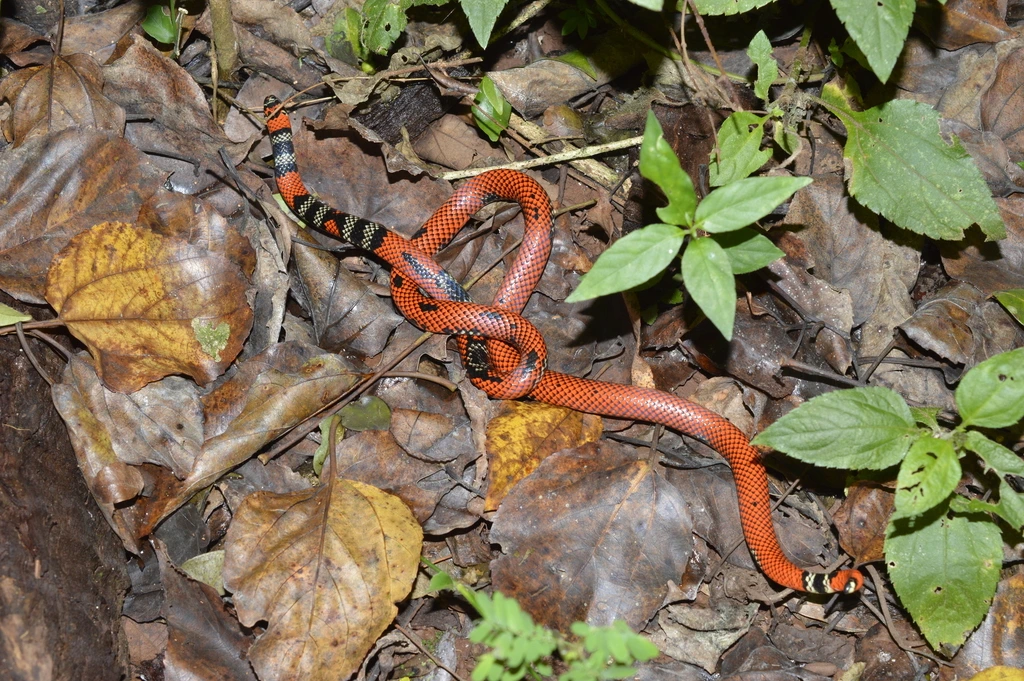
Micrurus altirostris(COPE, 1860)
VenomousClinical severity not establishedThe Uruguayan Ministry of Environment species database marks confirmed presence (1.0) in forest ecosystems, grasslands and/or wooded grassland. Only confirmed ecosystem rows are used; potential presence (0.5), map-grid cells and protected-area membership are excluded. These are historical national ecosystem assignments, not new locality records or exclusive habitat preferences.
Venom & human effects
The species account explicitly identifies this snake as venomous. Human medical effects have not yet been assessed for this atlas.
Exact-species statement in the retained Reptile Database treatment; this review establishes venom presence only, not human bite severity.
Comment field: Venomous.
These are editorial summaries of the linked evidence, not toxicity rankings or WHO antivenom-priority categories. Effects vary with the bite and patient. Non-venomous does not mean safe to handle.
The scientific identity
Reliable identification uses the published combination of scale characters, proportions and other diagnostic evidence. Colour or a photograph alone may not separate closely related species.
From observations & literature
No sourced size & measurements summary has yet been added to this account.
Recorded prey include snakes, amphisbaenians and reptile eggs. This is a compiled list of food records, not an exclusive diet.
Exact-name row in the 2024 literature compilation. These are records from studied populations, not typical values, an exhaustive biological account, or evidence of occurrence in every region.
SquamBase 1.0, Supplementary Table S1, row 9767: Micrurus altirostris; columns Diet, Diet metadata.
The 2021 Museo de La Plata checklist summarises stomach-content records from 27 of 74 examined individuals: snakes, worm lizards and reptile eggs were recorded. The absence of lizard remains in that sample does not exclude lizards from the species’ diet elsewhere.
Attributed synthesis of published natural-history reports from Argentina and neighbouring countries. Sample-specific results, captive observations and uncertainties retain their stated limits; the earlier cited studies were not independently re-examined here.
Williams, Vera & Di Pietro (2021), Revista del Museo de La Plata 6(1):26–124, species account Micrurus altirostris, Alimentación section. Original works cited in that section: (2018); (1994 , 1996 ); ( Vidal, 2002 ; Carreira et al. , 2005 ).
The cited compilation records night activity.
Exact-name entry in the 2024 SquamBase literature compilation, using an explicitly populated trait and its cited metadata. Records reflect the studied populations; they do not establish uniform behaviour across all seasons, ages or localities. Historical species concepts requiring review and imputed/uncertain metadata are excluded.
SquamBase 1.0, Supplementary Table S1, row 9767: Micrurus altirostris; columns Activity time and Activity time metadata. Recorded value: Nocturnal. Original source metadata: Nocturnal (Feldman 2015), nocturnal and crepuscular (Williams and Vera 2023)
The 2021 Museo de La Plata checklist reports egg-laying, with cited clutches of 1–10 eggs and a short mating period. The clutch range is not a typical value for every female.
Attributed synthesis of published natural-history reports from Argentina and neighbouring countries. Sample-specific results, captive observations and uncertainties retain their stated limits; the earlier cited studies were not independently re-examined here.
Williams, Vera & Di Pietro (2021), Revista del Museo de La Plata 6(1):26–124, species account Micrurus altirostris, Tipo de reproducción section. Original works cited in that section: ( Giraudo et al. 2012b ).
The Uruguayan Ministry of Environment species database marks confirmed presence (1.0) in forest ecosystems, grasslands and/or wooded grassland. Only confirmed ecosystem rows are used; potential presence (0.5), map-grid cells and protected-area membership are excluded. These are historical national ecosystem assignments, not new locality records or exclusive habitat preferences.
[2]The field-habitat synthesis in Nogueira et al. (2019) supports woodland, grassland or savanna for Micrurus altirostris in the Brazilian account. These are broad habitat associations, not exclusive preferences or new collecting localities. The atlas distinguishes field observations from mapped ecoregions; only its explicit field-habitat statements are classified here.
[3]The Argentine national species assessment describes forest and forest leaf litter in Misiones and along the Uruguay River. Country-level habitat evidence only; no provincial occurrence is created. Grassland, where documented, is included under the shared savanna/grassland category.
[4]A reported observation is not necessarily the full ecological range of a species. Where reproduction is inferred in a source dataset, the account identifies that limitation.
One species · Across borders
Explore the recorded countries and islands. Select a highlighted area to see its distribution evidence.
Loading geographic boundaries…
Click a highlighted country to zoom in and explore its records.
Shading identifies recorded countries or named islands, not continuous habitat coverage. Uncoloured areas do not establish absence.
Natural Earth · 1:50m · public domain; Gibraltar: geoBoundaries. Small islands may lack an outline.
Explore the distribution
Select a highlighted area to see its status, island records and sources. Each country and island links to the same shared species collection.
Use “Worldwide records” to include distant introduced and uncertain records in the map view.
The checked taxonomic distribution account explicitly lists Argentina. Country-level evidence does not establish continuous occupancy or a complete national inventory.
Locality source 1 ↗The checked taxonomic distribution account explicitly lists Brazil. Country-level evidence does not establish continuous occupancy or a complete national inventory.
Locality source 1 ↗The checked taxonomic distribution account explicitly lists Paraguay. Country-level evidence does not establish continuous occupancy or a complete national inventory.
Locality source 1 ↗The checked taxonomic distribution account explicitly lists Uruguay. Country-level evidence does not establish continuous occupancy or a complete national inventory.
Locality source 1 ↗Country entries supported by this Americas review: Argentina, Brazil, Paraguay, Uruguay. These are reviewed atlas entries, not a complete global distribution. [1]
The text retains the source’s geographic qualifications. The map shows countries with atlas occurrence records; it is not a complete global range model. A type locality is a nomenclatural reference, not the only place the species occurs.
Status & its meaning
No matching global assessment was verified for this account. This is an unresolved assessment link, not an IUCN “Not Evaluated” classification and not evidence that the species is secure.
Locality coverage in the atlas does not measure abundance, population trends or national legal protection.
Follow the evidence
Latest evidence added 2026-10-19. Taxonomic and distribution treatments may change.
The linked taxonomic treatment provides its original descriptions, revisions and bibliography. Observations from other countries are not relabelled as local field studies.