Size & measurements
No sourced size & measurements summary has yet been added to this account.
Elapidae · Species account
Bungarus multicinctusBLYTH, 1861
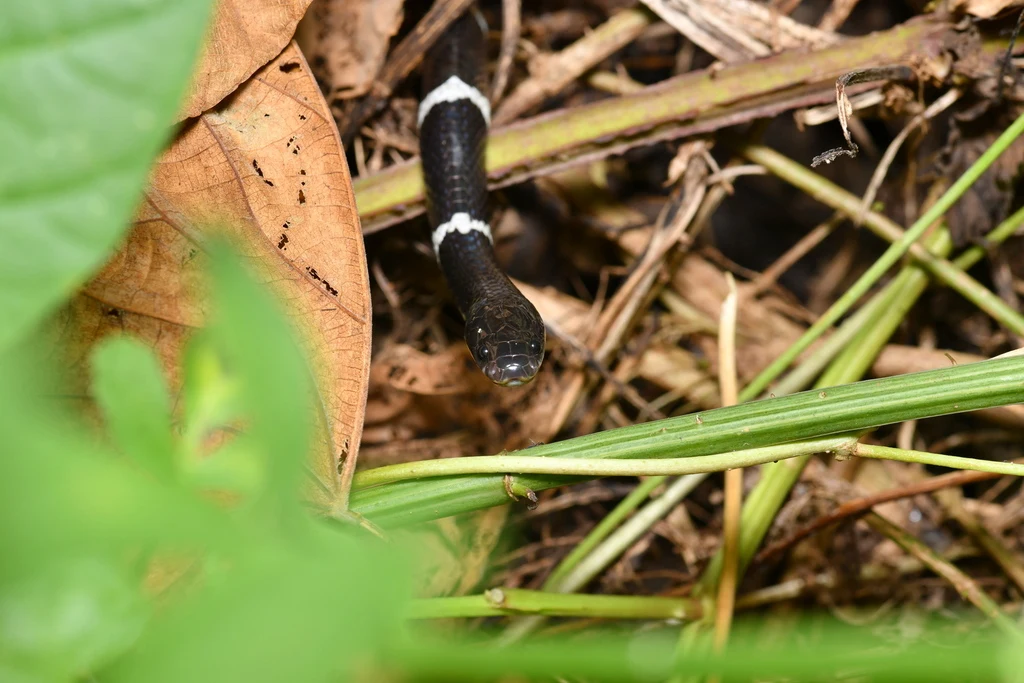
VenomousPotentially life-threateningA nocturnal, highly venomous species recorded in woodland, scrub, cultivated land and wet areas. The older account predates later work on cryptic krait lineages. These observations concern Hong Kong populations.
Venom & human effects
A Taiwanese hospital series recorded respiratory failure after bites from the many-banded krait, including two patients whose offending snakes were examined. Weakness and difficulty swallowing were also reported.
Retrospective 1995–2014 series:44 patients,12 with respiratory failure. Only six identifications used snake specimens;27 relied on picture recognition and11 on clinical features. These Taiwanese B. multicinctus multicinctus cases are not transferred to revised mainland krait species, and cohort proportions are not individual risk estimates.
Mao et al. (2017), Methods: Study population; Results: Demographic data; Table1, identification and respiratory-failure columns.
These are editorial summaries of the linked evidence, not toxicity rankings or WHO antivenom-priority categories. Effects vary with the bite and patient. Non-venomous does not mean safe to handle.
The scientific identity
A smooth-scaled krait with black and white bands, an enlarged vertebral scale row and a short tapering tail. The source reports typical lengths of 80–105 cm, with longer individuals recorded. [2]
Specimen measurements describe the cited material, rather than a population maximum. Snout-to-vent length excludes the tail; adult size ranges are identified separately.
Reliable identification uses the published combination of scale characters, proportions and other diagnostic evidence. Colour or a photograph alone may not separate closely related species.
Taxonomic treatment & original-description references ↗
Bungarus semifasciatus · Bungarus caeruleus · Bungarus candidus · Bungarus cf
Names trace the literature, including older combinations and historical usages. Their appearance here does not mean they are all currently accepted synonyms.
From observations & literature
No sourced size & measurements summary has yet been added to this account.
Other snakes are prominent prey; the cited account also reports eels, frogs, lizards and rodents.
[2]A nocturnal, highly venomous species recorded in woodland, scrub, cultivated land and wet areas. The older account predates later work on cryptic krait lineages. These observations concern Hong Kong populations.
[2]Taiwan: the Yangmingshan account describes forest and secondary growth, farms and grassland, streams, ponds and wetlands below 500 m, with an association with damp or waterside cover.
[6]The taxonomic treatment explicitly identifies this species as venomous. That designation does not, by itself, establish the severity of every bite.
[1]Myanmar is explicitly listed in the checked individual taxonomic treatment.
[3]Taiwan is explicitly listed in the checked individual taxonomic treatment.
[3]China is explicitly recorded in the checked individual species treatment. The accepted identity is also represented in the 2025 checklist; regional inclusion here is based on explicit locality evidence, not the checklist’s broader geographical scope. Named regional records: Fujian; Hong Kong. These localities do not imply continuous occupation of the entire region.
[4][5]The 2024 provincial checklist explicitly lists this species in Thanh Hoa. The 2026 provincial checklist explicitly lists this species in Ha Tinh. The 2020 provincial checklist explicitly lists this species in Son La. This establishes a provincial record; it does not imply occurrence in every protected area or across the whole editorial region.
[7][8][9]A reported observation is not necessarily the full ecological range of a species. Where reproduction is inferred in a source dataset, the account identifies that limitation.
One species · Across borders
Explore the recorded countries and islands. Select a highlighted area to see its distribution evidence.
Loading geographic boundaries…
Click a highlighted country to zoom in and explore its records.
Shading identifies recorded countries or named islands, not continuous habitat coverage. Uncoloured areas do not establish absence.
Natural Earth · 1:50m · public domain; Gibraltar: geoBoundaries. Small islands may lack an outline.
Explore the distribution
Select a highlighted area to see its status, island records and sources. Each country and island links to the same shared species collection.
Use “Worldwide records” to include distant introduced and uncertain records in the map view.
Laos: national occurrence; no finer locality is assigned in this atlas.
Locality source 1 ↗Vietnam: Hoa Binh. The 2024 provincial checklist explicitly lists this species in Thanh Hoa. The 2026 provincial checklist explicitly lists this species in Ha Tinh. The 2020 provincial checklist explicitly lists this species in Son La. This establishes a provincial record; it does not imply occurrence in every protected area or across the whole editorial region.
Northwest mountains → · Hoa Binh, Son La
North Central Coast & Annamites → · Thanh Hoa, Ha Tinh
Locality source 1 ↗ Locality source 2 ↗ Locality source 3 ↗ Locality source 4 ↗Thailand: country-level record; no named guide locality extracted.
Locality source 1 ↗Myanmar is explicitly listed in the checked individual taxonomic treatment.
Locality source 1 ↗China is explicitly recorded in the checked individual species treatment. The accepted identity is also represented in the 2025 checklist; regional inclusion here is based on explicit locality evidence, not the checklist’s broader geographical scope. Named regional records: Fujian; Hong Kong. These localities do not imply continuous occupation of the entire region.
Eastern hills, rivers & coast → · Fujian
Hong Kong → · Hong Kong
Locality source 1 ↗ Locality source 2 ↗Taiwan is explicitly listed in the checked individual taxonomic treatment.
Locality source 1 ↗Taiwan, S China (incl. Hong Kong, Hainan), Myanmar (= Burma), Laos, N Vietnam (Hoa Binh), and Thailand. [1]
The text retains the source’s geographic qualifications. The map shows countries with atlas occurrence records; it is not a complete global range model. A type locality is a nomenclatural reference, not the only place the species occurs.
Status & its meaning
Vulnerable
Global IUCN category indexed by iNaturalist for this scientific name. It is not a separate assessment of a national population, and its assessment date may predate later taxonomic changes.
Read the IUCN assessment ↗ · Taxon index & assessment link ↗
Locality coverage in the atlas does not measure abundance, population trends or national legal protection.
Follow the evidence
Latest evidence added 2026-10-28. Taxonomic and distribution treatments may change.
The linked taxonomic treatment provides its original descriptions, revisions and bibliography. Observations from other countries are not relabelled as local field studies.