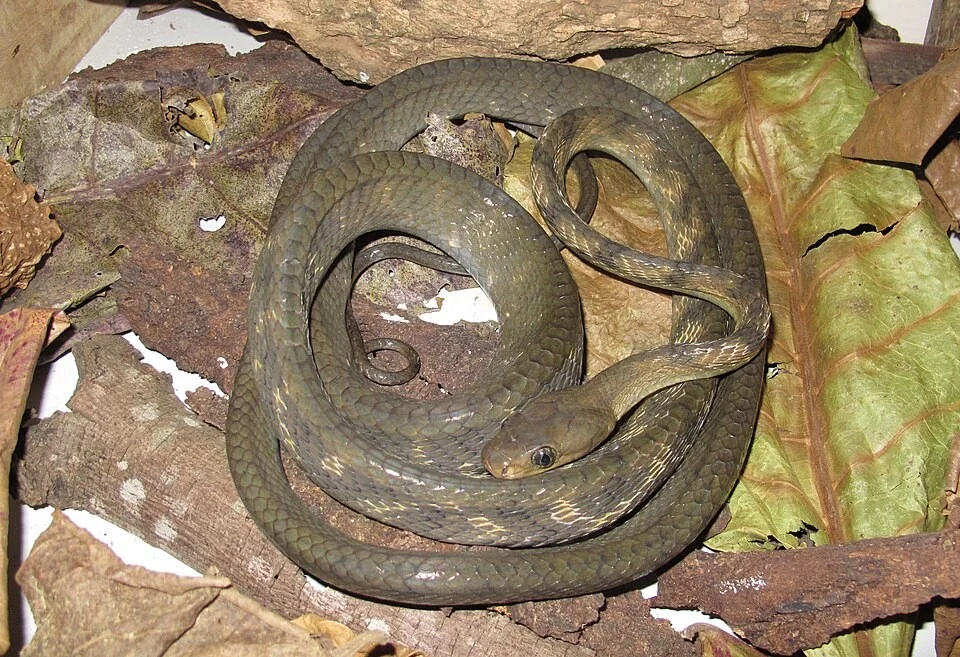
In Son La, Vietnam, a voucher specimen was collected at 20:50 on a branch about 1 m above ground in disturbed evergreen karst forest with medium-sized hardwoods and shrubs.
Classified as venomous in the cited account of genus Boiga; this species’ membership of that genus is verified separately.
Explicit genus-level classification applied to an exact listed member, not a species-specific venom assay or human clinical study of Boiga guangxiensis. The group statement does not transfer diet, body size, behaviour or medical severity. No human-harm tier is inferred.
Evidence & scope · checked 2026-10-29
McGivern et al. (2014), RNA-seq and high-definition mass spectrometry reveal the complex and divergent venoms of two rear-fanged colubrid snakes, BMC Genomics 15:1061, Background: the genus Boiga is explicitly characterised as rear-fanged venomous snakes. The experimental assays concern Boiga irregularis, not every genus member. Membership: exact-species taxonomic account Boiga guangxiensis.
The cited human cases reported limited effects. Sparse observations cannot exclude a severe reaction.
Medically significant effects
The cited human cases document clinically important injury or illness. This is not an upper limit on severity.
Potentially life-threatening
Species-specific clinical evidence documents life-threatening illness or deaths after bites. The account explains the affected patients and any uncertainty about the cause.
Clinical severity not established
Venom presence is documented, but the reviewed evidence does not establish a clinical tier. When human effects are reported under an unresolved historical species name, the badge and account say so explicitly.
Venom status uncertain
The reviewed sources are inconclusive or conflicting about venom presence. The account explains the uncertainty.
Venom status not assessed
The atlas lacks a reviewed venom-presence classification for this species.
These are editorial summaries of the linked evidence, not toxicity rankings or WHO antivenom-priority categories. Effects vary with the bite and patient. Non-venomous does not mean safe to handle.
The scientific identity
Taxonomy & recognition
Accepted name in this edition
Boiga guangxiensis
Authority
WEN, 1998
Family
Colubridae
Type-locality statement
Longgang Nature Reserve, Longzhou City, Guangxi Zhuang Autonomous Region, China.
Reliable identification uses the published combination of scale characters, proportions and other diagnostic evidence. Colour or a photograph alone may not separate closely related species.
Names trace the literature, including older combinations and historical usages. Their appearance here does not mean they are all currently accepted synonyms.
From observations & literature
Natural history
Size and ecological traits credited to SquamBase summarize published studies across the species’ range in its 2024 edition. They are complemented by the locality-specific observations below.
Size & measurements
The two examined adults measured 941–1,172 mm from snout to vent, with reported tail lengths of 298–368 mm.
One adult male (VQ.2025.104) and one adult female (VQ.2025.132) from Vu Quang, Ha Tinh, Vietnam. The account provides pooled ranges without assigning each endpoint to a sex; no sex-specific lengths or species-wide limits are inferred.
Study & evidence
Boiga guangxiensis treatment, Materials and Description.
In Son La, Vietnam, a voucher specimen was collected at 20:50 on a branch about 1 m above ground in disturbed evergreen karst forest with medium-sized hardwoods and shrubs.
The 2024 provincial checklist explicitly lists this species in Thanh Hoa. The 2026 provincial checklist explicitly lists this species in Ha Tinh. The 2020 provincial checklist explicitly lists this species in Son La. The 2020 treatment reports an examined specimen from Chieng Xuan, Van Ho District, Son La at 1090 m. This is a specimen elevation, not the full elevational range. The April 2025 Vu Quang survey collected this species at 610 m elevation. This is the documented observation elevation, not a species-wide altitudinal range. This establishes a provincial record; it does not imply occurrence in every protected area or across the whole editorial region.
A reported observation is not necessarily the full ecological range of a species. Where reproduction is inferred in a source dataset, the account identifies that limitation.
One species · Across borders
Global distribution
Explore the recorded countries and islands. Select a highlighted area to see its distribution evidence.
Recorded distributionN ↑
Loading geographic boundaries…
ListedIntroducedUncertain
Click a highlighted country to zoom in and explore its records.
Shading identifies recorded countries or named islands, not continuous habitat coverage. Uncoloured areas do not establish absence.
Vietnam: Lao Cai; Cao Bang, Lang Son, Thai Nguyen, Bac Giang; Vinh Phuc; Quang Binh, Phong Nha; Kon Tum, Gia Lai, Dak Lak, Lam Dong; Tay Ninh, Dong Nai.
The 2024 provincial checklist explicitly lists this species in Thanh Hoa. The 2026 provincial checklist explicitly lists this species in Ha Tinh. The 2020 provincial checklist explicitly lists this species in Son La. The 2020 treatment reports an examined specimen from Chieng Xuan, Van Ho District, Son La at 1090 m. This is a specimen elevation, not the full elevational range. The April 2025 Vu Quang survey collected this species at 610 m elevation. This is the documented observation elevation, not a species-wide altitudinal range. This establishes a provincial record; it does not imply occurrence in every protected area or across the whole editorial region.
China (Yunnan), Vietnam (Lao Cai [Coc San, Cao Bang [Nguyen Binh], Lang Son [Mau Son, Huu Lung], Thai Nguyen [Ky Phu], Vinh Phuc [Tam Dao], Bac Giang [Luc Nam], Quang Binh [Phong Nha-Ke Bang], Kon Tum [Kon Plong], Gia Lai [Tram Lap], Lam Dong [Da Teh], Tay Ninh [Tay Ninh] and Dong Nai [Bien Hoa], Dak Lak), Laos [1]
The text retains the source’s geographic qualifications. The map shows countries with atlas occurrence records; it is not a complete global range model. A type locality is a nomenclatural reference, not the only place the species occurs.
Status & its meaning
Conservation
Least Concern
Global IUCN category indexed by iNaturalist for this scientific name. It is not a separate assessment of a national population, and its assessment date may predate later taxonomic changes.
The linked taxonomic treatment provides its original descriptions, revisions and bibliography. Observations from other countries are not relabelled as local field studies.