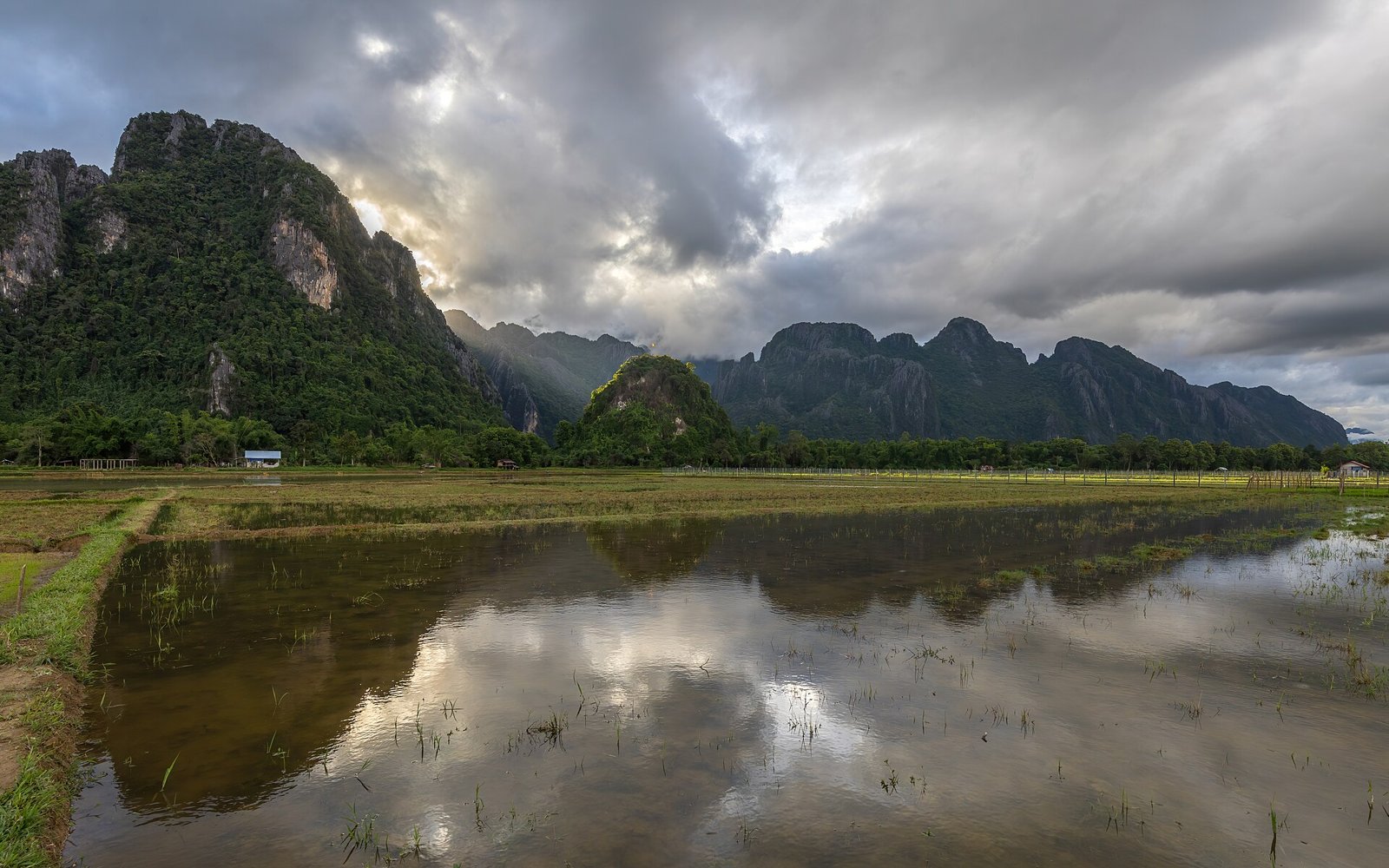
Sunlight over the karst mountains of Vang Vieng, Laos.

Laos · Habitat guide

Limestone & karst forests

Rocky ridges, caves and forest patches create a landscape full of small environmental contrasts.

7species with habitat evidence
4families

Sunlight over the karst mountains of Vang Vieng, Laos.

Photograph: Basile Morin · Image source · CC BY-SA 4.0. Cropped to fill the hero; darkened for text legibility.

Geography & biotopes

Life within the habitat.

Rocky ridges, caves and forest patches create a landscape full of small environmental contrasts.

Limestone terrain can juxtapose exposed rock with damp crevices and shaded forest within a very short distance. Phong Nha-Ke Bang and Hin Nam No demonstrate that these landscapes continue across the Laos–Vietnam border.

Some species descriptions are based on records at cave mouths or beside limestone forest paths. Such observations identify the setting in which a specimen was found; they do not prove that the species is restricted to caves.

The species shown here have explicit limestone or karst associations in the checked literature. Small ranges and sparse records make preserving the original locality context especially important.

Geography and habitat references ↓

Explore by place

Mountains. Karst. Mekong.

Choose a region on the map to open its own guide and species collection.

The species collection

Snakes of Limestone & karst forests.

Species with the habitat associations documented in their accounts. This selection is not an exhaustive habitat checklist.

7 species · showing 7

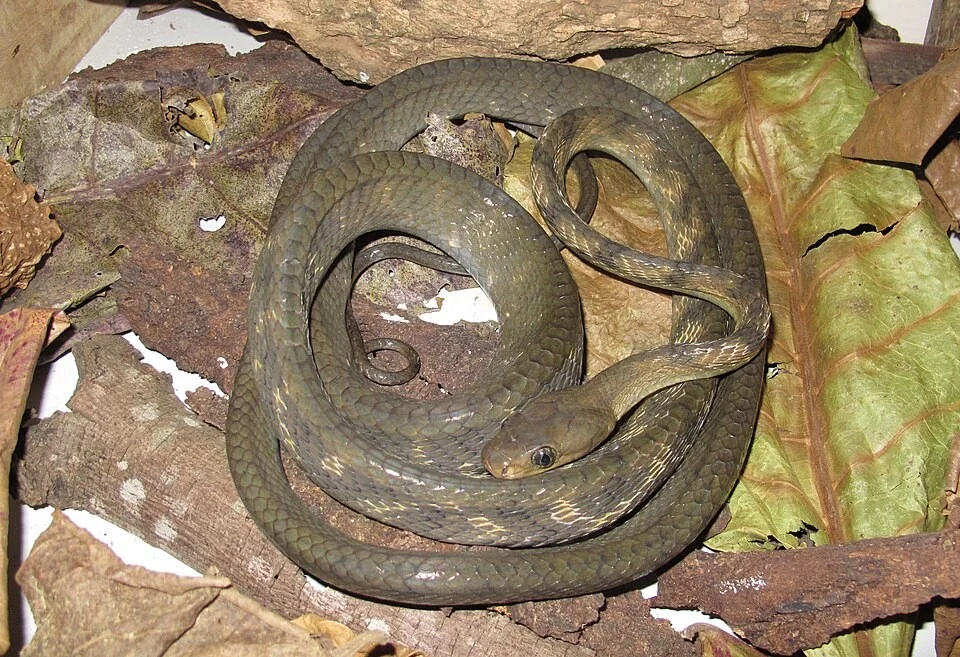
Boiga guangxiensis — real specimen photograph; identification follows the linked source.

001 · Colubridae

Species account

Boiga guangxiensis

WEN, 1998

VenomousClinical severity not established

Laos: national occurrence; no finer locality is assigned in this atlas.

Read the species account →

[Photo: A.V. Pham] Pham AV, Ziegler T, Nguyen TQ (2020) New records and an updated checklist of snakes from Son La Province, Vietnam. Biodiversity Data Journal 8: e52779. https://doi.org/10.3897/BDJ.8.e52779 · CC BY 4.0 · https://creativecommons.org/licenses/by/4.0

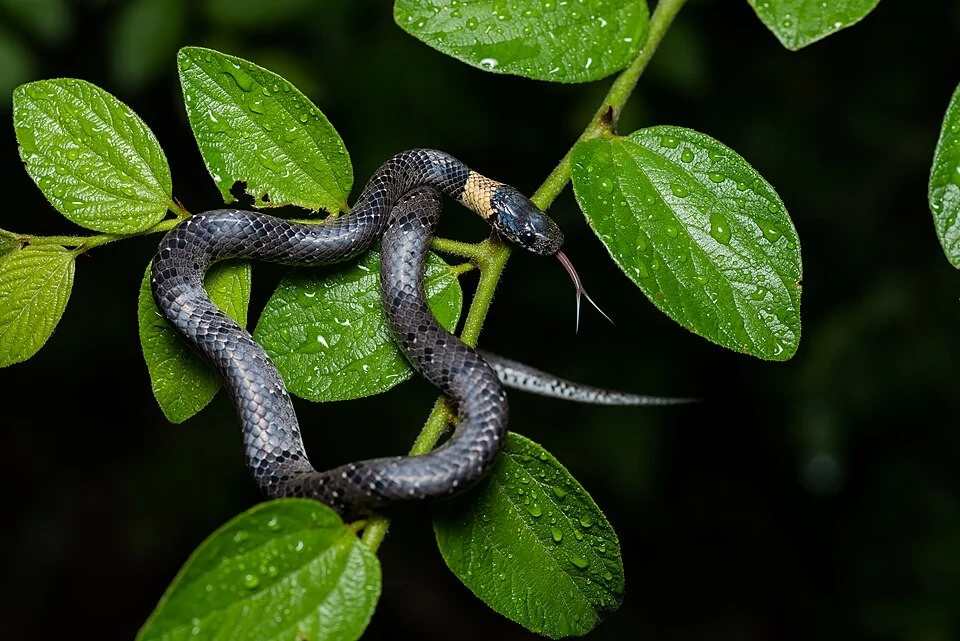
Pareas margaritophorus — real specimen photograph; identification follows the linked source.

006 · Pareidae

Mountain Slug Snake

Pareas margaritophorus

(JAN, 1866)

Non-venomous

Laos: national occurrence; no finer locality is assigned in this atlas.

Read the species account →

Rushenb · CC BY-SA 4.0 · https://creativecommons.org/licenses/by-sa/4.0

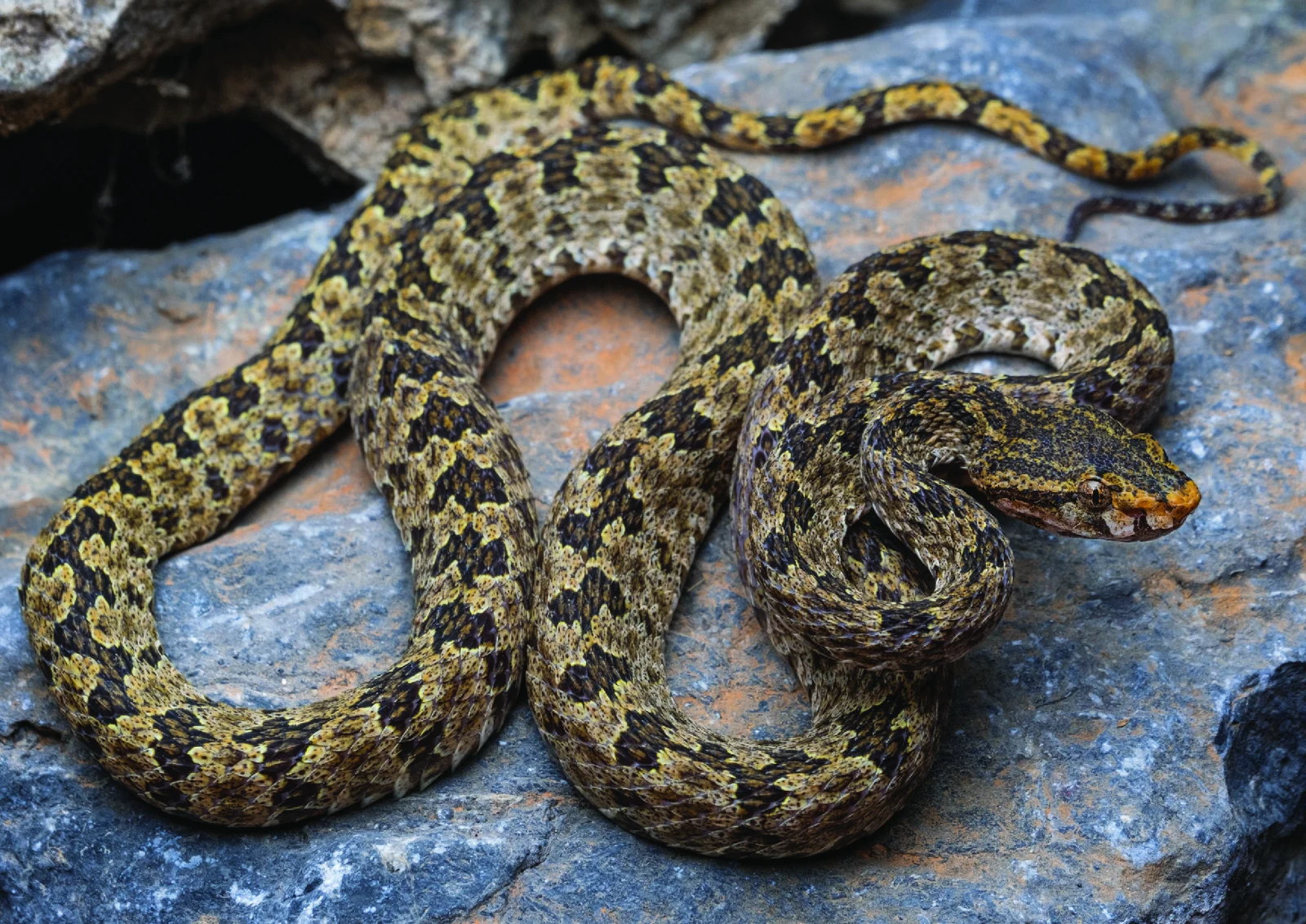
Protobothrops flavirostris holotype NUOL 2024.89, an adult female photographed alive in situ in Laos. Grassby-Lewis et al. (2025), figure 4.

007 · Viperidae

Vang Vieng lance-headed pit viper

Protobothrops flavirostris

GRASSBY-LEWIS, BRAKELS, MAURY, SITTHIVONG, FROHLICH, PAWANGKHANANT, IDIIATULLINA, NGUYEN & POYARKOV, 2025

VenomousClinical severity not established

Laos: Vientiane.

Read the species account →

Rupert J. Grassby-Lewis · CC BY 4.0 · https://creativecommons.org/licenses/by/4.0/

Explore all 125 listed species of Laos →

Living landscapes

Conservation begins with the habitat.

Keep the record in context

New descriptions and revised identifications continue to change these collections. A species known from few localities may be poorly surveyed; the number of records alone is not a population estimate.

Read assessments at their scale

A global Red List assessment is not a national census. Where an assessment is linked in a species account, follow its date, geographic scope and taxonomic treatment before interpreting it locally.

Protect the setting

Forest loss, altered wetlands and collection pressure are discussed in the national biodiversity literature. The significance of each pressure differs between species and localities.

National reports & studies →

The research library

Sources & the checklist.

The national collection contains 125 listed species in this edition. Names and country occurrences were checked on 7–8 October 2026 against individual taxonomic treatments, with a country-range and synonymy review on 11 October 2026 and disputed records and synonymies reviewed separately.

How to read the counts

Maury, David & Sudavanh reported 126 known snake species in 2022, drawing partly on their unpublished data and excluding several unsupported country records. This is a dated literature baseline, not a verified 2026 total.

The current atlas count uses its documented taxonomic decisions; it is not a claim that every species in nature has been discovered. Regional counts require named localities. Habitat collections require explicit habitat evidence. Neither is calculated by assigning every national species to every landscape.

Range and taxonomy review

Country links use a single accepted species identity. Revised names and disputed records are kept visible here; uncertain records do not enter the listed collection or regional totals.

Naja kaouthia

Uncertain — excluded from the listed total

Balchan et al. (2025) questions Lao occurrence after the Naja fuxi split; the remaining Vientiane-area records are probable but unconfirmed.

Source 1 ↗

Source 2 ↗

Boiga cynodon

Uncertain — excluded from the listed total

The treatment warns that Lao reports may be misidentified Boiga siamensis (formerly B. ocellata).

Source 1 ↗

Trimeresurus gumprechti

Liang et al. (2025) synonymized Trimeresurus gumprechti with T. yunnanensis. Historical names, locality evidence and the old URL are retained under one accepted species.

Taxonomic revision ↗
Reviewed exclusions, uncertainties & historical names (13)

Ahaetulla mycterizans

Country occurrence unresolved

The database explicitly marks Laos with a question mark; no confirmed Lao locality is used.

Source 1 ↗

Asthenodipsas laevis

Excluded from the listed total

Maury, David & Sudavanh (2022) exclude the Lao record as unsubstantiated or misidentified.

Source 1 ↗ Source 2 ↗

Boiga cynodon

Country occurrence unresolved

The taxonomic account warns that Lao reports often represent misidentified Boiga siamensis (formerly B. ocellata).

Source 1 ↗

Boiga kraepelini

Excluded from the listed total

Maury, David & Sudavanh (2022) reject the unsupported Lao record.

Source 1 ↗ Source 2 ↗

Calamaria yunnanensis

Country occurrence unresolved

Lee (2021) reassigned the documented Lao specimen formerly identified as C. yunnanensis to C. nebulosa. No independent Lao record reconciled with that revision was verified; this name is not counted a second time.

Source 1 ↗ Source 2 ↗

Deinagkistrodon acutus

Country occurrence unresolved

Laos is queried in the checked distribution treatment.

Source 1 ↗

Elaphe moellendorffi

Country occurrence unresolved

Laos is queried in the checked distribution treatment.

Source 1 ↗

Hypsiscopus plumbeus

Country occurrence unresolved

Northern Indochinese populations formerly called plumbeus were separated as murphyi. A verified Lao record of plumbeus in the narrower sense was not established.

Source 1 ↗ Source 2 ↗

Hypsiscopus wettsteini

Excluded from the listed total

The 2024 revision restricts wettsteini to the Red River basin and eastward. Lao records under the formerly broader name belong to murphyi.

Source 1 ↗ Source 2 ↗

Oligodon cyclurus

Excluded from the listed total

The taxonomic treatment restricts cyclurus to India, Bangladesh and Myanmar; the similar fasciolatus is retained for Laos.

Source 1 ↗

Pareas carinatus

Excluded from the listed total

The 2022 revision assigns mainland records in this complex to other species, including berdmorei; carinatus is not carried over from older broad treatments.

Source 1 ↗ Source 2 ↗

Ramphotyphlops acuticaudus

Excluded from the listed total

The search matched Palaos, the historical name for Palau. This is not a record from Laos.

Source 1 ↗

Trimeresurus gumprechti

Counted under the accepted name: Trimeresurus yunnanensis

Counted within Trimeresurus yunnanensis following the synonymy of Liang et al. (2025).

Source 1 ↗
  1. Maury, David & Sudavanh (2022) — The snake fauna of Laos with new provincial records ↗

    National count and its exclusions: pp. 84–85; geography and survey habitats: introduction and methods. Surveys do not constitute a complete current national checklist.

  2. Lao PDR — Fourth National Report to the Convention on Biological Diversity (2010) ↗

    Physical geography, seasonal climate and broad ecological regions. Historical report; no current forest-cover percentages inferred.

  3. UNESCO — Phong Nha-Ke Bang and Hin Nam No National Parks ↗

    Transboundary karst geography and habitats, including the 2025 extension. Not a national snake inventory.

  4. The Reptile Database

    Individual species treatments supply taxonomy, distribution, type localities and cited natural-history observations. Each account links its own source.

  5. Bernstein et al. (2024) — Revised treatment of Hypsiscopus mud snakes

    Used to separate revised species concepts around the Red River and interpret older country records.

  6. Regional boundary sources, modifications & licences