Size & measurements
Recorded size
SquamBase 1.0 records a literature maximum of 41 cm total length, including the tail. This is a compiled maximum, not a typical adult size or a measurement specific to this country.
[2]Atractaspididae · Species account
Aparallactus capensisSMITH, 1849
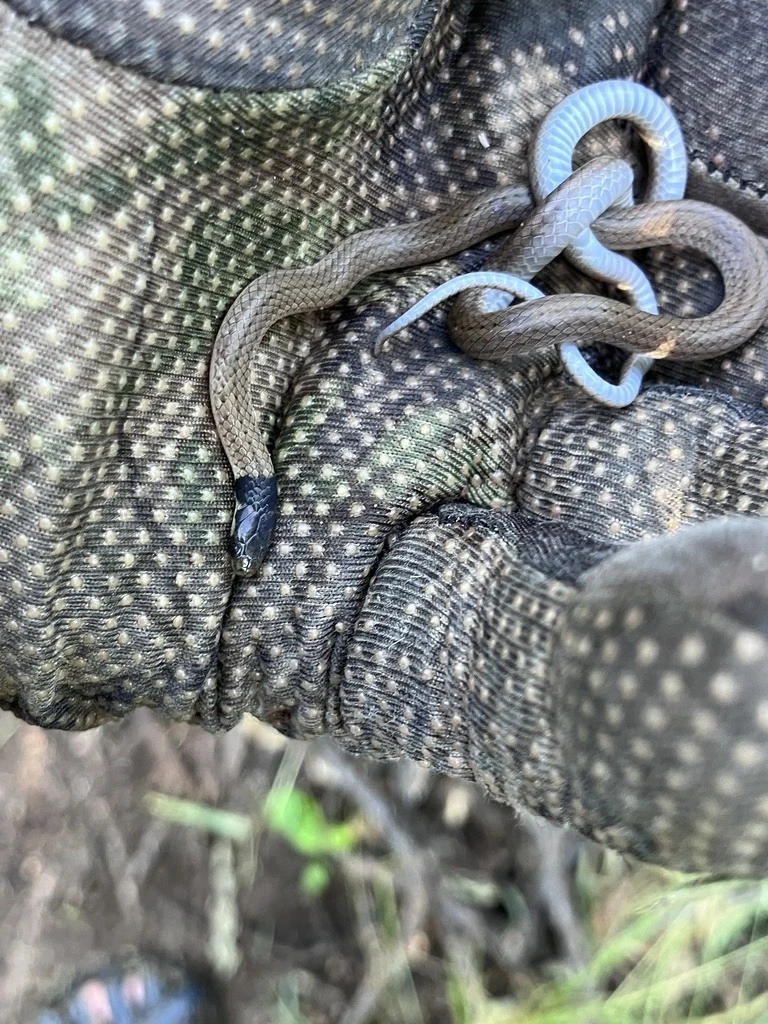
VenomousClinical severity not establishedBurrowing and surface activity is reported in the studies compiled by SquamBase. This describes the species across its studied range, not a record from every country or region.
Venom & human effects
The species account explicitly identifies this snake as venomous. Human medical effects have not yet been assessed for this atlas.
Exact-species statement in the retained Reptile Database treatment; this review establishes venom presence only, not human bite severity.
Comment field: Venomous.
These are editorial summaries of the linked evidence, not toxicity rankings or WHO antivenom-priority categories. Effects vary with the bite and patient. Non-venomous does not mean safe to handle.
The scientific identity
Reliable identification uses the published combination of scale characters, proportions and other diagnostic evidence. Colour or a photograph alone may not separate closely related species.
From observations & literature
Size and ecological traits credited to SquamBase summarize published studies across the species’ range in its 2024 edition. They are complemented by the locality-specific observations below.
SquamBase 1.0 records a literature maximum of 41 cm total length, including the tail. This is a compiled maximum, not a typical adult size or a measurement specific to this country.
[2]Dissection of 62 preserved snakes found identifiable food in 15 individuals: all 16 prey items were centipedes. This supports centipede specialization without proving that other prey are never eaten.
Primary museum dissection study. The 16 newly examined prey items are distinct from the 21 total wild feeding records used in the separate literature-plus-simulation analysis.
Maritz, Rawoot & van Huyssteen (2021), African Journal of Herpetology 70(1):61–67; Abstract, original stomach-content sample (62 examined; 15 with food; 16 centipedes).
The 2024 compilation classifies activity as mainly after dark. This range-wide summary does not exclude activity at other times.
[2]Burrowing and surface activity is reported in the studies compiled by SquamBase. This describes the species across its studied range, not a record from every country or region.
[2]Egg-laying.
No sourced habitat & ecology summary has yet been added to this account.
Central District: observation GBIF 5154631001 (2025). The original iNaturalist entry was rechecked for research-grade identification, wild status and unrestricted coordinates; its reported uncertainty footprint lies within the mapped region. This is a community-reviewed observation, not a museum voucher. Central District: observation GBIF 4438956109 (2023). The original iNaturalist entry was rechecked for research-grade identification, wild status and unrestricted coordinates; its reported uncertainty footprint lies within the mapped region. This is a community-reviewed observation, not a museum voucher. These are dated locality records, not evidence of occurrence throughout every part of a region or a complete present-day inventory.
[3][4][5][6]Lubombo: observation GBIF 5008461649 (2025). The original iNaturalist entry was rechecked for research-grade identification, wild status and unrestricted coordinates; its reported uncertainty footprint lies within the mapped region. This is a community-reviewed observation, not a museum voucher. Lubombo: observation GBIF 5903768886 (2025). The original iNaturalist entry was rechecked for research-grade identification, wild status and unrestricted coordinates; its reported uncertainty footprint lies within the mapped region. This is a community-reviewed observation, not a museum voucher. Hhohho: observation GBIF 4507859835 (2023). The original iNaturalist entry was rechecked for research-grade identification, wild status and unrestricted coordinates; its reported uncertainty footprint lies within the mapped region. This is a community-reviewed observation, not a museum voucher. Hhohho: observation GBIF 4507924870 (2022). The original iNaturalist entry was rechecked for research-grade identification, wild status and unrestricted coordinates; its reported uncertainty footprint lies within the mapped region. This is a community-reviewed observation, not a museum voucher. These are dated locality records, not evidence of occurrence throughout every part of a region or a complete present-day inventory.
[7][8][9][10][11][12][13][14]Maputo: observation GBIF 6422470902 (2026). The original iNaturalist entry was rechecked for research-grade identification, wild status and unrestricted coordinates; its reported uncertainty footprint lies within the mapped region. This is a community-reviewed observation, not a museum voucher. Maputo: observation GBIF 4006711890 (2022). The original iNaturalist entry was rechecked for research-grade identification, wild status and unrestricted coordinates; its reported uncertainty footprint lies within the mapped region. This is a community-reviewed observation, not a museum voucher. Inhambane: museum voucher MUHNAC IICT/R 1012-1948 (1948). The museum record's reported coordinate uncertainty footprint lies within the mapped region. Inhambane: museum voucher MUHNAC IICT/R 1194-1948 (1948). The museum record's reported coordinate uncertainty footprint lies within the mapped region. Manica: museum voucher MUHNAC IICT/R 16-1964 (1964). The museum record's reported coordinate uncertainty footprint lies within the mapped region. Manica: observation GBIF 5827637333 (2025). The original iNaturalist entry was rechecked for research-grade identification, wild status and unrestricted coordinates; its reported uncertainty footprint lies within the mapped region. This is a community-reviewed observation, not a museum voucher. Gaza: observation GBIF 5936371205 (2025). The original iNaturalist entry was rechecked for research-grade identification, wild status and unrestricted coordinates; its reported uncertainty footprint lies within the mapped region. This is a community-reviewed observation, not a museum voucher. Gaza: observation GBIF 5840155655 (2025). The original iNaturalist entry was rechecked for research-grade identification, wild status and unrestricted coordinates; its reported uncertainty footprint lies within the mapped region. This is a community-reviewed observation, not a museum voucher. Sofala: observation GBIF 5062880692 (2024). The original iNaturalist entry was rechecked for research-grade identification, wild status and unrestricted coordinates; its reported uncertainty footprint lies within the mapped region. This is a community-reviewed observation, not a museum voucher. Sofala: observation GBIF 4973908253 (2024). The original iNaturalist entry was rechecked for research-grade identification, wild status and unrestricted coordinates; its reported uncertainty footprint lies within the mapped region. This is a community-reviewed observation, not a museum voucher. Nampula: observation GBIF 3383904543 (2020). The original iNaturalist entry was rechecked for research-grade identification, wild status and unrestricted coordinates; its reported uncertainty footprint lies within the mapped region. This is a community-reviewed observation, not a museum voucher. Niassa: observation GBIF 3985722322 (2018). The original iNaturalist entry was rechecked for research-grade identification, wild status and unrestricted coordinates; its reported uncertainty footprint lies within the mapped region. This is a community-reviewed observation, not a museum voucher. These are dated locality records, not evidence of occurrence throughout every part of a region or a complete present-day inventory.
[15][16][17][18][19][20][21][22][23][24][25][26][27][28][29][30][31][32][33][34][35]Free State: observation 402688557, 2026-09-23. Free State: observation 402688352, 2026-09-23. North West: observation 391999317, 2026-08-16. North West: observation 376898378, 2026-06-28. KwaZulu-Natal: observation 331709344, 2025-12-22. KwaZulu-Natal: observation 331708597, 2025-12-22. Gauteng: observation 401513722, 2026-09-19. Gauteng: observation 391486267, 2026-08-15. Limpopo: observation 402421280, 2026-09-12. Limpopo: observation 385744052, 2026-07-26. Mpumalanga: observation 389310046, 2026-08-07. Mpumalanga: observation 379745366, 2026-07-09. Original records have agreeing research-grade identifications, wild status and open coordinates. Points and sampled reported uncertainty envelopes fall within the mapped region. These are dated community-reviewed observations, not museum vouchers or evidence of presence throughout the region. Exact coordinates are not republished.
[36][37][38][39][40][41][42][43][44][45][46][47][48][49][50][51][52][53][54][55][56][57][58][59]Masvingo: observation 343499243, 2026-03-17. Matabeleland North: observation 323275852, 2025-10-26. Original records have agreeing research-grade identifications, wild status and open coordinates. Points and sampled reported uncertainty envelopes fall within the mapped region. These are dated community-reviewed observations, not museum vouchers or evidence of presence throughout the region. Exact coordinates are not republished.
[60][61][62][63]A reported observation is not necessarily the full ecological range of a species. Where reproduction is inferred in a source dataset, the account identifies that limitation.
One species · Across borders
Explore the recorded countries and islands. Select a highlighted area to see its distribution evidence.
Loading geographic boundaries…
Click a highlighted country to zoom in and explore its records.
Shading identifies recorded countries or named islands, not continuous habitat coverage. Uncoloured areas do not establish absence.
Natural Earth · 1:50m · public domain; Gibraltar: geoBoundaries. Small islands may lack an outline.
Explore the distribution
Select a highlighted area to see its status, island records and sources. Each country and island links to the same shared species collection.
Use “Worldwide records” to include distant introduced and uncertain records in the map view.
The current taxonomic treatment explicitly lists this country. This is country-scale checklist evidence, not a claim of continuous occupancy or a complete regional inventory. Central District: observation GBIF 5154631001 (2025). The original iNaturalist entry was rechecked for research-grade identification, wild status and unrestricted coordinates; its reported uncertainty footprint lies within the mapped region. This is a community-reviewed observation, not a museum voucher. Central District: observation GBIF 4438956109 (2023). The original iNaturalist entry was rechecked for research-grade identification, wild status and unrestricted coordinates; its reported uncertainty footprint lies within the mapped region. This is a community-reviewed observation, not a museum voucher. These are dated locality records, not evidence of occurrence throughout every part of a region or a complete present-day inventory.
Central District → · Central District
Locality source 1 ↗ Locality source 2 ↗ Locality source 3 ↗ Locality source 4 ↗ Locality source 5 ↗The current taxonomic treatment explicitly lists this country. This is country-scale checklist evidence, not a claim of continuous occupancy or a complete regional inventory.
Locality source 1 ↗The current taxonomic treatment explicitly lists this country. This is country-scale checklist evidence, not a claim of continuous occupancy or a complete regional inventory.
Locality source 1 ↗The current taxonomic treatment explicitly lists this country. This is country-scale checklist evidence, not a claim of continuous occupancy or a complete regional inventory. Maputo: observation GBIF 6422470902 (2026). The original iNaturalist entry was rechecked for research-grade identification, wild status and unrestricted coordinates; its reported uncertainty footprint lies within the mapped region. This is a community-reviewed observation, not a museum voucher. Maputo: observation GBIF 4006711890 (2022). The original iNaturalist entry was rechecked for research-grade identification, wild status and unrestricted coordinates; its reported uncertainty footprint lies within the mapped region. This is a community-reviewed observation, not a museum voucher. Inhambane: museum voucher MUHNAC IICT/R 1012-1948 (1948). The museum record's reported coordinate uncertainty footprint lies within the mapped region. Inhambane: museum voucher MUHNAC IICT/R 1194-1948 (1948). The museum record's reported coordinate uncertainty footprint lies within the mapped region. Manica: museum voucher MUHNAC IICT/R 16-1964 (1964). The museum record's reported coordinate uncertainty footprint lies within the mapped region. Manica: observation GBIF 5827637333 (2025). The original iNaturalist entry was rechecked for research-grade identification, wild status and unrestricted coordinates; its reported uncertainty footprint lies within the mapped region. This is a community-reviewed observation, not a museum voucher. Gaza: observation GBIF 5936371205 (2025). The original iNaturalist entry was rechecked for research-grade identification, wild status and unrestricted coordinates; its reported uncertainty footprint lies within the mapped region. This is a community-reviewed observation, not a museum voucher. Gaza: observation GBIF 5840155655 (2025). The original iNaturalist entry was rechecked for research-grade identification, wild status and unrestricted coordinates; its reported uncertainty footprint lies within the mapped region. This is a community-reviewed observation, not a museum voucher. Sofala: observation GBIF 5062880692 (2024). The original iNaturalist entry was rechecked for research-grade identification, wild status and unrestricted coordinates; its reported uncertainty footprint lies within the mapped region. This is a community-reviewed observation, not a museum voucher. Sofala: observation GBIF 4973908253 (2024). The original iNaturalist entry was rechecked for research-grade identification, wild status and unrestricted coordinates; its reported uncertainty footprint lies within the mapped region. This is a community-reviewed observation, not a museum voucher. Nampula: observation GBIF 3383904543 (2020). The original iNaturalist entry was rechecked for research-grade identification, wild status and unrestricted coordinates; its reported uncertainty footprint lies within the mapped region. This is a community-reviewed observation, not a museum voucher. Niassa: observation GBIF 3985722322 (2018). The original iNaturalist entry was rechecked for research-grade identification, wild status and unrestricted coordinates; its reported uncertainty footprint lies within the mapped region. This is a community-reviewed observation, not a museum voucher. These are dated locality records, not evidence of occurrence throughout every part of a region or a complete present-day inventory.
Maputo → · Maputo
Inhambane → · Inhambane
Manica → · Manica
Gaza → · Gaza
Sofala → · Sofala
Nampula → · Nampula
Niassa → · Niassa
Locality source 1 ↗ Locality source 2 ↗ Locality source 3 ↗ Locality source 4 ↗ Locality source 5 ↗ Locality source 6 ↗ Locality source 7 ↗ Locality source 8 ↗ Locality source 9 ↗ Locality source 10 ↗ Locality source 11 ↗ Locality source 12 ↗ Locality source 13 ↗ Locality source 14 ↗ Locality source 15 ↗ Locality source 16 ↗ Locality source 17 ↗ Locality source 18 ↗ Locality source 19 ↗ Locality source 20 ↗ Locality source 21 ↗ Locality source 22 ↗The current taxonomic treatment explicitly lists this country. This is country-scale checklist evidence, not a claim of continuous occupancy or a complete regional inventory. Free State: observation 402688557, 2026-09-23. Free State: observation 402688352, 2026-09-23. North West: observation 391999317, 2026-08-16. North West: observation 376898378, 2026-06-28. KwaZulu-Natal: observation 331709344, 2025-12-22. KwaZulu-Natal: observation 331708597, 2025-12-22. Gauteng: observation 401513722, 2026-09-19. Gauteng: observation 391486267, 2026-08-15. Limpopo: observation 402421280, 2026-09-12. Limpopo: observation 385744052, 2026-07-26. Mpumalanga: observation 389310046, 2026-08-07. Mpumalanga: observation 379745366, 2026-07-09. Original records have agreeing research-grade identifications, wild status and open coordinates. Points and sampled reported uncertainty envelopes fall within the mapped region. These are dated community-reviewed observations, not museum vouchers or evidence of presence throughout the region. Exact coordinates are not republished.
Free State → · Free State
North West → · North West
KwaZulu-Natal → · KwaZulu-Natal
Gauteng → · Gauteng
Limpopo → · Limpopo
Mpumalanga → · Mpumalanga
Locality source 1 ↗ Locality source 2 ↗ Locality source 3 ↗ Locality source 4 ↗ Locality source 5 ↗ Locality source 6 ↗ Locality source 7 ↗ Locality source 8 ↗ Locality source 9 ↗ Locality source 10 ↗ Locality source 11 ↗ Locality source 12 ↗ Locality source 13 ↗ Locality source 14 ↗ Locality source 15 ↗ Locality source 16 ↗ Locality source 17 ↗ Locality source 18 ↗ Locality source 19 ↗ Locality source 20 ↗ Locality source 21 ↗ Locality source 22 ↗ Locality source 23 ↗ Locality source 24 ↗ Locality source 25 ↗The current taxonomic treatment explicitly lists this country. This is country-scale checklist evidence, not a claim of continuous occupancy or a complete regional inventory.
Locality source 1 ↗The current taxonomic treatment explicitly lists this country. This is country-scale checklist evidence, not a claim of continuous occupancy or a complete regional inventory. Masvingo: observation 343499243, 2026-03-17. Matabeleland North: observation 323275852, 2025-10-26. Original records have agreeing research-grade identifications, wild status and open coordinates. Points and sampled reported uncertainty envelopes fall within the mapped region. These are dated community-reviewed observations, not museum vouchers or evidence of presence throughout the region. Exact coordinates are not republished.
Masvingo → · Masvingo
Matabeleland North → · Matabeleland North
Locality source 1 ↗ Locality source 2 ↗ Locality source 3 ↗ Locality source 4 ↗ Locality source 5 ↗The current taxonomic treatment explicitly lists this country. This is country-scale checklist evidence, not a claim of continuous occupancy or a complete regional inventory. Lubombo: observation GBIF 5008461649 (2025). The original iNaturalist entry was rechecked for research-grade identification, wild status and unrestricted coordinates; its reported uncertainty footprint lies within the mapped region. This is a community-reviewed observation, not a museum voucher. Lubombo: observation GBIF 5903768886 (2025). The original iNaturalist entry was rechecked for research-grade identification, wild status and unrestricted coordinates; its reported uncertainty footprint lies within the mapped region. This is a community-reviewed observation, not a museum voucher. Hhohho: observation GBIF 4507859835 (2023). The original iNaturalist entry was rechecked for research-grade identification, wild status and unrestricted coordinates; its reported uncertainty footprint lies within the mapped region. This is a community-reviewed observation, not a museum voucher. Hhohho: observation GBIF 4507924870 (2022). The original iNaturalist entry was rechecked for research-grade identification, wild status and unrestricted coordinates; its reported uncertainty footprint lies within the mapped region. This is a community-reviewed observation, not a museum voucher. These are dated locality records, not evidence of occurrence throughout every part of a region or a complete present-day inventory.
Lubombo → · Lubombo
Hhohho → · Hhohho
Locality source 1 ↗ Locality source 2 ↗ Locality source 3 ↗ Locality source 4 ↗ Locality source 5 ↗ Locality source 6 ↗ Locality source 7 ↗ Locality source 8 ↗ Locality source 9 ↗Country entries documented in this Africa review: Botswana, Democratic Republic of the Congo, Lesotho, Mozambique, South Africa, Zambia, Zimbabwe, eSwatini. Consult individual occurrence records for qualifications. These entries are not a complete global range polygon. [1]
The text retains the source’s geographic qualifications. The map shows countries with atlas occurrence records; it is not a complete global range model. A type locality is a nomenclatural reference, not the only place the species occurs.
Status & its meaning
No matching global assessment was verified for this account. This is an unresolved assessment link, not an IUCN “Not Evaluated” classification and not evidence that the species is secure.
Locality coverage in the atlas does not measure abundance, population trends or national legal protection.
Follow the evidence
Latest evidence added 2026-10-13. Taxonomic and distribution treatments may change.
The linked taxonomic treatment provides its original descriptions, revisions and bibliography. Observations from other countries are not relabelled as local field studies.