Size & measurements
No sourced size & measurements summary has yet been added to this account.
Colubridae · Species account
Thelotornis mossambicanus(BOCAGE, 1895)
VenomousClinical severity not establishedCoastal counties: observation GBIF 6479245777 (2026). The original iNaturalist entry was rechecked for research-grade identification, wild status and unrestricted coordinates; its reported uncertainty footprint lies within the mapped region. This is a community-reviewed observation, not a museum voucher. Coastal counties: observation GBIF 6147273252 (2026). The original iNaturalist entry was rechecked for research-grade identification, wild status and unrestricted coordinates; its reported uncertainty footprint lies within the mapped region. This is a community-reviewed observation, not a museum voucher. These are dated locality records, not evidence of occurrence throughout every part of a region or a complete present-day inventory.
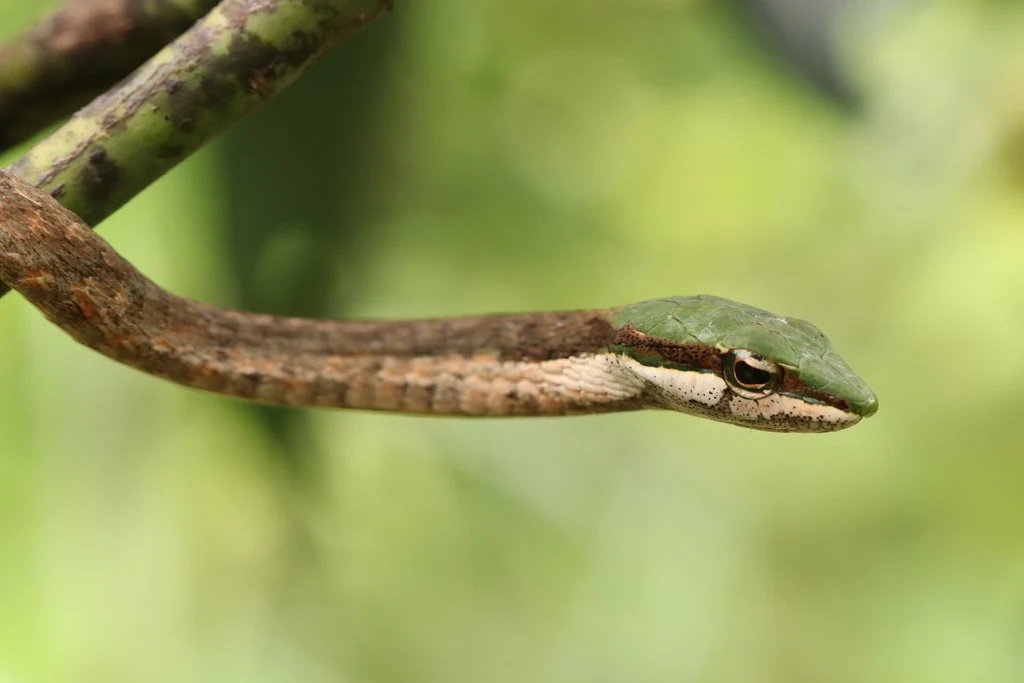
Venom & human effects
The species account explicitly identifies this snake as venomous. Human medical effects have not yet been assessed for this atlas.
Exact-species statement in the retained Reptile Database treatment; this review establishes venom presence only, not human bite severity.
Comment field: Venomous.
These are editorial summaries of the linked evidence, not toxicity rankings or WHO antivenom-priority categories. Effects vary with the bite and patient. Non-venomous does not mean safe to handle.
The scientific identity
Reliable identification uses the published combination of scale characters, proportions and other diagnostic evidence. Colour or a photograph alone may not separate closely related species.
From observations & literature
No sourced size & measurements summary has yet been added to this account.
No sourced diet & feeding summary has yet been added to this account.
The cited compilation records daytime activity.
Exact-name entry in the 2024 SquamBase literature compilation, using an explicitly populated trait and its cited metadata. Records reflect the studied populations; they do not establish uniform behaviour across all seasons, ages or localities. Historical species concepts requiring review and imputed/uncertain metadata are excluded.
SquamBase 1.0, Supplementary Table S1, row 10958: Thelotornis mossambicanus; columns Activity time and Activity time metadata. Recorded value: Diurnal. Original source metadata: Diurnal (Pietersen et al. 2021, genus and similar to capensis), diurnal (Marais 2022, Malonza and Bwong 2023, Spawls et al. 2023)
Published records compiled in SquamBase report 4–18 eggs per clutch. These are the smallest and largest reported broods in the compilation, not a typical brood size or a complete limit for the species.
Exact-name row in the 2024 literature compilation. These are records from studied populations, not typical values, an exhaustive biological account, or evidence of occurrence in every region.
SquamBase 1.0, Supplementary Table S1, row 10958: Thelotornis mossambicanus; columns Mode of reproduction, Mode of reproduction metadata, smallest brood, largest brood, brood size metadata.
The cited compilation records microhabitat use including trees and other above-ground vegetation.
Exact-name entry in the 2024 SquamBase literature compilation, using an explicitly populated trait and its cited metadata. Records reflect the studied populations; they do not establish uniform behaviour across all seasons, ages or localities. Historical species concepts requiring review and imputed/uncertain metadata are excluded. This describes substrate or microhabitat use, not vegetation, a geographical range, or use of every habitat in that range.
SquamBase 1.0, Supplementary Table S1, row 10958: Thelotornis mossambicanus; columns substrate and substrate metadata. Recorded value: Arboreal. Original source metadata: Arboreal (Harrington et al. 2018, Wilkey and Terrell 2017, Pietersen et al. 2021, Marais 2022, Malonza and Bwong 2023, Spawls et al. 2023)
The cited taxonomic account describes habitat use as fully arboreal (Harrington et al. 2018).
Explicit information assigned to this exact species in the cited taxonomic compilation. Original citations are retained where the account supplies them; an uncited entry is not presented as a primary study. Local, specimen-specific, captive and uncertain statements retain those limits. No venom or human-danger classification is inferred.
The Reptile Database, Thelotornis mossambicanus, Comment field, Habitat paragraph. Citations in this paragraph: (Harrington et al. 2018).
Coastal counties: observation GBIF 6479245777 (2026). The original iNaturalist entry was rechecked for research-grade identification, wild status and unrestricted coordinates; its reported uncertainty footprint lies within the mapped region. This is a community-reviewed observation, not a museum voucher. Coastal counties: observation GBIF 6147273252 (2026). The original iNaturalist entry was rechecked for research-grade identification, wild status and unrestricted coordinates; its reported uncertainty footprint lies within the mapped region. This is a community-reviewed observation, not a museum voucher. These are dated locality records, not evidence of occurrence throughout every part of a region or a complete present-day inventory.
[2][3][4][5]Northern Region: observation GBIF 6422732684 (2026). The original iNaturalist entry was rechecked for research-grade identification, wild status and unrestricted coordinates; its reported uncertainty footprint lies within the mapped region. This is a community-reviewed observation, not a museum voucher. Northern Region: observation GBIF 4516923745 (2024). The original iNaturalist entry was rechecked for research-grade identification, wild status and unrestricted coordinates; its reported uncertainty footprint lies within the mapped region. This is a community-reviewed observation, not a museum voucher. Southern Region: observation GBIF 5154258788 (2025). The original iNaturalist entry was rechecked for research-grade identification, wild status and unrestricted coordinates; its reported uncertainty footprint lies within the mapped region. This is a community-reviewed observation, not a museum voucher. Southern Region: observation GBIF 4522758510 (2024). The original iNaturalist entry was rechecked for research-grade identification, wild status and unrestricted coordinates; its reported uncertainty footprint lies within the mapped region. This is a community-reviewed observation, not a museum voucher. These are dated locality records, not evidence of occurrence throughout every part of a region or a complete present-day inventory.
[6][7][8][9][10][11][12][13]The checked taxonomic treatment gives Manica as the type-locality area. Its published place or administrative label places it within this atlas group (Manica). This is historical taxonomic locality evidence, not a recent field survey or evidence of occupancy across the whole region. These are dated locality records, not evidence of occurrence throughout every part of a region or a complete present-day inventory.
[14]Unguja: observation 207125005, 2019-01-20. Western mainland: observation 214032712, 2024-05-03. Western mainland: observation 195246303, 2023-12-05. Original records have agreeing research-grade identifications, wild status and open coordinates. Points and sampled reported uncertainty envelopes fall within the mapped region. These are dated community-reviewed observations, not museum vouchers or evidence of presence throughout the region. Exact coordinates are not republished.
[15][16][17][18][19][20]A reported observation is not necessarily the full ecological range of a species. Where reproduction is inferred in a source dataset, the account identifies that limitation.
One species · Across borders
Explore the recorded countries and islands. Select a highlighted area to see its distribution evidence.
Loading geographic boundaries…
Click a highlighted country to zoom in and explore its records.
Shading identifies recorded countries or named islands, not continuous habitat coverage. Uncoloured areas do not establish absence.
Natural Earth · 1:50m · public domain; Gibraltar: geoBoundaries. Small islands may lack an outline.
Explore the distribution
Select a highlighted area to see its status, island records and sources. Each country and island links to the same shared species collection.
Use “Worldwide records” to include distant introduced and uncertain records in the map view.
The current taxonomic treatment explicitly lists this country. This is country-scale checklist evidence, not a claim of continuous occupancy or a complete regional inventory. Coastal counties: observation GBIF 6479245777 (2026). The original iNaturalist entry was rechecked for research-grade identification, wild status and unrestricted coordinates; its reported uncertainty footprint lies within the mapped region. This is a community-reviewed observation, not a museum voucher. Coastal counties: observation GBIF 6147273252 (2026). The original iNaturalist entry was rechecked for research-grade identification, wild status and unrestricted coordinates; its reported uncertainty footprint lies within the mapped region. This is a community-reviewed observation, not a museum voucher. These are dated locality records, not evidence of occurrence throughout every part of a region or a complete present-day inventory.
Coastal counties → · Coastal counties
Locality source 1 ↗ Locality source 2 ↗ Locality source 3 ↗ Locality source 4 ↗ Locality source 5 ↗The current taxonomic treatment explicitly lists this country. This is country-scale checklist evidence, not a claim of continuous occupancy or a complete regional inventory. Northern Region: observation GBIF 6422732684 (2026). The original iNaturalist entry was rechecked for research-grade identification, wild status and unrestricted coordinates; its reported uncertainty footprint lies within the mapped region. This is a community-reviewed observation, not a museum voucher. Northern Region: observation GBIF 4516923745 (2024). The original iNaturalist entry was rechecked for research-grade identification, wild status and unrestricted coordinates; its reported uncertainty footprint lies within the mapped region. This is a community-reviewed observation, not a museum voucher. Southern Region: observation GBIF 5154258788 (2025). The original iNaturalist entry was rechecked for research-grade identification, wild status and unrestricted coordinates; its reported uncertainty footprint lies within the mapped region. This is a community-reviewed observation, not a museum voucher. Southern Region: observation GBIF 4522758510 (2024). The original iNaturalist entry was rechecked for research-grade identification, wild status and unrestricted coordinates; its reported uncertainty footprint lies within the mapped region. This is a community-reviewed observation, not a museum voucher. These are dated locality records, not evidence of occurrence throughout every part of a region or a complete present-day inventory.
Northern Region → · Northern Region
Southern Region → · Southern Region
Locality source 1 ↗ Locality source 2 ↗ Locality source 3 ↗ Locality source 4 ↗ Locality source 5 ↗ Locality source 6 ↗ Locality source 7 ↗ Locality source 8 ↗ Locality source 9 ↗The current taxonomic treatment explicitly lists this country. This is country-scale checklist evidence, not a claim of continuous occupancy or a complete regional inventory. The checked taxonomic treatment gives Manica as the type-locality area. Its published place or administrative label places it within this atlas group (Manica). This is historical taxonomic locality evidence, not a recent field survey or evidence of occupancy across the whole region. These are dated locality records, not evidence of occurrence throughout every part of a region or a complete present-day inventory.
Manica → · Manica
Locality source 1 ↗The current taxonomic treatment explicitly lists this country. This is country-scale checklist evidence, not a claim of continuous occupancy or a complete regional inventory. The country-scale source may cover a wider area than the separately labelled Somalia outline in this geographic atlas; regional placements require their own localities.
Locality source 1 ↗The current taxonomic treatment explicitly lists this country. This is country-scale checklist evidence, not a claim of continuous occupancy or a complete regional inventory. Unguja: observation 207125005, 2019-01-20. Western mainland: observation 214032712, 2024-05-03. Western mainland: observation 195246303, 2023-12-05. Original records have agreeing research-grade identifications, wild status and open coordinates. Points and sampled reported uncertainty envelopes fall within the mapped region. These are dated community-reviewed observations, not museum vouchers or evidence of presence throughout the region. Exact coordinates are not republished.
Unguja → · Unguja
Western mainland → · Western mainland
Locality source 1 ↗ Locality source 2 ↗ Locality source 3 ↗ Locality source 4 ↗ Locality source 5 ↗ Locality source 6 ↗ Locality source 7 ↗The current taxonomic treatment explicitly lists this country. This is country-scale checklist evidence, not a claim of continuous occupancy or a complete regional inventory.
Locality source 1 ↗The current taxonomic treatment explicitly lists this country. This is country-scale checklist evidence, not a claim of continuous occupancy or a complete regional inventory.
Locality source 1 ↗Country entries documented in this Africa review: Kenya, Malawi, Mozambique, Somalia, United Republic of Tanzania, Zambia, Zimbabwe. Consult individual occurrence records for qualifications. These entries are not a complete global range polygon. [1]
The text retains the source’s geographic qualifications. The map shows countries with atlas occurrence records; it is not a complete global range model. A type locality is a nomenclatural reference, not the only place the species occurs.
Status & its meaning
No matching global assessment was verified for this account. This is an unresolved assessment link, not an IUCN “Not Evaluated” classification and not evidence that the species is secure.
Locality coverage in the atlas does not measure abundance, population trends or national legal protection.
Follow the evidence
Latest evidence added 2026-10-13. Taxonomic and distribution treatments may change.
The linked taxonomic treatment provides its original descriptions, revisions and bibliography. Observations from other countries are not relabelled as local field studies.