Colubridae · Species account

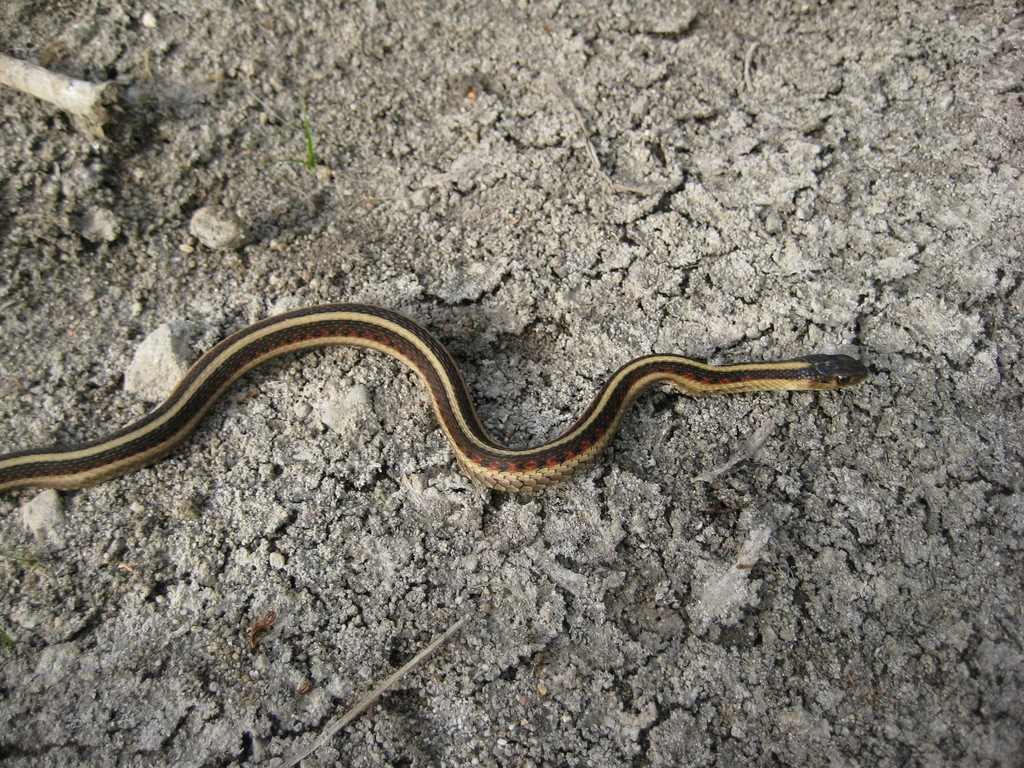
Common Garter Snake

Thamnophis sirtalis(LINNAEUS, 1758)

VenomousClinical severity not established

Wet grass, water margins, wooded patches and prairies form a broad habitat mosaic in Florida. Source scope: Florida Museum account; habitat use does not establish occurrence in every state.

FamilyColubridae
ReproductionLive-bearing
Country chaptersCanada · United States of America · Mexico · The Bahamas
Evidence updated2026-10-16
Explore its biology ↓

Venom & human effects

What is documented?

VenomousClinical severity not established

A 2025 study describes venom-related gland gene expression in sampled individuals of this species. This is molecular evidence; it does not establish the effects of a bite on humans.

Study samples from California, USA, Florida, USA, Michigan, USA. Gene expression does not by itself measure venom potency or clinical severity.

Evidence & scope · checked 2026-10-30

Heptinstall et al. (2025), Materials and methods: DVG transcriptomics; Results, Fig.2; Discussion: DVG transcriptomics; Conclusion; Supplementary Material1 sample metadata. Sample IDs: Tsirt-CLP2692, Tsirt-CLP2693, Tsirt-CLP2694, Tsirt-CLP2876, Tsirt-CLP2878, Tsirt-CLP2952, Tsirt-CLP2953, Tsirt-DRR0017.

How to read these badges
Limited documented effects
The cited human cases reported limited effects. Sparse observations cannot exclude a severe reaction.
Medically significant effects
The cited human cases document clinically important injury or illness. This is not an upper limit on severity.
Potentially life-threatening
Species-specific clinical evidence documents life-threatening illness or deaths after bites. The account explains the affected patients and any uncertainty about the cause.
Clinical severity not established
Venom presence is documented, but the reviewed evidence does not establish a clinical tier. When human effects are reported under an unresolved historical species name, the badge and account say so explicitly.
Venom status uncertain
The reviewed sources are inconclusive or conflicting about venom presence. The account explains the uncertainty.
Venom status not assessed
The atlas lacks a reviewed venom-presence classification for this species.

These are editorial summaries of the linked evidence, not toxicity rankings or WHO antivenom-priority categories. Effects vary with the bite and patient. Non-venomous does not mean safe to handle.

The scientific identity

Taxonomy & recognition

From observations & literature

Natural history

Size & measurements

The museum gives an approximate adult total-length range of 46–66 cm.

Regional guide value for adults, not a maximum size or the full species-wide size range. Total length includes the tail.

Study & evidence

Florida Museum of Natural History, Thamnophis sirtalis, Basic description, first sentence.

Study source 1 ↗

Diet & feeding

Common prey includes amphibians, freshwater fish and earthworms; other small animals are also eaten.

Regional museum synthesis centered on Florida. Reported brood ranges and seasons apply to that account, not to every population; explicitly identified records from elsewhere retain their stated origin.

Study & evidence

Florida Museum of Natural History, Thamnophis sirtalis, Diet and feeding behavior section.

Study source 1 ↗

Published feeding records in the cited compilation include bird eggs, birds, crayfish, earthworms, fish, frogs, leeches, lizards, mammals, salamander larvae, salamanders, slugs, snails, snakes, and tadpoles.

Compiled field records from different populations; this list does not establish prey preference or feeding frequency.

Study & evidence

Heptinstall et al. (2024), Dietary Record Collection and public GloBI dataset, exact species rows. Representative original references by prey group: bird eggs: Olson and Warner 2001 (CSV line 437); birds: Sajdak and Sajdak 1999 (CSV line 429); crayfish: Hamilton 1951 (CSV line 564); earthworms: Olson and Warner 2001 (CSV line 444); fish: Rombough 2020 (CSV line 488); frogs: Meshaka 1997 (CSV line 428); leeches: Olson and Warner 2001 (CSV line 445); lizards: Mendyk 2007 (CSV line 463); mammals: Olson and Warner 2001 (CSV line 441); salamander larvae: Lefcort et al 1991 (CSV line 422); salamanders: Norman 1988 (CSV line 421); slugs: Hamilton 1951 (CSV line 547); snails: Surface 1906 (CSV line 503); snakes: Uhler 1939 (CSV line 513); tadpoles: Leonard and Leonard 1996 (CSV line 423).

Study source 1 ↗

Study source 2 ↗

Activity & behaviour

Usually active during daylight.

Florida museum account; activity and behaviour may vary by season, locality and individual.

Study & evidence

Florida Museum of Natural History, Thamnophis sirtalis, Diet and feeding behavior section.

Study source 1 ↗

Reproduction

The Florida account reports live birth to 3–80 young during July–October.

Regional museum synthesis centered on Florida. Reported brood ranges and seasons apply to that account, not to every population; explicitly identified records from elsewhere retain their stated origin.

Study & evidence

Florida Museum of Natural History, Thamnophis sirtalis, Reproduction section.

Study source 1 ↗

Habitat & ecology

Habitat & microhabitat · United States of America

Wet grass, water margins, wooded patches and prairies form a broad habitat mosaic in Florida. Source scope: Florida Museum account; habitat use does not establish occurrence in every state.

[2]

Habitat & microhabitat · United States of America, Canada, Mexico

Moist grassy ground, marshes, woodland and water margins provide a broad range of habitats. Logs, stones, vegetation and other ground cover supply shelter. Source scope: Animal Diversity Web species account; habitat use is not a state or province occurrence record.

[3]

Uses wet grasslands, marshes and wooded wetlands, frequently near water and sometimes in suburban areas.

Regional museum synthesis centered on Florida. Reported brood ranges and seasons apply to that account, not to every population; explicitly identified records from elsewhere retain their stated origin.

Study & evidence

Florida Museum of Natural History, Thamnophis sirtalis, Habitat section.

Study source 1 ↗

Further observations & source notes (2)

Documented localities · Canada

The treatment names these subdivisions in its Canada distribution clause: Prince Edward Island, New Brunswick, Ontario, Manitoba, Saskatchewan, Alberta, Northwest Territories. They are assigned to the declared atlas navigation groups; this is not a field observation, a whole-region range polygon or a complete local inventory. The provincial Conservation Data Centre species account establishes British Columbia membership; no precise site or additional province is inferred.

[4][5]

Documented localities · United States of America

The treatment names these subdivisions in its United States of America distribution clause: Mississippi, North Carolina, Oklahoma, Virginia, West Virginia, Louisiana, Michigan, Massachusetts, Idaho, Florida, Nebraska, Washington, South Dakota, Texas, Alabama, Georgia, Pennsylvania, Missouri, Colorado, Utah, Tennessee, Wyoming, New York, Kansas, Nevada, Illinois, Vermont, Montana, Iowa, South Carolina, New Hampshire, New Jersey, Maryland, Maine, Delaware, Rhode Island, Kentucky, Ohio, Wisconsin, Oregon, North Dakota, Arkansas, Indiana, Minnesota, Connecticut. They are assigned to the declared atlas navigation groups; this is not a field observation, a whole-region range polygon or a complete local inventory.

[6]

A reported observation is not necessarily the full ecological range of a species. Where reproduction is inferred in a source dataset, the account identifies that limitation.

One species · Across borders

Global distribution

Explore the recorded countries and islands. Select a highlighted area to see its distribution evidence.

Recorded distribution
Thamnophis sirtalis — select a recorded country or island

Loading geographic boundaries…

ListedIntroducedUncertain

Click a highlighted country to zoom in and explore its records.

Shading identifies recorded countries or named islands, not continuous habitat coverage. Uncoloured areas do not establish absence.

Natural Earth · 1:50m · public domain; Gibraltar: geoBoundaries. Small islands may lack an outline.

Explore the distribution

Across borders

4 recorded countries & territories

Select a highlighted area to see its status, island records and sources. Each country and island links to the same shared species collection.

Use “Worldwide records” to include distant introduced and uncertain records in the map view.

Canada · regional locality evidence

The checked taxonomic distribution account explicitly lists Canada. Country-level evidence does not establish continuous occupancy or a complete national inventory. The treatment names these subdivisions in its Canada distribution clause: Prince Edward Island, New Brunswick, Ontario, Manitoba, Saskatchewan, Alberta, Northwest Territories. They are assigned to the declared atlas navigation groups; this is not a field observation, a whole-region range polygon or a complete local inventory. The provincial Conservation Data Centre species account establishes British Columbia membership; no precise site or additional province is inferred.

Prince Edward Island → · Prince Edward Island

New Brunswick → · New Brunswick

Ontario → · Ontario

Manitoba → · Manitoba

Saskatchewan → · Saskatchewan

Alberta → · Alberta

Northwest Territories → · Northwest Territories

British Columbia → · British Columbia

Locality source 1 ↗ Locality source 2 ↗
United States of America · regional locality evidence

The checked taxonomic distribution account explicitly lists United States of America. Country-level evidence does not establish continuous occupancy or a complete national inventory. The treatment names these subdivisions in its United States of America distribution clause: Mississippi, North Carolina, Oklahoma, Virginia, West Virginia, Louisiana, Michigan, Massachusetts, Idaho, Florida, Nebraska, Washington, South Dakota, Texas, Alabama, Georgia, Pennsylvania, Missouri, Colorado, Utah, Tennessee, Wyoming, New York, Kansas, Nevada, Illinois, Vermont, Montana, Iowa, South Carolina, New Hampshire, New Jersey, Maryland, Maine, Delaware, Rhode Island, Kentucky, Ohio, Wisconsin, Oregon, North Dakota, Arkansas, Indiana, Minnesota, Connecticut. They are assigned to the declared atlas navigation groups; this is not a field observation, a whole-region range polygon or a complete local inventory.

Mississippi → · Mississippi

North Carolina → · North Carolina

Oklahoma → · Oklahoma

Virginia → · Virginia

West Virginia → · West Virginia

Louisiana → · Louisiana

Michigan → · Michigan

Massachusetts → · Massachusetts

Idaho → · Idaho

Florida → · Florida

Nebraska → · Nebraska

Washington → · Washington

South Dakota → · South Dakota

Texas → · Texas

Alabama → · Alabama

Georgia → · Georgia

Pennsylvania → · Pennsylvania

Missouri → · Missouri

Colorado → · Colorado

Utah → · Utah

Tennessee → · Tennessee

Wyoming → · Wyoming

New York → · New York

Kansas → · Kansas

Nevada → · Nevada

Illinois → · Illinois

Vermont → · Vermont

Montana → · Montana

Iowa → · Iowa

South Carolina → · South Carolina

New Hampshire → · New Hampshire

New Jersey → · New Jersey

Maryland → · Maryland

Maine → · Maine

Delaware → · Delaware

Rhode Island → · Rhode Island

Kentucky → · Kentucky

Ohio → · Ohio

Wisconsin → · Wisconsin

Oregon → · Oregon

North Dakota → · North Dakota

Arkansas → · Arkansas

Indiana → · Indiana

Minnesota → · Minnesota

Connecticut → · Connecticut

Locality source 1 ↗
Mexico · regional locality evidence

The checked taxonomic distribution account explicitly lists Mexico. Country-level evidence does not establish continuous occupancy or a complete national inventory.

Locality source 1 ↗
The Bahamas · regional locality evidence

The checked taxonomic distribution account explicitly lists The Bahamas. Country-level evidence does not establish continuous occupancy or a complete national inventory.

Locality source 1 ↗

Geographic scope of the source

Country entries supported by this Americas review: Canada, United States of America, Mexico, The Bahamas. These are reviewed atlas entries, not a complete global distribution. [1]

The text retains the source’s geographic qualifications. The map shows countries with atlas occurrence records; it is not a complete global range model. A type locality is a nomenclatural reference, not the only place the species occurs.

Status & its meaning

Conservation

No matching global assessment was verified for this account. This is an unresolved assessment link, not an IUCN “Not Evaluated” classification and not evidence that the species is secure.

Locality coverage in the atlas does not measure abundance, population trends or national legal protection.

Follow the evidence

Sources & further reading

The linked taxonomic treatment provides its original descriptions, revisions and bibliography. Observations from other countries are not relabelled as local field studies.