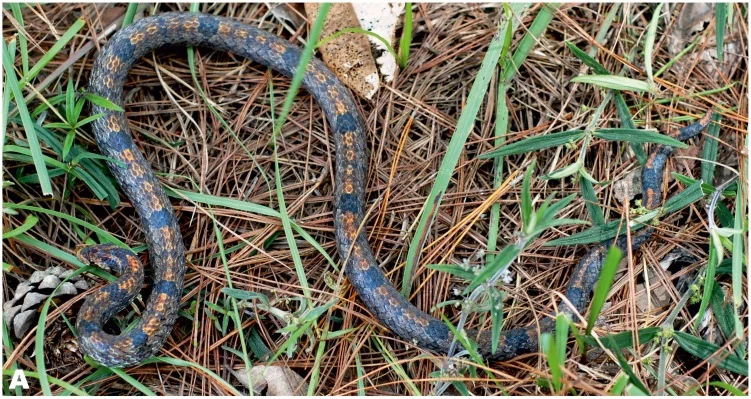
Oligodon rostralis, living male holotype SIEZC 20201 photographed in situ, Bidoup–Nui Ba National Park, Lam Dong Province, Vietnam. Figure 6A in Nguyen et al. (2020), A new species of Oligodon Fitzinger, 1826 from the Langbian Plateau, southern Vietnam, with additional information on Oligodon annamensis Leviton, 1953 (Squamata: Colubridae), PeerJ 8:e8332. Linh Hoang Nguyen · CC BY 4.0. Original description Figure 6 identifies the living holotype SIEZC 20201, male; panel A is the dorsal in-situ view. Type locality is Bidoup–Nui Ba National Park in Lam Dong. Figure explicitly credits Linh Hoang Nguyen. One photographic panel cropped from the published figure; resized only downward and converted to WebP. No retouching or synthesis.
Venom & human effects
What is documented?
Non-venomous
Classified as non-venomous in the cited description of genus Oligodon; this species’ current membership is verified separately.
Explicit genus-level classification applied to a verified accepted member. The source does not provide a species-specific venom assay or human clinical study.
Evidence & scope · checked 2026-10-30
Neang & Hun (2013), First record of Oligodon annamensis Leviton, 1953 (Squamata: Colubridae) from the Cardamom Mountains of southwest Cambodia, Herpetology Notes 6:271–273. Opening paragraph, p.271, explicitly describes the kukri-snake genus as non-venomous. Current membership: Reptile Database genus search, exact accepted listing Oligodon rostralis, checked 2026-10-30.
The cited human cases reported limited effects. Sparse observations cannot exclude a severe reaction.
Medically significant effects
The cited human cases document clinically important injury or illness. This is not an upper limit on severity.
Potentially life-threatening
Species-specific clinical evidence documents life-threatening illness or deaths after bites. The account explains the affected patients and any uncertainty about the cause.
Clinical severity not established
Venom presence is documented, but the reviewed evidence does not establish a clinical tier. When human effects are reported under an unresolved historical species name, the badge and account say so explicitly.
Venom status uncertain
The reviewed sources are inconclusive or conflicting about venom presence. The account explains the uncertainty.
Venom status not assessed
The atlas lacks a reviewed venom-presence classification for this species.
These are editorial summaries of the linked evidence, not toxicity rankings or WHO antivenom-priority categories. Effects vary with the bite and patient. Non-venomous does not mean safe to handle.
Bidoup–Nui Ba National Park, ca. 6 km northwards from Da Nhim village, Da Chais Commune, Lac Duong District, Lam Dong Province, southern Vietnam (12.1518°N, 108.5279°E; elevation 1,622 m a.s.l.),
Reliable identification uses the published combination of scale characters, proportions and other diagnostic evidence. Colour or a photograph alone may not separate closely related species.
Size and ecological traits credited to SquamBase summarize published studies across the species’ range in its 2024 edition. They are complemented by the locality-specific observations below.
Size & measurements
Recorded size
The largest measurements compiled in SquamBase 1.0 are 58.2 cm total length (including the tail) and 46.8 cm snout-to-vent length (excluding the tail). These are separate literature maxima, not typical adult sizes or necessarily measurements of the same animal.
No sourced diet & feeding summary has yet been added to this account.
Activity & behaviour
The type specimen was encountered at 23:00 on the ground in leaf litter on a steep slope near a mountain summit. The source records a late-night encounter, but does not explicitly describe movement or establish a species-wide activity schedule.
Exact-species observations from the original description. Encounter times are distinguished from directly observed movement; small samples do not establish universal daily or seasonal activity, habitat preferences or presence outside documented localities.
Study & evidence
Oligodon rostralis treatment; Habitat and natural history paragraph.
The original specimen was in leaf litter at the junction of pine woodland and evergreen montane broadleaf forest. This is the observed collection environment, not a full habitat range.
A reported observation is not necessarily the full ecological range of a species. Where reproduction is inferred in a source dataset, the account identifies that limitation.
One species · Across borders
Global distribution
Explore the recorded countries and islands. Select a highlighted area to see its distribution evidence.
Recorded distributionN ↑
Loading geographic boundaries…
ListedIntroducedUncertain
Click a highlighted country to zoom in and explore its records.
Shading identifies recorded countries or named islands, not continuous habitat coverage. Uncoloured areas do not establish absence.
The text retains the source’s geographic qualifications. The map shows countries with atlas occurrence records; it is not a complete global range model. A type locality is a nomenclatural reference, not the only place the species occurs.
Status & its meaning
Conservation
No matching global assessment was verified for this account. This is an unresolved assessment link, not an IUCN “Not Evaluated” classification and not evidence that the species is secure.
Locality coverage in the atlas does not measure abundance, population trends or national legal protection.
Follow the evidence
Sources & further reading
Latest evidence added 2026-10-29. Taxonomic and distribution treatments may change.
The linked taxonomic treatment provides its original descriptions, revisions and bibliography. Observations from other countries are not relabelled as local field studies.