
Size & measurements
Recorded size
SquamBase 1.0 records a literature maximum of 115 cm total length, including the tail. This is a compiled maximum, not a typical adult size or a measurement specific to this country.
[2]Colubridae · Species account
Oligodon fasciolatus(GÜNTHER, 1864)
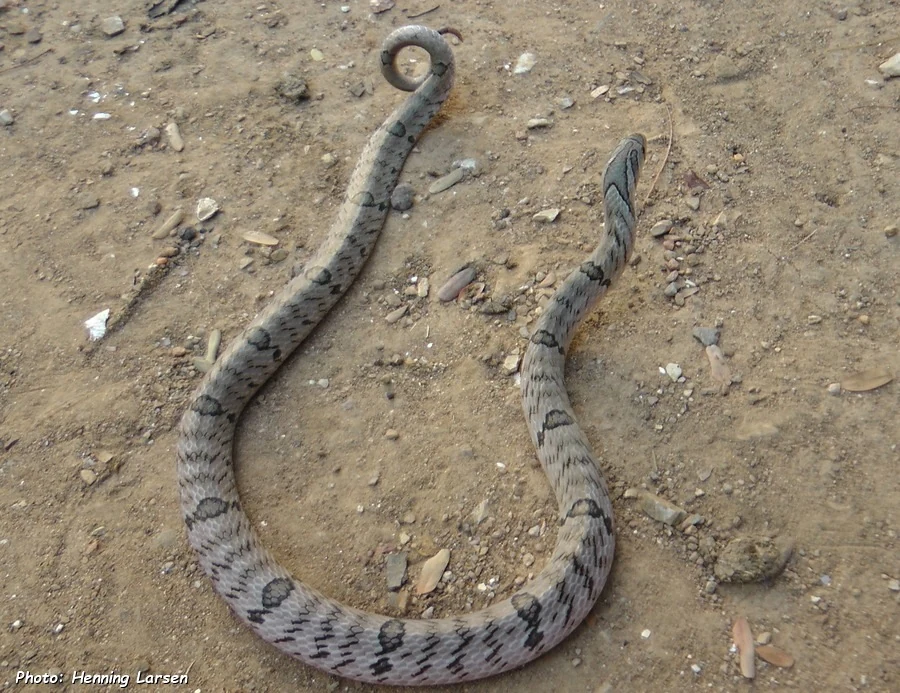
Non-venomousThai woodland habitat recorded by ONEP (2005), p. 142.
Venom & human effects
Classified as non-venomous in the cited description of genus Oligodon; this species’ current membership is verified separately.
Explicit genus-level classification applied to a verified accepted member. The source does not provide a species-specific venom assay or human clinical study.
Neang & Hun (2013), First record of Oligodon annamensis Leviton, 1953 (Squamata: Colubridae) from the Cardamom Mountains of southwest Cambodia, Herpetology Notes 6:271–273. Opening paragraph, p.271, explicitly describes the kukri-snake genus as non-venomous. Current membership: Reptile Database genus search, exact accepted listing Oligodon fasciolatus, checked 2026-10-30.
These are editorial summaries of the linked evidence, not toxicity rankings or WHO antivenom-priority categories. Effects vary with the bite and patient. Non-venomous does not mean safe to handle.
The scientific identity
Reliable identification uses the published combination of scale characters, proportions and other diagnostic evidence. Colour or a photograph alone may not separate closely related species.
Taxonomic treatment & original-description references ↗
Simotes fasciolatus · Oligodon cyclurus
Names trace the literature, including older combinations and historical usages. Their appearance here does not mean they are all currently accepted synonyms.
From observations & literature
Size and ecological traits credited to SquamBase summarize published studies across the species’ range in its 2024 edition. They are complemented by the locality-specific observations below.
SquamBase 1.0 records a literature maximum of 115 cm total length, including the tail. This is a compiled maximum, not a typical adult size or a measurement specific to this country.
[2]Prey reported in the studies compiled by SquamBase include frogs and eggs. The list describes documented food rather than an exclusive diet.
[2]The snake caught an adult banded bullfrog, Kaloula pulchra, and ultimately swallowed it whole. Whole-prey swallowing was documented here, rather than consumption restricted to internal organs.
One photographed and video-recorded encounter outside Ban Phue, Udon Thani, Thailand, on 15 September 2020. The observers did not handle either animal.
Bringsøe et al. (2021), Herpetozoa 34:49–55; Methods and Results, Observation #1, pp.50–51; Figs 1–2.
Activity is predominantly after dark. This is the range-wide classification in the 2024 compilation; it does not exclude occasional activity at other times.
[2]The 2024 compilation classifies activity as mainly after dark. This range-wide summary does not exclude activity at other times.
[2]Ground-dwelling activity is reported in the studies compiled by SquamBase. This describes the species across its studied range, not a record from every island.
[2]Feeding was watched from approximately 06:10 to 06:45. While gripping the frog’s belly, the snake repeatedly rotated around its own long axis; eleven rotations were recorded in two video sequences.
One photographed and video-recorded encounter outside Ban Phue, Udon Thani, Thailand, on 15 September 2020. The observers did not handle either animal.
Bringsøe et al. (2021), Herpetozoa 34:49–55; Methods and Results, Observation #1, pp.50–51; Figs 1–2.
The compilation records 9–26 eggs per clutch. These published records need not represent the full variation between populations, and are not a separate estimate for Laos or Vietnam.
[2]The encounter occurred beside a building wall at a rural factory site, about 20 m from a pond, within a landscape of rice fields, rubber and cassava plantations, and abandoned land.
One photographed and video-recorded encounter outside Ban Phue, Udon Thani, Thailand, on 15 September 2020. The observers did not handle either animal.
Bringsøe et al. (2021), Herpetozoa 34:49–55; Methods and Results, Observation #1, pp.50–51; Figs 1–2.
Myanmar is explicitly listed in the checked individual taxonomic treatment.
[3]China is explicitly recorded in the checked individual species treatment. The accepted identity is also represented in the 2025 checklist; regional inclusion here is based on explicit locality evidence, not the checklist’s broader geographical scope. Named regional records: Yunnan. These localities do not imply continuous occupation of the entire region.
[4][5]The 2024 provincial checklist explicitly lists this species in Thanh Hoa. The 2020 provincial checklist explicitly lists this species in Son La. This establishes a provincial record; it does not imply occurrence in every protected area or across the whole editorial region.
[7][8]Grismer et al. (2008), Cambodian Journal of Natural History 1:12–28, document LSUHC 8482 from the named 2007 survey locality. The atlas grouping follows the published province, not the broader Cardamom ecoregion. FMNH 267730; Stuart & Emmett (2006), 21.
[9][10]A reported observation is not necessarily the full ecological range of a species. Where reproduction is inferred in a source dataset, the account identifies that limitation.
One species · Across borders
Explore the recorded countries and islands. Select a highlighted area to see its distribution evidence.
Loading geographic boundaries…
Click a highlighted country to zoom in and explore its records.
Shading identifies recorded countries or named islands, not continuous habitat coverage. Uncoloured areas do not establish absence.
Natural Earth · 1:50m · public domain; Gibraltar: geoBoundaries. Small islands may lack an outline.
Explore the distribution
Select a highlighted area to see its status, island records and sources. Each country and island links to the same shared species collection.
Use “Worldwide records” to include distant introduced and uncertain records in the map view.
Laos: national occurrence; no finer locality is assigned in this atlas.
Locality source 1 ↗Vietnam: national occurrence; no finer locality is assigned in this atlas. The 2024 provincial checklist explicitly lists this species in Thanh Hoa. The 2020 provincial checklist explicitly lists this species in Son La. This establishes a provincial record; it does not imply occurrence in every protected area or across the whole editorial region.
North Central Coast & Annamites → · Thanh Hoa
Northwest mountains → · Son La
Locality source 1 ↗ Locality source 2 ↗ Locality source 3 ↗Thailand: Bangkok.
Central plains → · Bangkok
Locality source 1 ↗Myanmar is explicitly listed in the checked individual taxonomic treatment.
Locality source 1 ↗Cambodia is explicitly included in the checked species distribution treatment. Country membership reviewed on 11 October 2026; no finer locality is assigned by this record. Grismer et al. (2008), Cambodian Journal of Natural History 1:12–28, document LSUHC 8482 from the named 2007 survey locality. The atlas grouping follows the published province, not the broader Cardamom ecoregion. FMNH 267730; Stuart & Emmett (2006), 21.
Tonle Sap basin → · O’Lakmeas, Veal Veng, Pursat
Cardamoms & Gulf coast → · Areng Valley, Koh Kong
Locality source 1 ↗ Locality source 2 ↗ Locality source 3 ↗China is explicitly recorded in the checked individual species treatment. The accepted identity is also represented in the 2025 checklist; regional inclusion here is based on explicit locality evidence, not the checklist’s broader geographical scope. Named regional records: Yunnan. These localities do not imply continuous occupation of the entire region.
Southwestern mountains & basins → · Yunnan
Locality source 1 ↗ Locality source 2 ↗SE Myanmar, Thailand, Cambodia, Laos, Vietnam, China (Yunnan) [1]
The text retains the source’s geographic qualifications. The map shows countries with atlas occurrence records; it is not a complete global range model. A type locality is a nomenclatural reference, not the only place the species occurs.
Status & its meaning
Least Concern
Global IUCN category indexed by iNaturalist for this scientific name. It is not a separate assessment of a national population, and its assessment date may predate later taxonomic changes.
Read the IUCN assessment ↗ · Taxon index & assessment link ↗
Locality coverage in the atlas does not measure abundance, population trends or national legal protection.
Follow the evidence
Latest evidence added 2026-10-11. Taxonomic and distribution treatments may change.
The linked taxonomic treatment provides its original descriptions, revisions and bibliography. Observations from other countries are not relabelled as local field studies.