Size & measurements
No sourced size & measurements summary has yet been added to this account.
Colubridae · Species account
Hypsiglena chlorophaeaCOPE, 1860
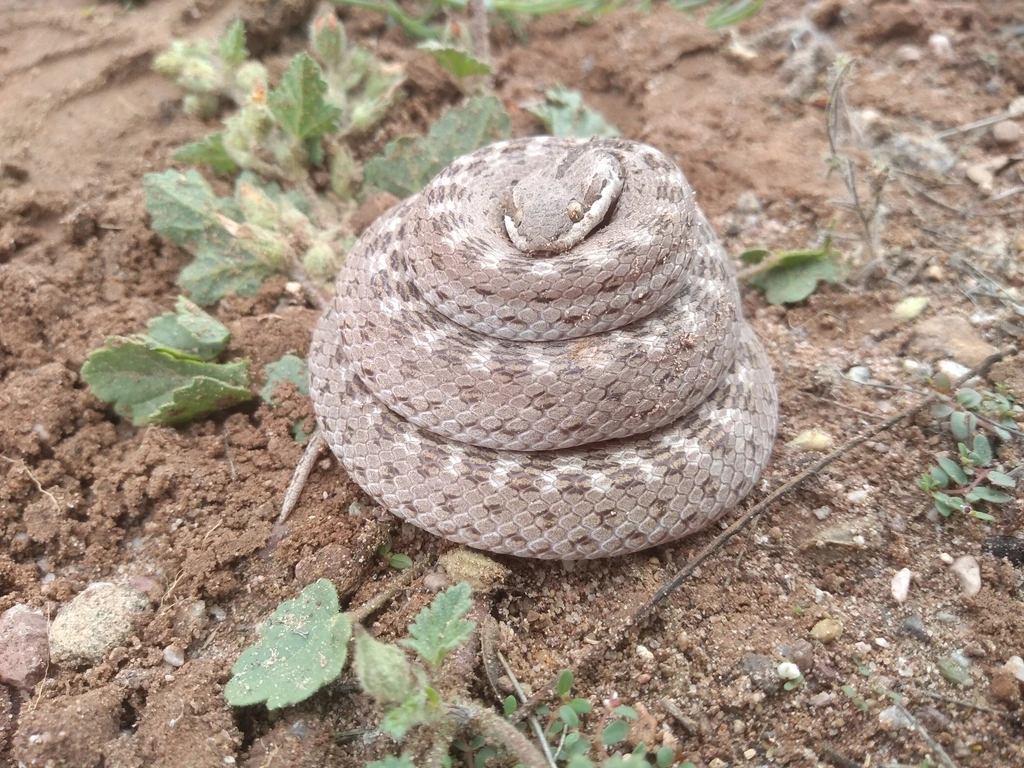
Venom unknownNot yet assessedThe Canadian account emphasizes talus and rock outcrops in the southern Okanagan and lower Similkameen, with some shrub-steppe and open pine or Douglas-fir woodland. Winter refuges and connected seasonal habitat are required.
Venom & human effects
Venom status has not yet been established from the reviewed evidence for this account.
Missing evidence is not a non-venomous classification or a statement of low risk.
These are editorial summaries of the linked evidence, not toxicity rankings or WHO antivenom-priority categories. Effects vary with the bite and patient. Non-venomous does not mean safe to handle.
The scientific identity
Reliable identification uses the published combination of scale characters, proportions and other diagnostic evidence. Colour or a photograph alone may not separate closely related species.
From observations & literature
No sourced size & measurements summary has yet been added to this account.
No sourced diet & feeding summary has yet been added to this account.
No sourced activity & behaviour summary has yet been added to this account.
Egg-laying.
The Canadian account emphasizes talus and rock outcrops in the southern Okanagan and lower Similkameen, with some shrub-steppe and open pine or Douglas-fir woodland. Winter refuges and connected seasonal habitat are required.
[2]Colorado describes rocky slopes and canyons with open pinyon-juniper woodland, shrubs and grasses, plus occasional plains grassland. Its joint account explicitly applies to both named nightsnake species. No new state or locality occurrence is inferred.
[3]The treatment names these subdivisions in its United States of America distribution clause: Idaho, Washington, California, Colorado, Utah, Nevada, Arizona. They are assigned to the declared atlas navigation groups; this is not a field observation, a whole-region range polygon or a complete local inventory.
[6]The treatment names these subdivisions in its Mexico distribution clause: Chihuahua, Sonora. They are assigned to the declared atlas navigation groups; this is not a field observation, a whole-region range polygon or a complete local inventory.
[7]The recovery strategy explicitly documents Desert Nightsnake in the Okanagan–Similkameen area of British Columbia.
[8]A reported observation is not necessarily the full ecological range of a species. Where reproduction is inferred in a source dataset, the account identifies that limitation.
One species · Across borders
Explore the recorded countries and islands. Select a highlighted area to see its distribution evidence.
Loading geographic boundaries…
Click a highlighted country to zoom in and explore its records.
Shading identifies recorded countries or named islands, not continuous habitat coverage. Uncoloured areas do not establish absence.
Natural Earth · 1:50m · public domain; Gibraltar: geoBoundaries. Small islands may lack an outline.
Explore the distribution
Select a highlighted area to see its status, island records and sources. Each country and island links to the same shared species collection.
Use “Worldwide records” to include distant introduced and uncertain records in the map view.
The checked taxonomic distribution account explicitly lists Canada. Country-level evidence does not establish continuous occupancy or a complete national inventory. Canadian support comes from the treatment’s accepted deserticola subspecies entry, which names southern British Columbia. The recovery strategy explicitly documents Desert Nightsnake in the Okanagan–Similkameen area of British Columbia.
British Columbia → · British Columbia
Locality source 1 ↗ Locality source 2 ↗The checked taxonomic distribution account explicitly lists United States of America. Country-level evidence does not establish continuous occupancy or a complete national inventory. The treatment names these subdivisions in its United States of America distribution clause: Idaho, Washington, California, Colorado, Utah, Nevada, Arizona. They are assigned to the declared atlas navigation groups; this is not a field observation, a whole-region range polygon or a complete local inventory.
Idaho → · Idaho
Washington → · Washington
California → · California
Colorado → · Colorado
Utah → · Utah
Nevada → · Nevada
Arizona → · Arizona
Locality source 1 ↗The checked taxonomic distribution account explicitly lists Mexico. Country-level evidence does not establish continuous occupancy or a complete national inventory. The treatment names these subdivisions in its Mexico distribution clause: Chihuahua, Sonora. They are assigned to the declared atlas navigation groups; this is not a field observation, a whole-region range polygon or a complete local inventory.
Chihuahua → · Chihuahua
Sonora → · Sonora
Locality source 1 ↗Country entries supported by this Americas review: Canada, United States of America, Mexico. These are reviewed atlas entries, not a complete global distribution. [1]
The text retains the source’s geographic qualifications. The map shows countries with atlas occurrence records; it is not a complete global range model. A type locality is a nomenclatural reference, not the only place the species occurs.
Status & its meaning
No matching global assessment was verified for this account. This is an unresolved assessment link, not an IUCN “Not Evaluated” classification and not evidence that the species is secure.
Locality coverage in the atlas does not measure abundance, population trends or national legal protection.
Follow the evidence
Latest evidence added 2026-10-19. Taxonomic and distribution treatments may change.
The linked taxonomic treatment provides its original descriptions, revisions and bibliography. Observations from other countries are not relabelled as local field studies.