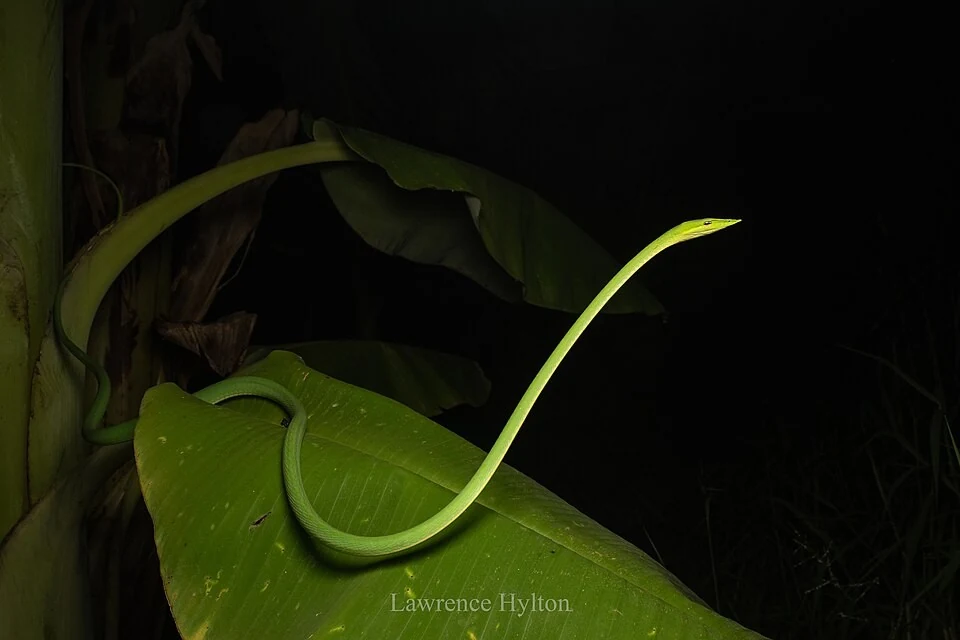
Classified as tree-dwelling in the ecological treatment cited by the taxonomic account. That classification is inferred rather than based on a species-specific observation.
FamilyColubridae
ReproductionLive-bearing
Country chaptersVietnam · Thailand · Myanmar · Cambodia
Ahaetulla fusca — real specimen photograph; identification follows the linked source. Lawrence Hylton · CC BY 4.0. Commons file metadata identifies Ahaetulla fusca. Caption/category attribution retained; not an independent specimen diagnosis. Resized and converted to WebP.
Venom & human effects
What is documented?
VenomousClinical severity not established
Classified as venomous in the cited description of genus Ahaetulla; this species’ accepted membership is verified separately.
Explicit genus-level venom-presence evidence applied to Ahaetulla fusca. This is not a species-specific venom assay or human clinical study. The source’s description of the genus as mildly venomous does not establish a human-harm tier.
Evidence & scope · checked 2026-10-30
Mirza et al. (2024), A new long-snouted vine snake species in the genus Ahaetulla Link, 1807 (Colubridae: Chrysopeleinae) from India, Introduction, printed p. 696: explicit genus description as venomous and rear-fanged. Membership: exact accepted taxonomic account Ahaetulla fusca, checked 2026-10-30.
The cited human cases reported limited effects. Sparse observations cannot exclude a severe reaction.
Medically significant effects
The cited human cases document clinically important injury or illness. This is not an upper limit on severity.
Potentially life-threatening
Species-specific clinical evidence documents life-threatening illness or deaths after bites. The account explains the affected patients and any uncertainty about the cause.
Clinical severity not established
Venom presence is documented, but the reviewed evidence does not establish a clinical tier. When human effects are reported under an unresolved historical species name, the badge and account say so explicitly.
Venom status uncertain
The reviewed sources are inconclusive or conflicting about venom presence. The account explains the uncertainty.
Venom status not assessed
The atlas lacks a reviewed venom-presence classification for this species.
These are editorial summaries of the linked evidence, not toxicity rankings or WHO antivenom-priority categories. Effects vary with the bite and patient. Non-venomous does not mean safe to handle.
Reliable identification uses the published combination of scale characters, proportions and other diagnostic evidence. Colour or a photograph alone may not separate closely related species.
Names trace the literature, including older combinations and historical usages. Their appearance here does not mean they are all currently accepted synonyms.
From observations & literature
Natural history
Size and ecological traits credited to SquamBase summarize published studies across the species’ range in its 2024 edition. They are complemented by the locality-specific observations below.
Size & measurements
Recorded size
The largest measurements compiled in SquamBase 1.0 are 144.9 cm total length (including the tail) and 131 cm snout-to-vent length (excluding the tail). These are separate literature maxima, not typical adult sizes or necessarily measurements of the same animal.
SquamBase 1.0 records a literature maximum of 144.9 cm total length, including the tail. This is a compiled maximum, not a typical adult size or a measurement specific to this country.
No sourced diet & feeding summary has yet been added to this account.
Activity & behaviour
Use of the landscape
Classified as tree-dwelling in the ecological treatment cited by the taxonomic account. That classification is inferred rather than based on a species-specific observation.
Climbing and tree-dwelling activity is reported in the studies compiled by SquamBase. This describes the species across its studied range, not a record from every island.
The 2026 provincial checklist explicitly lists this species in Ha Tinh. This establishes a provincial record; it does not imply occurrence in every protected area or across the whole editorial region.
A reported observation is not necessarily the full ecological range of a species. Where reproduction is inferred in a source dataset, the account identifies that limitation.
One species · Across borders
Global distribution
Explore the recorded countries and islands. Select a highlighted area to see its distribution evidence.
Recorded distributionN ↑
Loading geographic boundaries…
ListedIntroducedUncertain
Click a highlighted country to zoom in and explore its records.
Shading identifies recorded countries or named islands, not continuous habitat coverage. Uncoloured areas do not establish absence.
Select a highlighted area to see its status, island records and sources. Each country and island links to the same shared species collection.
Use “Worldwide records” to include distant introduced and uncertain records in the map view.
Vietnam · regional locality evidence
Vietnam: national occurrence; no finer locality is assigned in this atlas.
The 2026 provincial checklist explicitly lists this species in Ha Tinh. This establishes a provincial record; it does not imply occurrence in every protected area or across the whole editorial region.
Myanmar is explicitly listed in the checked individual taxonomic treatment.
Historical type locality of the synonym Ahaetulla rhodogaster; synonymy checked in the current treatment.
Cambodia is explicitly included in the checked species distribution treatment. Country membership reviewed on 11 October 2026; no finer locality is assigned by this record.
The text retains the source’s geographic qualifications. The map shows countries with atlas occurrence records; it is not a complete global range model. A type locality is a nomenclatural reference, not the only place the species occurs.
Status & its meaning
Conservation
No matching global assessment was verified for this account. This is an unresolved assessment link, not an IUCN “Not Evaluated” classification and not evidence that the species is secure.
Locality coverage in the atlas does not measure abundance, population trends or national legal protection.
Follow the evidence
Sources & further reading
Latest evidence added 2026-10-12. Taxonomic and distribution treatments may change.
The linked taxonomic treatment provides its original descriptions, revisions and bibliography. Observations from other countries are not relabelled as local field studies.