The habitat paragraph in the checked taxonomic treatment explicitly describes forest or woodland, savanna or grassland, river, stream, swamp or freshwater settings. This is a species-level association at the source’s stated scale, not a locality assignment for every country.
FamilyPsammophiidae
ReproductionEgg-laying
Country chaptersAngola · Democratic Republic of the Congo · Malawi · Zambia
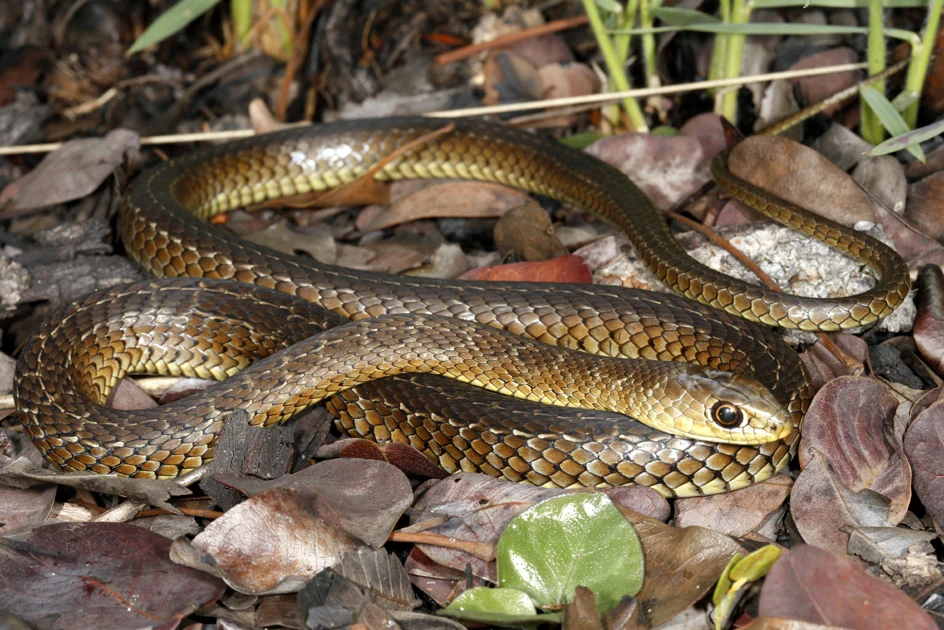
Psammophis zambiensis from Cuando River source, Angola. Fig. 31 in Conradie et al. (2021), Amphibian & Reptile Conservation 15(2):244–278. Werner Conradie · CC BY 4.0. The original field study identifies this specimen as Psammophis zambiensis in Fig. 31, p. 268, with an accompanying taxonomic account. The figure and individual photographer credit were checked against the rendered original page. Individual photograph extracted from the original PDF, excluding adjacent maps and text; full frame converted to WebP. No retouching or generated content.
Venom & human effects
What is documented?
VenomousClinical severity not established
Classified as venomous in the cited account of genus Psammophis; this species’ membership of that genus is verified separately.
Explicit genus-level classification applied to an exact listed member, not a species-specific venom assay or human clinical study of Psammophis zambiensis. The group statement does not transfer diet, body size, behaviour or medical severity. No human-harm tier is inferred.
Evidence & scope · checked 2026-10-29
Ineich, Girard and Weinstein (2020), Local envenoming by the Schokari sand racer and a brief review of reported bites by sand racers, Toxicon 185:72–75, Introduction opening paragraph describes Psammophis as a genus with low-pressure venom glands; following paragraph explicitly states the snakes use venom to subjugate prey. Clinical observations on particular species are not transferred to other genus members. Membership: exact-species taxonomic account Psammophis zambiensis.
The cited human cases reported limited effects. Sparse observations cannot exclude a severe reaction.
Medically significant effects
The cited human cases document clinically important injury or illness. This is not an upper limit on severity.
Potentially life-threatening
Species-specific clinical evidence documents life-threatening illness or deaths after bites. The account explains the affected patients and any uncertainty about the cause.
Clinical severity not established
Venom presence is documented, but the reviewed evidence does not establish a clinical tier. When human effects are reported under an unresolved historical species name, the badge and account say so explicitly.
Venom status uncertain
The reviewed sources are inconclusive or conflicting about venom presence. The account explains the uncertainty.
Venom status not assessed
The atlas lacks a reviewed venom-presence classification for this species.
These are editorial summaries of the linked evidence, not toxicity rankings or WHO antivenom-priority categories. Effects vary with the bite and patient. Non-venomous does not mean safe to handle.
The scientific identity
Taxonomy & recognition
Accepted name in this edition
Psammophis zambiensis
Authority
HUGHES & WADE, 2002
Family
Psammophiidae
Read the complete diagnosis
Reliable identification uses the published combination of scale characters, proportions and other diagnostic evidence. Colour or a photograph alone may not separate closely related species.
The largest measured female (PEM R23433) was 524 mm from snout to vent with a 78 mm tail; the largest measured male (PEM R23444) was 656 mm from snout to vent with a 237 mm tail.
Specimens measured in the Angolan Okavango–Cuando–Zambezi survey. These are the largest measured specimens of each sex in that sample, not species-wide maxima or typical adult sizes; maturity is not inferred. The source defines size as snout-to-vent length plus tail length.
Study & evidence
Conradie et al. (2021), Amphibian & Reptile Conservation 15(2):244–278, e292; Psammophis zambiensis account, Description, p.267; Materials and methods, size convention.
One examined snake contained a Ptychadena uzungwensis frog; another contained Trachylepis lizard remains.
Original observations from the Angolan Okavango–Cuando–Zambezi headwater study. These individual feeding records do not establish a complete diet or prey preference.
Study & evidence
Conradie et al. (2021), Amphibian & Reptile Conservation 15(2):244–278 (e292); Psammophis zambiensis, Habitat and natural history notes, pp. 267–268.
No sourced activity & behaviour summary has yet been added to this account.
Reproduction
Egg-laying.
Habitat & ecology
Habitat & microhabitat
The habitat paragraph in the checked taxonomic treatment explicitly describes forest or woodland, savanna or grassland, river, stream, swamp or freshwater settings. This is a species-level association at the source’s stated scale, not a locality assignment for every country.
Eastern plateaus: museum voucher MUHNAC IICT/R 303-1959 (1959). The museum record's reported coordinate uncertainty footprint lies within the mapped region.
Eastern plateaus: museum voucher MUHNAC IICT/R 30A-1958 (1958). The museum record's reported coordinate uncertainty footprint lies within the mapped region. These are dated locality records, not evidence of occurrence throughout every part of a region or a complete present-day inventory.
A reported observation is not necessarily the full ecological range of a species. Where reproduction is inferred in a source dataset, the account identifies that limitation.
One species · Across borders
Global distribution
Explore the recorded countries and islands. Select a highlighted area to see its distribution evidence.
Recorded distributionN ↑
Loading geographic boundaries…
ListedIntroducedUncertain
Click a highlighted country to zoom in and explore its records.
Shading identifies recorded countries or named islands, not continuous habitat coverage. Uncoloured areas do not establish absence.
Select a highlighted area to see its status, island records and sources. Each country and island links to the same shared species collection.
Use “Worldwide records” to include distant introduced and uncertain records in the map view.
Angola · regional locality evidence
The current taxonomic treatment explicitly lists this country. This is country-scale checklist evidence, not a claim of continuous occupancy or a complete regional inventory.
Eastern plateaus: museum voucher MUHNAC IICT/R 303-1959 (1959). The museum record's reported coordinate uncertainty footprint lies within the mapped region.
Eastern plateaus: museum voucher MUHNAC IICT/R 30A-1958 (1958). The museum record's reported coordinate uncertainty footprint lies within the mapped region. These are dated locality records, not evidence of occurrence throughout every part of a region or a complete present-day inventory.
The current taxonomic treatment explicitly lists this country. This is country-scale checklist evidence, not a claim of continuous occupancy or a complete regional inventory.
The current taxonomic treatment explicitly lists this country. This is country-scale checklist evidence, not a claim of continuous occupancy or a complete regional inventory.
The current taxonomic treatment explicitly lists this country. This is country-scale checklist evidence, not a claim of continuous occupancy or a complete regional inventory.
Country entries documented in this Africa review: Angola, Democratic Republic of the Congo, Malawi, Zambia. Consult individual occurrence records for qualifications. These entries are not a complete global range polygon. [1]
The text retains the source’s geographic qualifications. The map shows countries with atlas occurrence records; it is not a complete global range model. A type locality is a nomenclatural reference, not the only place the species occurs.
Status & its meaning
Conservation
No matching global assessment was verified for this account. This is an unresolved assessment link, not an IUCN “Not Evaluated” classification and not evidence that the species is secure.
Locality coverage in the atlas does not measure abundance, population trends or national legal protection.
Follow the evidence
Sources & further reading
Latest evidence added 2026-10-16. Taxonomic and distribution treatments may change.
The linked taxonomic treatment provides its original descriptions, revisions and bibliography. Observations from other countries are not relabelled as local field studies.