Size & measurements
No sourced size & measurements summary has yet been added to this account.
Viperidae · Species account
Crotalus atroxBAIRD & GIRARD, 1853
VenomousPotentially life-threateningRocky dry country with shrubs supplies shelter in crevices and small-mammal burrows. The account also lists grassland and chaparral. Source scope: Animal Diversity Web species account; habitat use is not a state or province occurrence record.
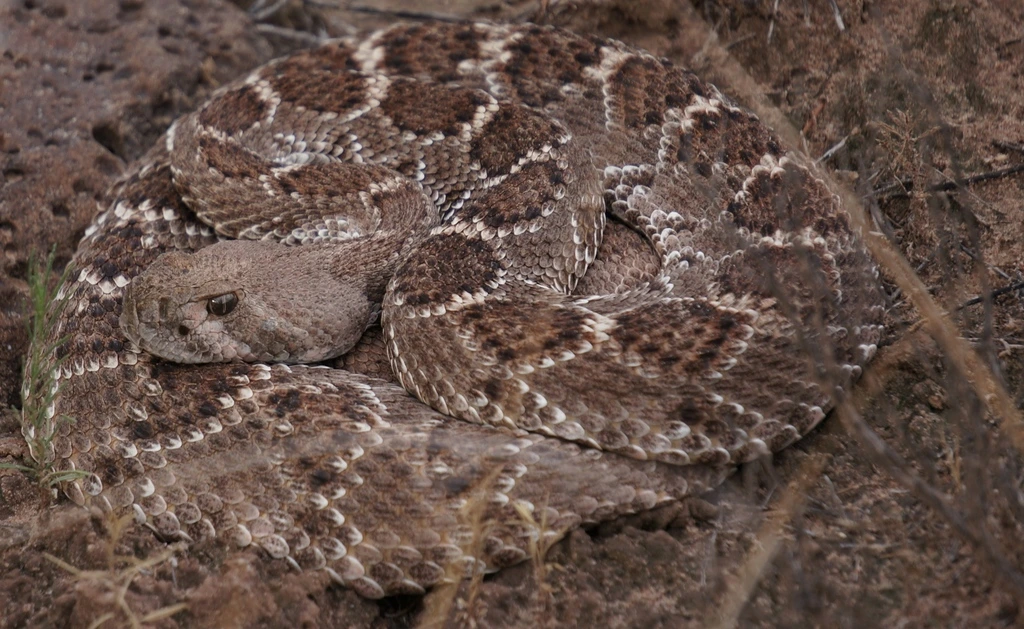
Venom & human effects
A facial bite from a captive western diamondback was followed by severe clotting abnormalities, lung bleeding and respiratory failure. The patient required intensive respiratory support and recovered.
One 36-year-old man reported in 2026. A facial bite is an unusual exposure; this report does not imply that these complications are typical. Captive species identity is reported by the authors; the abstract does not give a separate verification method.
Papatriantafyllou et al. (2026), Perfusion, online 10 August 2026, Abstract: Case presentation.
These are editorial summaries of the linked evidence, not toxicity rankings or WHO antivenom-priority categories. Effects vary with the bite and patient. Non-venomous does not mean safe to handle.
The scientific identity
Reliable identification uses the published combination of scale characters, proportions and other diagnostic evidence. Colour or a photograph alone may not separate closely related species.
From observations & literature
No sourced size & measurements summary has yet been added to this account.
No sourced diet & feeding summary has yet been added to this account.
Arboreal activity is explicitly described in the treatment. This does not establish forest occupancy at every locality or imply that the species spends all its time above ground.
[1]Live-bearing.
Rocky dry country with shrubs supplies shelter in crevices and small-mammal burrows. The account also lists grassland and chaparral. Source scope: Animal Diversity Web species account; habitat use is not a state or province occurrence record.
[2]The treatment names these subdivisions in its United States of America distribution clause: Oklahoma, New Mexico, Texas, California, Nevada, Arizona, Arkansas. They are assigned to the declared atlas navigation groups; this is not a field observation, a whole-region range polygon or a complete local inventory.
[3]The treatment names these subdivisions in its Mexico distribution clause: Aguascalientes, Baja California, Chihuahua, Coahuila, Durango, Guanajuato, Hidalgo, Jalisco, Mexico, Nuevo Leon, Oaxaca, Queretaro, San Luis Potosi, Sinaloa, Sonora, Tamaulipas, Veracruz, Zacatecas. They are assigned to the declared atlas navigation groups; this is not a field observation, a whole-region range polygon or a complete local inventory.
[4]A reported observation is not necessarily the full ecological range of a species. Where reproduction is inferred in a source dataset, the account identifies that limitation.
One species · Across borders
Explore the recorded countries and islands. Select a highlighted area to see its distribution evidence.
Loading geographic boundaries…
Click a highlighted country to zoom in and explore its records.
Shading identifies recorded countries or named islands, not continuous habitat coverage. Uncoloured areas do not establish absence.
Natural Earth · 1:50m · public domain; Gibraltar: geoBoundaries. Small islands may lack an outline.
Explore the distribution
Select a highlighted area to see its status, island records and sources. Each country and island links to the same shared species collection.
Use “Worldwide records” to include distant introduced and uncertain records in the map view.
The checked taxonomic distribution account explicitly lists United States of America. Country-level evidence does not establish continuous occupancy or a complete national inventory. The treatment names these subdivisions in its United States of America distribution clause: Oklahoma, New Mexico, Texas, California, Nevada, Arizona, Arkansas. They are assigned to the declared atlas navigation groups; this is not a field observation, a whole-region range polygon or a complete local inventory.
Oklahoma → · Oklahoma
New Mexico → · New Mexico
Texas → · Texas
California → · California
Nevada → · Nevada
Arizona → · Arizona
Arkansas → · Arkansas
Locality source 1 ↗The checked taxonomic distribution account explicitly lists Mexico. Country-level evidence does not establish continuous occupancy or a complete national inventory. The treatment names these subdivisions in its Mexico distribution clause: Aguascalientes, Baja California, Chihuahua, Coahuila, Durango, Guanajuato, Hidalgo, Jalisco, Mexico, Nuevo Leon, Oaxaca, Queretaro, San Luis Potosi, Sinaloa, Sonora, Tamaulipas, Veracruz, Zacatecas. They are assigned to the declared atlas navigation groups; this is not a field observation, a whole-region range polygon or a complete local inventory.
Aguascalientes → · Aguascalientes
Baja California → · Baja California
Chihuahua → · Chihuahua
Coahuila → · Coahuila
Durango → · Durango
Guanajuato → · Guanajuato
Hidalgo → · Hidalgo
Jalisco → · Jalisco
State of Mexico → · Mexico
Nuevo Leon → · Nuevo Leon
Oaxaca → · Oaxaca
Queretaro → · Queretaro
San Luis Potosi → · San Luis Potosi
Sinaloa → · Sinaloa
Sonora → · Sonora
Tamaulipas → · Tamaulipas
Veracruz → · Veracruz
Zacatecas → · Zacatecas
Locality source 1 ↗Country entries supported by this Americas review: United States of America, Mexico. These are reviewed atlas entries, not a complete global distribution. [1]
The text retains the source’s geographic qualifications. The map shows countries with atlas occurrence records; it is not a complete global range model. A type locality is a nomenclatural reference, not the only place the species occurs.
Status & its meaning
No matching global assessment was verified for this account. This is an unresolved assessment link, not an IUCN “Not Evaluated” classification and not evidence that the species is secure.
Locality coverage in the atlas does not measure abundance, population trends or national legal protection.
Follow the evidence
Latest evidence added 2026-10-16. Taxonomic and distribution treatments may change.
The linked taxonomic treatment provides its original descriptions, revisions and bibliography. Observations from other countries are not relabelled as local field studies.