Prey reported in the studies compiled by SquamBase include fishes and aquatic snails. The list describes documented food rather than an exclusive diet.
FamilyAcrochordidae
ReproductionLive-bearing
Country chaptersCambodia · Indonesia · Vietnam · Malaysia · Thailand · Brunei
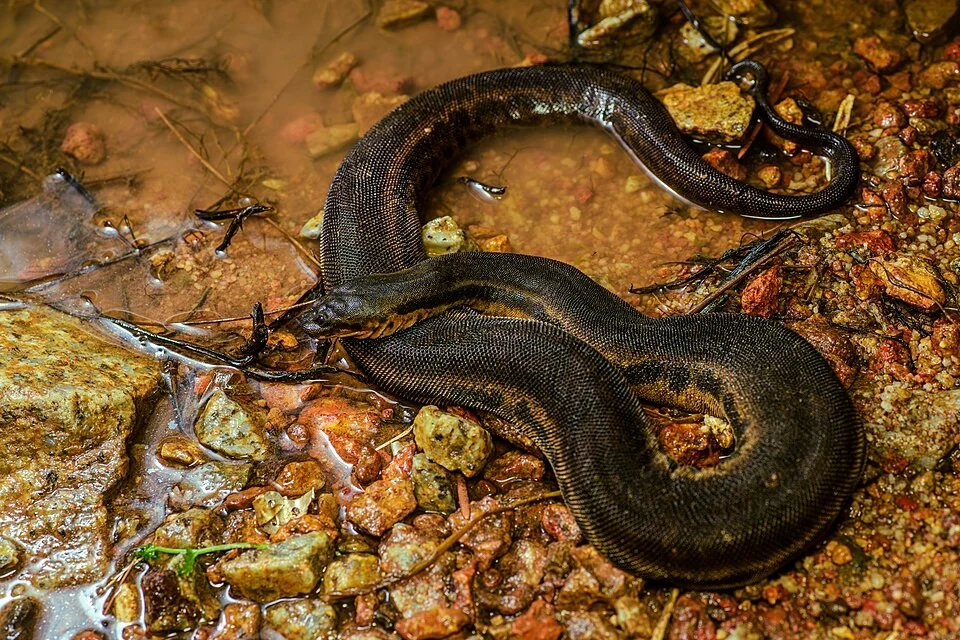
Acrochordus javanicus — real specimen photograph; identification follows the linked source. Rushenb · CC BY-SA 4.0. Commons file metadata identifies Acrochordus javanicus. Caption/category attribution retained; not an independent specimen diagnosis. Resized and converted to WebP.
Venom & human effects
What is documented?
Venom unknownNot yet assessed
Venom status has not yet been established from the reviewed evidence for this account.
Missing evidence is not a non-venomous classification or a statement of low risk.
How to read these badges
Limited documented effects
The cited human cases reported limited effects. Sparse observations cannot exclude a severe reaction.
Medically significant effects
The cited human cases document clinically important injury or illness. This is not an upper limit on severity.
Potentially life-threatening
Species-specific clinical evidence documents life-threatening illness or deaths after bites. The account explains the affected patients and any uncertainty about the cause.
Clinical severity not established
Venom presence is documented, but the reviewed evidence does not establish a clinical tier. When human effects are reported under an unresolved historical species name, the badge and account say so explicitly.
Venom status uncertain
The reviewed sources are inconclusive or conflicting about venom presence. The account explains the uncertainty.
Venom status not assessed
The atlas lacks a reviewed venom-presence classification for this species.
These are editorial summaries of the linked evidence, not toxicity rankings or WHO antivenom-priority categories. Effects vary with the bite and patient. Non-venomous does not mean safe to handle.
Reliable identification uses the published combination of scale characters, proportions and other diagnostic evidence. Colour or a photograph alone may not separate closely related species.
Names trace the literature, including older combinations and historical usages. Their appearance here does not mean they are all currently accepted synonyms.
From observations & literature
Natural history
Size and ecological traits credited to SquamBase summarize published studies across the species’ range in its 2024 edition. They are complemented by the locality-specific observations below.
Size & measurements
Recorded size
The largest measurements compiled in SquamBase 1.0 are 290 cm total length (including the tail) and 155 cm snout-to-vent length (excluding the tail). These are separate literature maxima, not typical adult sizes or necessarily measurements of the same animal.
SquamBase 1.0 records a literature maximum of 290 cm total length, including the tail. This is a compiled maximum, not a typical adult size or a measurement specific to this country.
Prey reported in the studies compiled by SquamBase include fishes and aquatic snails. The list describes documented food rather than an exclusive diet.
Eats mainly fish and sometimes amphibians; body coils and rough skin help restrain slippery prey.
Regional museum synthesis centered on Florida. Reported brood ranges and seasons apply to that account, not to every population; explicitly identified records from elsewhere retain their stated origin.
Study & evidence
Florida Museum of Natural History, Acrochordus javanicus, Diet and feeding behavior section.
Activity is predominantly after dark. This is the range-wide classification in the 2024 compilation; it does not exclude occasional activity at other times.
Aquatic activity is reported in the studies compiled by SquamBase. This describes the species across its studied range, not a record from every island.
The compilation records 13–52 young per litter. These published records need not represent the full variation between populations, and are not a separate estimate for Laos or Vietnam.
The account cites Sumatra records of 13–52 live young; it explicitly says Florida litter sizes are unknown.
Regional museum synthesis centered on Florida. Reported brood ranges and seasons apply to that account, not to every population; explicitly identified records from elsewhere retain their stated origin.
Study & evidence
Florida Museum of Natural History, Acrochordus javanicus, Reproduction section.
Fully aquatic, typically occupying slow-flowing or still water, including streams, lagoons, swamps and estuaries.
Regional museum synthesis centered on Florida. Reported brood ranges and seasons apply to that account, not to every population; explicitly identified records from elsewhere retain their stated origin.
Study & evidence
Florida Museum of Natural History, Acrochordus javanicus, Habitat section.
The Thai government Red Data account (2005, p. 111) documents these named Thai localities. These are historical locality records, not a complete present-day range survey.
A reported observation is not necessarily the full ecological range of a species. Where reproduction is inferred in a source dataset, the account identifies that limitation.
One species · Across borders
Global distribution
Explore the recorded countries and islands. Select a highlighted area to see its distribution evidence.
Recorded distributionN ↑
Loading geographic boundaries…
ListedIntroducedUncertain
Click a highlighted country to zoom in and explore its records.
Shading identifies recorded countries or named islands, not continuous habitat coverage. Uncoloured areas do not establish absence.
Thailand: country-level record; no named guide locality extracted.
The Thai government Red Data account (2005, p. 111) documents these named Thai localities. These are historical locality records, not a complete present-day range survey.
The national checklist of Ahmad Sah et al. (published July 2026) includes this taxon for Brunei. The checklist combines historical literature with observations from 2021–2025; inclusion is not a claim of a recent sighting.
Eastern Indonesian range unspecified; no eastern region inferred.
Geographic scope of the source
Indonesia (Borneo, Java, Kalimantan, Sumatra; exact range in eastern Indonesia unknown); Cambodia; Malaysia (Malaya and East Malaysia); Thailand; Vietnam. [1]
The text retains the source’s geographic qualifications. The map shows countries with atlas occurrence records; it is not a complete global range model. A type locality is a nomenclatural reference, not the only place the species occurs.
Status & its meaning
Conservation
Least Concern
Global IUCN category indexed by iNaturalist for this scientific name. It is not a separate assessment of a national population, and its assessment date may predate later taxonomic changes.
The linked taxonomic treatment provides its original descriptions, revisions and bibliography. Observations from other countries are not relabelled as local field studies.