Conservation context
Protect wetland water connections and avoid disturbance of remote habitat. Wetland designation is not a species survey.
Sources: UKOTCF · North, Middle and East Caicos Ramsar review
Turks and Caicos Islands · Habitat field guide
The large Ramsar landscape spans coastal wetlands associated with North, Middle and East Caicos. Tidal flats and mangroves must be read separately from dry terrestrial snake habitats.
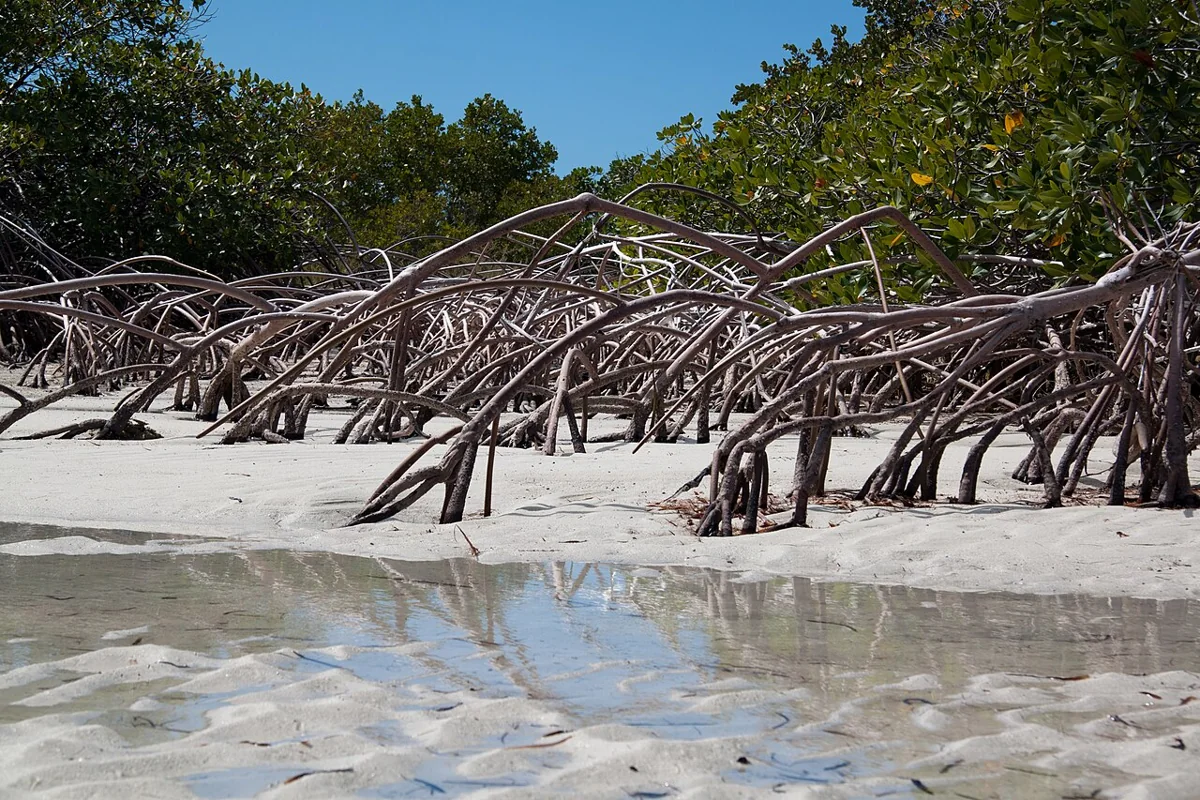
Mangrove roots at Princess Alexandra Land and Sea National Park, Providenciales, in February 2011. This national habitat example is separate from the guide’s North, Middle and East Caicos Ramsar anchors.
Understanding the environment
The large Ramsar landscape spans coastal wetlands associated with North, Middle and East Caicos. Tidal flats and mangroves must be read separately from dry terrestrial snake habitats.
Explore the structure · Follow the named landscape settings
Select a zone to see what changes.
Tidal
Sheltered coastal water supports salt-tolerant vegetation.
Use the linked source for the local setting; no animal occurrence follows from this zone alone.
A conceptual habitat reading, not a measured transect or a snake distribution map.
Sources: UKOTCF · North, Middle and East Caicos Ramsar review
Field notes · 01
The large Ramsar landscape spans coastal wetlands associated with North, Middle and East Caicos. Tidal flats and mangroves must be read separately from dry terrestrial snake habitats.
Sources: UKOTCF · North, Middle and East Caicos Ramsar review
Field notes · 02
The country catalogue uses independently checked snake records. Habitat suitability alone does not establish occupancy, and a published historical record does not establish current abundance.
Sources: UKOTCF · North, Middle and East Caicos Ramsar review
Pressures on Turks and Caicos Islands’s habitats
Protect wetland water connections and avoid disturbance of remote habitat. Wetland designation is not a species survey.
Sources: UKOTCF · North, Middle and East Caicos Ramsar review
Keep to established access routes, leave shelter in place and follow local protected-area rules. Report unusual introduced animals to the relevant local conservation authority.
The connected collection
These 0 species have supported country occurrence and an explicit habitat association in the shared account. The association may come from elsewhere in their range. This is not a complete local habitat inventory; the places above are landscape examples, not asserted collecting sites.
No species-level association has yet been resolved for this habitat in the collection. That does not mean snakes are absent.
0 species · showing 0
Try another name or clear the filters. Absence from a regional list does not establish absence in nature.
Read further
Guide reviewed 2026-10-28. Source dates and geographic scope matter; landscape photographs do not establish species occurrence.
Coastal wetland habitat and conservation setting; not species occurrences.
Continue through Turks and Caicos Islands
Dry ground, rocky shelter and low scrub form a principal terrestrial setting on the Caicos Bank. Native snake records are restricted to the islands actually named by the reviewed sources.
02The archipelago’s low islands meet shallow bank waters and deeper passages. Beaches and coastal vegetation provide geographic context while the snake records remain tied to their named islands.