
Natrix natrix
Older broad grass-snake labels are not current-identity records; western populations require helvetica or astreptophora reconciliation.
Belgium · Place guide
This guide covers Wallonia using the credited source outlines. Its named source units are Wallonne Gewest.
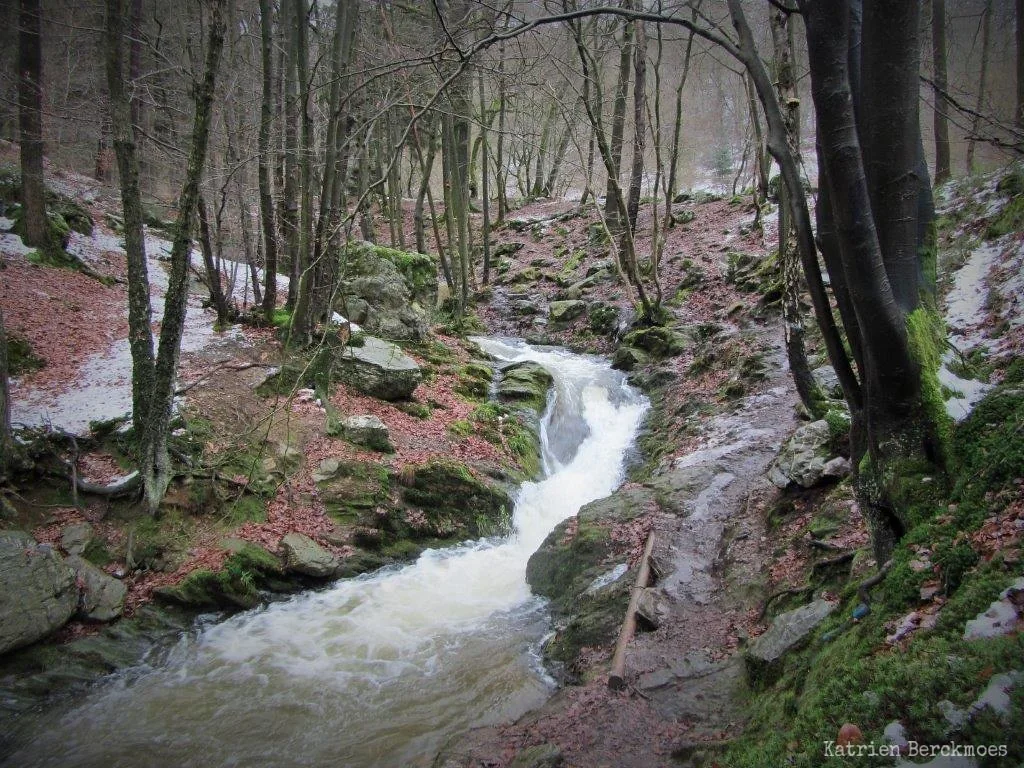
The Ninglinspo stream through woodland in Liege Province, Wallonia, Belgium.
Geography & biotopes
This guide covers Wallonia using the credited source outlines. Its named source units are Wallonne Gewest.
National geographic context: Forests, grasslands and heathlands form part of a landscape strongly shaped by settlement and agriculture. This describes the broader setting; the habitat at an individual locality still needs its own evidence.
Record the place name, date, elevation where available, and the actual vegetation or substrate at the observation point. Keep a species identification separate from the surrounding landscape description; a suitable-looking habitat is not a presence record.
Use the responsible local authority’s current access information. Respect restricted sites and avoid disturbing animals or revealing sensitive breeding localities. Historical map boundaries do not establish present access conditions.
This guide indexes these source names: Wallonne Gewest. A country-only record is not automatically assigned to this place. Map markers identify navigation destinations, not collection sites.
Habitats & living landscapes
Explore 1 guides to the environments, places and conservation pressures that shape this country. Each guide connects to the regional map and shared species accounts.
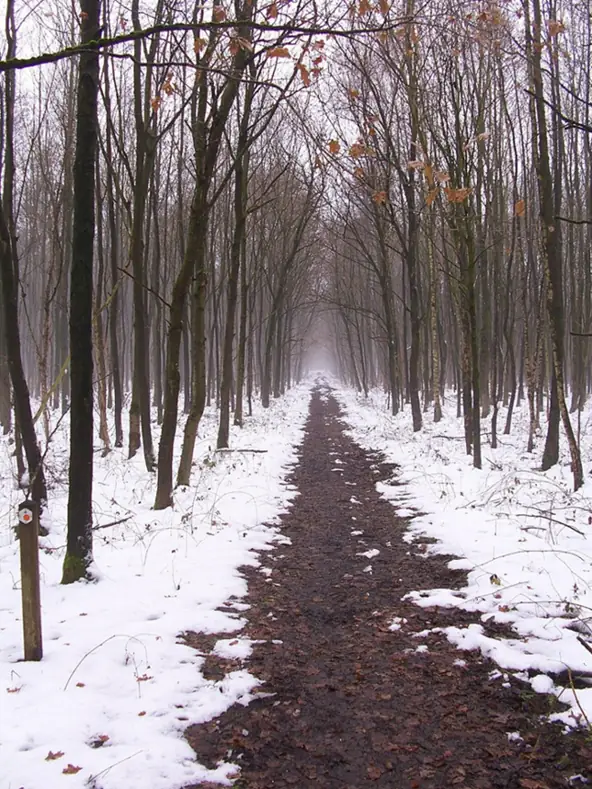
Winter woodland at Stramprooierbroek, in the Belgian KempenBroek landscape. This shows a wooded component of the wider mosaic, not open water at Smeetshof. — KB72. Original photograph · CC BY-SA 3.0. Cropped for the cards; photographs do not establish snake occurrence.
The species catalogue
Only records naming this place appear below. These are extracted locality records, not complete island or regional inventories.
No supported locality records have been extracted for this selection. This is a research gap, not evidence that snakes are absent.
0 species · showing 0
Try another name or clear the filters. Absence from a regional list does not establish absence in nature.
The research library
This edition lists 4 species with supported country records from checked taxonomic treatments and cited field studies. This total includes 1 record marked as introduced; it is not a native-species total. It is not a claim of a complete national inventory. Each account retains its source and check date; individual evidence entries retain their own review dates.
4 documented current or explicitly qualified country records. This is a source-backed working inventory; recent national completeness and locality coverage remain under review.
Individually reviewed taxonomic treatments and cited primary records ↗
Older broad grass-snake labels are not current-identity records; western populations require helvetica or astreptophora reconciliation.
The treatment explicitly rejects this country record.
Country links use a single accepted species identity. Revised names and disputed records are kept visible here; uncertain records do not enter the listed collection or regional totals.
Introduced occurrence
Introduced Belgian population, not native. The study documents an introduced, reproducing population concentrated around western Hasselt. Records through 2019 include eggs and juveniles; they are a historical survey baseline, not a present-day population census.
Uncertain — excluded from the listed total
Older broad grass-snake labels are not current-identity records; western populations require helvetica or astreptophora reconciliation.
Uncertain — excluded from the listed total
The treatment explicitly rejects this country record.
Search results were checked against distribution text and taxonomic qualifications. A geographic name alone does not establish a political country: New Guinea, the Solomon archipelago and Micronesia span more than one country or territory. Introduced and unresolved records require separate interpretation.
Place counts require explicit named localities, including valid type localities. Counts can overlap where sources name multiple places. Regional maps group historical boundary snapshots for navigation, while island outlines use Natural Earth; neither is a species range or an observation map. Small islands can be below the outline dataset’s resolution, so geographic reference markers and the directory remain available.
Eurostat- European Commission; geoBoundaries gbOpen ADM1; 2022; Creative Commons Attribution 4.0 (CC BY 4.0). Generalised navigation outlines, not species ranges. Map provenance →
Historical national biodiversity context; no current percentage, condition, species count or access inference.
Eurostat- European Commission; geoBoundaries gbOpen ADM1; 2022; Creative Commons Attribution 4.0 (CC BY 4.0). Generalised navigation outlines, not species ranges.
Individual treatments and locality evidence are linked from each species account.
Species-level literature measurements and ecological traits. Exact-name matches only; imputed or ambiguous fields are omitted. These summaries are not local observations.